Who blew up the Nord Stream pipelines? In February, veteran journalist and Pulitzer Prize-winner Seymour Hersh dropped a bombshell report detailing how President Joe Biden ordered the destruction of the Nord Stream pipelines.
A government-linked academic group pushed Twitter to censor factually correct stories about Covid-19 if they risked “fueling hesitancy” about vaccines, according to the latest batch of internal documents released by the platform’s new owner, Elon Musk.
Published by journalist Matt Taibbi on Friday, the documents show that from February 2021 onwards, senior Twitter management – including former trust and safety chief Yoel Roth – signed up to a Stanford University initiative that would alert them to the latest “vaccine-related disinformation narratives” spreading on the platform.
Titled ‘The Virality Project,’ the initiative was led by a former CIA employee and comprised academics from several universities, as well as researchers from organizations funded by the Pentagon, the National Science Foundation, and the US State Department.
The Virality Project also stated on its website that it “built strong ties” with the Office of the Surgeon General, the Centers for Disease Control and Prevention-CDC, and the Department of Homeland Security, among other agencies and departments.
43.VP would later say it partnered with “several government agencies,” including the Office of the Surgeon General and the CDC. It reportedly also worked with DHS’s CISA (Cybersecurity and Infrastructure Security Agency) and GEC, among others. pic.twitter.com/WUlrkFk7JX
In its briefings to Twitter, the Virality Project recommended that “true content which might promote vaccine hesitancy” – such as stories of side effects and certain vaccines being banned abroad – be censored.
Posts raising concern about vaccine mandates were viewed as “anti-vax” misinformation, while “just asking questions” was deemed “a tactic commonly used by spreaders of misinformation,” and posting about the “surveillance state” was deemed a bannable “conspiracy” theory.
It is unclear how often Twitter acceded to the Virality Project’s demands, though Taibbi said that within a month, the platform’s staff began using the project’s recommendations when evaluating content to censor.
At the time, Twitter’s rules on Covid-19 “misinformation” required a specific post to be “demonstrably false,” while permitting “strong commentary,” opinion writing, and satire. The Virality Project, however, urged Twitter management to ban “repeat offenders” before they even made new posts.
Sharing the leaked emails of White House coronavirus czar Anthony Fauci could“exacerbate distrust in Dr. Fauci and in US public health institutions,” the Virality Project warned in a June 2021 briefing.
A follow-up report highlighted the spread of “worrisome jokes” about harassing the door-to-door vaccine promoters deployed by the administration of US President Joe Biden.
“As Orwellian proof-of-concept, the Virality Project was a smash success,” Taibbi wrote on Friday. “Government, academia, and an oligopoly of would-be corporate competitors organized quickly behind a secret, unified effort to control political messaging.”
Since purchasing Twitter in October and installing himself as the platform’s new CEO, Musk has been releasing regular batches of internal documents and communications in a bid to shed light on its previously opaque censorship policies.
A tranche of files released in December revealed that Twitter censored “legitimate content” on Covid-19 at the direct request of the White House.
A Spanish journalist has been rotting in a Polish prison for the past year. And nobody knew or cared, Stephen Karganovic writes.
Those who watched Duran associate Alex Christoforou’s podcast the other day [at 18 to 19:45 minutes] must have been as taken aback as I was by Alex’s revelation of the unsavoury fate of Spanish journalist Pablo Gonzales in European “values” stronghold Poland.
Gonzales, a Spanish (another “EU values” country) citizen, it turns out has been rotting in a Polish prison for the past year. Not a week, not a month or even a couple of months, but for just over a year. And nobody knew or cared. He is not being detained on any specific charges to which he could mount a legal defence. He is listed simply as “under investigation” for the somewhat vague offence of being an agent of Russia.
If that is what indeed he is, so far it seems no judicially cognisable evidence to support such an allegation has been produced by the Polish authorities. After just over a year that Gonzales has been kept in prison, the Polish “investigation” has failed to turn up any incriminating facts that might form the basis for even a flimsy indictment. As a result, no charges have been filed and no trial is in prospect for Gonzales.
As trite as that may sound, it is also disturbingly accurate: in the Europe that, with its gallant overseas allies, fights for democracy in Ukraine, European journalist Pablo Gonzales is languishing in a Kafkaesque predicament.
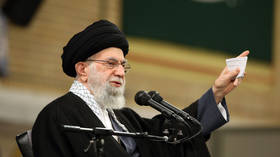
Iran’s supreme leader, Ayatollah Ali Khamenei, has pardoned 22,628 people arrested during demonstrations that followed the death in police custody of 22-year-old Kurdish woman Mahsa Amini last year. Judiciary head Gholamhossein Mohseni Ejei made the announcement in a statement on Monday reported by Iranian state media.
Ejei clarified that those receiving pardons were not accused of theft or violent crime, spying, or membership of certain groups.
Overall, Khamenei pardoned a total of 82,656 Iranian prisoners and individuals facing charges in the mass amnesty, which marks the 44th anniversary of the 1979 Islamic Revolution.
The announcement also comes a week before the Persian new year celebration of Nowruz and the start of the Muslim holy month of Ramadan.
The mass amnesty was first announced last month, when the Ayatollah agreed to pardon “tens of thousands” of prisoners. Among these could be any participants in the recent unrest who were not accused of espionage or involvement with foreign intelligence agents, did not damage state property, and did not injure or kill anyone during the riots.
Opposition groups and activists that had been calling for the release of incarcerated protesters are demanding that Iranian officials be “held accountable” for what the deputy director of the US-based Center for Human Rights in Iran described as “the arbitrary imprisonments of tens of thousands.”
Iran accused the US and Israel of fomenting the unrest that erupted in September after Amini, detained by the so-called morality police for wearing an “improper” hijab, reportedly collapsed and died while in custody.
While a medical examination attributed her death to multiple organ failure stemming from a preexisting condition, anti-government NGOs and US-backed groups claimed she was beaten to death by police.
Amini’s death became a rallying cry for often violent demonstrations which Iran argues were deliberately orchestrated to provoke a police crackdown that the West could use as justification for more sanctions against the Islamic Republic.
An EU effort to follow the US by declaring the Islamic Revolutionary Guard Corps a terrorist organization was scuttled at the last minute in January. The bloc’s foreign policy chief, Josep Borrell, acknowledged that an EU country would first have to find the Iranian military organization guilty of terrorism.
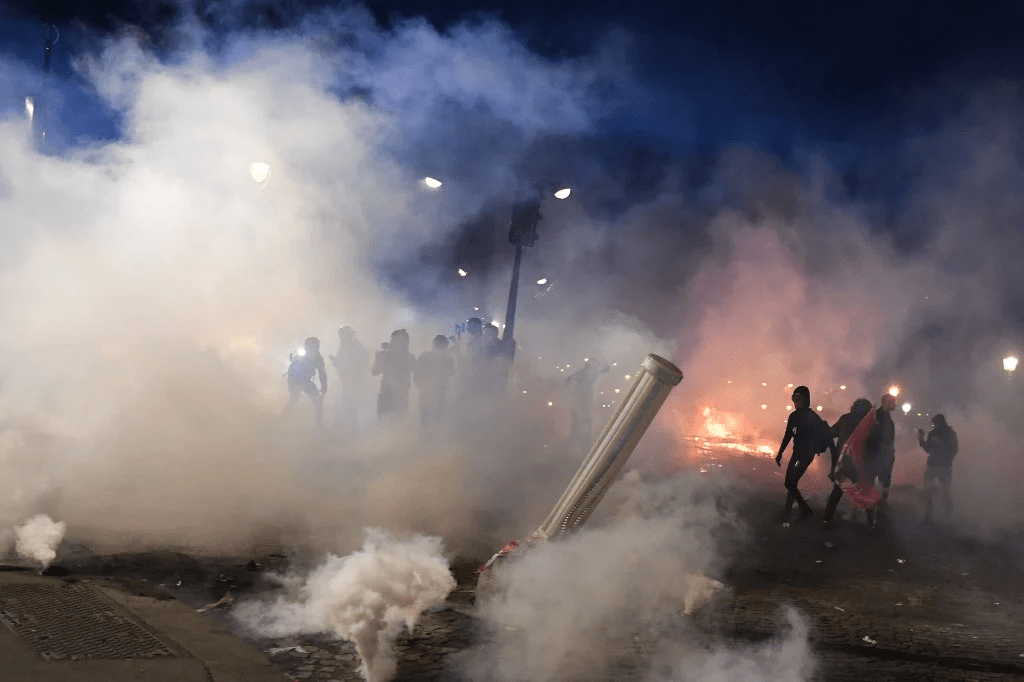
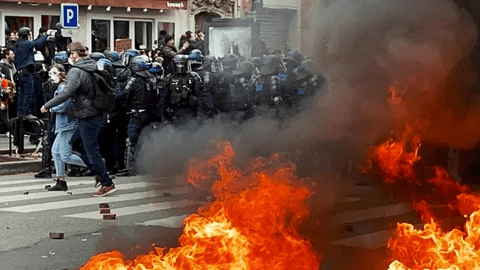
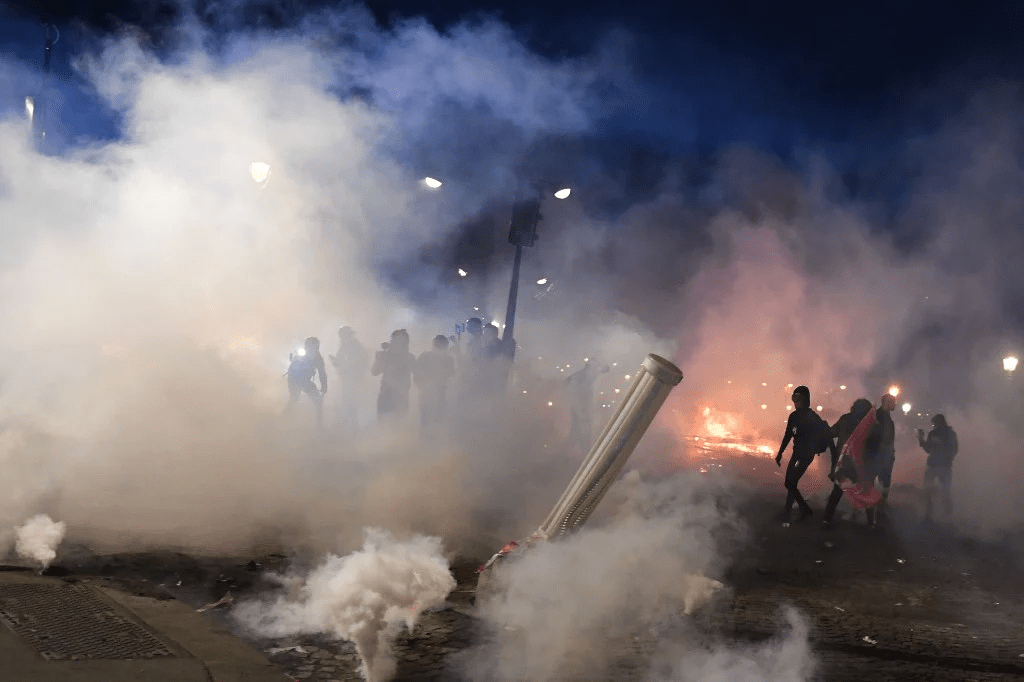
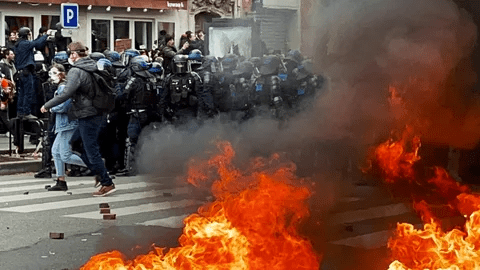
Immediately numerous protesters gathered in the streets and clashes with the police took place throughout the night in several French cities, such as Nantes, Lyon, Rennes, Marseille and Paris.
In total the number of detainees is 310. Of them 258 in Paris, after the police intervened to evict the Place de la Concorde.
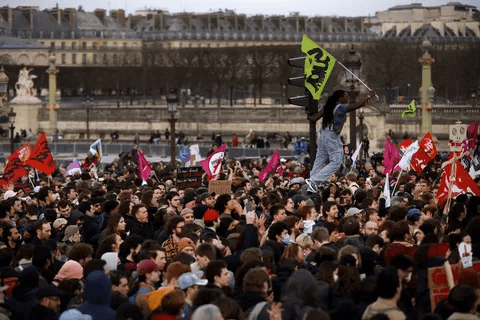
The rally had been called by the Solidaires union and some 6,000 protesters gathered.
The situation became progressively tense until the police decided to evict the demonstrators, who were still numerous after having gathered in the afternoon.
Located in front of the Plaza de la Concordia, the Assembly was specially protected by the police during the day. But they finally started firing tear gas shortly before 8:00 p.m.
The police then used water cannons to disperse the crowd, which was still massive. Shortly after there was a large charge by dozens of policemen.
Ayer el gobierno francés decidió saltarse las votaciones en la Asamblea e imponer el recorte de las pensiones por decreto. Inmediatamente numerosos manifestantes se concentraron en las calles y los enfrentamientos con la policía se sucedieron durante toda la noche en varias ciudades francesas, como Nantes, Lyon, Rennes, Marsella y París.
En total el número de detenidos es de 310. De ellos 258 en París, después de que la policía intervinera para desalojar la Plaza de la Concordia.
La concentración había sido convocada por el sindicato Solidaires y se congregaron unos 6.000 manifestantes. La situación se fue tensando progresivamente hasta que la policía decidió evacuar a los manifestantes, que seguían siendo numerosos tras haberse concentrado por la tarde.
Situada frente a la Plaza de la Concordia, la Asamblea estuvo especialmente protegida por la policía durante el día. Pero finalmente comenzó a disparar gases lacrimógenos poco antes de las 20.00 horas.
Luego la policía utilizó cañones de agua para dispersar a la multitud, que seguía siendo masiva. Poco después se produjo una gran carga de decenas de policías.
Las cargas provocaron importantes movimientos de la multitud en la plaza, que respondió disparando morteros pirotécnicos contra la policía.
Tras las cargas, los manifestantes abandonaron la plaza para dispersarse por las calles y barrios de los alrededores, donde prendieron fuego a los contenedores en los que desde hace 10 días se apilan montañas de basura, por la huelga de los trabajadores de la limpieza.
Tras los incendios de anoche, esta mañana han comenzado los cortes de carretera en el periférico de París, lo que está provocando grandes atascos de tráfico.
Los sindicatos Tras los incendios de anoche, esta mañana han comenzado los cortes de carretera en el periférico de París, lo que está provocando atascos de tráfico.
Los sindicatos han convocado una novena jornada de huelgas y manifestaciones para el jueves de la semana que viene.
En el día de ayer, los administradores de Blogger, donde se almacenaban los contenidos «espejo» (réplica) de MPR21.info, notificaron a los administradores de esta web la eliminación de varios artículos por ser «contenidos no permitidos» de acuerdo a la política del servidor, pero que se han podido preservar.
El 28 de febrero se produjo un choque frontal entre dos trenes en Grecia, cerca de la ciudad de Larissa. Murieron 57 pasajeros y hay, además, cientos de heridos, lo que ha desatado una ola de indignación popular que se ha prolongado a lo largo del mes de marzo. Se han convocado manifestaciones masivas en […]
Durante los tres años de pandemia los gobiernos paralizaron deliberadamente la actividad económica. Generaron una cantidad gigantesca de deudas y, para pagarlas, liberaron dinero fiduciario a espuertas. Esa gran masa de moneda circulante (dólares, euros, libras) aumentó aún más con la Guerra de Ucrania, desatando una inflación galopante. El coste de la energía y los […]
El documento de identidad digital entra en su fase de implantación a escala europea. Después de que la Comisión revelara la arquitectura técnica que dará soporte a los distintos proyectos piloto, y de que se eligieran a las empresas que los van a elaborar, el documento digital está ahora en manos de las instituciones europeas, […]
Las armas que Estados Unidos ha suministrado a Ucrania tenían fecha de caducidad. Era más barato entregárselas que reciclarlas, según expone la revista American Thinker (1). Si no se hubiera desprendido de ellas, el Pentágono habría tenido que gastar unos 35.000 millones de dólares en reciclarlas. En los debates sobre los costes de la guerra […]
Israeli President Isaac Herzog has warned that the Jewish state stands on the brink of civil war over proposed judicial reforms by Prime Minister Benjamin Netanyahu’s government.
Amid nationwide protests, Herzog presented a set of alternate reforms, which were rejected by Netanyahu.
“Those who think that a real civil war, with human lives, is a border we won’t cross, have no idea,” Herzog said in a video address on Wednesday. “The abyss is within touching distance,” he continued, adding that “at any price, and by any means, I won’t let it happen.”
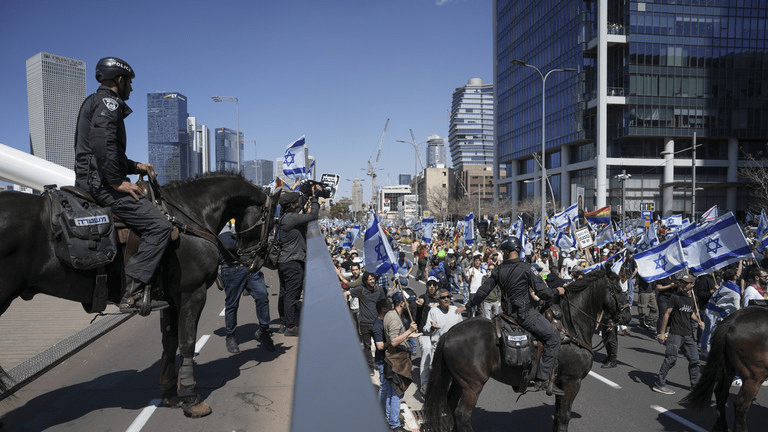
Israel has been rocked by continuous protests since Netanyahu announced his proposed reforms in January.
These legal changes would allow Israel’s parliament to override Supreme Court rulings with a simple majority vote, would grant the government more power in appointing judges, and would limit the ability of the court to review legislation it deems “unreasonable.”
Parliament on Tuesday voted to advance a bill that would allow lawmakers to override rulings. The vote came after hundreds of thousands of demonstrators took to the streets of Tel Aviv, Jerusalem, Haifa, and other Israeli cities over the weekend to oppose its passage.
Herzog, whose role is largely a ceremonial one, responded by proposing an alternate package of reforms. Herzog’s plan would still forbid the court from reviewing legislation it considers “unreasonable” but would allow it to strike down parliamentary decisions with a two-thirds majority of justices.
Among other compromises, it would also allow parliament to override rulings, but only with the agreement of at least one other branch of government.
Netanyahu rejected Herzog’s plan, telling reporters that it “would only perpetuate the existing situation.”
His rejection triggered renewed protests on Wednesday evening, as demonstrators gathered at Ben Gurion Airport in Tel Aviv in a bid to disrupt a planned trip by the PM to Berlin.
Critics of the prime minister argue that the legal change would allow Netanyahu to rule as an authoritarian, and to pass legislation shielding him from ongoing corruption investigations.
Herog sided with these critics last week, calling the reforms “oppressive” and anti-democratic.
In an appeal before Tuesday’s vote, he declared that the reforms had triggered a “constitutional and social crisis,” and should be abandoned before Israel suffers “diplomatic, economic, social and security repercussions.”

 Image by Felton Davis via Flickr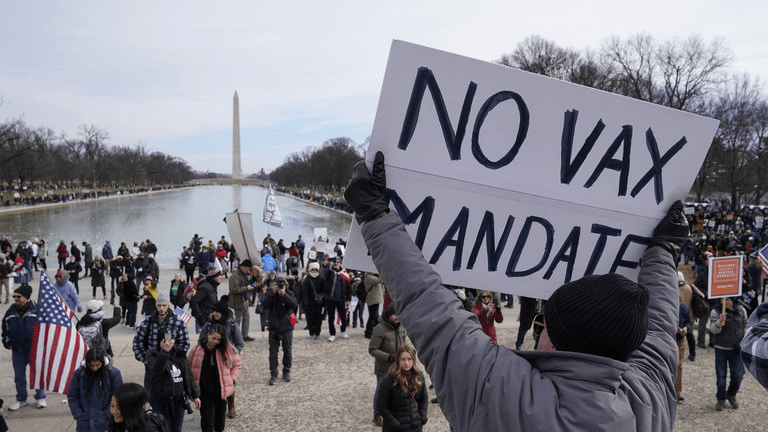








 The Free