Spanish Spycops Unmasked, Victims in UK Respond// Espías policias españoles desenmascarados, víctimas británicas responden/ Eng/Cat/Esp

As another deep-cover police infiltrator is exposed in political groups in Barcelona, those targeted by operations by British secret police have issued this statement of solidarity

from thefreeonline on 8th February 2023 by Campaign Opposing Police Surveillance

Spanish and Catalan translations are below the English.

We read with horror the stories of the discovery of another police officer infiltrated in political movements in the Spanish state. Our hearts go out to the many who will be affected by this, especially the women tricked into being intimate with him.
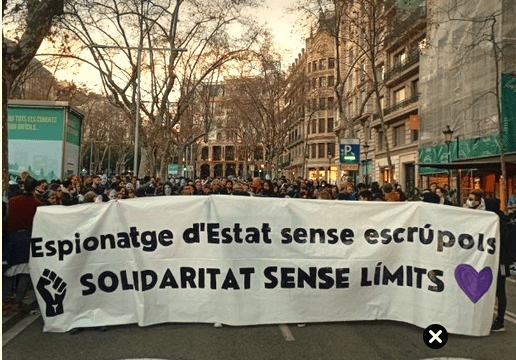
A moment of the demonstration in the streets of the center of Barcelona by social entities against the infiltration of a policeman in the anarchist social movement 4th feb 2023

We note that this infiltrator was not the first and probably will not be the last to come to light, and there will undoubtedly be more tales of abuses of power to come. We would like to extend our solidarity to all those affected, in what we know is not, nor will it ever be, an easy moment.

Cover of issue 562 of Directa, 30 Jan-12 Feb 2023, which exposed the spycop

We wish we could say we’re surprised, but sadly we’re not. British police treated us with the same contempt for over 50 years of undercover policing, and we are only now learning the full scale of what they did. Such activities are never acceptable or justified, be it in the UK, Spain or anywhere in the world. We denounce all political surveillance as deeply undemocratic and an abuse of human rights.

We have been where you are now. We know the feelings of anger and sadness generated by the intrusion into your lives, and the sense of disempowerment and abuse to which it leads.
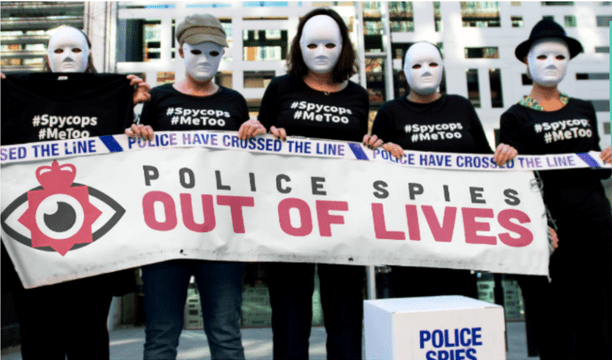
We also know that through solidarity among us we have managed to fight over the years. Nothing will undo the damage, but by standing our ground against the state, we’ve forced it back down, winning apologies, court rulings and compensation and, most importantly, credible information about its nefarious activities.

The police saw us as weak, they abused us without consequences, they invaded and damaged our lives and our political work for their ideological reasons. Instead, our politics, the reason we were attacked, brought us together and helped us emerge stronger as a collective, even when everything seemed darkest and when all our work seemed to have been for nothing.

Continue reading “Spanish Spycops Unmasked, Victims in UK Respond// Espías policias españoles desenmascarados, víctimas británicas responden/ Eng/Cat/Esp”
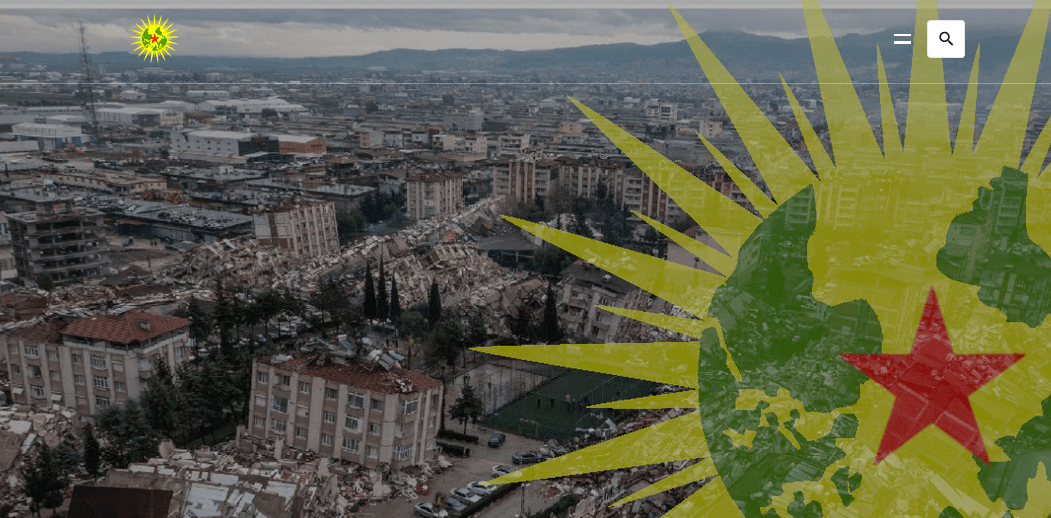
Statement from the Internationalist Commune of Rojava on the earthquake in Kurdistan, Syria and Turkey

A natural disaster, inseparable from its political implications

From the Internationalist Commune of Rojava we are extremely touched by the tragedy of this earthquake. Our thoughts are with all the families who have been hit hard, whatever their origin.

from thefreeonline on 08/02/23 by Internationalist Commune .. ++

Where we are, we have felt the earth shake, but without the dramatic consequences that other regions are experiencing. If borders mark lines that are sometimes unbridgeable, the connection between people is not.

Here, in the north-east of Syria/Western Kurdistan (Rojava), there are thousands of people who have a strong relationship with others elsewhere in the country, but also especially with the people of southern Turkey/Northern Kurdistan (Bakûr).

We believe that emotions should not make us forget to take a political look at the situation. What is happening today is not a natural event disconnected from the way society is organised, with nationalist and racist fault lines dividing peoples, with a capitalist economy that favours profit over well-being, with nation-state policies guided by short-termism and electoralism.

Many voices are being raised at the moment to appeal to feelings of solidarity, to universalist values. We support these appeals, but we do not accept to put aside the socio-political context in which these events are taking place. Past, present and future responsibilities cannot be erased under the guise of a humanist vision that has never existed in the eyes of political regimes in the nation-states of the region and the rest of the world.

The mainstream media is rightly moved by the situation, but the same media was silent not long ago about the suffering of these same people and will probably be silent again in a few weeks.

Continue reading “Statement from the Internationalist Commune of Rojava on the earthquake in Kurdistan, Syria and Turkey”

David Swanson and Lee Camp: Can The March To WW3 Be Stopped?

dandelionsalad's avatarDandelion Salad

World War 3 - III Image by r2hox via Flickr

by David Swanson
Writer, Dandelion Salad
Let’s Try Democracy, Feb. 7, 2023
February 8, 2023

“It’s incredible the extent to which people still fantasize about a nuclear war in one part of the globe as if the scientists haven’t told us it impacts the entire Earth and the cloud of dust renders agriculture impossible and everybody starves and the living envy the dead.” — David Swanson.

View original post 286 more words

Massive mobilisations keep growing in France

In the last weeks, the European working class has been on an accelerating political offensive. There have been mass health strikes in Belgium and Spain, tech strikes over wages in Finland, anti-war protests in Denmark, and a massive mobilization of a half-million workers in Britain. But in France……..

from thefreeonline on by Anarchist Communist Group ..

Millions of workers in France join third mass protest against pension cuts

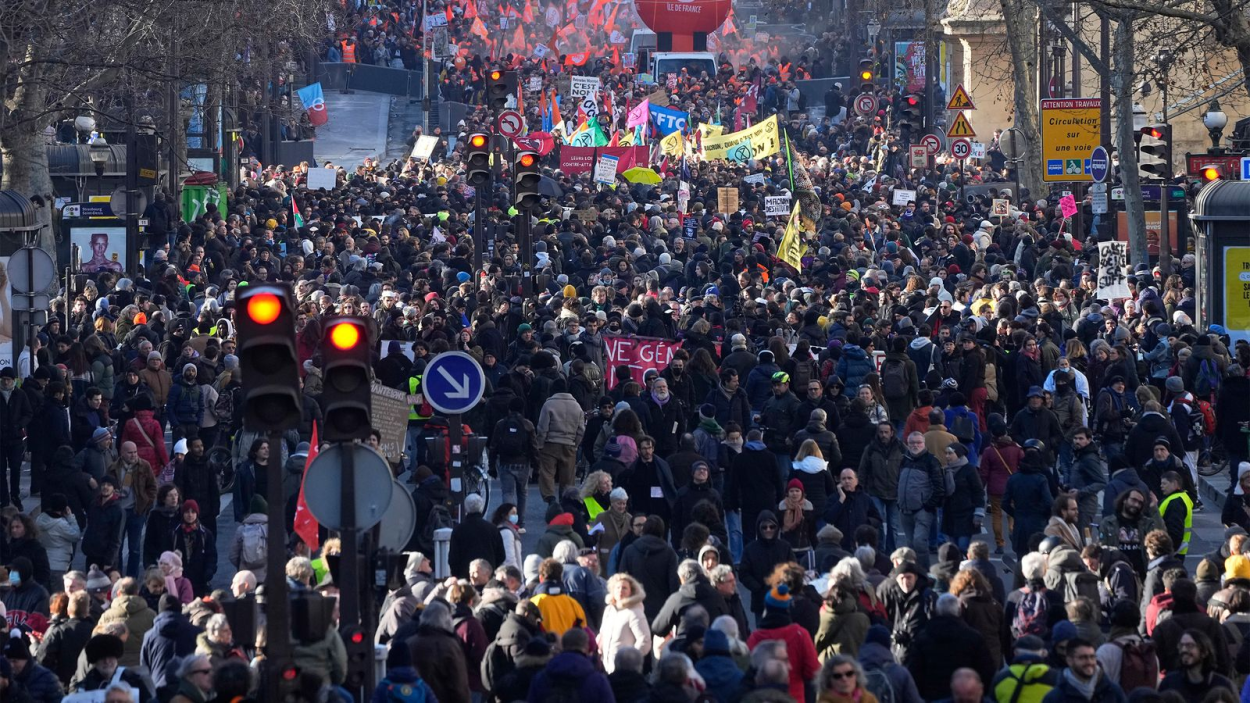
President Emmanuel Macron is planning to raise the pension age in France by two years to 64. In response there have been two huge mobilisations against these plans, the first on January 19th, the second on January 31st.

The first mobilisation saw 2 million out on the streets. This was exceeded on the second mobilisation. There were 250 demonstrations throughout France.

In Paris 280,000 came out on the streets. There were a lot of creative placards, including ones like“Metro-Boulot-Tombeau”(Undergound-Work- Grave) and “Metro-Boulot-Caveau” (Underground-Work- Burial Chamber) adaptations of the old May 1968 slogan Metro-Boulot- Dodo  (Underground- Work- Sleep). There was a large turnout by high school and college students.

Bitter clashes broke out as police assaulted demonstrators in Nantes, Rennes, and Paris, where police repeatedly charged and beat peaceful protesters. Riot police units even attacked the security detail of the trade unions at the head of the march in Paris, after which riot police faced off against the protesters, including units of striking firemen who put on their gear to withstand tear gas.


Continue reading “Massive mobilisations keep growing in France”

Were we hypnotised by Desmet? Part I: Where does his argument fall apart?

from thefreeonline on 8th Feb 2023 by Rusere Shoniwa at Holding The Line: Journalists Against Censorship

Comment on ‘Were we hypnotised by Desmet? Part I: Where does his argument fall apart?

The highly persuasive Belgian psychologist Mattias Desmet burst onto the covid resistance scene in the late summer of 2021 with his explanation of the terrifying global march of the Covidian Cult. I was completely seduced by his theory of mass formation hypnosis, expounded in a series of interviews between August 2021 and March 2022. With each interview he did, his star seemed to burn brighter.

But then he published his book The Psychology of Totalitarianism in June 2022. And that’s when his seemingly wonderful exposition, hitherto hung on a series of brilliant one-hour interviews, started to fall apart. If ever there was an argument for forgoing a disquisition in favour of keeping things simple on YouTube, the curious incident of the hypnotic psychologist seems to be it.   

Desmet was attacked by the likes of Peter Breggin, a US psychiatrist no less, who accused him of blaming the victims of totalitarianism instead of the perpetrators and, far more sensationally, of having “protected a mass murderer in his therapy practice.” Robert Malone soon discovered that Breggin’s wrath knew no bounds as Malone himself was maligned for being an alleged promoter of Desmet’s theory.

Malone, having none of it, is now suing Breggin for a cool $25 million and, reading between the lines, Breggin seems worried. C J Hopkins, with his trademark devil-may-care insouciance, has delighted in attracting the ire of Desmet’s fan club by trashing the mass hypnosis theory in less than diplomatic tones.    

Et moi? For starters, I have checked the above paragraph to ensure it is libel-proof, such is the febrile atmosphere surrounding the mass formation brouhaha. I must also disclose that I have gone from being a fully paid-up acolyte of the mass hypnosis theory to being less convinced. I have gone from exhorting friends to listen to Desmet interviews to co-authoring a two-part critique of the hypnosis part of the theory – one questioning whether hypnosis is really at play in mass formation and another suggesting that a hard core of Covidians are not under a hypnotic spell but rather may simply be crisis addicts. I always emphasise that the second piece is not offered up as a neat, self-contained single explanation of the cause of the violent lurch towards totalitarianism but rather as a rejection of one simple theory and a discussion of one (among many) potential psychological catalysts in a complex political crime.

So, the ‘we’ in the title to this piece clearly does not refer to the Breggins and Hopkins of the world who poured petrol and lit a match on Desmet’s theory at the first opportunity. It refers to the likes of me, who started out ‘hypnotised’ by mass hypnosis theory and then became sceptical after reading the book and hearing other critiques. 

Continue reading “Were we hypnotised by Desmet? Part I: Where does his argument fall apart?”

Rage, fear in India’s Azamgarh over State land robbery for airport

from thefreeonline on 8th Feb 2023 by Astha Savyasachi at Al Jazeera shared with thanks

Months-old protest becomes a ‘fight for survival’ as mainly marginalised residents of eight villages resist government’s move.

India Azamgarh
Villagers holding a protest march on January 26, India’s Republic Day [Astha Savyasachi/Al Jazeera]

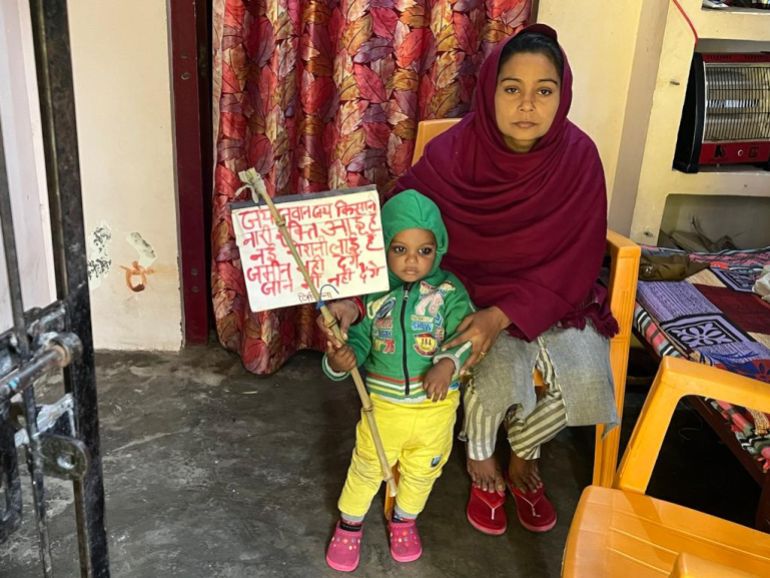
Azamgarh, India – Cradling her toddler in one arm, Arti Sharma adjusts her saree with another as she picks up the placard that says: “Zameen nahi denge, jaan bhi nahi denge [We will neither give our land nor our lives].”

It is a placard her husband Deepak Sharma had made, days before he succumbed to a heart attack at 31.

Key land acquisition law comes into forcc..New law on land acquisition replaces a 119-year-old statute promulgated during British colonial rule.

Oblivious to the reality, the toddler tries to wipe his mother’s tears as she marches to Khiria Bagh in Uttar Pradesh state’s Azamgarh district, where a protest against the acquisition of land for expansion of an airport has been going on for months.

Arti clutches the placard close to her chest. “It keeps our struggle warm with his memories,” she tells Al Jazeera.

India Azamgarh
Arti, wife of late Deepak Sharma, with her son holding a placard [Astha Savyasachi/Al Jazeera]

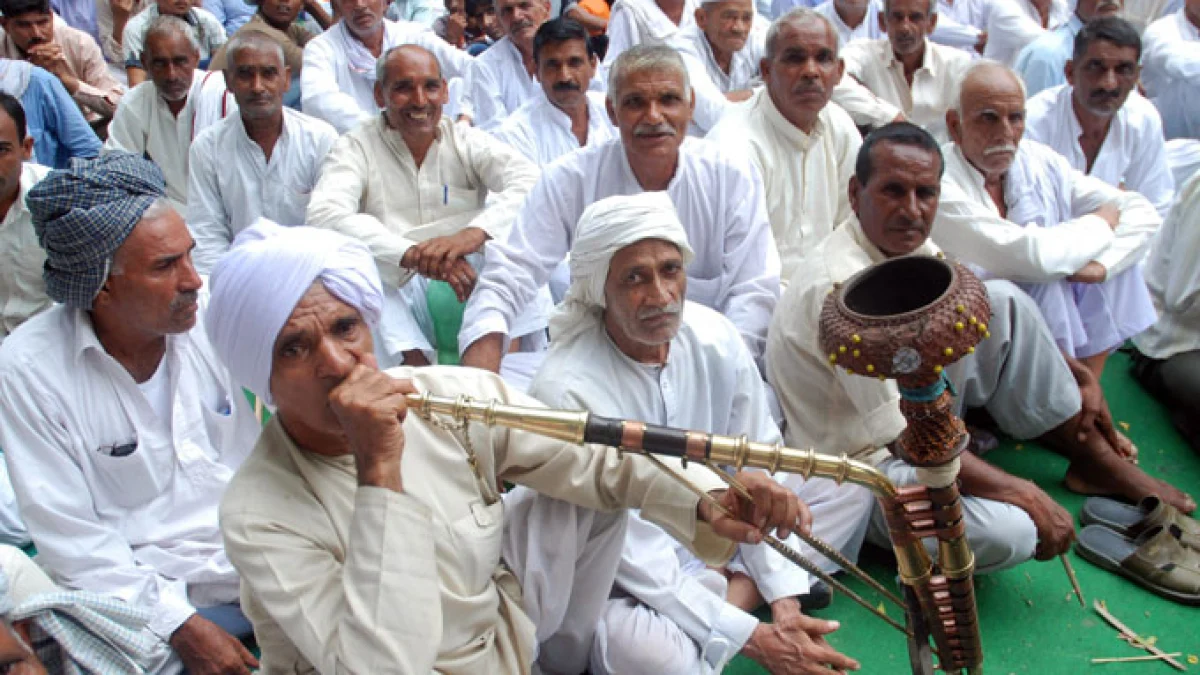
Tens of thousands of people residing in eight villages of Azamgarh call their protest a “fight for survival” and it looks like one. On January 26, as India celebrated its 74th Republic Day which marks the adoption of its constitution in 1950, hundreds of villagers were protesting at Khiria Bagh park.

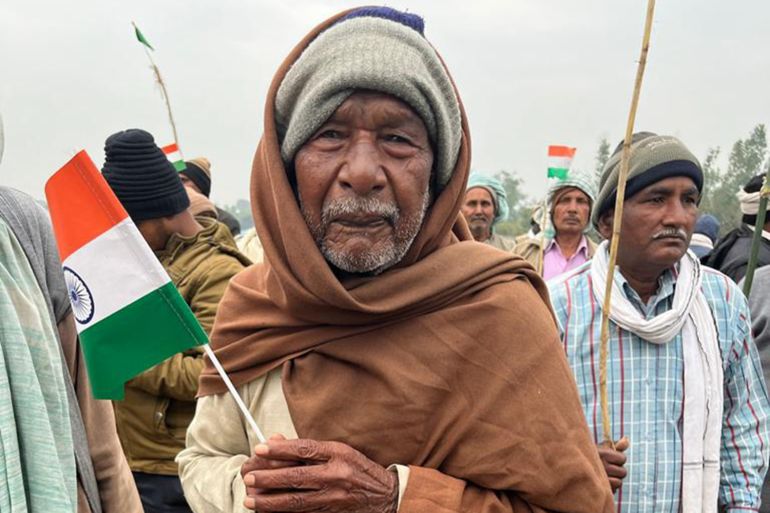
A 90-year-old man, his frail legs shivering with cold, held a small tricolour – the national flag – in his hand as he declared, “We will fight till our last breath. We won’t move until they bring the bulldozer and run it over us.”

There was an air of desperation at the park. A man in his 30s dragged his wheelchair with a tricolour tied to its handle. A woman held a placard as she ran barefoot on the damp mud. A handful of coins clunk to the walls of the rusty tin box meant to collect donations for the protest – meagre savings from meals skipped to feed the movement.

Children had skipped school, women left their chores half-done, daily wage workers who had not earned for months, farmers forced to postpone weeding of their crops – all stood under the sea of tricolours waving over their heads, protesting against the land acquisition for the proposed international airport at Azamgarh.

India Azamgarh
A 90-year-old man joins the protest at Khiria Bagh park [Astha Savyasachi/Al Jazeera]

‘Which caste are you from?’

In 2004, an airstrip was built in this eastern district of Uttar Pradesh. It was not used until November 2018 when state Chief Minister Yogi Adityanath announced its expansion and building of an international airport under an ambitious scheme aimed at upgrading India’s underserved air routes.

A budget of nearly $2.4m was allocated the following year for the proposed airport. According to the statements by Vishal Bharadwaj, the district magistrate of Azamgarh, about 270 hectares (670 acres) of land were meant to be acquired from eight villages – Gadanpur, Hichchanpatti, Jigna Karmanpur, Jamua Hariram, Jamua Jolha, Hasanpur, Kadipur Harikesh, Jehra Pipri, Manduri, and Baldev Manduri – for the project.

Continue reading “Rage, fear in India’s Azamgarh over State land robbery for airport”

Gangs, cholera and political turmoil leave half Haiti’s children relying on aid

Roxana Vanessa's avatarStigmatis News

Triple threat sees Caribbean country in worst crisis since 2010 earthquake, with young people bearing the brunt, warns Unicef

Global development | By Luke Taylor

An escalation of gang violence, political instability and a deadly cholera outbreak in Haiti has left half its children relying on humanitarian aid to survive, Unicef says.

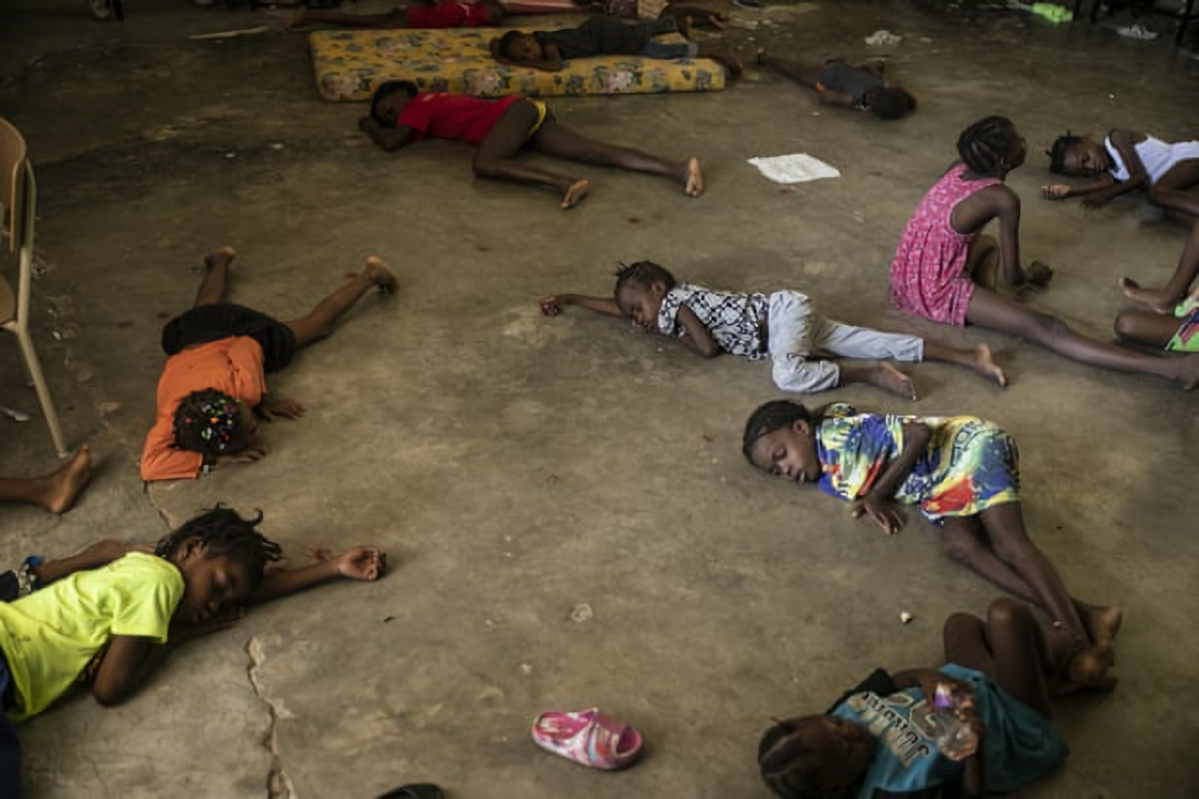
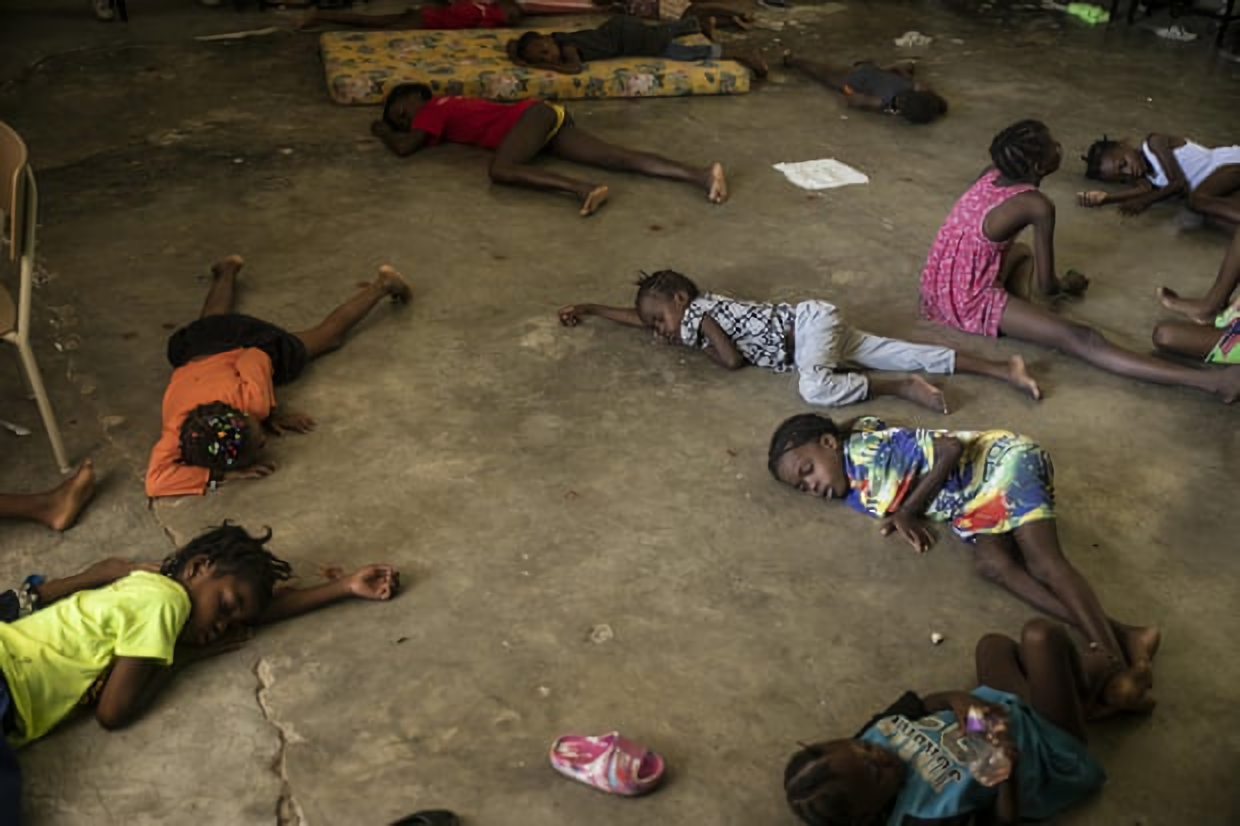
Children sleep on the floor of a Port-au-Prince school that was turned into a shelter after they were forced by gang violence to leave their homes. Photograph: Odelyn Joseph/AP

At least 2.6 million are expected to need immediate lifesaving assistance this year as the overlapping crises leave Haiti’s children in the worst position since the earthquake of 2010, Unicef’s Haiti representative, Bruno Maes, told the Guardian.

“Haitian children don’t just face challenges accessing food and potable water while the health system collapses around them,” Maes said. “There is also a lack of protection. Children are being abused, young…

View original post 615 more words