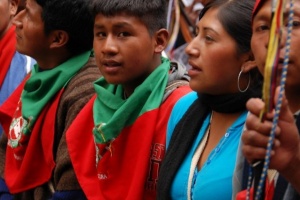
In 2021 tens of thousands of indigenous marched on Bogota supporting the 2 month General Strike which brought down the racist colonialist regime. Yet the elite fought back, blocking land, health and social reform and on 1st May 2025 a new indigenous ‘Minga’ arrived to support a people’s Referendum
By Lital Khaikin at Waging Nonviolence on 12th May 2025 via thefreeonline at https://wp.me/pIJl9-GRD Telegramt.me/thefreeonline/3098

The 2021 Indigenous ‘Minga’ approaching Bogota
Despite facing existential threats, unarmed Indigenous guards are at the forefront of the struggle to reclaim their ancestral lands and end oil drilling in the Amazon.

Sharing a border with Ecuador and Peru, the southern Colombian department of Putumayo takes its name from the Quechua term for “gushing river.” For some, its landscapes are a sacred doorway to the Amazon rainforest, a world unfathomably greater than the human.
For others, however, this land looks more like oilfields and military bases, optimized waterflood assets and strategic trafficking corridors. This difference in worldview is at the heart of peacebuilding in Putumayo and the Indigenous struggle to reclaim ancestral territories across the Amazon basin.

Indigenous ‘land back’ movement in Colombia
Colombia’s 2016 peace agreement with the Revolutionary Armed Forces of Colombia, or FARC, promised to usher in peace and restore lands to the people most affected by conflict, including Indigenous communities repeatedly displaced across their homelands.
But in Putumayo, dispersed conflict continues and Indigenous communities have been scattered across 86 reservations as their land claims remain in limbo. Financed by coca farms, the rival Comandos de la Frontera, or Border Commandos, and the Carolina Ramirez Front compete over land and drug trafficking corridors.
In the south, where remote villages straddle the border across the Putumayo River, armed groups hold nearly absolute control.
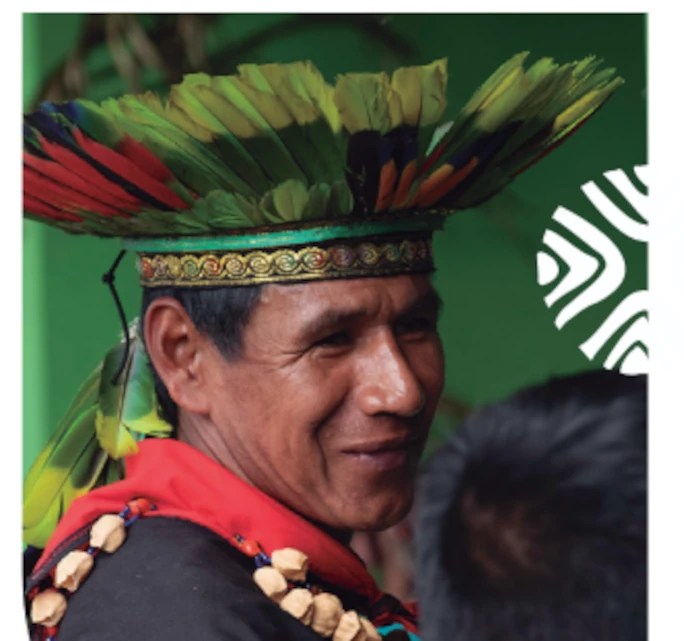
“We want the restitution of these territories from the hands of third parties, like those of the state, campesinos and armed groups,” said Fredy Javier Piaguay Ortiz, Siona (Zio Baín) leader for the Piñuña Blanco Reservation on the Ecuadorian border.
“There is a constant presence of armed groups,” he said, describing an atmosphere of heightened vigilance in these areas. “One has to be very strategic in order to endure these conditions in our territories. … There are no measures that completely guarantee freedom of movement.”
Land rights and special protections for Indigenous communities are entrenched in Colombia’s post-conflict transitional justice measures like the Truth Commission, the Special Jurisdiction for Peace, and the Victims and Land Restitution Law.
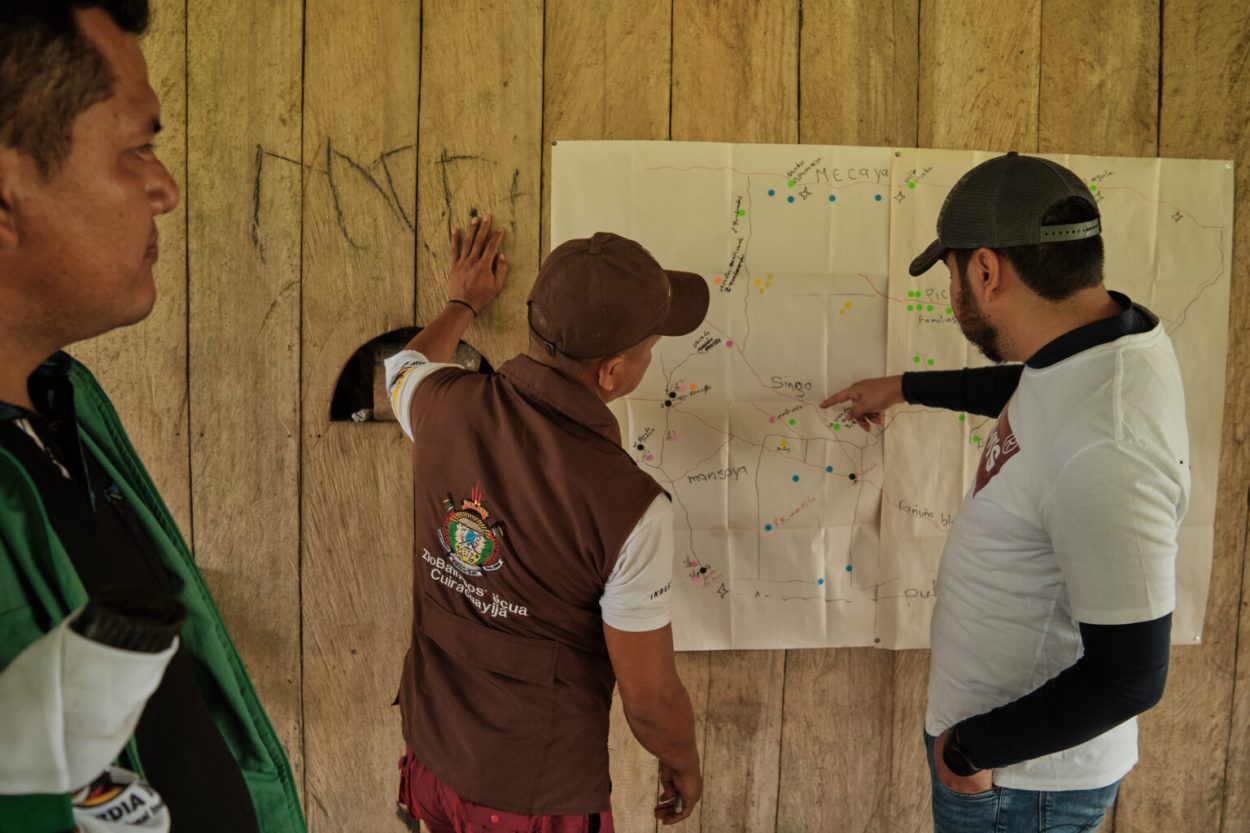
The Siona draw a map of their ancestral territory to support their land title claim with the Colombian Government. (Nicolas Kingman/Amazon Frontlines)
Putumayo has the most applications for land titles, or rights to land ownership, in Colombia. Ancestral territories make up a quarter of all applications in Putumayo to legally recognize the collective ownership and conservation of land that has been under Indigenous stewardship for generations.
Over nearly a decade, there has been little progress. The Observatory of the Territorial Rights of Indigenous Peoples reports that some requests have been idle for over 30 years.
Titles alone aren’t enough to measure the efficacy of land restitution, as plots may change hands informally and still end up under the control of armed groups, explained Lina Maria Espinosa, a Colombian attorney working with Amazon Frontlines. But they do give important legal protection.
“It is how Indigenous peoples construct their identity, and a place upon which Indigenous people depend for their collective existence, and to express themselves and their identity,” Espinosa said.
The competition is fierce and much of the land ends up in private ownership. In one of Colombia’s coca-growing hotspots, formalized land titles — that make ownership of previously informally held titles official — can also help access loans and coca crop substitution programs.
Campesinxs, or small-scale farmers, have received over half of the authorized land titles from the 7.4 million acre goal set out by the peace agreement. However, vast swathes of land have gone to cattle ranchers who have in turn driven rapid deforestation in Amazonian regions.
Indigenous land restitution does not mean displacing farming communities. It means co-existence. But in the process, both are up against a common obstruction. Oil companies have not been deterred by continued armed conflict waged largely against civilians.
Financing Colombia’s war economy at the height of the civil war, the extractive sector has laid claim to hundreds of thousands of acres in the Amazon basin and continues to drive divisions.
Hearts and minds
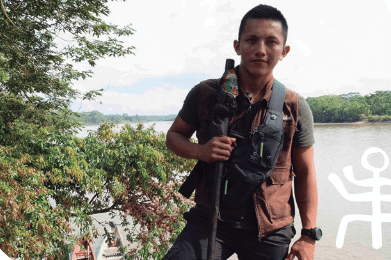
Mario Erazo Yaiguaje is the former governor of the Siona Buenavista Reservation and is working to advance land restitution at the Inter-American Court of Human Rights, or IACHR. He is also a member of his community’s Indigenous guard.
There are 12 recognized Indigenous groups encompassing around 51,700 people across Putumayo, including the larger groups of Awá, Camëntsä, Inga, Kichwa and Siona. Among these communities, there are an estimated 350 Indigenous guards, each unique in their customs and centering mandates on protecting their communities, cultures and the lands under their stewardship.

Siona leader Mario Erazo Yaiguaje. (WNV/Daris Payaguaje Tangoy) Tercer encuentro del proceso de intercambio de saberes para la defensa territorial en Puerto Silencio, Colombia.
Traditionally unarmed, they legitimize Indigenous authority on their own territories, Yaiguaje explained. All generations and genders participate. Elders pass on ancestral knowledge, language and a sense of social responsibility to youth for their future roles as community leaders amid the industrialization of the Amazon and the pressures of individualistic and consumerist lifestyles.
“We are armed with spirituality, valor and courage,” Yaiguaje said. “We demonstrate respect to our community and our territory.”
Collective responsibilities vary. Territorial patrols take charge of mapping and monitoring environmental data, identifying medicinal plants and tracking animal welfare. Across different reservations, Indigenous guards may coordinate emergency response from pandemic logistics, to mutual aid after floods or landslides.
They are a mediator and buffer for conflict. Members of the guard may accompany community leaders and land defenders in public events or on errands to provide a sense of security amid the persistent threats to their lives.
According to internal norms, they may act as an alternative to colonial carceral systems like police or private security to enact justice and reintegrate offenders, including former combatants from Indigenous communities.
Land is more meaningful than just a quantity of acres, Yaiguaje explained, and the Indigenous guard cultivates a spiritual sense of control over homelands that are fragmented across reservations.
This sense of wellbeing is critical not only to sustaining the Siona’s cultural and spiritual integrity, but for maintaining morale in a fight against seemingly insurmountable opponents.
“Much of Putumayo has already been licensed for exploration or exploitation,” María del Rosario Arango Zambrano, Colombian human rights lawyer working with the Forest Peoples Programme explained. Companies that have entrenched in the Amazon basin have included Colombia’s Ecopetrol, China’s Emerald Energy, Amerisur and its Chilean successor GeoPark, and Canada’s Gran Tierra.
The fossil fuel economy is in a tenuous place as Colombia is intent on transitioning toward renewable energy. In 2023, Colombian President Gustavo Petro banned new oil and gas exploration in the country.
Later that year, Colombia endorsed the Fossil Fuel Non-Proliferation Treaty. Colombia has also pushed forward on enforcing a domestic fracking ban despite longstanding opposition from the oil lobby.

After appeals by the Siona reservations of Buenavista and Piñuna Blanco, the Colombian Supreme Court ordered an injunction on the exploration and exploitation of natural resources protecting 140,000 acres of ancestral Siona lands in 2018.
But the urgency of the peace agreement’s immediate aftermath faded. Impeded by Petro’s decrees, oil pioneers scouting Colombia’s northern regions shifted back to Putumayo. “All the interest turned toward Putumayo because they already have licenses there,” Rosario explained.
Some older oil concessions that overlap with Indigenous territories have been dormant or have just started to be developed.Sitting on one of Putumayo’s highest-producing oil fields, GeoPark’s sprawling Platanillo concession is currently in development despite the lack of Siona consent and Colombia’s commitment to protect ancestral Indigenous territories from exploration and exploitation.
Espinosa, who also provides human rights and technical training to the Siona communities of Buenavista and Wisuya, explained that oil companies and armed groups have exploited the state abandonment of these far-flung regions, ingratiatingthemselves into communities.
They do this without regard for continued conflict in Putumayo that is pushing people off their lands, or locking them into forced confinement.
“People know that the only way to maintain their territory is to quietly comply with the extortion of armed groups,” she said. “All those who benefit from the conflict enable the existence of conflict.”
There are repeated reports of oil companies co-opting local authorities like community council leaders to give the appearance of community consent. “Anyone who speaks out against their presence receives death threats or are attacked.
Continue reading “Inside the Indigenous ‘land back’ movement in Colombia”


![Dayanera and her daughter at the stand where they sell food to neighbours; opportunities to make money are limited, and often confined to the community itself. [Julia Zulver/Al Jazeera]](https://thefreeonline.com/wp-content/uploads/2015/12/eng-file-cd5-upr-int-3rd.jpg)
![Lubis, one of the leaders of the League who helped to build the City of Women [Julia Zulver/Al Jazeera]](https://thefreeonline.com/wp-content/uploads/2015/12/4a36f0b5dcdc4cbdb9546c12934dbdb2_18.jpg)
 The Free