
from Peoples World
via thefreeonline at https://wp.me/pIJl9-Epn on 15 Oct24 by Marilyn Bechtel

A three-years’-long quest by four public interest groups has taken a major step forward with a federal judge’s ruling that the government agencies responsible for U.S. nuclear weapons must thoroughly examine environmental consequences and potential alternatives for their plans to ramp up production of new plutonium pits, or bomb cores, for a new generation of nuclear weapons that includes the W87-1 warhead and the new Sentinel intercontinental ballistic missile it is to arm.…

This undated file photo shows the Los Alamos National Laboratory in Los Alamos, N.M. |
The plaintiff organizations – Savannah River Site Watch, Nuclear Watch New Mexico and Tri-Valley Communities Against a Radioactive Environment (Tri-Valley CAREs), are longtime monitors of sites where nuclear weapons are developed.
They were joined by a tribal group located near the Savannah River Site in South Carolina, the Gullah Geechee Sea Island Coalition.

In June 2021 they filed a lawsuit to compel the U.S. Department of Energy (DOE) and its semi-autonomous National Nuclear Security Administration (NNSA) to perform a thorough environmental review, as required under the National Environmental Policy Act (NEPA), of their plans to ramp up production of the new pits to 80 per year.
Production is to be split between Los Alamos National Laboratory in New Mexico and – for the first time – Savannah River Site in South Carolina.
DOE and NNSA had been relying on earlier environmental reviews and failed to provide an analysis of feasible alternatives to this two-site plan.
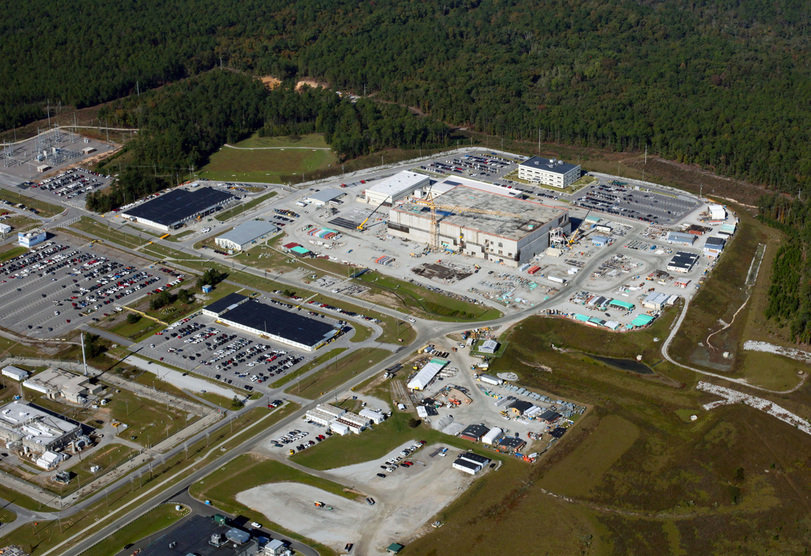
Photo: The heart of the MOX boondoggle cover-up: $17 billion MOX plant at Savannah River Site (SRS), terminated in 2018
Some experts argue that none of the new pits are needed for maintaining safety and reliability of the existing, extensively tested nuclear weapons stockpile. JASON, an Independent group of elite scientists that advises the United States government on matters of science and technology (mostly of a sensitive nature) found that existing plutonium pits, some 15,000 of which are currently stored, have a shelf-life of at least a century, and at present have an average age of 42 years.
Instead, the monitoring groups say, the new pits are for “speculative new-design nuclear weapons that can’t be tested because of an international testing moratorium, or alternatively could prompt the U.S. to resume full-scale testing, which would have serious proliferation consequences.” They add that expanded pit production will cost taxpayers more than $60 billion over the next 30 years.
Continue reading “Judge’s Ruling a small Victory in Fight to Control Nuclear Weapons Proliferation – Marilyn Bechtel”

 The Free