Based on a handful of think tank reports and witness testimonies, Western governments have levied false allegations of genocide and slavery in Xinjiang Uyghur Autonomous Region. A closer look makes clear that the politicization of China’s anti-terrorism policies in Xinjiang is another front of the U.S.-led hybrid war on China.
This resource compilation provides a starting point for critical inquiry into the historical context and international response to China’s policies in Xinjiang, providing a counter-perspective to misinformation that abounds in mainstream coverage of the autonomous region.
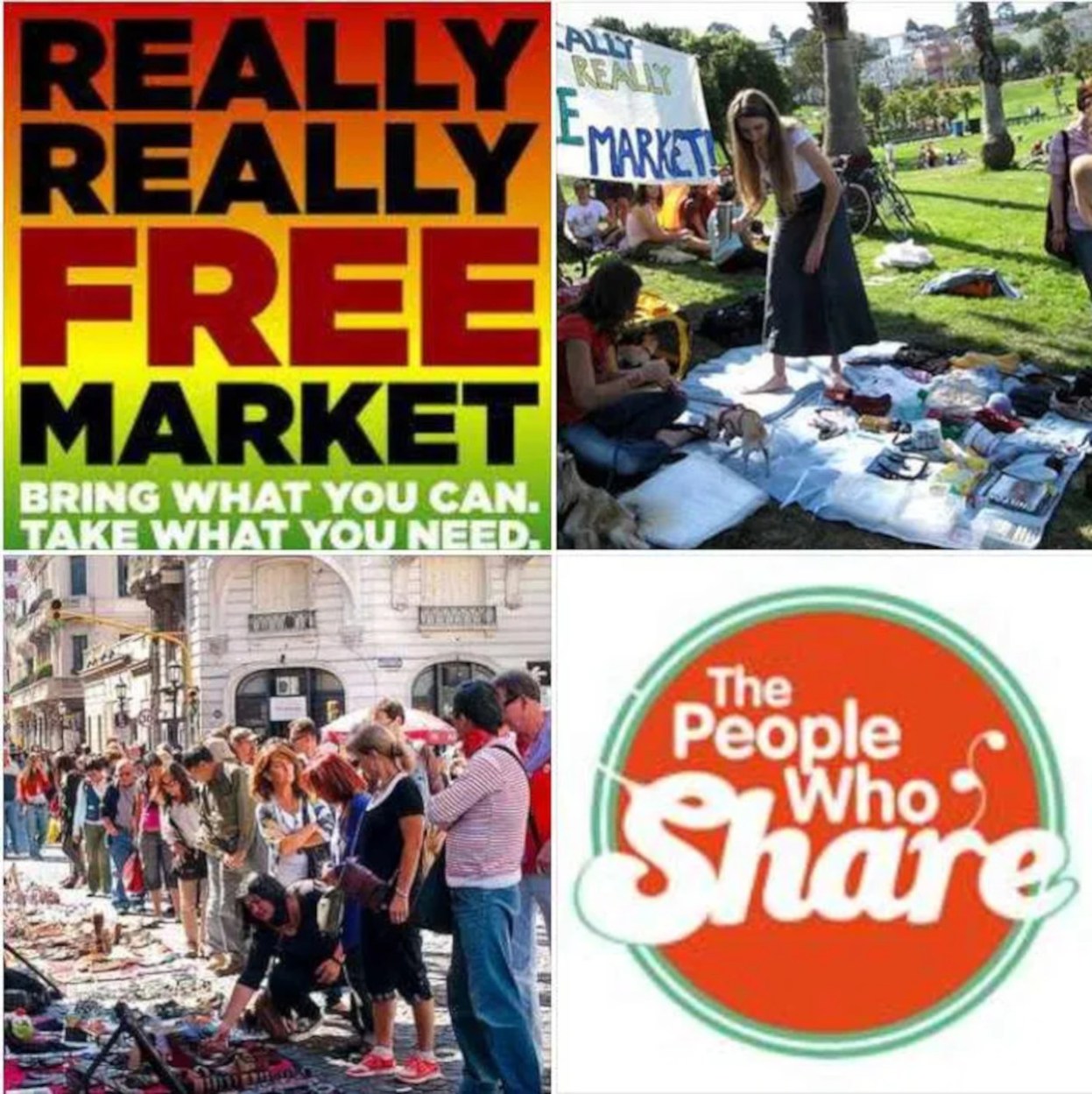
Disambiguation: According to the capitalist lexicon, the “Free Market” is the economic system in which prices are determined by unrestricted competition between privately owned businesses. Any sensible person can recognize immediately that neither human beings nor resources are free in such a system; hence, a “Really Really Free Market” is a market that operates according to gift economics, in which nothing is for sale and the only rule is share and share alike. In the interest of not taxing the reader’s patience, a single apostrophe stands in for the two “Really”s throughout this text.
Once a month two hundred or more people from all walks of life gather at the commons in the center of our town. They bring everything from jewelry to firewood to give away, and take whatever they want. There are booths offering bicycle repair, hairstyling, even tarot readings. People leave with full-size bed frames and old computers; if they don’t have a vehicle to transport them, volunteer drivers are available.
No money changes hands, no one haggles over the comparative worth of items or services, nobody is ashamed about being in need. Contrary to government ordinances, no fee is paid for the use of this public space, nor is anyone “in charge.” Sometimes a marching band appears; sometimes a puppetry troupe performs, or people line up to take a swing at a piñata.
free shop in Utrecht, Holland.
Games and conversations take place around the periphery, and everyone has a plate of warm food and a bag of free groceries. Banners hang from branches and rafters proclaiming “FOR THE COMMONS, NOT LANDLORDS OR BUREAUCRACY” and “NI JEFES, NI FRONTERAS” and a king-size blanket is spread with radical reading material, but these aren’t essential to the event—
this is a social institution, not a demonstration.
Thanks to our monthly ’Free Markets, everyone in our town has a working reference point for anarchist economics. Life is a little easier for those of us with low or no income, and relationships develop in a space in which social class and financial means are at least temporarily irrelevant.
Why the ’Free Market Works
The ’Free Market model has several virtues to recommend it for anarchists hoping to build local infrastructures and momentum. First, like Critical Mass or Food Not Bombs, it lends itself to a decentralized approach: so long as the idea is well-distributed, neither hierarchy nor central coordination is necessary to organize a ’Free Market.
Some 200 people demonstrated to demand “political courage” to ban carsThe demonstration included a ‘performance’ to simulate deaths caused by pollution / ACN
Neighborhood and social organizations have cut a section of the Diagonal mainstreet to demand the reduction of private vehicles in Barcelona. For at least an hour, some 200 people took part in a rally , the mobilization, which was choreographed to simulate deaths due to pollution, featured pedestrians and bicycles and was the last event of the ”Let’s confine cars, recover the city ”campaign.
The demonstrators demand an “urgent” shock plan to convert into priority roads for pedestrians and bicycles, in all the streets and accesses of the city; and the application of an anti-pollution toll.
During the rally, music and shouts could be heard in favor of cleaner air. At the end of the event, a choreography was performed to simulate how air pollution causes suffocation, illness and, finally, death.
I’ve been seeing a meme doing the rounds that identifies a set of experiences as internalised capitalism: Feeling guilty for resting, self worth based on career, putting productivity before health, believing that hard work leads to happiness, feeling lazy when you can’t work and using busyness to avoid your needs.
It struck me that this can be as much about poverty as it is about capitalism.
If you are comfortably off, then you might be able to avoid these feelings. But, in reality most people are a paycheck or two away from total disaster. One big, unexpected bill can throw most people into difficulty. If anyone depends on you, then that’s a lot of pressure to be under.
So you work when you’re ill, because you have to try and stay ahead to keep you and your people safe. There is no job security anymore, no certainty, nothing much you can count on to help you if things go wrong, in too many parts of the world.
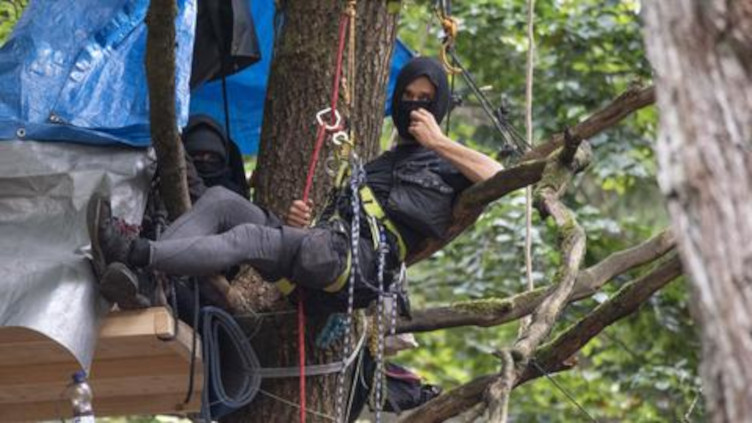
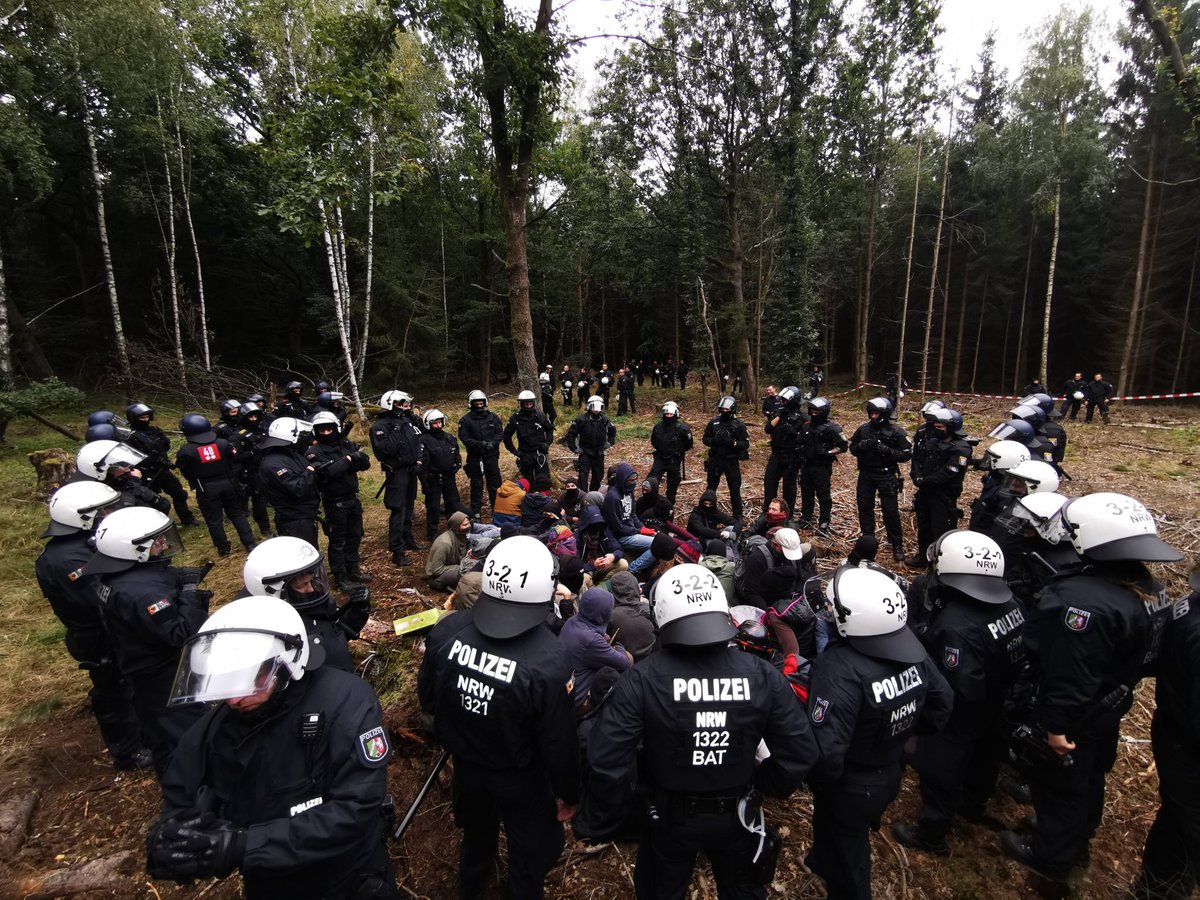
Dannenrod. Germany. October 1. 2020. The clearing of the forest for the controversial further construction of the A49 freeway began in the early hours of this morning.
The logging work is taking place under police protection in the Herrenwald FFH protection area. This lies on the planned route of the A49, north of the Dannenröder Forest, which has been occupied for a year in protest against the construction of the freeway section and for a consistent traffic transition.
A few weeks ago, platforms and tree houses were also constructed in the Herrenwald, and activists have announced that they will also block the logging there and the associated expansion of the freeway.
In case you missed it! Crimethinc responds to a stupid anti anarchist article in the New York Times. And in the process gives us insights into the BLM and anarchist resistance. AnalysisCurrent Events
The Ex-Worker Responds to the New York Times
Yesterday, Farah Stockman from the New York Times editorial board published an article claiming to be “The Truth About Today’s Anarchists.” It draws on the work of an amateur conspiracy theorist, a poorly researched report from a nonprofit including a former Republican state attorney general and a former NYPD chief, a couple interviews with politicians and reformers, decontextualized and misleading references to two of our own publications, and regurgitated right-wing talking points to argue that violent anarchists are somehow controlling the ongoing countrywide protests but don’t care about Black lives.///
What follows is a detailed rebuttal of this dangerously irresponsible article. Fortunately, initial reactions on social media suggest that the reading public has largely seen through its distortions. Nonetheless, we want to take the opportunity to reply in full—because despite its absurdity, the article touches on critical issues that deserve to be addressed. This is an opportunity to set the record straight, to explain why many anarchists have participated in these protests, and to elaborate our vision for a freer world.
How did Stockman learn this “truth”? She appears to have spoken to at least one experienced activist in the course of her research, though she didn’t use any of the information or contacts that person offered her. There are thousands she could have approached—but she didn’t include perspective from any of them.
Instead, the article’s primary source is Jeremy Lee Quinn, an amateur conspiracy theorist posing as an investigative journalist who has no more familiarity with anarchists than one can gain from standing around at a couple demonstrations. Admitting he has no prior background on the subject, he claims to have “gone undercover” during black bloc protests in several cities over a period of months, and has now posted a website full of videos and disjointed rants as “a non-partisan source of information on riot Direct Action [sic] and how it may succeed under the cover of protest.”
If words are as dangerous as bullets and sharp as knives Can we start filling the pages? grinding our pencils to stubs Turning ink into guillotines prose the ropes onto their wrist and rhyme these prison walls to paste cause nothing else seems to be working heads aren’t rolling, the streets are on holiday maybe enough words can spark a million fires in our hearts which would create a million fires in the banks a million convicts in the streets Not giving a fuck about a voters box Giving a fuck about having a life our words can break these chains? then gather our dictionaries there aren’t enough thesauruses in the world I need to fight more, I need to write more My tongue has been shackled I haven’t resisted, I haven’t insisted More words, more battles, more victories more poems, more struggle, more bumps We’d be fighting with our minds dismantling the system that strangles us Then turning those words into life A life more important than burning and bombing Enough magic, love, growth and life We can grow into a space worth existing in Our words can get us free.
– Eric King, political prisoner, FCI Englewood, 2020
Who is Eric King?
by Eric King Support Crew
Eric G. King, a 33-year-old vegan anarchist political prisoner and poet, was arrested and charged with an attempted firebombing of a congressperson’s office in Kansas City, Missouri, in September 2014. As part of his plea and sentencing, Eric publicly and proudly acknowledged that his intent was to take direct political action in solidarity with the community of Ferguson, Missouri, following the August 2014 police killing of Michael Brown Jr.
Eric was charged with throwing a hammer through a window of the building, followed by two lit Molotov cocktails. The criminal complaint states that both incendiary devices failed to ignite. Eric was identified as a suspect by local police because he had previously come under suspicion for anti-government and anti-police graffiti.







 The Free