

Por David Cobo Publicado el 2 Sep, 2021 from Kaos en la Red shared with thanks translation TheFreeOnline
“We have received five fines today.” “We already have eighteen but we don’t know when it will stop.” “About twenty people have been fined for that eviction.” “At least forty more of us have been fined.”

These are phrases uttered by compas from four different housing groups in Barcelona to explain the outbreak of administrative sanctions they are receiving. They are not the only ones.
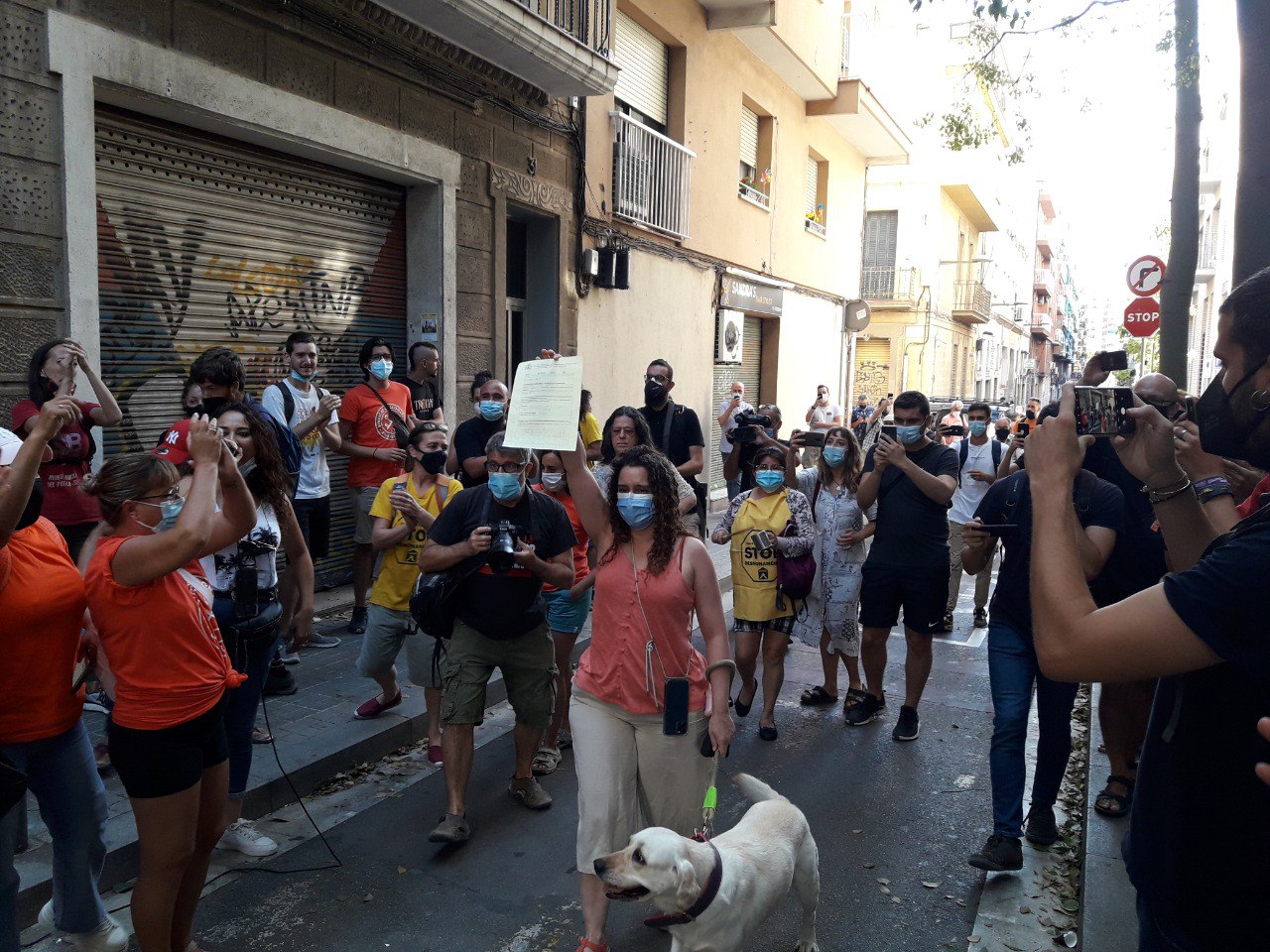
The fines refer back to the end of last year and since then many evictions have been opposed with the same tactic- blocking access to bailiffs until dragged away by police.. And you get identified by the police, in the Spanish State it’s illegal to be without your National Identity Card.. and possibly fined or charged months or years later.

According to TOT Barcelona, the administrative complaints imposed by the riot police of the Mossos d’Esquadra have hit just this month members of the Housing Network of Eixample, the Housing Union of the Raval, the Horta-Guinardó Housing Network, Sants Housing Group and the PAH of Barcelona.
This campaign of sanctions, which is ongoing, represents a new scenario in the tug-of-war between the administration and activism for the right to housing.
People who sit in front of a door to try to stop the expulsion of a family are starting to be fined 601 euros through what is known as the Gag Law. Accusations vary between Disobedience and Obstruction of Authority.
Last November, the first warning of the phenomenon was appeared. Different groups present in an eviction in the Eixample received some thirty fines for having tried to prevent the court order. At that time the Tenants’ Union explained that this fact extraordinary. “In four years we had never received a fine for standing in front of a door peacefully and passively,” said spokesman Jaime Palomera.
Now, months later, this police technique is no longer an exception. Dozens of fines are being imposed on different housing groups in Barcelona.
From the usual scene to economic risk
One of the peculiarities of these sanctions is that, at least in the cases confirmed by this newspaper, they describe an identical sequence. The scene begins with dozens of people sitting on the sidewalk, in front of the entrance to the estate where the family lives, which the courts order to evict.
The letter of the sanction then emphasizes that the Mossos have repeatedly warned the protesters that they must step aside in order for the court order to be complied with.
Seeing no movement, the riot police start attacking the activists, who stay on the ground linking their arms to their comrades. One by one, the agents drag away the activists. And finally the eviction occurs.

Until now, during these last years of constant friction in evictions that have ended up being executed, this is where the story ended on the vast majority of occasions. The retaliation for the mobilized neighbors was, eminently, in the acceptance of the expulsion of the family.
During the pandemic there was supposedly a pause in evictions, normally dozens every day, though many continued. Now there are many more, but also at least in Barcelona, defence groups and unions have sprung up in solidarity, and the riot police are using more force and adopting new tactics against resistance.

The cornerstone of the anti-eviction movement — standing at the door of a building to prevent an eviction when all other options have failed — has become an economic risk. A spontaneous action, often called at the last minute, can get a punishment of thousands of euros.”It’s another step in their idea of repressing what we are as housing groups.
But these fines are not going to deter us “, says Llum Oliver, spokesman for the Sants Housing Group, pointing to the “inconsistency” of the administration making announcements in favor of the right to housing, (in the Constitution) on the one hand, and choking them financially, on the other.

In their group, one of the evictions with a lot of fines took place in the Gayarre Block last December, from which four families with minors were expelled.
Although the narrated scene is similar in many cases, with the current fines there is a change in criteria when processing the complaint by the Mossos police. In the first batch of sanctions, last November, the police letter said: “All the people accompanied in this act have offered passive resistance, not wanting to get up or leave the place at any time.” He also detailed that the picketers were held by the arms. However, the category of passive resistance was established and was considered a serious breach of Law 4/2015.
Now, different housing unions that have found the arrival of these new complaints point out that the wording of the police has changed with respect to that previous case. Despite describing identical facts, they now speak of “active resistance.”
The complaint for the case of Gayarre says so and so do the sanctions imposed on several people who tried to stop an eviction on Carrer Trobador last December, they explain from the Horta-Guinardó Housing Network.
Social movements suspect it is a way to aggravate the perception of the scene and prevent resistance from thriving by fines. Months ago, in a conversation with this newspaper, the lawyer Eduardo Cáliz defended that these sanctions “have no legal basis” and “violate the fundamental right to demonstrate and freedom of expression.”
In any case, with the end of judicial semi-truce on evictions – the Barcelona housing movement is still trying to account for the scale of the economic downturn. One of the main fears is whether these sanctions, which refer to cases between October and December 2020, could be multiplied soon.

Despite the decree of the Spanish government that stopped many evictions, in recent months activists have put their bodies on the line in many scenarios where families continued to be evicted.
If the same police criteria were maintained, the fines would amount to tens of thousands of euros. In the face of this, an answer is being prepared. Next week, neighborhood groups will begin holding assemblies and pooling complaints, as well as an approach on how to handle it.
Source: Tot de Barcelona magazine (shortened)
Onada de multes dels Mossos a grups d’habitatge per intentar aturar desnonaments
La policia catalana va començar a tramitar desenes de sancions a finals del 2020 que poden sumar desenes de milers d’euros,
Por David Cobo Publicado el 2 Sep, 2021 Patrocinado
“Avui mateix ens n’han arribat cinc, de multes”. “Nosaltres ja en portem divuit però no sabem quan s’aturarà”. “Unes vint persones hem rebut multa per aquell desnonament”. “Almenys unes quaranta persones han estat multades”.
Són frases que pronuncien representants de quatre grups d’habitatge diferents de Barcelona per explicar l’eclosió de sancions administratives que estan rebent aquest agost. No són els únics. Altres col·lectius també n’estan rebent, tot i que en plenes vacances encara no tenen apamat l’abast del maldecap econòmic.
Segons ha pogut saber el TOT Barcelona, les denúncies administratives imposades pels antiavalots dels Mossos d’Esquadra han arribat aquest mes almenys a membres de la Xarxa d’Habitatge de l’Esquerra de l’Eixample, al Sindicat d’Habitatge del Raval, a la Xarxa d’Habitatge d’Horta-Guinardó, al Grup d’Habitatge de Sants i a la PAH de Barcelona.
Aquesta onada de sancions, que han coincidit en el temps i que encara no s’han aturat, suposa un nou escenari en l’estira-i-arronsa entre l’administració i l’activisme pel dret a l’habitatge. A les persones que seuen davant d’una porta per intentar frenar l’expulsió d’una família els estan començant a aplicar sancions de 601 euros a través de la coneguda com a llei mordassa. Les acusacions ballen entre la desobediència i l’obstrucció a l’autoritat.
El novembre passat ja es va fer el primer avís del fenomen. Diferents grups presents en un desnonament a l’Eixample van denunciar l’arribada d’una trentena de multes per haver intentat impedir l’ordre judicial. Llavors, des del Sindicat de Llogateres van explicar que aquest fet era extraordinari. “En quatre anys mai ens havia arribat una multa per estar davant d’una porta pacíficament i passiva”, deia llavors el portaveu Jaime Palomera, que alhora en responsabilitzava el conseller d’Interior de la Generalitat del moment, Miquel Sàmper. Ara, mesos després, aquesta tècnica policial ha començat a consolidar-se. Ja no és una excepció. Estan arribant desenes de multes a diferents grups d’habitatge de Barcelona.
D’escena habitual a risc econòmic
Una de les particularitats d’aquestes sancions és que, almenys en els casos confirmats per aquest diari, descriuen una seqüència idèntica. L’escena comença amb desenes de persones assegudes a la vorera, davant de l’accés a la finca on viu la família que els jutjats ordenen desnonar. Tot seguit, l’escrit de la sanció subratlla que els Mossos avisen diverses vegades els concentrats dient-los que s’han d’apartar perquè es compleixi el mandat judicial. En no veure-hi moviment, els antiavalots inicien l’arrenca-cebes dels activistes, que es mantenen a terra enllaçant els braços amb els seus companys. Un a un, els agents retiren els activistes. I finalment es produeix el desnonament.
Fins ara, durant aquests últims anys de friccions constants en desnonaments que s’han acabat executant, aquí s’acabava la història en la immensa majoria d’ocasions. La represàlia per als veïns mobilitzats quedava, eminentment, en l’acceptació de l’expulsió de la família. Ara, però, la pedra angular del moviment antidesnonaments —situar-se a la porta d’un edifici per evitar una execució judicial quan tota la resta d’opcions han fallat—s’ha convertit en un risc econòmic. Una acció espontània, moltes vegades convocada a última hora, pot representar un càstig de milers d’euros.
“És un pas més en la seva idea de reprimir el que som els grups d’habitatge. És la manera que han trobat. Però aquestes multes no s’aguanten per enlloc i les recorrerem, i tant”, apunta Llum Oliver, portaveu del Grup d’Habitatge de Sants. També assenyala “la incoherència” que l’administració faci anuncis en favor del dret a l’habitatge, d’una banda, i els escanyi econòmicament, de l’altra. Al seu col·lectiu, un dels desnonaments que els ha valgut l’acumulació de denúncies és el que es va viure al conegut com a Bloc Gayarre el passat desembre, d’on es va expulsar quatre famílies amb menors. La denúncia que afecta una de les presents en aquella acció veïnal i a la qual ha tingut accés aquest diari mostra, fil per randa, els ingredients paradigmàtics d’aquestes sancions: el relat de les persones assegudes, els avisos i els braços entrellaçats.

Els textos policials en cap moment fan referència a cap fet violent. Sí que mencionen, en canvi, l’esforç dels activistes per agafar-se amb els braços durant l’extracció dels antiavalots.
El canvi de resistència
Si bé l’escena narrada és molt similar en tots els casos, amb les multes actuals s’aprecia un canvi de criteri a l’hora de tramitar la denúncia per part dels Mossos. En la primera fornada de sancions, la del novembre passat, l’escrit policial deia: “Totes les persones acompanyades en aquesta acta han ofert resistència passiva, no volent aixecar-se ni marxar del lloc en cap moment”. També detallava que els concentrats estaven agafats pels braços. Amb tot, s’establia la categoria de resistència passiva i es considerava una falta greu de la llei 4/2015.
Ara, diferents sindicats d’habitatge que s’han trobat l’arribada d’aquestes noves denúncies apunten que el redactat policial ha canviat respecte a aquell cas anterior. Tot i descriure uns fets idèntics, ara parla de “resistència activa”. Ho diu la denúncia pel cas de Gayarre i ho diuen també les sancions imposades a diverses persones que van intentar frenar un desnonament al carrer Trobador el desembre passat, expliquen des de la Xarxa d’Habitatge d’Horta-Guinardó.
Tot i que desconeixen perquè s’ha donat aquest canvi de criteri, els moviments socials sospiten que és una manera d’agreujar la percepció de l’escena i evitar que prosperin els recursos a les multes. Mesos enrere, en conversa amb aquest diari, l’advocat Eduardo Cáliz defensava que aquestes sancions “no tenen base jurídica” i “vulneren el dret fonamental de manifestació i la llibertat d’expressió”.
També ho va censurar el regidor de Drets de Ciutadania de l’Ajuntament de Barcelona, Marc Serra, que va considerar “molt preocupant” i “inadmissible” que “s’enviï els Mossos a denunciar a veïns i veïnes que protesten per un desnonament en plena pandèmia”. Per la seva banda, ni llavors ni ara els Mossos expressen cap canvi de criteri. De fet, al contrari del que diuen els activistes, la policia nega que aquestes denúncies suposin una variació de la seva manera de funcionar anterior. Sobre aquests casos, portaveus oficials dels Mossos d’Esquadra recorden que la presència de la policia en aquests escenaris respon a les ordres judicials i remarquen que “la mediació és sempre la primera opció”. Pel que fa a les multes, insisteixen que el fet que una actuació policial en un desnonament acabi tramitant denúncies “no respon a cap criteri preestablert”. “Sempre s’actua cas a cas i així queda recollit en les actes que arriben a l’òrgan competent a l’hora de tramitar l’expedient sancionador”, resolen.
Sigui com sigui, mentre l’agost s’acaba —i amb ell la treva judicial en matèria de desnonaments— el moviment per l’habitatge barceloní encara intenta comptabilitzar la dimensió del daltabaix econòmic. Una de les principals pors és si aquestes sancions, que fan referència a casos d’entre l’octubre i desembre del 2020, es poden multiplicar pròximament.
Tot i la vigència del decret del govern espanyol que frenava bona part dels desnonaments, durant els últims mesos els activistes han posat el cos en nombrosos escenaris on se seguia desnonant famílies. Si es mantingués el mateix criteri policial, les sancions podrien ascendir a desenes de milers d’euros. Davant d’això, es prepara una resposta. La setmana vinent, els grups de barri començaran a fer assemblees i es posaran en comú les denúncies, així com el plantejament de com gestionar-ho. El següent pas serà la pressió política.

 The Free
Reblogged this on The Free.
LikeLike