
Recently we reported on the over 3 million fracking wells and chemical lakes abandoned in the USA, many leaking oil and methane and poisoning groundwater.

Now we find that the same thing has happened in the Gulf of Mexico where the billionaire capitalists have for 50 years illegally abandoned hundreds of undersea oil pipelines and badly sealed wells, bribing the authorities to turn a blind eye and adding to the environmental apocalypse in the biggest marine ‘Dead Zone’.
The US media highlighted heroic efforts to control an oil slick visible from the Port Fourchon shore, while ignoring the other 349 spills. (The massive onshore petrochemical disaster is another ignored story).
Hurricane Ida: nearly 350 reported oil spills “investigated”

Map of current undersea pipelines and drilling rigs off Louisiana

Gulf of Mexico dead zone is “largest” ever recorded
*****************
Hundreds of Abandoned oil pipelines still leaking in the wake of Hurricane Ida
Published on September 10, 2021 by Charles Digges from Bellona.org > Gulf of Mexico oil spills

More than a week after Hurricane Ida hit Louisiana so violently that it reversed the course of the Mississippi River, it’s become clear that the storm had also made a shambles of one of the nation’s largest chemical, petroleum and natural gas hubs.
According to the New York Times, the government is investigating hundreds of reported oil spills in the Gulf of Mexico following the storm – many of them coming from a vast network of abandoned pipelines that have been left by oil companies on the ocean floor.
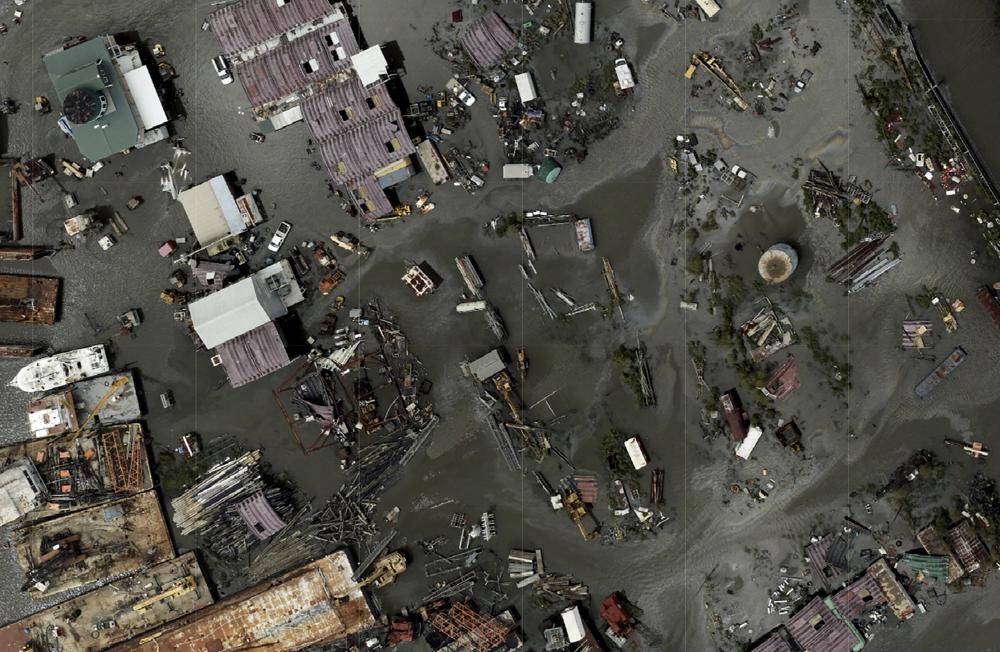
In this drone image released by NOAA, flood waters cover Tom’s Marine & Salvage in Barataria, La., following the aftermath of Hurricane Ida. Credit: NOAA
Since last Saturday, as technicians continued the struggle to restore power to millions of gulf residents on land, cleanup workers began efforts to contain some of the spills, which were picked up by US Coast Guard examinations of aerial of satellite and aerial survey images.

According to the Bureau of Safety and Environmental Enforcement, more than 90% of the Gulf’s oil and gas infrastructure was knocked offline by the storm, which hit midday on August 29.
The scope of the damage, while still difficult to pinpoint, is thought to be enormous, and assigning blame will be complicated. On Monday, the Coast Guard said it is investigating nearly 350 reports of oil spills in the Gulf following Ida.

Dozens of Offshore Oil Spills Caused by Hurricane Ida
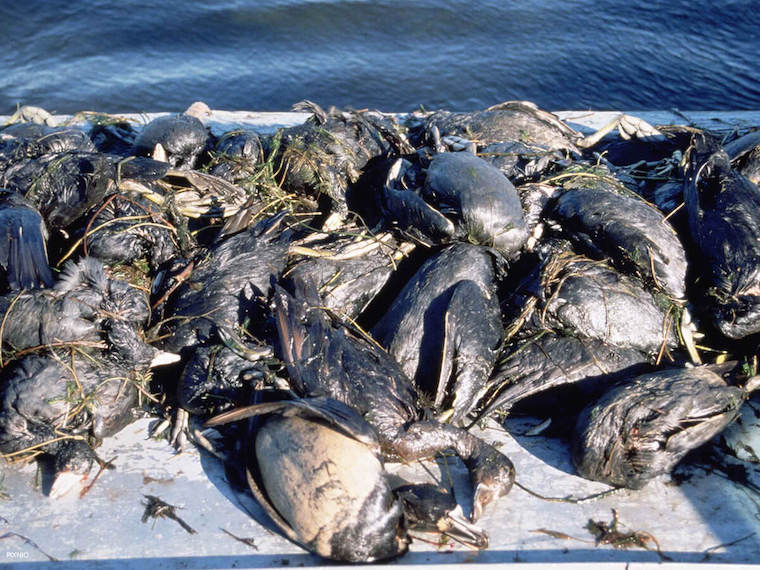
According to Louisiana wildlife officials groups, oiled birds – once the hallmark of disasters like the Deepwater Horizon blowout in 2010 – are starting to turn up by the dozen on beaches near the Phillips 66 refinery, one of the area’s largest.
One of the biggest spills was spotted off Port Fourchon, a major oil and gas hub on Louisiana’s southern tip, and the town where the Hurricane made landfall as a Category 4 storm. Images captured by the National Oceanic and Atmospheric Administration showed a slick 16 kilometers long forming off the coast of the devastated town.
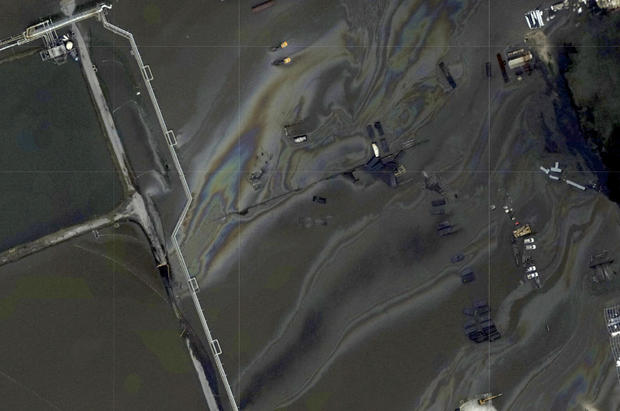
Lt. John Edwards of the U.S. Coast Guard told the Times that the spill was believed to be crude oil from an old pipeline owned by the Houston-based oil and gas exploration company, Talos Energy. The company had leased an area near where the spill was detected, but ceased its operations in 1987.
The Gizmodo science and technology website reported that divers working on the cleanup site said that the spill appears to have sprung from a pipeline that broke off the ocean floor in shallow water, about 10 meters underwater. Two other, smaller pipelines in the area were also “open and apparently abandoned,” the Associated Press reported.
A cleanup vessel hired by Talos was using skimmers to recover the oil and had placed a containment boom in the area to try to contain the spread, Edwards told the Times.

U.S. Gulf has 30% of oil production still shut after Hurricane Ida
In a release, Talos Energy said that it had removed all its infrastructure in 2019, that its equipment was not responsible, and that the leak appears to have come from an abandoned pipeline in a nearby leasing area.
The company said it is “working closely with the [Coast Guard] and Louisiana state officials to identify the owner of the line and is continuing to collaborate with [Coast Guard] and other state and federal officials to receive approval to initiate permanent repair of the line.”

A Secret, 14-Year-Long Oil Spill is Becoming as Bad as BP …
In short, according to Wilma Subra, a chemist and technical adviser at the nonprofit Louisiana Environmental Action Network, it’s nearly impossible to determine who, exactly, is responsible for the leaks.
“If you would look at all the pipelines, on a map, offshore, it looks like spaghetti, you just threw spaghetti in there. Pipelines everywhere, everywhere, everywhere,” Subra told CNN.

“There are lots of pipelines out there, lots of old pipelines as well as newer ones, and ones like Talos has gotten rid of over the years,” she said.
According to a Government Accountability Office report released this year, “the Bureau of Safety and Environmental Enforcement has allowed the offshore oil and gas industry to leave 97% of pipelines (18,000 miles) [29,000 kilometers] on the seafloor when no longer in use,” since the 1960s. “Pipelines can contain oil or gas if not properly cleaned in decommissioning.”
The same report found that the roughly 8,600 miles (14,000 kilometers) of active oil and gas pipelines are also not being sufficiently monitored for problems.
Many of the government’s favorite monitoring techniques—like the surveys conducted over the Gulf in the wake of Ida—lean heavily on surface observations, but the slow-moving nature of some leaks and the way ocean currents can carry oil for miles makes it “difficult, if not impossible, to associate [sheens and bubbles] with a specific pipeline,” the report found.

U.S. Gulf crude oil ramps up after hurricane losses -data …
“Relying on surface observations could allow leaks—particularly slow leaks in deep water that are dispersed by currents—to go undetected for extended periods of time.”
In light of this report, preventing spills like the ones that are currently blooming in the Gulf is almost frustratingly easy: The government simply needs to follow its own standards and ask more oil companies to clean up their messes after they’re done.

How Oil Companies Avoid Environmental Accountability …
“The agreement between the operator and the federal government is: remove everything,” Megan Milliken Biven, an energy policy researcher and former employee at the Bureau of Ocean Management under President Obama, told Gizmodo.
“That’s what all the regs pretty much say.”
Biven explained that the current status quo of allowing pipelines to remain on the ocean floor has been “mutated” into official policy—one that the Department of Interior could easily reorient without any change in law. “[Secretary of the Interior] Deb Haaland could say today, we need to remove these [pipelines] because they’re hazardous… The benefit of that is you wouldn’t have events like this.”
*****************
‘And the whole mess disappeared from the media, which filled up with ‘green-washing’ stories, and is ignored until the next disaster strikes’.
Climate change, Fossil fuels, Gulf of Mexico oil spill, Oil

 The Free