
Following up our coverage of last week’s uprising in Kazakhstan, we have translated an array of perspectives on the situation from various Russian anarchist sources and interviewed two anarchists from Almaty, the largest city in Kazakhstan and the place where the fighting became most intense.
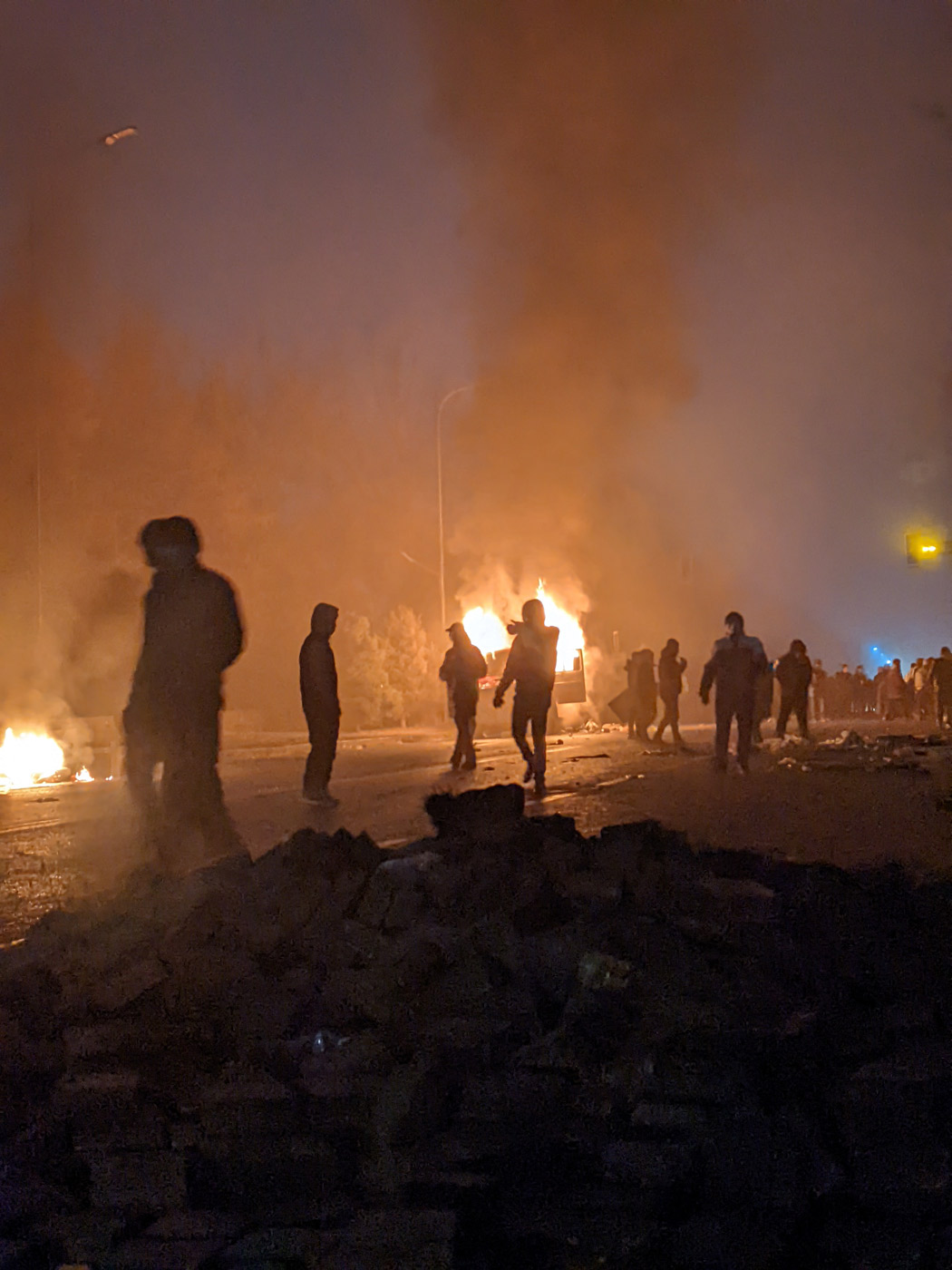
This text also includes previously unpublished photographs taken by our contacts in Almaty.
The following sources should serve to debunk any facile misrepresentations of the uprising from the authorities in Kazakhstan, Russia, or the United States—or their misguided supporters.
To those who spread conspiracy theories about the United States attempting to stage-manage a “color revolution” in Kazakhstan, we must point out that the protests began in response to the government canceling its subsidy on gas, which is produced under a profitable state monopoly in Kazakhstan.
Those who defend the governments of Kazakhstan and Russia are defending repressive forces that are imposing neoliberal austerity measures upon exploited workers in an extraction-based economy.

The honorable place for all who genuinely oppose capitalism is at the side of ordinary workers and other rebels who stand up to the ruling class, not supporting the governments who claim to represent protesters while gunning them down and imprisoning them.
This is not to say that the clashes in Kazakhstan represent a unified anti-capitalist struggle, or for that matter a labor movement. The most credible accounts of the composition of the protests acknowledge that there have been a wide range of different participants utilizing different tactics to pursue different agendas.
Of course, if we are sympathetic to workers who protest against the rising cost of living, we can also understand why the unemployed and marginalized might engage in looting.
A crisis like the uprising in Kazakhstan opens up all the fault lines within a society. Every preexisting conflict is pushed to a breaking point: ethnic and religious tensions, rivalries among the ruling elite, geopolitical contests for influence and power. We saw this to a lesser degree in France during the Yellow Vest movement and in the United States during the George Floyd Uprising and its aftermath, though those crises did not proceed as far as the uprising in Kazakhstan, where, owing to the entrenched authoritarian power structure, any struggle is immediately an all-or-nothing venture.
If it is true, as we have argued, that the protesters in Kazakhstan were opposing the same forces that rest of us face all around the world, then the violent suppression of those protests by the soldiers of six armies poses questions that we all must confront. It seems that such moments of truth are becoming practically inevitable as economic, political, and ecological catastrophes hit one after the other all around the world.
How do we prepare in advance, in order to maximize the likelihood that these ruptures will turn out well despite all the forces that are arrayed against us? In such moments of revolutionary potential, how can we propose transformative questions to the others who make up this society with us, focusing the lines of conflict along the most generative and liberating axes even as we compete with a variety of factions that aim to centralize their own ideologies and interests? How do we avoid both conspiracy theories and manipulation, both defeatism and defeat?
In the following overview, composed in collaboration with Russian anarchists, we present the analysis of the uprising in Kazakhstan that has come out of the ex-Soviet region, then share an interview we conducted with anarchists in Almaty as soon as internet access was reestablished following the crackdown.

The Prison of Nations
Starting on January 1, what began as a single protest against the rising cost of living escalated to a full-scale nationwide uprising, which for now has been brutally suppressed by a combination of domestic and foreign military force.
At first, the protesters sought the resignation of government, a reduction in the price of gas, and the removal of the ex-president—Nursultan Nazarbayev, the Grey Cardinal of Kazakhstan—from the head of the National Security Council. The slogan of the whole country for these days became “Shal ket!”—”Grandpa, go away!” As the protests gained momentum, people quickly came to the point of not wishing to agree to anything less than a complete change in the government, including the ouster of current president Kassym-Jomart Tokayev.
The regime attempted to suppress the protests. Yet the protesters managed to seize weapons from the police and fight back, looting shops and burning down or occupying municipal buildings. President Tokaev declared a state of emergency and sent military against the protesters with orders to shoot on sight anyone who dared to resist. At the same time, Tokaev officially asked the Collective Security Treaty Organization (CSTO, consisting of Russia and several neighboring countries) for support in regaining the control over the country.
Continue reading “Kazakhstan after the Uprising: Eyewitness Accounts from Almaty; Analysis from Russian Anarchists…. by Crimethinc”












 The Free