Progressives have been urging governments to embark on an accelerated global clean energy transition since Russia’s late-February invasion of Ukraine and the ensuing Western sanctions unleashed chaos in energy markets around the world, but policymakers have opted instead to expand fossil fuel infrastructure.
That’s according to researchers from Climate Action Tracker, which released a new report Wednesday warning that this reaction threatens to lock in decades of heat-trapping emissions at a time when the window to slash greenhouse gas pollution and avert the most catastrophic effects of the climate crisis is rapidly closing.
«So far, governments have largely failed to seize their chance to rearrange their energy supplies away from fossil fuels,» states the report.
«Instead, we are witnessing a global ‘gold rush’ for new fossil gas production, pipelines, and liquefied natural gas (LNG) facilities. This risks locking us into another high-carbon decade and keeping the Paris agreement’s 1.5°C limit out of reach.»
Key findings of the analysis include:
New planned LNG import facilities in the European Union—especially in Germany, Italy, Greece, and the Netherlands—could supply a quarter more gas to the E.U. than before;
Canada plans to fast-track new LNG projects to increase exports;
The United States has signed a deal to export additional LNG to the E.U. Qatar and Egypt have signed similar deals with Germany and Italy, respectively. Algeria has signed a deal to export additional gas via pipeline to Italy;
In Africa, old gas pipeline projects are being revived (e.g. Nigeria) and countries with previously no fossil gas exports (e.g. Senegal) are now encouraged to supply gas to Europe; and
Domestic fossil fuel production has increased in the U.S., Canada, Norway, Italy, and Japan, and new long-term import contracts are closed or extended in the United Kingdom, E.U., Germany, Poland, and Italy.
«If all these plans materialize,» the report warns, «they will either end up as massive stranded assets or they’ll lock the world into irreversible warming.»
Climate Action Tracker shared a graphic detailing what governments should and shouldn’t do in response to the global energy crisis.
The recommended measures include halting the expansion of fracked gas infrastructure; discouraging domestic fossil fuel production; ramping up renewable energy supplies, including by reinvesting revenue raised through taxes on Big Oil’s windfall profits; eliminating fossil fuel subsidies and raising the price of carbon once oil and gas prices fall; and incentivizing energy efficiency and electrification.
A handful of governments, including the E.U. and the U.K., have proposed increasing their renewable energy targets, but these plans remain inadequate, the report says.
«Almost no government supports behavioral change,» the report laments. «Immediate and low-cost options to reduce energy demand and therefore the need for Russian fossil fuels would include shifts in behavior, such as encouraging slower driving by introducing/lowering speed limits, home office policies, restricting car access to cities, or turning down the heating in buildings.»
«These options still seem to be very unattractive to governments,» the authors note. «We have only found governments recommending their population to those behavioral shifts and few incentivizing it. So far only New Zealand, [the] U.S. (California), Italy, Germany, and Ireland have introduced new incentives for public transport.»
In addition, «more emphasis on energy efficiency and electrification [is] needed,» says the report. «We find only a few countries putting additional emphasis on energy efficiency and/or electrification as a reaction to the current crisis.
A push for heat pumps, electric cars, [and] electrification in industry would be an adequate reaction, but is currently underdeveloped.»
Responding to the war in Ukraine by boosting the extraction and international shipment of fossil fuels rather than replacing Russian oil and gas supplies with green energy would represent a second missed opportunity since 2020 to take decisive climate action while there’s still time to secure a livable future.
«After failing to focus on climate during Covid-19 recovery, many governments look set to make the same mistake in the face of a global energy shock,» says the report. «Governments largely failed to make decarbonization a focus in their post-pandemic economic recovery packages, with only a small fraction of the billions spent dedicated to accelerating the energy transition to bring down emissions.»
«Instead, they missed a massive opportunity, spending the lion’s share of those packages on maintaining the status quo,» the report adds.
«According to our analysis, governments are making the same mistake, twice
“How much the US loves war”: China highlights that Washington invested 400 times more in Ukraine than in economic cooperation with ASEAN countries Date: June 5, 2022 Author: Prensa Bolivariana 0 Comments
According to data published by the Chinese Foreign Ministry spokesman, Washington invested 54 billion dollars in supporting kyiv and only 150 million in economic programs with the Asian bloc.
The spokesman for the Chinese Ministry of Foreign Affairs, Zhao Lijian, outlined the US priorities on Saturday, highlighting that Washington invested 54,000 million dollars in supporting Ukraine and only 150 million in economic cooperation with 10 countries of the Association of Nations. of South East Asia (ASEAN).
“A difference of 400 times shows how much the United States loves war,” reflected the diplomat on his Twitter account.
In the middle of last month, US President Joe Biden made the decision to contribute 150 million dollars to ASEAN in programs that cover areas such as maritime security, decarbonization of energy supply, health, among others, in order to counteract the influence of the Asian giant.
For its part, Beijing commented: “The cooperation between China and ASEAN is defined by mutually beneficial cooperation, openness and inclusiveness. […] China and ASEAN are not seeking zero-sum games, nor are they promoting bloc confrontation.
Meanwhile, the White House tenant announced on Wednesday a new military aid package for Ukraine, valued at 700 million dollars. The aid will provide kyiv with HIMARS multiple rocket launcher systems, 1,000 Javelin anti-tank and man-portable missiles, 6,000 anti-tank missiles, 4 Mi-17 helicopters, 15 tactical vehicles and several radars.
«Cuánto ama EE.UU. la guerra»: China destaca que Washington invirtió 400 veces más en Ucrania que en cooperación económica con los países de la ASEAN
Según los datos publicados por el portavoz del Ministerio de Asuntos Exteriores chino, Washington invirtió 54.000 millones de dólares en apoyar a Kiev y solo 150 millones en programas económicos con el bloque asiático.
El portavoz del Ministerio de Asuntos Exteriores chino, Zhao Lijian, expuso este sábado las prioridades de EE.UU., destacando que Washington invirtió 54.000 millones de dólares en apoyar a Ucrania y solo 150 millones en cooperación económica con 10 países de la Asociación de Naciones de Asia Sudoriental (ASEAN).
«Una diferencia de 400 veces muestra cuánto ama Estados Unidos la guerra», reflexionó el diplomático en su cuenta de Twitter.
A mediados del mes pasado, el presidente estadounidense Joe Biden tomó la decisión de aportar 150 millones de dólares a la ASEAN en programas que abarcan áreas como la seguridad marítima, la descarbonización del suministro de energía, la salud, entre otros, con el fin de contrarrestar la influencia del gigante asiático.
Por su parte, Pekín comentó: «La cooperación entre China y la ASEAN se define por la cooperación mutuamente beneficiosa, la apertura y la inclusión. […] China y la ASEAN no buscan juegos de suma cero, ni impulsan la confrontación en bloque.
En tanto, el inquilino de la Casa Blanca anunció el miércoles un nuevo paquete de ayuda militar para Ucrania, valorado en 700 millones de dólares. La ayuda proporcionará a Kiev sistemas de lanzacohetes múltiples HIMARS, 1.000 misiles antitanques y portátiles Javelin, 6.000 misiles antitanques, 4 helicópteros Mi-17, 15 vehículos tácticos y varios radares.
Integrantes y simpatizantes de la comunidad LGBT+ marchan hoy, por las principales calles de Tuxtla Gutiérrez, estado de Chiapas (México). EFE/Carlos López
In March 2022, United Nations (UN) Secretary-General António Guterres warned of a ‘hurricane of hunger’ due to the war in Ukraine. Forty-five developing countries, most of them on the African continent, he said, ‘import at least a third of their wheat from Ukraine or Russia, with 18 of those import[ing] at least 50 percent’.
Russia and Ukraine export 33% of global barley stocks, 29% of wheat, 17% of corn, and nearly 80% of the world’s supply of sunflower oil. Farmers outside of Russia and Ukraine, trying to make up for the lack of exports, are now struggling with higher fuel prices also caused by the war.
Fuel prices impact both the cost of chemical fertilisers and farmers’ ability to grow their own crops. Maximo Torero Cullen, chief economist at the UN’s Food and Agriculture Organisation, said that ‘one of every five calories people eat have crossed at least one international border, up more than 50 percent from 40 years ago’.
En nuestra ciencia histórica nativa se considera tradicionalmente que la base social del movimiento anarquista ruso de principios del siglo XX era la pequeña burguesía. Así, en las obras del periodo soviético es típica la opinión de S. N. Kanyev, quien señaló que los elementos dominantes entre los anarquistas rusos eran “el campesinado pequeño burgués… los pequeños propietarios, los trabajadores de la artesanía y los artesanos, y también parte de la intelectualidad” [1]. Nociones similares sobre “el típico anarquista” persistieron incluso después del colapso de la URSS y la liberación de la ciencia histórica de muchos dogmas anteriores. Por ejemplo, la enciclopedia de “Partidos Políticos de Rusia” nos informa: “La base social de las organizaciones anarquistas estaba compuesta predominantemente por artesanos y pequeños comerciantes, pero el movimiento también atrajo a campesinos, trabajadores y a la intelectualidad” [2]. Paradójicamente, estos mismos autores, a la hora de elaborar los acontecimientos y hechos…
US and European acquiescence in Turkey’s long-standing refusal to honour Kurdish ethnic, cultural, and political rights has come home to roost with Turkish opposition to Finnish and Swedish NATO membership.
The opposition has sparked debates about Turkey’s controversial place in the North Atlantic defense alliance.
Turkey’s detractors point to 3 problematic military intervention in Syria including continuing occupation and ethnic cleansing, mush worse than anything Russia has done in Ukraine, relations with Russia, refusal to sanction Moscow, and alleged fuelling of tension in the eastern Mediterranean, calling the country’s NATO membership into question.
Its defenders note that Turkey, NATO’s second-largest standing military, is key to maintaining the alliance’s southern flank. Also, Turkey’s geography, population size, economy, military power, and cultural links to a Turkic world make it a critical link between Europe and Asia. In addition, Turkish drones have been vital in Ukraine’s war with Russia, while Turkey has been a mediator in the conflict, albeit with limited success.
Kurdish rights hardly figure in the debates, and if they do, only as a prop for taking Turkey to task for its slide into authoritarianism.
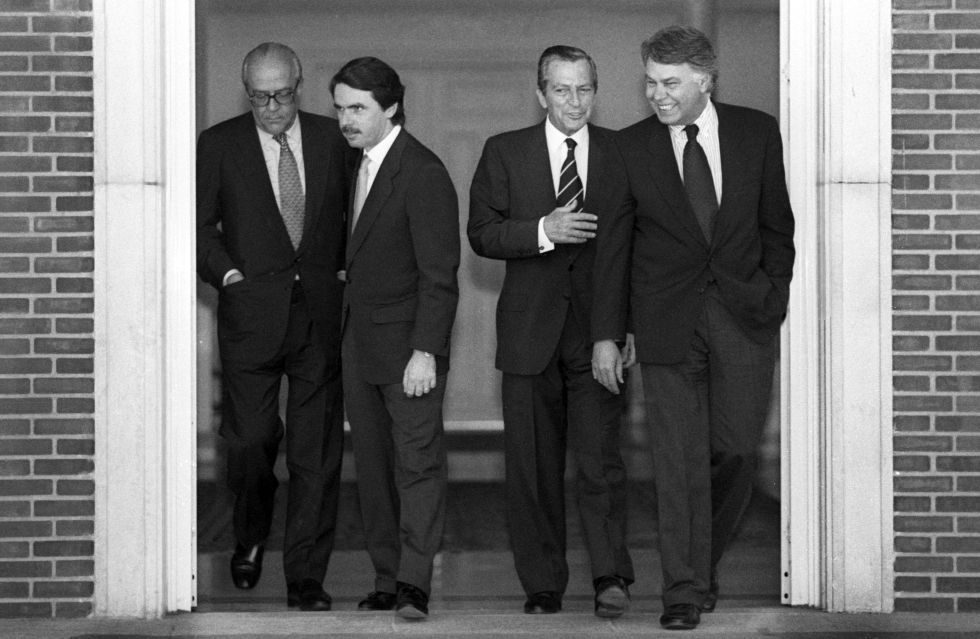
From left to right, Leopoldo Calvo Sotelo, José María Aznar (host of the meeting), Adolfo Suárez and Felipe González, photographed at the Moncloa Palace on the occasion of the 20th anniversary of the first democratic elections after the Civil War. This meeting of the four presidents of the Government was held on June 13, 1997. Photo: Gorka Lejarcegi.
Corrupt Spanish politicians have always betrayed their citizens to the USA for cash and influence.
In the case of the Canary Islands they ordered the murder of Antonio Cubillo, leader of the Free Canaries movement, which was later admitted.
Cubillo survived, but never walked again. The attack on Cubillos coincided with the secret agreement to join NATO, even though only 18% of Spanish people were in favour.
The CIA had infiltrated Free Canaries, whio immediately stoppedn their actions and disbanded, once the US had the NATO agreement with the Spanish politicians. This even though Free Canaries had the support of the African National Congress and Cubillo was due to speak at the UN. We still don’t know what cash, property and powers changed hands.
By Kahlil Wall-Johnson – Jun 6, 2022
A recent interview with former Spanish politician José Manuel Otero has revealed further details regarding his country’s entry into NATO and attests to the double-dealing politics of the Spanish Socialist Workers’ Party (PSOE).
Prior to Spain’s absorption into NATO, Otero was minister of the presidency and then minister of education. According to a recent interview he agreed to with the Spanish news outlet 20minutos, his country’s decision to enter the treaty was dictated by an implicit threat made by the US government: “either you join NATO or we will make the Canaries independent.”
As Otero recognized early on in the interview, before officially joining NATO in 1982, Spain had already been “indirectly integrated” for more than 20 years due to military and economic agreements with the US; agreements which dated back to 1953 when the Pact of Madrid signaled the end of the country’s post-World War Two international isolation. In Otero’s words, “NATO, in the end, was the US.”
Nevertheless, Adolfo Suárez, the first prime minister of Spain’s constitutional monarchy after the Francoist regime, was considerably more opposed to entering NATO than his successors, including those representing nominally socialist parties. As for Suárez himself, he ran on what is remembered as a center to center-right platform, with the now-disbanded Union of the Democratic Center (UCD) alliance. However, under Suárez, Spain even attended the 6th Summit of the Non-Aligned Movement in 1979 in Cuba, as a guest, for the first time ever.
In this regard, Otero’s testimony has shed light on the specific pressures that led Spain to formally join NATO in the midst of cold war tensions. According to him, the Soviet Union, under the leadership of Leonid Brezhnev, was very concerned with Spain’s potential entry and had abandoned all hopes of PSOE aiding in the spread of socialism, as the USSR was principally concerned with preventing Spain’s incorporation into the Atlanticist treaty.
Interestingly, Otero has asserted that the process of joining NATO was accelerated when Spanish intelligence detected an increase in activity amongst the Movement for the Self-Determination and Independence of the Canaries Archipelago (MPAIAC), little more than a year after the newly-appointed soviet ambassador in Spain, Sergey Bogomolov, had met with him and Suárez to persuade them to abstain from NATO membership.
According to Otero, at this point, the Spanish authorities were fully aware of MPAIAC’s existence. Certainly, by that time, the movement had consistently been carrying out several attacks per month since their initial flurry of 11 attacks during November, 1976, which included bombings, bomb threats, and vandalization. He alleges that he found himself among the victims of one of these attacks; an unsuccessful attempt made on the life of Adolfo Suárez during his time in office. However, the author of this article has so far been unable to determine which MPAIAC attack Otero was referring to.
After being asked by Suárez for his opinion on the matter, Otero claims that he told the prime minister: “I don’t think our secret services, as they stand today, have the capacity to discover American secrets. I tend to think that the Americans are sending a message of their own through their channels. This means that it’s as if they sent us a letter saying: ‘either you join NATO or we will make the Canaries independent.’”
As mentioned above, MPAIAC’s first official attacks were those of November, 1976. After this, and until the following November, they averaged slightly more than four attacks per month. Therefore, when Otero refers to a decisive spike in MPAIAC activity, “approximately a year after” the Bogomolov meeting, we must assume that he is referring to the period spanning November 1976 through February 1978, as these four months registered 13, 15, 11 and 8 attacks, respectively. From this moment on, the process of formally entering NATO was fast tracked, despite the fact that, according to polls carried out by El Pais, only 18% of Spaniards were in favor of Spain joining, while 52% were opposed and 30% did not answer.
According to Otero, the sequence of events was as follows: in 1978, the Saturday after the then Minister of Foreign Affairs Marcelino Oreja had publicly declared, before the senate, that Spain would join NATO on March 9, the Spanish ambassador in Algiers notified the central government that Antonio Cubillo had been stabbed by two hired knives. Then, the Algerian government, which had previously supported Cubillo, shut down The Voice of the Free Canaries (MPAIAC’s radio station), a few collaborators were put on trial, and, as Otero put it, “we never heard of MPAIAC again.”
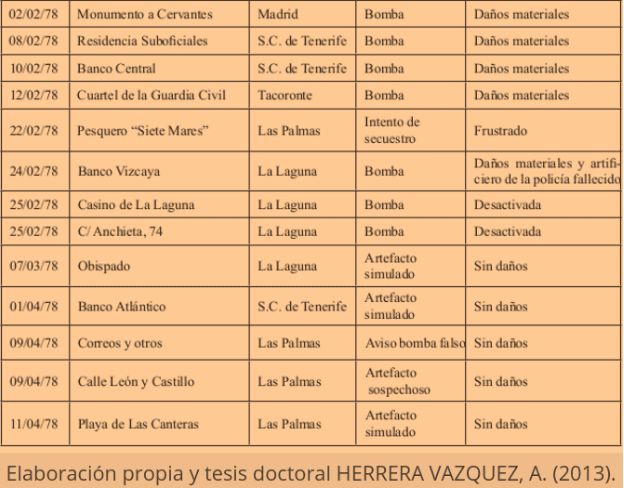
Furthermore, the frequency of the attacks after Oreja’s pro-NATO declaration in early March coincides with an abrupt lull in MPAIAC activity (March and April saw one and three attacks, respectively), and shortly after, the organization all but disappeared. Similarly, all four of the attacks that took place after Oreja officially committed his country to NATO participation were either a “simulated artifact,” a “false bomb alert,” or a “suspicious artifact.” While attacks of this kind were common before Oreja’s March 9 announcement, they were vastly outnumbered by actual bombings, arson, and robberies. In fact, more than two false attacks of this kind had never occurred one after the other, and they were staged at a ratio of less than one to four, when compared to actual attacks on persons or property.
February-April MPAIAC attacks.
Yet it could even be said that the MPAIAC attacks had become less frequent before the attempted hit on Cubillo and the disintegration of the organization that quickly followed. That is, the moment at which attacks become rarer and more harmless more aptly corresponds to late February and early March, precisely when the Spanish government was planning to announce their willingness to join NATO. What is more, after the last string of bombings were carried out on February 25, the final six MPAIAC incidents were all false alarms with no resulting damage.
In any case, from the perspective of Otero’s testimony, there is no need to mark Oreja’s March 9 announcement as the date after which the US would have responded to Spain’s acquiescence by toning down the MPAIAC threat. Surely it is safe to presume that the US-NAT0 axis was aware of Spain’s decision on the NATO issue prior to the March 9 announcement, as Oreja is since reported to have admitted to the secret back-channels he maintained with NATO officials. Similarly, regarding MPAIAC’s final activities, one wonders if there could be any alternative explanation for the six consecutive false threats.
Moreover, we must also remember that this assassination attempt was carried out only five days before Cubillo was set to speak in New York at the UN Special Committee on Decolonization, and MPAIAC was enjoying substantial diplomatic success at the time, especially within the Organization of African Unity.
The fate of Antonio Cubillo The Spanish government has since officially been held responsible for the attack on Cubillo, after which he never walked again. Moreover, according to La Vanguardia, upon returning to the Canaries, he even won a lawsuit against the Spanish government in 2003, which made him the only victim of state terrorism to be legally recognized for such a crime, for which he received €150,203 in compensation. Almost ten years later, he passed away in 2012 at the age of 82.
However, in a different interview with La Nueva España, Otero maintains that “I don’t think it was anyone from the Spanish government who intervened there (in the attack).” Similarly, according to the piece by La Vanguardia, one of the two Spaniards who confessed to the crime identified himself as “a soldier of the FRAP [Revolutionary Antifascist Patriotic Front of Spain] with the mission of killing a CIA agent (Cubillo).”
However, José Luis Espinosa Pardo, who was held responsible for the crime, is widely recognized to have been a Spanish police agent who had infiltrated various organizations such as the FRAP, the Spanish Communist Party (PCE) and MPAIAC, just to mention a few. Unfortunately, at 90 years old, he died along with many of his secrets, just weeks before he was scheduled to be interviewed by El Confidencial.
Similarly, Cubillo himself knew that his assassins were convinced he was a CIA agent and has categorically denied these allegations. Yet, given the US track record of using secessionist movements to apply pressure on foreign governments, it certainly seems plausible that the US was at least leveraging the diplomatic successes of MPAIAC, which had caused so much concern in Madrid, as a means of assuring Spain’s compliance.
To obscure matters even more, German and French secret services are also said to have been interested in taking Cubillo out of the picture. Additionally, after the failed hit, Cubillo (the general secretary of MPAIAC at the time) was formally expelled from what remained of the movement. Interestingly, the remnants of the group pinned the organization’s disintegration on Cubillo’s behavior, claiming that, before the attack, he had compromised the identities of MPAIAC operatives and had even orchestrated attacks against dissident members. They also cited excessive his ties with foreigners, and even claimed that he had hosted José Luis Espinosa Pardo—the Spanish operative alleged to have hired the failed assassins—in his home on various occasions.
With regards to Otero, his denial of Spain’s involvement in the assassination attempt is congruent with his description of Cubillo’s attempted murder, and the subsequent quelling of MPAIAC, which he casts as the implicit result of Spain’s acquiescence to NATO entry, and not as the result of Spanish counterintelligence. However, given that the Spanish government ultimately admitted being behind the attack, we must digest both the official narrative and Otero’s testimony with a healthy degree of skepticism; we can only yearn for the missing pieces which, as he put it, “I can’t reveal for now.”
During this time, both great powers apparently saw the numerous peripheral secessionist movements threatening the territorial unity of Spain as a card to be played in their efforts to keep the country in, or out of, NATO. Specifically, a Newsweekarticle appeared in 1979 claiming that the USSR had offered Marcelino Oreja help with resolving the ETA [Basque Homeland and Liberty] problem in exchange for NATO non-entry. However, the article did not mention its sources, and the claim was immediately denied by the Soviet embassy in Spain.
The Spanish socialists Due to the Spanish electorate’s stance on the issue, PSOE (which succeeded the UCD governments of Suárez and Leopoldo Calvo-Sotelo) was forced to present itself as unwilling to join NATO, only to later backtrack on these promises and make deals behind closed doors. Thus Felipe González, the prime minister under the aforementioned PSOE government, famously called for the 1986 referendum to halt Spain’s entry into NATO, only to change his position when the referendum actually took place.
However, the most shameless double-dealer is none other than Javier Solana who, as PSOE secretary for information and press, organized a night-time mass vigil against joining NATO. Yet when the 1986 referendum came around, he declared himself in favor of entry, and shamelessly went on to be secretary general of NATO, occupying numerous high-ranking European Union posts, presiding over EU and US meddling in Ukraine, and standing behind Colin Powell’s notorious UN Security Council speech on weapons of mass destruction in Iraq.
Admittedly, PSOE has been a compromised organization from the start, receiving the support of Western powers concerned with the formidable strength of the Spanish Communist Party during the country’s so-called transition away from the Francoist regime. Thus, early on, PSOE rejected its Marxist roots and opted for more moderate positions, while seeking to present itself as the true left.
As Alfredo Grimaldos wrote in The CIA in Spain, Felipe González’s arrival to power with PSOE in 1982 was “designed and controlled by the CIA in order to maintain their control over Spain.” With this in mind, PSOE’s behavior should be considered an endemic feature of the party as opposed to a degeneration with respect to a more idyllic past.
Indeed, thanks to declassified CIA documents, it is now a matter of fact that PSOE, practically from day one, was behind the dirty war against ETA in the Basque regions of northern Spain and south-eastern France. The party has also aided the CIA with transporting detainees to Guantanamo Bay by allowing CIA rendition flights to refuel at Spanish airports. While WikiLeaks cables have confirmed that, during the Iraq war, PSOE helped cover up the infamous gunning down of journalists by US forces, which included Spanish journalist José Couso, the brother of whom is now a fierce critic of US foreign policy.
To this day, PSOE continues to be a reliable partner of US interventionism, always at the service of US ambitions in Latin America, while offering its cadres to the EU-NATO bureaucratic machine. For instance, Josep Borrell, the current high representative of the European Union, is another PSOE career-politician turned pawn in the EU’s capitulation to US interests.





 The Free