A statement on the incident from US Indo-Pacific Command says the Chinese ship “executed maneuvers in an unsafe manner” in the presence of US and Canadian warships during a “routine south to north Taiwan Strait transit” by the naval forces of those nations, coming as close as 150 yards from the American vessel.
The reader may well ask: what is a Chinese navy vessel doing in the Taiwan Strait, right where US and Canadian warships are peacefully conducting routine navigation exercises? Exercises they cannot conduct off the coast of British Columbia or the state of Washington?
It seems that China has somehow brilliantly managed to place its country immediately adjacent to the Taiwan Strait, and is now only 100 miles from Taiwan itself. This narrow channel of water was the only space the US and Canadian navies were given practice and to travel through, placing them dangerously…
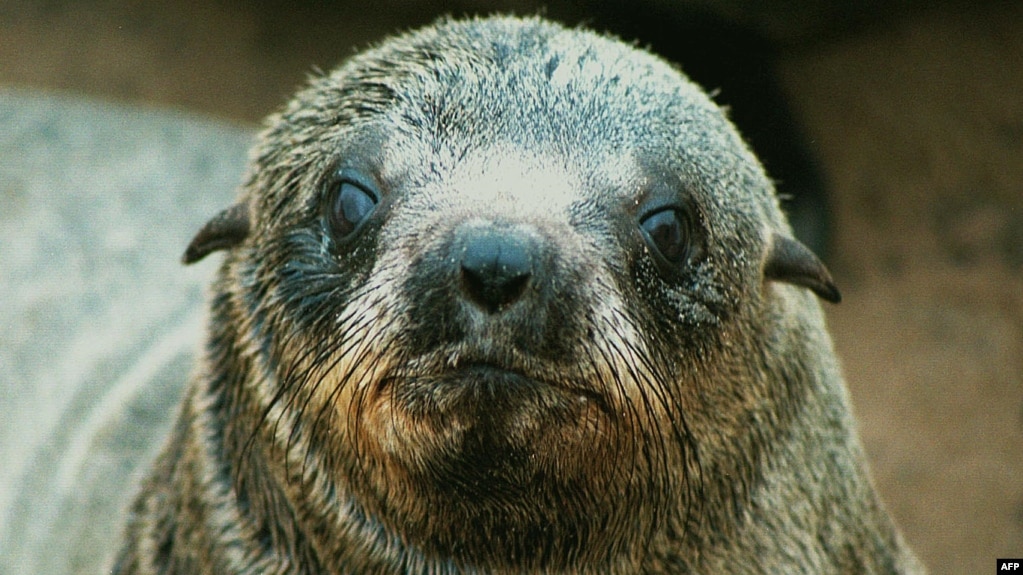
FILE – A Namibian Cape fur seal pup is pictured at a seal reserve 430 kilometers west of Windhoek. Namibia’s Ministry of Fisheries has issued a quota for the harvesting of 80,000 pups and 6,000 bulls in the harvesting season that begins July 1, 2023.
Share
Print
WINDHOEK, NAMIBIA —
This year’s Cape fur seal culling along Namibia’s coastline is set to begin July 1 – a harvest that’s done onshore for population control.
The seal population, according to the country’s Ministry of Fisheries and Marine Resources, stands at 1.6 million and is made up of 26 colonies. The ministry has issued a quota for the harvesting of 80,000 pups and 6,000 bulls this year.
The annual harvest is usually met with controversy because of the methods used in the culling of seals. Pups are clubbed over the head, while the bigger…
On the title photo – action in memory of murdered antifascists in Moscow, 2015.
The antifascist movement emerged in Russia in the late 1990s – early 2000s as a response to neo-Nazis’ violence: back then, the far-right was attacking migrants, homeless people, punks and anyone they didn’t like almost daily.
Over the past couple of decades, the movement has changed significantly, having gone through murders of its participants, numerous criminal cases and now a split due to the war. Radio Svoboda (RS) recountsthe story of Russian antifa. Author: Yana Sakhipova.
“Glory to Russia” – says a man in military uniform and raises a bottle of beer, while the band Klowns performs on stage under the flags of the so-called “DPR” and “LPR”. The musicians came to Donetsk in January of 2023 – as they claim, to do “a good deed” for the people that “have lived in cultural isolation” for the past nine years.
A significant part of the visitors are military men.
Klowns was one of the first and most popular antifascist bands in Russia. Now, only Sergei is left from the original lineup. And he doesn’t count himself as a member of antifa anymore. “I want Russia to be integral, so that Maidan wouldn’t be repeated here” – he says.
In three months and a hundred kilometers from Donetsk, in Bakhmut, the Russian antifascist and anarchist Dmitri Petrov will die while fighting on the Ukrainian side. “As an anarchist, revolutionary and Russian, I felt it necessary to take part in the armed resistance of Ukrainians against Putin’s occupants” – Petrov wrote in a letter he commanded to be published after his death. “I did it for the sake of justice, protection of Ukrainian society and of liberation of my own country – Russia- from oppression. For the sake of all the people, whom a heinous, totalitarian system, formed in Russia and Belarus, deprives of dignity and opportunity to breath freely”. .
Even before February 2022, it would be difficult to call the Russian antifascist movement unitary. The full-scale war in Ukraine though literally scattered antifascists on different sides of the front. But it started very differently.
The 2000s
In 2002, the 13-year-old Inessa Dymnich went to a concert for the first time – the band was “Tarakany!”. At that time, Inessa was not interested in politics – she just liked punk rock. Before one of the following concerts, bottles flew against Inessa and people walking next to her, smashing against a wall above their heads. Back then this was becoming commonplace: concerts were regularly attacked by fascists.
Under the threat of an attack were performances of bands of various genres – from punk and hardcore to reggae and rap. An antifascist movement as such didn’t exist yet and the concerts often didn’t have a political orientation: the far-right simply didn’t like punks and representatives of other subcultures. Attacks were occurring not only in the clubs but also on the way to them.
“While on the bus, heading to the concert, you had to be constantly on the watch for what’s going on, if there are any individuals dressed like the far-right. You could be attacked on your way out of the bus, at any passage.
You were going out with a feeling that you’re waking into a fighting pit. You never knew what could be thrown at you on the way – a bottle, a stone, a fist. A part of people found themselves in antifascism because they were simply fed up constantly getting jumped on at concerts” – recounts Inessa.
People had to walk from the metro in groups, while we were learning about the concerts by word of mouth: public announcements were too dangerous.
This was not saving us from regular attacks and concert goers had to defend themselves by engaging in clashes with the Nazis – that way, gradually, a subcultural antifascist movement started to form.
With time, antifascists started organizing the security of events.
“We used to gather people near the metro station with our security group. Those who had traumatic pistols were surrounding this crowd and were leading them to the club. If someone walked away alone to the bathroom or to a shop, he could be killed” – says Shura, an antifascist who was involved in the security of concerts.
“Back then, when someone was coming to a concert without a gun everyone was looking at him in bewilderment: are you immortal?”
After a while Inessa also got involved in the security of concerts. She started getting interested in the ideological component of antifascism, as well – she found unacceptable the fact that some distinguish people on the basis of their nationality and looks, while the attacks on migrants and homeless were happening almost daily.
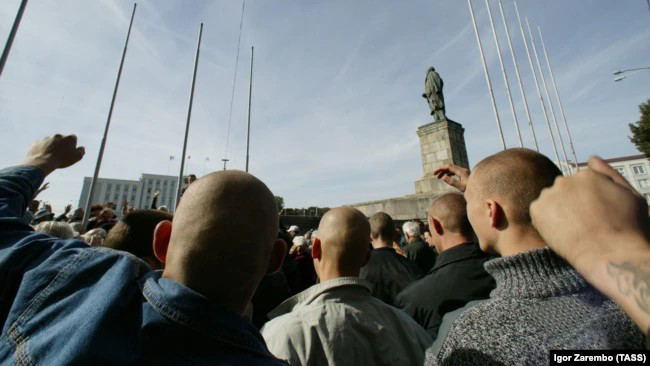
ç (Photo) Neo-Nazis at the rally “in defense of Russians rights”, 2004
The concept of antifascist resistance emerged at the beginning of 20th century in Italy and Germany, that back then were rapidly moving towards fascism and Nazism.
In 1970-1980s, when in the post-war world the far-right started gaining power again, the antifascist movement was also reborn. Similarly, to the far-right, the new antifascist were not only a political movement but also a subculture, closely related to music and style – yet based on certain ideological principles.
In that form the antifascist movement, or antifa, arrived in Russia about 30 years later.
In high school Inessa was writing slogans of the sort “Liberty, equality and fraternity”, “Against sexism and homophobia”, “Animal rights” on the margins of her notebook.
This photo shows fishermen on May 22 protesting on Jeju Island against the anticipated discharge of wastewater from the Fukushima Daiichi Nuclear Power Plant. (Yonhap)
A type of radioactive isotope in the over 1.3 million tons of wastewater being collected at the destroyed Fukushima nuclear power plant and planned for discharge by as early as this summer has been found at levels beyond those earlier suggested to be safe by the Japanese government, a wastewater safety review report by the International Atomic Energy Agency showed Thursday.
The finding has raised the need to ensure the treated wastewater is diluted before it is discharged, so that the wastewater discharge might potentially be of little harm to neighboring countries including South Korea.
According to the report, which corroborated analyses of the treated wastewater by six laboratories including the Korea Institute of Nuclear Safety, the activity concentrations of tritium in the treated water were estimated to be at least 148,900 becquerels per liter.
The wastewater filtered through Japan’s Advanced Liquid Processing System at the Fukushima Daiichi Nuclear Power Station contained more tritium than what was stipulated in Japan’s national regulatory standards for discharge, 60,000 becquerels per liter.
This figure is in line with expectations that tritium is one of the two radioactive elements — along with carbon-14 — that is hard to remove through the filtering process at the quake- and tsunami-hit Japanese power plant, which suffered multiple reactor meltdowns in 2011. According to a government official on condition of anonymity, the figures for the concentrations of radionuclides in the IAEA report are for the treated wastewater before dilution.
Tritium is one of the 28 types of radionuclides included in the earlier radiological environmental impact assessment by plant operator Tokyo Electric Power Company. Of them, 12 radionuclides were detected in the treated wastewater in at least two out of six participating laboratories — from the United States, Austria, Switzerland, France, Korea and Japan.
The IAEA report also included 58 additional types of radionuclides beyond what was included in the earlier TEPCO assessment, none of which were detected “at significant levels,” according to the IAEA report.
Nuclear Safety and Security Commission Chairperson Yoo Guk-hee briefs reporters on the site visit of Korea’s inspection team of the wastewater treatment facilities of the Fukushima Daiichi Nuclear Power Plant on Wednesday. (Yonhap)
The findings, however, are not likely a point of concern if Japan dilutes the treated water to have 1,500 becquerels or less per liter of tritium as planned, two Korean experts said.
Given that the average concentration of tritium in the wastewater before treatment stood at 620,000 becquerels per liter as of 2021, the latest figure indicates a reduced level of concentration in the wastewater post-treatment, said Joo Han-gyu, president of the Korea Atomic Energy Research Institute.
The treated wastewater “has a reduced concentration of radionuclides — except for tritium — to meet legal standards,” said Jeong Yong-hoon, a nuclear and quantum engineering professor at the Korea Advanced Institute of Science and Technology, adding that diluting the treated wastewater should reduce the concentration of tritium and other nuclides.
The dilution facility was one of the subjects of the inspection by a team of 21 Korean nuclear experts led by Nuclear Safety and Security Commission Chairman Yoo Guk-hee the previous week.
Yoo has declined to reveal the team’s full inspection results, saying that it will take more time to acquire more data and review its findings, in a briefing held Wednesday. But he said the team “confirmed the sea water pump is installed properly to meet the goal of dilution with adequate capacity.”
Meanwhile, the IAEA report also identified inconsistencies between the laboratories in terms of the sample assessment results for three out of the 28 types of radionuclides, including Iodine-129. The results for this radioactive isotype by multiple laboratories could not be agreed on with a high level of confidence.
Seeing it the other way around, this means that the six participating laboratories evaluated 98 percent of the nuclides at a 99.7 percent confidence level, according to the IAEA.
Such inconsistencies “would cause little trouble for (IAEA’s) assessment,” Jeong said.
This photo shows a group of Korean experts inspecting the wastewater treatment facilities at the Fukushima Daiichi Nuclear Power Plant on May 24. (Tokyo Electric Power Co.)
Lim Seung-cheol, secretary general of Nuclear Safety and Security Commission, told reporters Thursday it is “premature to make an assessment on the (quality of the) treated wastewater,” given that two more follow-up assessments by the IAEA are up and coming.
This most recent tentative assessment came amid concerns about the health impacts of long-term, low-dose exposure to tritium as a result of Japan’s multi-decade plan to release the wastewater into the sea. Minor progressive Jinbo Party leader Yoon Hee-sook said in a statement Wednesday that the Korean inspection team that visited the treatment facilities has failed to address the “biological threat two times more serious than cesium” that the wastewater discharge plan could cause. The final assessment by IAEA is poised to be announced later in June.
The antifascist movement emerged in Russia in the late 1990s – early 2000s as a response to neo-Nazis’ violence: back then, the far-right was attacking migrants, homeless people, punks and anyone they didn’t like almost daily.
On the title photo – action in memory of murdered antifascists in Moscow, 2015.
Over the past couple of decades, the movement has changed significantly, having gone through murders of its participants, numerous criminal cases and now a split due to the war. Radio Svoboda (RS) recountsthe story of Russian antifa. Author: Yana Sakhipova
“Glory to Russia” – says a man in military uniform and raises a bottle of beer, while the band Klowns performs on stage under the flags of the so-called “DPR” and “LPR”. The musicians came to Donetsk in January of 2023 – as they claim, to do “a good deed” for the people that “have lived in cultural isolation” for the past nine years.
A significant part of the visitors are military men.
Klowns was one of the first and most popular antifascist bands in Russia. Now, only Sergei is left from the original lineup. And he doesn’t count himself as a member of antifa anymore. “I want Russia to be integral, so that Maidan wouldn’t be repeated here” – he says.
In three months and a hundred kilometers from Donetsk, in Bakhmut, the Russian antifascist and anarchist Dmitri Petrov will die while fighting on the Ukrainian side. “As an anarchist, revolutionary and Russian, I felt it necessary to take part in the armed resistance of Ukrainians against Putin’s occupants” – Petrov wrote in a letter he commanded to be published after his death. “I did it for the sake of justice, protection of Ukrainian society and of liberation of my own country – Russia- from oppression. For the sake of all the people, whom a heinous, totalitarian system, formed in Russia and Belarus, deprives of dignity and opportunity to breath freely”.
Even before February 2022, it would be difficult to call the Russian antifascist movement unitary. The full-scale war in Ukraine though literally scattered antifascists on different sides of the front. But it started very differently.
The 2000s
In 2002, the 13-year-old Inessa Dymnich went to a concert for the first time – the band was “Tarakany!”. At that time, Inessa was not interested in politics – she just liked punk rock. Before one of the following concerts, bottles flew against Inessa and people walking next to her, smashing against a wall above their heads. Back then this was becoming commonplace: concerts were regularly attacked by fascists.
Under the threat of an attack were performances of bands of various genres – from punk and hardcore to reggae and rap. An antifascist movement as such didn’t exist yet and the concerts often didn’t have a political orientation: the far-right simply didn’t like punks and representatives of other subcultures. Attacks were occurring not only in the clubs but also on the way to them.
“While on the bus, heading to the concert, you had to be constantly on the watch for what’s going on, if there are any individuals dressed like the far-right. You could be attacked on your way out of the bus, at any passage.
You were going out with a feeling that you’re waking into a fighting pit. You never knew what could be thrown at you on the way – a bottle, a stone, a fist. A part of people found themselves in antifascism because they were simply fed up constantly getting jumped on at concerts” – recounts Inessa.
People had to walk from the metro in groups, while we were learning about the concerts by word of mouth: public announcements were too dangerous.
This was not saving us from regular attacks and concert goers had to defend themselves by engaging in clashes with the Nazis – that way, gradually, a subcultural antifascist movement started to form.
With time, antifascists started organizing the security of events.
“We used to gather people near the metro station with our security group. Those who had traumatic pistols were surrounding this crowd and were leading them to the club. If someone walked away alone to the bathroom or to a shop, he could be killed” – says Shura, an antifascist who was involved in the security of concerts.
“Back then, when someone was coming to a concert without a gun everyone was looking at him in bewilderment: are you immortal?”
After a while Inessa also got involved in the security of concerts. She started getting interested in the ideological component of antifascism, as well – she found unacceptable the fact that some distinguish people on the basis of their nationality and looks, while the attacks on migrants and homeless were happening almost daily.
ç (Photo) Neo-Nazis at the rally “in defense of Russians rights”, 2004
The concept of antifascist resistance emerged at the beginning of 20th century in Italy and Germany, that back then were rapidly moving towards fascism and Nazism.
In 1970-1980s, when in the post-war world the far-right started gaining power again, the antifascist movement was also reborn. Similarly, to the far-right, the new antifascist were not only a political movement but also a subculture, closely related to music and style – yet based on certain ideological principles.
In that form the antifascist movement, or antifa, arrived in Russia about 30 years later.
In high school Inessa was writing slogans of the sort “Liberty, equality and fraternity”, “Against sexism and homophobia”, “Animal rights” on the margins of her notebook.
Por Alberto Pinzón Sánchez. El triunfo aplastante de la extrema derecha Pinochetista en las elecciones de este 07 de mayo/ 23 en Chile, con todas las futuras consecuencias que traerá no solo para la sociedad chilena, sino para el conjunto de los pueblos latinoamericanos actualmente en lucha por quitarse el secular yugo de opresión y […]
Biden’s son Hunter was a board member of Burisma and also allegedly in on the scheme [Gary Varvel / The Week, 2019] EXCLUSIVE: President Joe Biden was allegedly paid $5 million by an executive of the Ukrainian natural gas firm Burisma Holdings, where his son Hunter Biden sat on the board, a confidential human source told […]












 The Free