
‘How will I give birth?’: Dangers of a Gaza pregnancy amid Israeli Genocide bombing
from thefreeonline on 2nd Nov 2023 by Linah Alsaafin and Ruwaida Amer at Al Jazeera

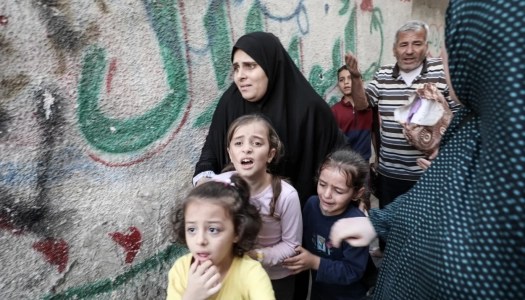
A Palestinian woman holds her children at Al-Shifa Hospital in Gaza City on October 23, 2023, after an Israeli air strike wounded the family [Mohammed Al-Masri/Reuters]
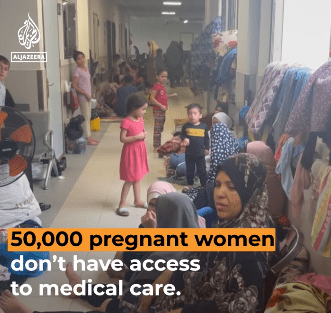
Gaza has 50,000 pregnant women who lack treatment, access to doctors and adequate healthcare centres.
Khan Younis, Gaza Strip – Niveen al-Barbari is terrified for her unborn child. With every Israeli air attack near her, the 33-year-old’s back and stomach convulse with fear and pain.
Before the Israeli offensive began on October 7, al-Barbari regularly visited a specialist because she has gestational diabetes and high blood pressure. But the bombings forced her to seek shelter in her family’s home, and she lost contact with her doctor.
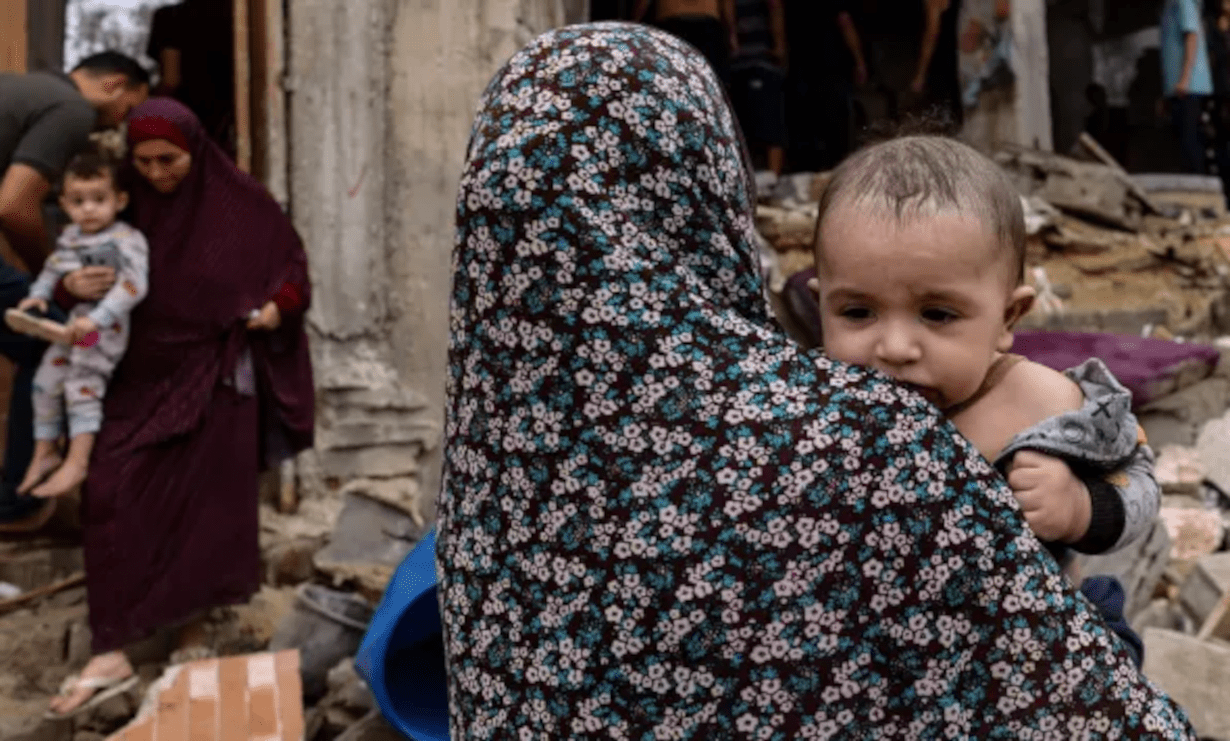
“Every day,” she said, “I wonder how I’ll give birth and where. The bombs don’t stop, and no human, tree or stone has been spared. We don’t know whose house will be destroyed or who will die. I just hope me and my child are safe.”
Al-Barbari is due to give birth to her first child this month, one of thousands of women in the Gaza Strip nearing the end of their pregnancies.
According to the United Nations Population Fund (UNPF), there are 50,000 pregnant women in the besieged territory, many suffering from a lack of regular check-ups and treatment because Gaza’s healthcare system is on the brink of collapse due to the siege imposed by Israel on the territory. Last week, the UNPF called for “urgent health care and protection” of the pregnant women.
“All these images of babies and children under the rubble of their homes or lying in hospital with injuries makes me very scared for my baby,” al-Barbari said. “Every day I pray for the war to end in order to save my child from these missiles that have no mercy on anyone.”
According to Walid Abu Hatab, a medical consultant in obstetrics and gynaecology at the Nasser Medical Complex in Khan Younis, access to health centres has become very difficult, especially in light of the mass internal displacement of half the Gaza Strip’s 2.3 million people over the past two weeks.
“There are women who have been displaced from their places of residence to other areas, which means changing the health centres which had previously monitored their condition,” he told Al Jazeera. “This makes access to them very difficult for them as they need primary care and follow-up sessions during the various periods of pregnancy.”
The displaced people, most of whom left northern Gaza and Gaza City for the south due to Israeli bombardment of residential areas, are staying with relatives, friends or at overcrowded UN-run schools, which Abu Hatab described as being mired in a “health and environment disaster”.
“This may lead to cases of poisoning due to the unclean environment in the shelter centres,” he said.

Fatigue amid displacement
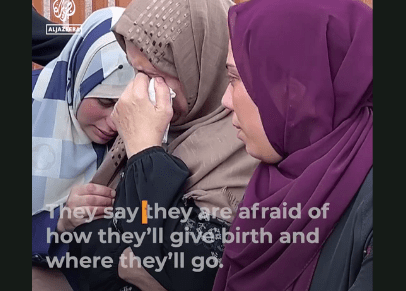
For Suad Asraf, who is six months pregnant with her third child, her own displacement from the Shati refugee camp in Gaza City to a UN school in the southern city of Khan Younis has taken a toll on her, and she suffers from extreme fatigue.
“I am tired from the lack of sleep and fear,” the 29-year-old said. “I have to take care of my two other children, but this shelter school has no clear water. I’m forced to drink saltwater, and I cannot stand it, and it also affects the pregnancy pressure I have.”

Asraf wants to know if she and her unborn child are OK, especially after the terror she experienced. She tried to contact the UN health centre at the Shati camp numerous times on the phone but has not managed to get through once.
There isn’t proper nutrition or care for her, and as a result, she always feels tired and nauseous. The schools are severely overcrowded and loud, and she cannot close her eyes for more than 30 minutes.
“There are also three pregnant women here, and their condition is similar to mine,” Asraf said. “Two days ago, one of them lost consciousness, and we tried to help her.”
Fear of losing a child
Some women who became pregnant after many painful IVF cycles are worried that they will miscarry.
Laila Baraka, 30, is three months pregnant after a successful round of IVF following years of trying for a second child.
“All day, I’m scared of the sound of bombings, and at night, it is even more intense and terrifying,” she said. “I hug my five-year-old son close as I try to swallow my fear, but I cannot. What we hear terrifies stones, not just humans.”
Baraka, who is from Bani Suhaila, a town east of Khan Younis, moved to the centre of the bigger city thinking it would be safer. But the health centre she had gone to before is not responding to her calls after residents in the eastern area close to Israel’s border fence have all fled.
“Even my doctor has been displaced from his home and communicating with him is very difficult,” she said. “I’m lucky that my mother is constantly by my side and is trying in her own way to make me feel reassured and less stressed.”
But that hardly works for Baraka, who feels exhausted from grieving over the images and footage of dead children on the news.
“I can’t imagine, as a woman myself, being faced with that kind of choice, where you’re trying to bring life in this world, bring joy, a new family member – and yet you’re traumatised, you’re fearful for yourself, for your child,”
More than 8,000 Palestinians have been killed in Israeli attacks on Gaza since October 7, two-thirds of them children and women.
The hardest moment for Baraka was watching a doctor on TV seeing his baby grandchild, who was killed in an Israeli air strike and was born this year after five years of IVF treatments.
“Can you imagine this is the fate of our children?” she said. “What the mothers of Gaza experience can never be described.”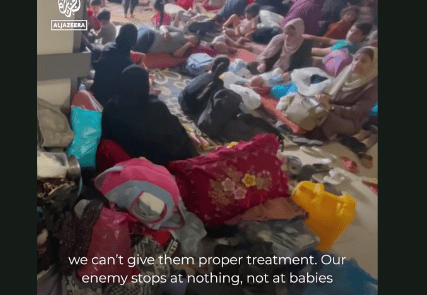
Lack of treatment, access to health centres
The destruction of the Gaza Strip’s main roads have increased the amount of time it takes for pregnant women to reach the few functional hospitals to give birth. A journey that would take only a few minutes by car can now take hours, putting the health of mothers at severe risk.
“An operation was performed on a woman the other day who was due to give birth and had severe bleeding,” Abu Hatab said. “She was on the road for two hours trying to make it to the Nasser Medical Complex. After several attempts, we managed to control the bleeding and saved her life.”
Israel has continuously threatened to target hospitals and repeatedly called on hospital staff and the tens of thousands of displaced Palestinians taking refuge at medical facilities to evacuate. Medical staff have refused to do so, pointing to the impossibility of moving their patients.
According to the Palestinian Family Planning and Protection Association, more than 37,000 pregnant women will be forced to give birth with no electricity or medical supplies in Gaza in the coming months, risking life-threatening complications without access to emergency obstetric services.
“I received dozens of calls from pregnant women telling me that they were unable to reach health centres to provide them with treatment such as insulin and treatment for blood thinning for those with heart disease,” Abu Hatab said. “The lack of access to healthcare and treatment puts their lives in danger and may lead to death, and this is what we are mainly concerned about.”
That choice, says Laila Baker of the UN Population Fund (UNFPA), is to “risk whatever delivery comes in the place where they reside and risk bombardment, or try to make it to one of the barely functioning health facilities”.
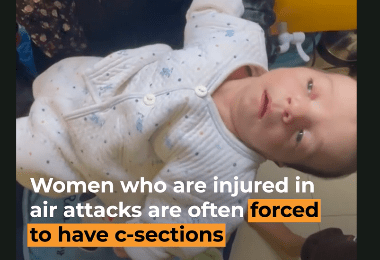
But those facilities are “overcrowded [and] unhygienic”, Baker told Al Jazeera, and if the women require a c-section, “the anecdotal evidence coming in right now has been that many of those have been without an anesthesia”.
UNFPA estimates that there are 50,000 pregnant women in the Gaza Strip, including approximately 5,500 who are due to give birth in the next 30 days.
UN rights committee calls for protection of Palestinian children
The UN’s child rights committee has called for an immediate ceasefire, saying there were “no winners in a war where thousands of children are killed”.
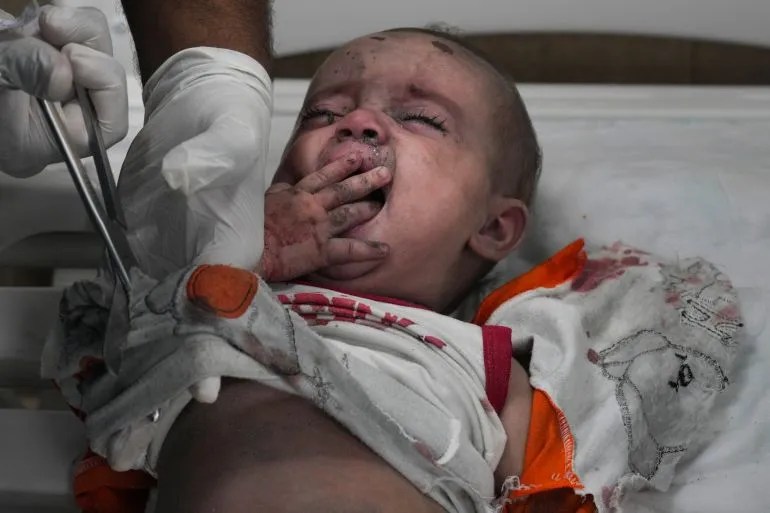
Palestinian child wounded in Israeli bombardment is treated in a hospital in Deir al Balah [Hatem Moussa/AP Photo]
“The committee calls for an end to the devastating harm being wreaked on children’s lives in the occupied Palestinian territory,” the independent committee, which monitors countries’ adherence to the UN Convention on the Rights of the Child, said in a statement.
“We add our voice to those calling for an immediate ceasefire. We urge the immediate release of child hostages, with their caregivers,” the committee said.
Both Israel and Palestine are parties to the Convention on the Rights of the Child.

 The Free