A controversial movie about a UK political leader is enjoying unprecedented success online, prompting the question: Did Gaza cause Jeremy Corbyn film to go viral? A controversial film about former UK Labour Party leader Jeremy Corbyn has gone viral. Oh Jeremy Corbyn – The Big Lie, which claims Corbyn was targeted by a coordinated campaign […]
Por Hedelberto López Blanch* | 15/04/2024 | Venezuela Ciertamente que ha sido enorme el apoyo brindado por los gobiernos de Occidente y de los grandes medios de comunicación hegemónicos para tratar de denostar las elecciones presidenciales que tendrán lugar en Venezuela el próximo 28 de julio.
The news should have stopped us in our tracks. Astonishingly, however, it was scarcely reported here. The latest map of mental wellbeing published by the Global Mind Project reveals that, out of the 71 countries it assessed, the United Kingdom, alongside South Africa, has the highest proportion of people in mental distress – and the second worst overall measure of mental health (we beat only Uzbekistan). Mental wellbeing has plummeted in the UK further than in any comparable nation. How was this not headline news?
More importantly, why has it happened? The Global Mind Project blames smartphones and ultra-processed food. They doubtless play a role, but they’re hardly peculiar to the UK. I think part of the reason is the sense that life here is, visibly and obviously, spiralling backwards.
There was a time when almost everyone in the UK believed the following promises. That a rising economic tide would lift all boats. That everybody would have a good home. That drudge work would diminish and jobs would become more interesting. That we would enjoy greater economic security and more leisure time.
That educational attainment would keep rising across all social classes. That our healthcare and health would inexorably improve. That the UK would become ever cleaner and greener. That governance and democratic engagement would get better by the year.
We could easily have had all of these things. A vast amount of money has flushed through this country. Science has advanced by leaps and bounds; health and labour-saving technologies have greatly improved; we know exactly how to build good homes, treat sewage and improve democracy.
Instead (literally, in the case of our rivers) almost everything has gone to shit. The five giant evils identified in 1942 by William Beveridge, who helped design the welfare state, have returned with a vengeance. He called them “want, disease, ignorance, squalor and idleness”. His paternalistic language translates today into poverty, morbidity, educational exclusion, wretched housing and crumbling infrastructure, and bad employment or an inability to work.
As they come thundering back, the five evil giants have brought some friends to the party: environmental chaos, extreme political dysfunction and misrule, impunity for the powerful and performative cruelty towards the powerless, and state-sponsored culture wars to distract us from the rest of the horror show.
There is a chance that around five billion people will die in just 72 hours in the event of nuclear war.
Though I’m sure you read the headline beforehand and are well prepared for some depressing insight into the future of humanity.
In this case, we have Annie Jacobsen to thank, an investigative journalist, New York Times bestselling author, and a 2016 Pulitzer Prize finalist.
The 56-year-old from Connecticut, US, has spent years researching the possible effects of nuclear war and she claims that there are only two countries where you might, I repeat, might survive.
The reason being that nuclear attacks would cause a thick smoke from burning fires to spread across the three continents, ultimately causing a mini ice-age.
This would most likely kill five billion of the eight billion people on earth within 72 hours.
She explained on Steven Bartlett’s Diary Of A CEO podcast: “Most of the world, certainly the mid-latitudes would be covered in sheets of ice …places like Iowa and Ukraine would be just snow for 10 years.
“Agriculture would fail, and when agriculture fails people just die.
“On top of that you have the radiation poisoning because the ozone layer will be so damaged and destroyed that you couldn’t be outside in the sunlight – people will be forced to live underground.”
Jacobsen said that Professor Brian Toon, a leading expert on climate and atmospheric science, told her that only two countries could potentially survive a nuclear winter – New Zealand and Australia, who can ‘sustain agriculture’.
The expert also opened up about the story of former US Secretary of Defence Bill Perry and the idea of a nuclear war happening by accident.
“He was on the night watch during the Carter Administration … he was told by the National Military Command Centre, which is the bunker beneath the Pentagon, that there were ballistic missiles on the way from Soviet Russia,” she said.
“This was confirmed by the nuclear bunker beneath Offutt Air Force Base in Nebraska the STRATCOM (Strategic Command) bunker.
“Not only were intercontinental ballistic missiles flying at the United States but there were sub-launched ballistic missiles coming at the United States. It was a massive motherlode of warheads.
“Within a matter of minutes he got word that it was a mistake – how does a mistake like that happen?
“What he told me was that there was a VHS tape of a simulated attack by the Soviet Union against the United States and the VHS tape had mistakenly been inserted into a machine in the nuclear bunker beneath the Pentagon and because it is linked to STRATCOM it was seen in both places.
Perry said to me it looked real because it was meant to look real.”
By Adongo Ogony May 18, 2024 Kenya’s Haiti Deployment Faces New Court Challenge The Thirdway Alliance Kenya led by Dr Ekuru Aukot has filed a new lawsuit seeking to prevent the government from sending police to violence-plagued Haiti as part of a UN-backed mission.
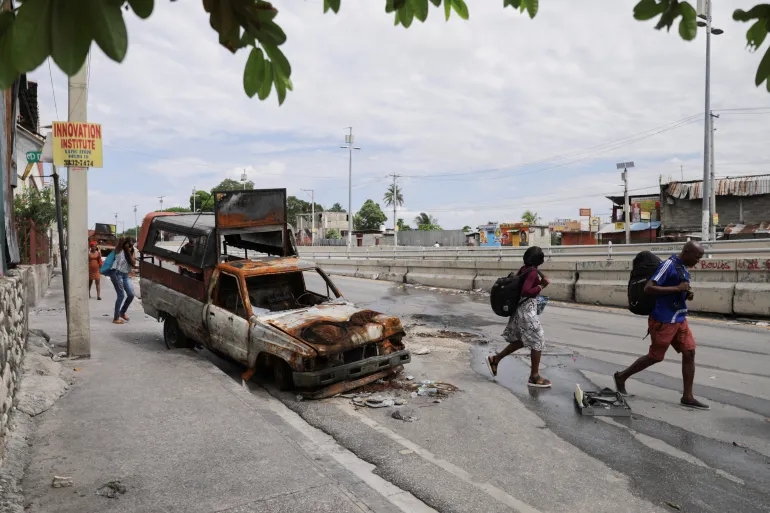
UN urges US to stop forced returns to Haiti after latest deportation fligh Haitians may face ‘life threatening risks’ and further displacement if returned to Haiti, UN refugee agency says... .. photo: Residents of the Lower Delmas area carry their belongings as they flee their homes due to gang violence, in Port-au-Prince, Haiti
Dr Aukot and Miruru Waweru lodged the complaint on Thursday, arguing that the government had “blatantly disregarded” a January court order prohibiting the deployment as unconstitutional and illegal.
The lawsuit said that its petitioners were “reliably informed” that the Kenyan deployment may take place no later than May 23, “hence the urgency of this application”.
Haiti has suffered from poverty, political instability and natural disasters for decades, and the UN-backed multinational force — to be led by Kenya — has been tasked with helping its beleaguered police rein in criminal gangs.
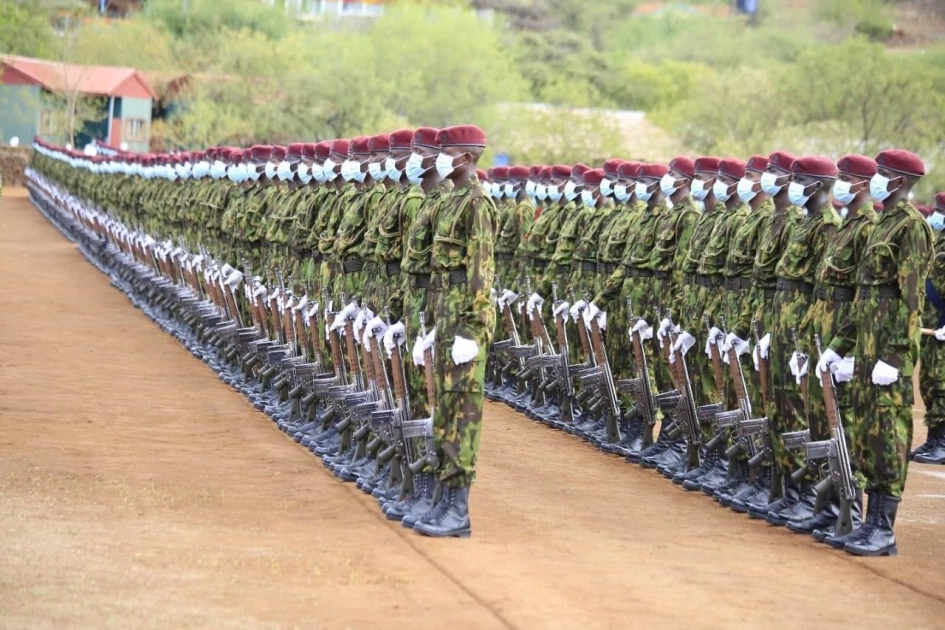
The expected deployment of a first batch of Kenyan police to the Caribbean nation would coincide with a visit by President William Ruto to Washington where he will meet US President Joe Biden on May 23.
A Haitian source had told AFP in early May that a first contingent of 200 Kenyan police were expected by that date.
The Kenyan government has not publicly commented on the date, but an interior ministry source told AFP they could arrive by next Tuesday.
Kenya pledged last July to deploy up to 1,000 personnel to Haiti, an offer welcomed by the United States and other nations that had ruled out putting their own forces on the ground.
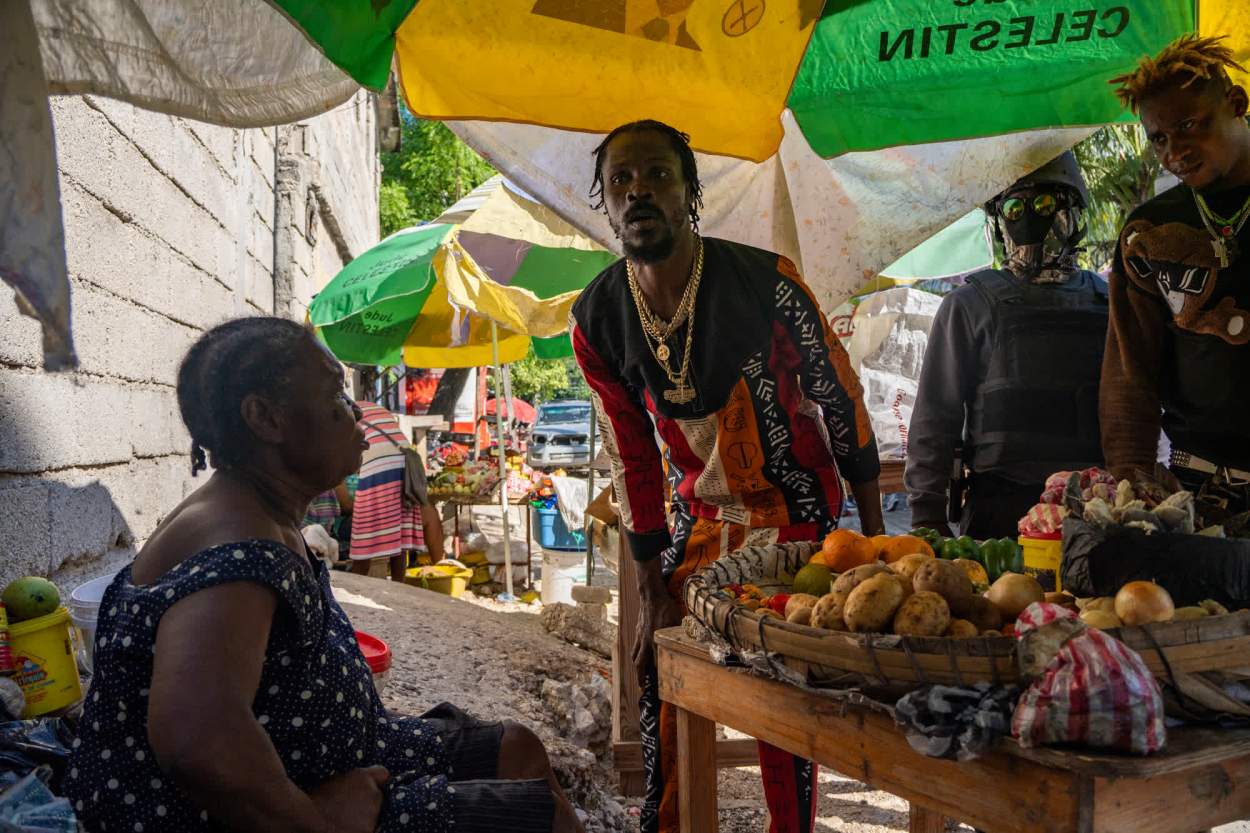
Photos offer rare glimpse into Haitian gangland
Story and photographs by Evelio Contreras, CNN Published April 30, 2024
Note> CNN is a mouthpiece of the US regime, with its 750 foreign military bases, and largely responsible for the continuing struggle in Haiti. In other analyses we have read that several of the “gangs” are authentic revolutionary movements. Below may be a nice photo essay, but the text is edited by CNN.
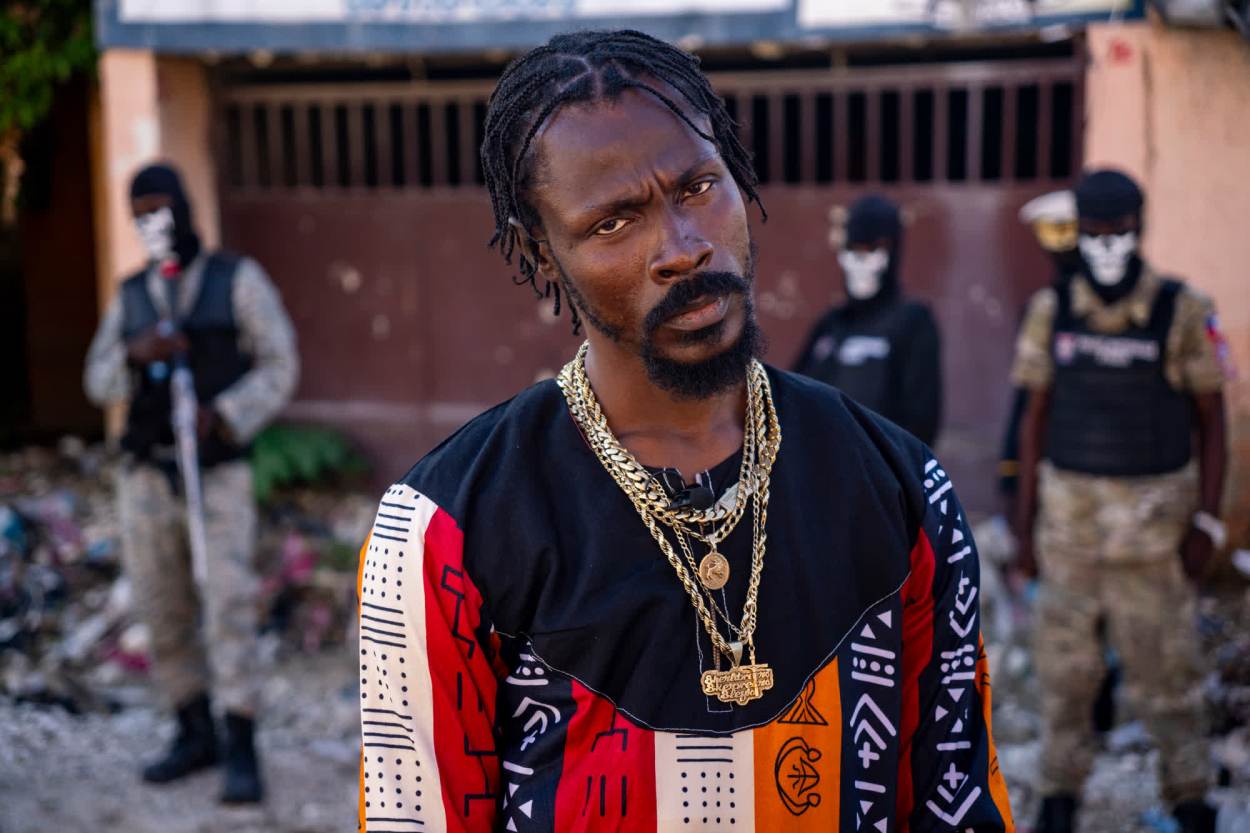
Gang leader Vitel’homme Innocent poses for a photo in the Tabarre district of Port-au-Prince, Haiti.
Soft spoken and direct, Vitel’homme Innocent, who is on the FBI’s “Ten Most Wanted List,” answered our phone calls over WhatsApp to say he would promise CNN safe passage into his gangland territory in Port-au-Prince, Haiti.
Port-au-Prince, Haiti’s capital, in March.
It was my second trip in as many months to the Haitian capital, working as a photographer with Senior National Correspondent David Culver and Senior Editor Caitlin Hu, after gang attacks brought the country’s international airport and main seaport to a standstill, effectively shutting down the city.
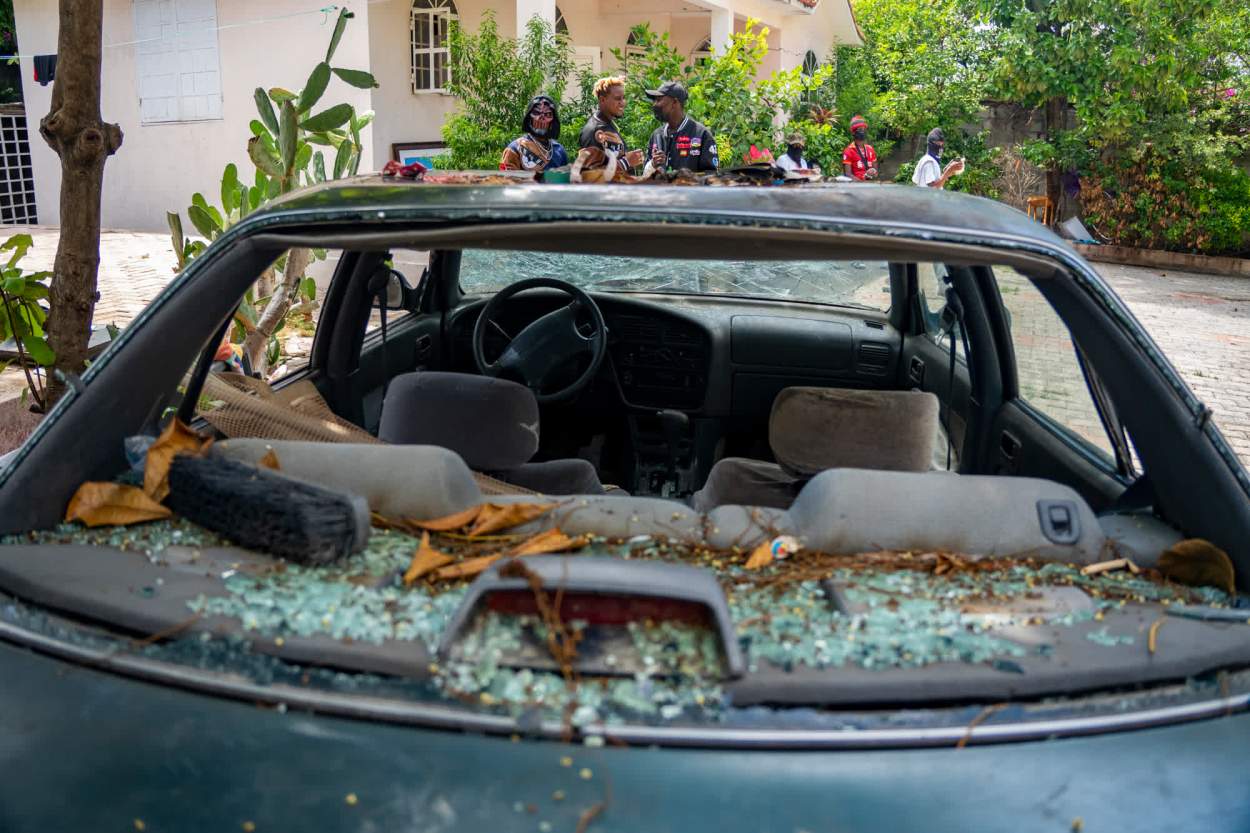
A wrecked car is next to the pool of the house where a CNN crew met Innocent in Port-au-Prince.
Innocent is the leader of a gang called Kraze Baryé, which controls a handful of neighborhoods near the US Embassy. He is accused of kidnapping US citizens in 2021 and in 2022, allegedly causing the death of an elderly American woman.
On the day of our meet, we waited on an empty road outside Innocent’s territory for one of his men to take us in.
We didn’t know what would happen next, so I wanted to capture everything.
The reporters are trying to figure out what is going on behind the scenes. Two of the stories rely on an anonymous source, a female resident of the Kharkov Oblast who secretly sends eye-witness reports to the Russian news outlet RIA.
According to this source: While the local population is split in their loyalties, a certain proportion of them are waiting, and hoping, for the Russian army to arrive. This is the main reason why they are resisting evacuation orders and remaining in their homes.
She notes that the local authorities are disorganized; and that whatever evacuations they do organize are rather haphazard.
There is actually no official process, all they do is just ineffectually urge the locals to leave. Systems have broken down, for the most part.
On this note, I have seen propaganda clips on the NATO mainstream channels like BBC, ABC News, etc, showing scenes of residents and their dogs climbing into buses, terrified old ladies being assisted by kindly Kraken soldiers, etc.
Even those sources eventually get down to admitting that the numbers of evacuated are more like in the hundreds than thousands.
According to SILA, the official Ukrainian number is only 970 people total, evacuated by the authorities from the Kharkov Oblast.
Everybody else either left ontheir own means, or decided to stay.
According to this eyewitness, those who are able and have the means, mostly head for Poltava. Those who want to stay, just hunker down and wait for the Russian army to arrive.
Ukrainian Soldiers Drinking Too Much
According to this same anonymous source, Ukrainian soldiers that she sees in her region of Kharkov, have started to drink too much and are basically drunk all the time.
This alcohol makes them even more aggressive than they were before. Some of them have started threatening to march on Kiev and overthrow the government.
“There are fewer of them than before,” the eyewitness reports, “and they are retreating all the time. Some of them have started to dig defensive trenches out in the fields. Earlier they used to forcibly quarter themselves inside our homes.”
She herself was forced, at one point, to lodge six Ukrainian soldiers in her home. She learned later that only three of them have survived. The soldiers that she sees in her area took terrible, they look like ragtag impoverished beggars roaming the streets like lost cats.
Their officers have fled, and nobody is there to take care of these young men.
Border Detachment Officer Saved From Blocking
The next story, by reporter Alyona Zhilina, is about a Ukrainian Officer named Lyubimir Gorokhonenko, whose life was saved by Russian soldiers in Volchansk. Gorokhonenko is the Deputy Commander of a Ukrainian border detachment operating on the Russo-Ukrainian border. Stationed in the northern part of Volchansk, his unit came under heavy Russian artillery fire.
He radioed in to the Ukrainian command, requesting an automobile for evacuation.
His request was refused. Together with his remaining troops, Gorokhonenko decided to evacuate on foot. They were attacked by Ukrainian “blocking troops” trying to stop them from retreating.
Gorokhonenko himself took bullets in his arms and legs. As he lay there wounded along the side of the road, he was eventually spotted by Russians soldiers driving by in a car.
He waved to the car, and they stopped for him. After he surrendered to the Russians they took him back to their position, gave him the medical treatment he needed, and also fed him a meal.
On the media level western reports are cryingf pabic rthatr evil Ryussia is aiming to seoze karekov. However reliable Telegram analysts and later Russian MoD said only 15% of available troops had attacked in small groups. Even the BBC reported the Russians “just walked in” because the contracted Defense Line was MISSING, the funds having been stolen.
The consensus was that the Russians kept going further than intended but there is no sign yet of a Grand Offensive.
https://www.naturalnews.com/2024-05-16-90percent-population-heart-syndrome-spike-protein-damage.html Ethan Huff 05/16/2024 New research is shaking up the medical establishment with data showing that an astounding 90 percent of the United States population now suffers from a heart condition that in many ways looks like spike protein organ damage from Wuhan coronavirus (COVID-19) “vaccines.” Last October, the American Heart Association (AHA) published a report about […]










 The Free