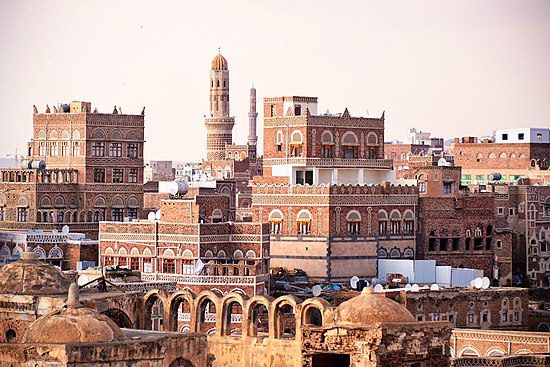
Senior Yemeni military offficials say there are plans to initiate a significant aerial assault on the Yemeni mainland.
Yemen Braces For Impending Massive US-Led Air/Ground Campaign

Senior Yemeni military offficials say there are plans to initiate a significant aerial assault on the Yemeni mainland.
Yemen Braces For Impending Massive US-Led Air/Ground Campaign
from thefreeonline May 3rd by Agencies / Mark Lance at Freedom / HomeWorld News
– Inspired by generations of US Backed Impunity the fascist right took power in Israel after a law making it exclusively a Jewish State…
Since then ANY CRITICISM of Israel can legally be Anti-Semitic in Israel . Now this convenient idiocy is being extended to the USA.
The US House of Representatives has passed a bill which its authors claim is aimed at combating anti-Semitism in American universities.
Jews didn’t kill Jesus – US House of Representatives .
If signed into law, it would mean suggesting that Jesus Christ was killed by Jews could be classed as anti-Semitism.
The Antisemitism Awareness Act contains a list of “contemporary examples” which have been shared online by social media users, including Republican Representative Marjorie Taylor Greene.
Among the cases of hatred toward Jews mentioned in the document is “using the symbols and images associated with classic anti-Semitism (e.g. claims of Jews killing Jesus or blood libel) to characterize Israel or Israelis.”

Approved by 320 votes to 91 on Wednesday, with 21 Republicans and 70 Democrats opposing, the bill would require the US Department of Education to adopt a broad definition of anti-Semitism used by the International Holocaust Remembrance Alliance (IHRA), which describes the phenomenon as “certain perception of Jews, which may be expressed as hatred toward Jews.”
Taylor Greene was among the lawmakers who voted against the bill. “Antisemitism is wrong,” she wrote on X (formerly Twitter) on Wednesday, but added that she would not support legislation that “could convict Christians of antisemitism for believing the Gospel that says Jesus was handed over to Herod to be crucified by the Jews.”

JEWS NOW A MINORITY IN ISRAEL! –
Other anti-Semitic acts mentioned in the bill include “accusing Jewish citizens of being more loyal to Israel… than to the interests of their own nations,” making allegations “about a world Jewish conspiracy and or of Jews controlling the media, economy, government,” as well as “drawing comparisons of contemporary Israeli policy to that of the Nazis.”

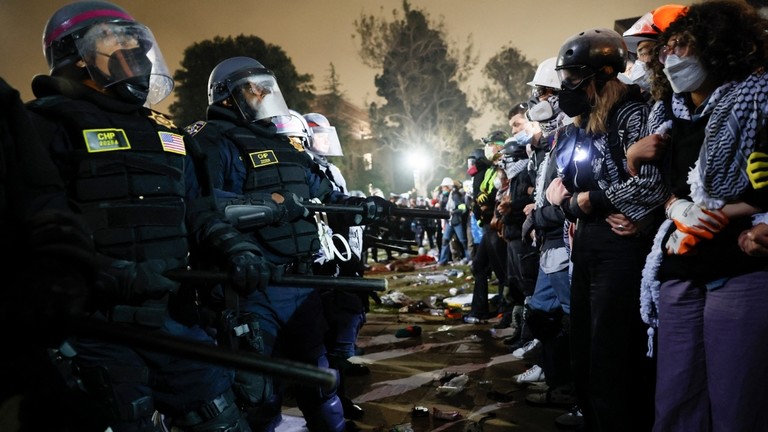
The demonstrations were initially peaceful, but clashes have erupted at Columbia University in New York, UCLA, and other colleges as police attacked the gatherings. Hundreds have been arrested amid the unrest.
Israel is facing increasing international criticism over the rising death toll among Palestinians following its latest invasion of Gaza. More than 34,000 people have been killed in the ongoing airstrikes and ground offensive.
The massacred are mostly children and women; thousands more have been buried alive, and thousands more arrested , tortured, and murdered or held hostage indefinitely without trial

With the spread of campus occupations in solidarity with Palestinians across the US, a distinctly rightwing narrative has taken hold of both political institutions and the mainstream media, putting American university administrations on the defensive.

According to this narrative, the protests are fundamentally anti-semitic, and colleges are not doing enough to violently suppress them.
Congressman Tom Cotton described protestors as a terrorist mob rampaging through campuses, and urged citizens to engage in vigilante attacks. Congress has demanded testimony from university presidents, some of whom have been forced to resign.
This narrative has roots both in the many sources of US state commitment to Israel – American imperial interests in the region, Christian Zionist lobbying, Israeli government lobbying, corporate lobbying by arms manufacturers and military contractors – and in the current broad rightwing assault on higher education.
The mainstream US press has, once again, abandoned its supposed duty to investigate what is actually happening, and either actively or passively played into this narrative.
I recently did a quick re-read of over 100 mainstream press articles covering the growing Palestine solidarity encampments on US campuses. Most came from the Washington Post and the New York Times, with a scattering of other sources. While this was not in any way a scientific survey, a number of points stand out. Only seven articles even mentioned the demands protestors are making (ceasefire, various forms and extents of divestment, an end to occupation and apartheid) – and when they did, it came well down the article and clearly not the central framing topic.

None of the articles mentioned the principles that are announced and posted at most encampments, and only one of them mentioned anything that happened prior to to the October 7 Hamas attacks or the structural conditions in Palestine.
Moreover, only three of the articles sought out the views of Jewish students involved in the protest, despite the fact that, at most campuses, groups like Jewish Voice for Peace (JVP) and If Not Now have been centrally involved in planning and implementation. Similarly, none mentioned Passover Seders that were held at over dozen encampments, or the many other expressions of inter-religious solidarity. If more of the reports did engage with Jewish students in the protest camps, they would likely hear positions similar to what one of my own students, a member of JVP and core organizer of many DC actions, articulated: “I’ve never in my life felt safer, as a Jew, than among my Palestinian comrades fighting for justice for all.”
Instead, the central framing of almost all coverage has been safety versus free speech. What “safety” means is consistently left vague. We get statements, usually unattributed, that students, often but not always said to be Jewish students, feel unsafe as a result of chants, or slogans, or signs. Very rarely is any incident actually described, and even more rarely does the incident involve any actual danger beyond hearing things one would prefer not to hear.
A consistent additional framing is that the tension on campus is between Jewish students and pro-Palestinian students. This framing is almost universal – 90 of the 100 articles mention it in some way, and a majority simply start there. Depending on the point of view of the author (I read both op-eds and news articles) this framing ranges from the assumption that occupiers are anti-semitic, pro-Hamas, terrorist-supporters, etc., to the statement that some perceive them that way. Only three of the articles described a verified instance of anti-semitism.
So how should members of the consistently anti-racist left respond to the near-constant hurling of charges of anti-semitism, the majority of which are patently aimed at distracting from the core issues of an apartheid regime and a genocide funded, armed, and politically protected by the US?
It may be tempting to adopt the attitude of a Jewish comrade and friend, expressed to me during the First Intifada when we were both getting into this work: “Meh, don’t be anti-semitic; as for the rest, ignore the motherfuckers”. But I think this is not adequate. For one, there is also actual anti-semitism in the movement, just as there has been throughout European history. Of course, many of the charges are made up (Tom Cotton) or the result of agent provocateurs (e.g., the Zionist counter-protestor at Northeastern university, caught on video yelling “Death to Jews!” and giving the pretext for police attacks). Moreover, the actual anti-semitic statements come from extremely fringe elements who have tried to attach themselves to the protests – e.g. at Columbia University. Some of these are the usual rightwing anti-semites, and occasionally they are Muslim anti-semites. But for all this, there are also anti-semitic inclinations among some on the left, and these can arise from people we may have considered allies.
Given the long and horrible history that such attitudes connect with, we cannot in good conscience ignore them. Further, the very fact that the charge has been so extensively weaponised means that, as a purely tactical matter, we must do everything possible to educate ourselves and distance ourselves from those who want to associate our cause with anti-semitic attitudes.
Over the last 40 years of organizing and activism, I’ve been called many names: “terrorist”; “anti-american scum”; “[slur for minority]-lover”; “race traitor”; “nazi”, “commie”, “anarchist”, … and of course “anti-semite” and “Jew hater”.
Most of these roll off and are best ignored or simply embraced (“race traitor”? “anarchist”?). But there are differences in the current context that call for greater awareness and greater vigilance. This means a few things:
Firstly, we stick to the issues. We are here to end a genocide and to dismantle a situation of apartheid, bringing freedom to everyone in the region. All talking points, chants, signs, etc. should, in my view, be directed toward this. An absolutely crucial point is that the purity of our movement is not relevant to the correctness of our demands. There have been ugly statements and actions in every movement for liberation throughout world history.
Even if every member of every encampment were an anti-semite, it would still be true that Israeli war crimes must end and apartheid be dismantled. The debate that matters is not how good we are. Always foreground the oppressed.
Secondly, we should clearly post our principles. Here’s a representative sample from the Yale University encampment:
“1. We are committed to Palestinian liberation and fighting for all oppressed people. 2. We are occupying this space to push Yale to disclose, divest, and reinvest in the New Haven community. 3. We are dedicated to taking care of this space. 4. We are dedicated to taking care of one another. We keep us safe. 5. We will not tolerate any forms of discrimination, including anti-semitism, Islamophobia, transphobia, homophobia, or racism”.
Thirdly, we must educate ourselves on the history and, yes, sometimes subtle expressions of anti-semitism. The fact that hermeneutics are weaponised to read our calls for freedom as calls for violence does not mean that all anti-semitism is overt and obvious. We should listen to the leadership of our Jewish comrades on this. Jewish Voice for Peace has held hundreds of trainings, but in the crush of actions, it is hard to organize such discussions. We need more.
Fourthly, we must have organized teams of marshals trained and ready to surround any provocateurs trying to insert messages into our protest in a way that clearly shows that they do not represent what we do.
And finally, we must have people designated to confront those more apparently in our midst if they violate our principles. This is a tricky tactical matter in a context where any confrontation can be used by cops as an excuse to escalate. In some of the most disciplined and best run actions I’ve been a part of over the last 40 years, we have had Palestinian leaders take point on such “message discipline”. But contexts vary. The point is to be prepared.
~ Mark Lance
Mark Lance is (for two more months) Professor of Philosophy and Professor of Justice and Peace at Georgetown University, rowing coach, and political activist. He has worked for over 40 years on a wide range of social justice and anti-war issues.
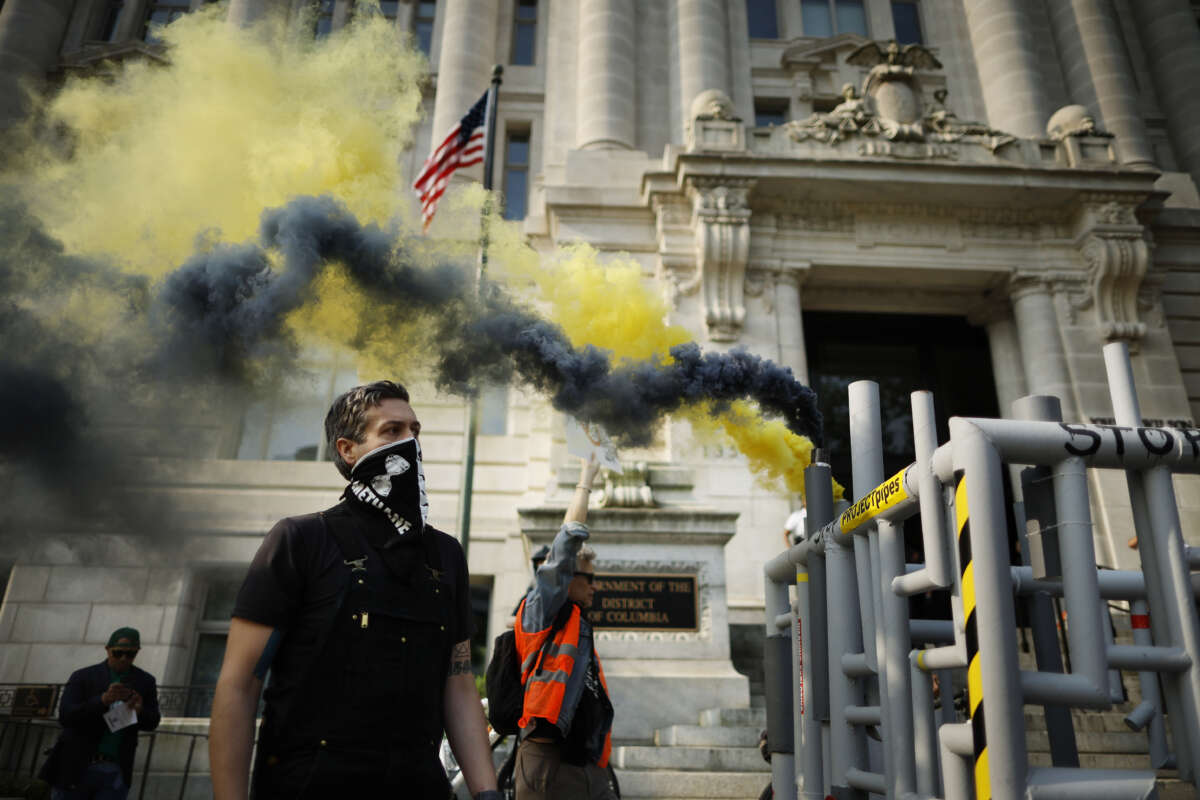
Despite the fracking boom, the price of natural gas for US households has skyrocketed by 52 percent since 2016.By Mike Ludwig , TRUTHOUTPublishedMay 4, 2024 Demonstrators rally outside the offices of the mayor and city council of the District of Columbia to protest against PROJECTpipes and demand a shift to renewable sources of energy on June 9, 2023, […]
Natural Gas Is a Climate Scam — and Consumers Are Paying for It

Revolutionary political prisoner and Black Panther Mumia Abu-Jamal called in to students at CUNY University to deliver a message at this historic moment in the movement for Palestine.
Mumia Abu-Jamal address to students protesting genocide in Gaza
from thefreeonline on May 4, 2024 by Repeating Islands

[Photo above by Josué Azor: A soccer game in Port-au-Prince.]

In this heart wrenching and inspiring piece, “The Haiti That Still Dreams,” Edwidge Danticat writes “The country is being defined by disaster. What would it mean to tell a new story?” Read the full article, with photos by Josué Azor, at The New Yorker.
I often receive condolence-type calls, e-mails, and texts about Haiti. Many of these messages are in response to the increasingly dire news in the press, some of which echoes what many of us in the global Haitian diaspora hear from our family and friends.
More than fifteen hundred Haitians were killed during the first three months of this year, according to a recent United Nations High Commissioner for Human Rights report, which described the country’s situation as “cataclysmic.” Women and girls are routinely subjected to sexual violence.
Access to food, water, education, and health care is becoming more limited, with more than four million Haitians, around a third of the population, living with food insecurity, and 1.4 million near starvation.
Armed criminal groups have taken over entire neighborhoods in Port-au-Prince and the surrounding areas, carrying out mass prison breaks and attacks on the city’s airport, seaport, government buildings, police stations, schools, churches, hospitals, pharmacies, and banks, turning the capital into an “open air prison.”
Even those who know the country’s long and complex history will ask, “Why can’t Haiti catch a break?” We then revisit some abridged version of that history. In 1804, after a twelve-year revolution against French colonial rule, Haiti won its independence, which the United States and several European powers failed to recognize for decades.
The world’s first Black republic was then forced to spend sixty years paying a hundred-and-fifty-million francs (now worth close to thirty billion dollars) indemnity to France.
Americans invaded and then occupied Haiti for nineteen years at the beginning of the twentieth century. The country endured twenty-nine years of murderous dictatorship under François Duvalier and his son, Jean-Claude, until 1986. In 1991, a few months after Haiti’s first democratically elected President, Jean-Bertrand Aristide, took office, he was overthrown in a coup staged by a military whose members had been trained in the U.S. Aristide was elected again, then overthrown again, in 2004, in part owing to an armed rebellion led by Guy Philippe, who was later arrested by the U.S. government for money laundering related to drug trafficking.
Last November, six years into his nine-year prison sentence, Philippe was deported by the U.S. to Haiti. He immediately aligned himself with armed groups and has now put himself forward as a Presidential candidate.
In 2010, the country was devastated by a 7.0-magnitude earthquake, which killed more than two hundred thousand people. Soon after, United Nations “peacekeepers” dumped feces in Haiti’s longest river, causing a cholera epidemic that killed more than ten thousand people and infected close to a million.
For the past thirteen years, Haiti has been decimated by its ruling party, Parti Haïtien Tèt Kale (P.H.T.K.), which rose to power after a highly contested election in 2011. In that election, the U.S.—then represented by Secretary of State Hillary Clinton—and the Organization of American States helped the candidate who finished in third place, Michel Martelly, claim the top spot. Bankrolled by kidnapping, drug trafficking, business élites, and politicians, armed groups have multiplied under P.H.T.K, committing massacres that have been labelled crimes against humanity.
In 2021, a marginally elected President, Jovenel Moïse, was assassinated in his bedroom, a crime for which many of those closest to him, including his wife, have been named as either accomplices or suspects.
The unasked question remains, as W. E. B. Du Bois wrote in “The Souls of Black Folk,” “How does it feel to be a problem?”
I deeply honor Haiti’s spirit of resistance and long history of struggle, but I must admit that sometimes the answer to that question is that it hurts. Sometimes it hurts a lot, even when one is aware of the causes, including the fact that the weapons that have allowed gangs to take over the capital continue to flow freely from Miami and the Dominican Republic, despite a U.N. embargo.
Internally, the poorest Haitians have been constantly thwarted by an unequal and stratified society, which labels rural people moun andeyò (outside people), and which is suffused with greedy and corrupt politicians and oligarchs who scorn the masses from whose tribulations they extract their wealth. [. . .]
Lately, some of our family gatherings are incantations of grief. But they can also turn into storytelling sessions of a different kind. They are opportunities for our elders to share something about Haiti beyond what our young ones, like everyone else, see on the news.
The headlines bleed into their lives, too, as do the recycled tropes that paint us as ungovernable, failures, thugs, and even cannibals. As with the prayers that we recite over the dead, words still have power, the elders whisper. We must not keep repeating the worst, they say, and in their voices I hear an extra layer of distress.
They fear that they may never see Haiti again. They fear that those in the next generation, some of whom have never been to Haiti, will let Haiti slip away, as though the country they see in the media—the trash-strewn streets and the barricades made from the shells of burnt cars, the young men brandishing weapons of war and the regular citizens using machetes to defend themselves—were part of some horror film that they can easily turn off.
The elders remind us that we have been removed, at least physically, from all of this by only a single generation, if not less.
We are still human beings, the elders insist—“Se moun nou ye.” We are still wozo, like that irrepressible reed that grows all over Haiti.
For a brief moment, I think someone might break into the Haitian national anthem or sing a few bars of the folk song “Ayiti Cheri.” (“Beloved Haiti, I had to leave you to understand.”)
Instead, they hum the music that the wozo has inspired: “Nou se wozo / Menm si nou pliye, nou pap kase.” Even if we bend, we will not break. [. . .]
For full article, see https://www.newyorker.com/culture/essay/the-haiti-that-still-dreams
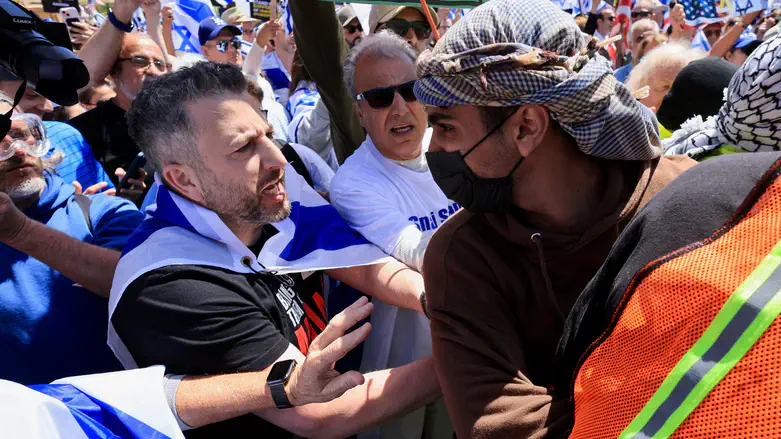
Peckford 42 Shiraz University head says students who who are expelled over their actions during recent protests are welcome to continue their studies at his institution.
The head of an Iranian university offered students expelled from American colleges while participating in the recent anti-Israel protests that have rocked campuses across the US in recent weeks […]
Mohammad Moazzeni, the head of Shiraz University in the Fars region, made the offer in an interview with the state-owned Press TV.
“Students and even professors who have been expelled or threatened with expulsion can continue their studies at Shiraz University and I think that other universities in Shiraz, as well as Fars Province, are also prepared,” Moazzeni said.
Earlier this week, the NYPD arrested more than 280 people at anti-Israel protests at Columbia University and City College of New York.
Protesters at Columbia broke into and occupied a hall on campus early Tuesday morning.
The recent waves of protests began a little over two weeks ago when anti-Israel protesters set up a tent encampment on the Columbia campus. Similar protest encampments spread to campuses across the country over the next two weeks.
These anti-Israel protests have become hotbeds of antisemitism and support for Hamas terrorists.
Several universities, including Columbia, have threatened to suspend students who violate campus policy in the course of the protests.
[…]
from thefreeonline May 4, 2024 by peoplenatureblog By Masashi Soga, and Maldwyn John Evans.
This Plain Language summary is published in advance of the paper discussed; check back soon for a link to the full paper.

Throughout history, humans have maintained an intricate connection with nature, often finding fascination with, and deriving numerous benefits from, the natural world.

This positive emotional bond with nature, which is considered to have a genetic basis, is known as “biophilia”. However, biophilia represents just one facet of our relationship with nature.
People can also harbour strong negative emotions and attitudes towards nature, referred to as “biophobia”. For example, encounters with snakes, spiders, and wasps can evoke profound fear in humans.
Similarly, people often feel disgust towards invertebrates such as flies, earthworms, and cockroaches.

Current evidence suggests that, in more urbanised and economically developed societies, the prevalence of biophobia is high and potentially increasing.
Further, research suggests that the prevalence of animal phobia is higher than that of other phobias such as fears of heights, medical experiences, flying, and enclosed spaces.
Despite this, the significance of biophobia in the human-nature interactions discourse has largely been overlooked. This is concerning, as levels of biophobia beyond that which could be considered useful or necessary can have far-reaching negative impacts on both human health and biodiversity conservation.
This Biophobia special feature comprises seven papers from different disciplinary perspectives, including biodiversity conservation, psychology, and behavioral science.

These studies explore diverse aspects of biophobia, with a particular emphasis on the drivers and consequences of increased biophobia.
They also provide key insights into how to mitigate excessive phobic responses towards nature. In this introductory paper, we will briefly explore what biophobia entails, how it operates, and why it is important in the context of the relationship between humans and nature.

We hope that this special feature will serve as a catalyst for more biophobia research, encouraging collaboration among researchers from diverse backgrounds to shed more light on this often-overlooked subject.
 The Free