by Marc Fawcett-Atkinson by Canada’s National Observer Subscribe to the Mother Jones Daily
…..On a small budget, with the first film they’ve ever made, Ali Tabrizi and Lucy Tabrizi have achieved what media giants have repeatedly failed to do: directly confronted power. Their film Seaspiracy has become a number 1 on Netflix in several nations, including the UK. (Disclosure: I’m a contributor). At last people have started to wake up to the astonishing fact that when you drag vast nets over the sea bed, or set lines of hooks 45 kilometres long, or relentlessly pursue declining species, you might just, well, you know, have some effect on ocean life.
The film gets some things wrong. It cites an outdated paper about the likely date of the global collapse of fisheries. Two of its figures about bycatch are incorrect. It confuses carbon stored by lifeforms with carbon stored in seawater. But the thrust of the film is correct: industrial fishing, an issue woefully neglected by the media and conservation groups, is driving many wildlife populations and ecosystems around the world towards collapse.
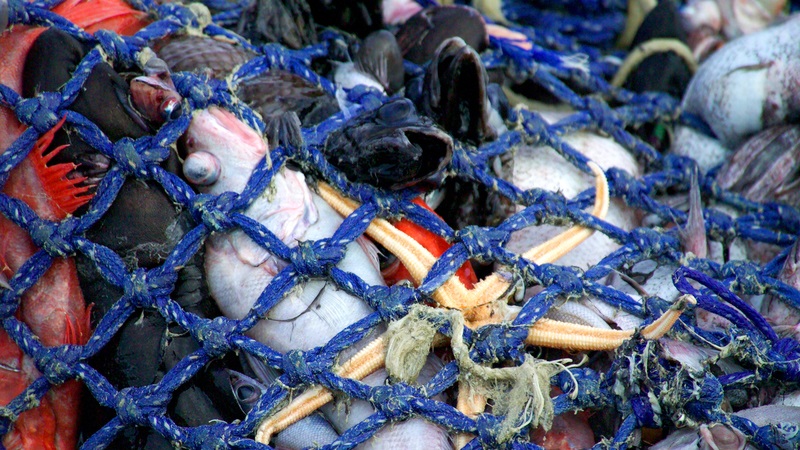
Vast fishing ships from powerful nations deprive local people of their subsistence. Many “marine reserves” are a total farce, as industrial fishing is still allowed inside them. In the EU, the intensity of trawling in so-called protected areas is greater than in unprotected places. “Sustainable seafood” is often nothing of the kind. Commercial fishing is the greatest cause of the death and decline of marine animals. It can also be extremely cruel to humans: slavery and other gross exploitations of labour are rampant…………
read full article here https://www.monbiot.com/2021/04/09/sea-change/
Bottom Trawling Fishing: An avoidable Climate Catastrophe..
Bottom trawling moves the carbon-rich sediment on the ocean floor, releasing far more carbon than previously thought, a new study has found. Globally, it releases as much CO2 as 320 million cars, a new study estimates.
Scientists push to add “huge” fish trawling emissions to national inventories
Bottom trawling, a common fishing practice where large nets are dragged along the sea floor, is exacerbating the climate crisis, a new study has found.
Centuries of dead plankton, fish and marine mammals lie on the sea floor, their decomposed bodies locking vast amounts of carbon in the sediments beneath the waves.
When those sediments are moved by giant trawl nets, the carbon they contain is released back into the ocean and atmosphere, say the team behind the research.
There’s quite a bit more carbon in the sediments than we (first) thought, said Boris Worm, professor of marine conservation biology at Dalhousie University and co-author on the study. “It’s, in fact, more than (is stored) on land—we did not know that.”

Disturbing the ocean’s depths has consequences: Each year, bottom trawling releases as much CO2 as the annual emissions of 320 million cars worldwide. That’s roughly equivalent to the amount of greenhouse gases spewed out by depleted agricultural soils.