GDP is nonsense, but all capitalist economics depends on promoting it.
Our whole idea of Gross Domestic Product as a measure of economic success is an absurd fallacy.
GDP is stupid, like having just one orange and measuring your well being by how fast you can eat it.
Some years ago the idea of Green GDP was put forward in China, but rapidly buried when the results turned out too bad.
Independent estimates of the cost to China of environmental degradation and resource depletion have for the last decade ranged from 8 to 12 percentage points of GDP growth.[4] These estimates support the idea that, by this measure at least, the growth of the Chinese economy is close to zero.
The most promising national activity on the Green GDP has been from India. The country’s Environmental Minister, Jairam Ramesh, stated in 2009 that “It is possible for scientists to estimate green GDP. An exercise has started under the country’s chief statistician Pronab Sen and by 2015, India’s GDP numbers will be adjusted with economic costs of environmental degradation
Now the inventor of Chinese Green GDP has come up with a much less green fudge which has been floated semi officially in the Chinese media, ahead of the many such proposals for the Rio Summit next year.
The idea of ‘Green GDP’ is a good one for educating people on the real limitations of the Biosphere we inhabit.
anarchism is permaculture
However this in itself changes nothing, the ruling capitalists and Corporations will only have to add a little greenwash.
If you factor in the exponential costs of climate change and the real costs of environmental destruction every country on Earth already has a plummeting GDP.
The ‘GDP Quality Index’ now being floated in China is one of many proposals worldwide to use economic theory to reverse environmental degradation and encourage sustainable values. No governments have adopted such measurements but they are likely to be given a push as next year’s Rio+20 United Nations summit. Last year, India said it would become the first country in the world to commit to publish accounts of its “natural wealth”.
#OCCUPYWALLSTREET started last Saturday, when 5,000 people descended on to the financial district of Lower Manhattan, held a people’s assembly and set up an encampment in Zuccotti Park on Liberty Street, a stone’s throw from Wall Street and a block from the Federal Reserve Bank of NewThree hundred spent the night, several hundred reinforcements arrived the next day and dug in for a long-term stay. Call in sick, invite your friends, hop on a bus or plane to New York City … join us! We’re now in DAY 4.
Early this morning at least five protesters were arrested by NYPD.
The first arrest was a protester who objected to the police removing a tarp that was protecting our media equipment from the rain. The police said that the tarp constituted a tent, in spite of it not being a habitat in any way. Police continued pressuring protesters with extralegal tactics, saying that a protester on a bullhorn was breaking a law. The protester refused to cease exercising his first amendment rights and was also arrested. Then the police began to indiscriminately attempt to arrest protesters, many of them unsheathed their batons, in spite of the fact that the protest remained peaceful.
The new residents of Liberty Square continued to serve as shining examples of law abiding behavior in spite of police harassment and the loose interpretation and selective enforcement of New York’s laws by the NYPD.
We’re still here. We intend to stay until we see movements toward real change in our country and the world. This is the third communiqué from the 99 percent.
Today, we occupied Wall Street from the heart of the Financial District. Starting at 8:00 AM, we began a march through the Wall Street area, rolling through the blocks around the New York Stock Exchange. At 9:30 AM, we rang our own “morning bell” to start a “people’s exchange,” which we brought back to Liberty Plaza. Two more marches occurred during the day around the Wall Street district, each drawing more supporters to us.
Hundreds of us have been occupying One Liberty Plaza, a park in the heart of the Wall Street district, since Saturday afternoon. We have marched on the Financial District, held a candlelight vigil to honor the fallen victims of Wall Street, and filled the plaza with song, dance, and spontaneous acts of liberation.
Food has been donated to the plaza from supporters all over the world. Online donations for pizza, falafels, and other food are coming in from supporters in Omaha, Madrid, Montreal, and other cities, and have exceeded $8,660 [admin: now $10,000]. (Link to donate: www.wepay.com/donate/99275)
On Saturday we held a general assembly, two thousand strong, based on a consensus-driven decision-making process. Decisions were made for the group to occupy Liberty Plaza in the Wall Street corridor, bedding down in sleeping bags and donated blankets. By 8:00 PM on Monday we still held the plaza, despite constant police presence.
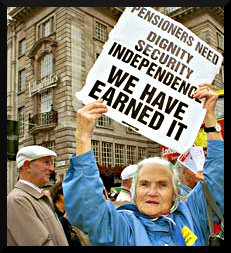
The IMF and World Bank blackmail countries into privatizing Pension Schemes, to create juicy short term profits in the Stock Market CASINO.
World Bank admits 85 percent of world’s population has no retirement income
..''sorry no more pensions. Just die okay''
By Jean Shaoul..Less than 15 percent of the world’s population over 65 years of age now receive any income in retirement, according to New Ideas about Old Age Security, a book published by the World Bank. The worldwide assault on social insurance and publicly funded pension systems has left millions of working people without any prospect of receiving support when they retire.
The worst affected countries are in Latin America and the former Soviet Union. But the impact is also beginning to be felt in the advanced countries. It has created a social catastrophe for elderly people, who face appalling poverty and isolation in the last years of their life.
Just under 20 percent of the population aged 65 years and older and just under 30 percent in the 15-64 year old age bracket would have some formal pension coverage, and the figure is FALLING.
The authors also acknowledge that the so-called pensions revolution has failed to deliver even the World Bank’s own economic and financial objectives of increasing individual savings. The much-vaunted efficiency of the market has proved to be a chimera. The cost of administering private pension schemes ranged from 6 percent of total contributions in the case of Bolivia, to a massive 23 percent in the case of Argentina, and contrasted starkly with the lower running costs of public schemes.
No Pension? Just die quickly please.
In the UK, the selling of completely inappropriate private pension products and the inability of the regulators to prevent scams and swindles has also brought the private pension industry into disrepute. There is widespread recognition that it would require governments making some element of private pensions mandatory if they were to supplant public pensions. But the authors go on to insist that this is a short-term phenomenon that should not deflect anyone.
Following proposals by the International Monetary Fund (IMF) in 1985 and the Organisation for Economic Development (OECD) in 1988, the two organisations insisted any loans made were conditional upon pension reform. By this the World Bank meant the type of “reforms” pioneered by Chile in 1981 under Pinochet. International finance capital was determined to get its hands on the social security funds that formed the basis of retirement income in industrialised and some East Asian countries, and channel it into the capital markets.
The World Bank also believes people must also be encouraged to extend their working life. To meet the cost of pensions and medical care for the elderly, estimated at $64 trillion worldwide, “industrial countries need to create an institutional framework that minimises the threat of inadequate savings by ensuring that social security schemes are fully funded and by discouraging early retirement”, it said. (In official terminology, pension schemes where the benefits paid to retirees are met from the contributions made by the existing workforce are misleadingly known as “unfunded schemes,” and those based on the dividends invested on the stock market, whether public or private, are known as “funded” schemes.)
The World Bank demanded a shift away from publicly funded pensions based on general taxation and/or contributory social insurance levied from both workers and employers, to private pension schemes invested on the stock market. Where pensions remained public, they were to be converted to “defined contribution” schemes whereby entitlement to retirement income depends upon the level of contributions made by the individual.
Pensions are abolished. Just die, okay!
Its goal was a two-tier mandatory scheme with declining levels of pension provision by the state and an increasing component funded directly through individual contributions to either a private or publicly administered scheme. In effect, everyone would have his or her own individual “retirement account”, which could then be collectively invested on the stock exchange.
Many countries such as the US, Germany and Britain have embraced some aspects of the World Bank’s policies. Pensions are often the state’s largest single item of budgetary expenditure. According to the most recent World Bank Indicators report, publicly funded pensions paid for by workforce and employer contributions in Austria, Poland and Italy account for 15 percent of GDP, although the average in the West is about 10 percent. In the countries that made up the former Soviet Union, they account for only 5 percent of GDP, and in many of the world’s poorer nations pension provision is non-existent, apart from a wealthy elite and a few top government officials.
In Latin America and the former Soviet Union, the World Bank has expressly linked the provision of credit under its Public Sector Adjustment Loan scheme to implementing the privatisation of public enterprises and pension reforms.
we invested your pension and, er, um...
The lack of a decent pension means that when workers retire, they will have to supplement their meagre pension by taking what work they can. Thus the pension “reforms” create an additional pool of cheap and experienced labour. The OECD’s book Maintaining Prosperity in an Ageing Society, states openly, “An important part of the strategy for maintaining prosperity will involve encouraging people to work longer by making it financially more attractive for them to do so.”
Private pensions also offer a vast new source of profiteering for big business and the financial institutions, as the OECD acknowledges: “Consequently financial market infrastructures will need to be strengthened to cope with large increases in private pension fund assets”. The huge scale of the transfer of funds to the stock market has added to its volatility and served to intensify speculation. More than 50 percent of corporate shares are held by pension funds and insurance companies in the UK. Whereas in the mid 1960s, UK pension funds held such shares for 23 years on average, now they only hold them for 18 months, in their search for ever higher returns.
Thus not only does the turn to private pensions make the income of retired workers dependent upon the uncertainties of the stock market, as Chilean and Malaysian pensioners found to their cost when the economies of these countries crashed in 1997; it is also leading to a huge increase in the rate of exploitation of the workforce.
PART 2 The Great Pension Revolt..Coming Soon on this Blog
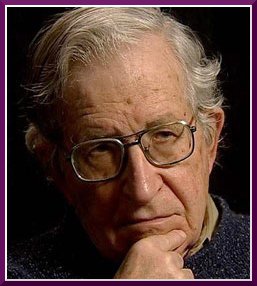
This guy is terrific. Today’s ‘Democracy Today” channel (inspired by him) has the top 3 stories with Chomsky fairly CHOMPING UP the Capitalist Bastards ruling and ruining our planet!
Noam Chomsky: ”2012 GOP Candidates Views are “Off the International Spectrum of Sane Behavior, Perry, who’s very likely … to win the primary and win the nomination, and maybe to win the election , is often in outer space.”
On Libya”I think it’s much harder to make a case for direct participation in a civil war and undercutting of possible options that were supported by almost the entire world,” Chomsky says.
On Palestine ”If Palestinians do bring the issue to the Security Council and the U.S. vetoes it, it will be just another indication of the real unwillingness to permit a settlement of this issue, in terms of what has been for a long time an overwhelming international consensus,” Chomsky says.
Another Chomsky report details how the US and Israel are undermining the ‘Arab Spring’. Chomsky dates the start of the rebellions not in Tunisia, but in the protest camp in Sahara, which was brutally attacked by the generation long, occupying Morrocan army.
Press Statement in response to court injunction against Dale Farm forced eviction.
Dale Farm resident, Kathleen McCarthy said, “We still need somewhere to go, if we have to leave here. Today is a great victory, but we still need Basildon Council to approve a legal site for us.”
Bailiffs are making final preparations before they begin clearing the Dale Farm travellers’ site in Essex.
As many as 400 people have been living on the 51 unauthorised caravan plots – but officials said 12 families had already left the site at Crays Hill.
Those remaining have built reinforcements at the six-acre site.
Police have been drafted in from several forces ready for the eviction at the UK’s largest unauthorised travellers’ site.
It is understood representatives of the Gypsy Council, the Irish Traveller Movement and a resident, Kathleen McCarthy, were due to meet council officials shortly after 10:00 BST.
Mary Sheridan, a representative of the residents, has applied for a personal injunction in another bid to stop the evictions and this will be heard by the Court of Appeal at 11:30 BST.
The campaign against the travellers has been spearheaded by a man who residents refer to as ‘our racist neighbour’. During my visit he was arrested for attempting to burn down a structure on the site. A stockpile of firearms was seized from his house. He has also reportedly sprayed sewage close to the encampment. Yet newspaper sources have for the most part given a sympathetic hearing to him.
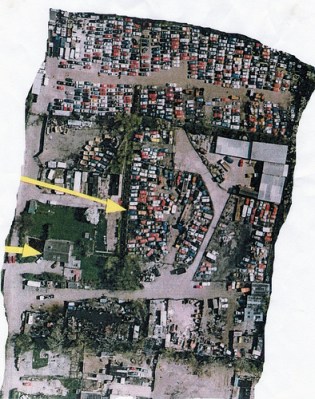
Dale Farm was a scrapyard before the Travellers bought it.
The same can’t be said for the residents who risk losing their homes – including children who risk losing their access to education. Nor do the people from outside the camp who have agreed to help resist the eviction get a good press. While I am there the local newspaper writes about ‘anarchist thugs’ coming to Basildon. During a lengthy conversation with a journalist I turn the questions on him and ask him about the coverage so far. ‘To be honest, the story’s mostly written before we get here,’ he tells me, ‘and writing about thoughtful bookish types standing up for human rights doesn’t sell newspapers the same way as stories about anarchists and violence.’ It is no surprise that mainstream media access to the site has been restricted to allotted times.
Attempts to Occupy Wall Street have so far been blocked by a heavy police presence.
Details of arrests or injuries are still lacking
Protesters blocked in bid to ‘occupy’ Wall Street
Hundreds of people marched Saturday near Wall Street in New York in an attempt to occupy the heart of global finance to protest greed, corruption and budget cuts. Plans by protesters to turn Lower Manhattan into an “American Tahrir Square” was thwarted when police blocked all the streets near the New York Stock Exchange and Federal Hall in Lower Manhattan. The demonstrators had planned to stake out Wall Street until their anger over a financial system they say favors the rich and powerful was heard.
“The one thing we all have in common is that We Are The 99 Percent that will no longer tolerate the greed and corruption of the one percent,” said a statement on the website Occupy Wall Street.
By noon, about 700 people, many carrying backpacks and sleeping bags, had gathered near Wall Street to search for a place to camp amid a heavy police presence. The protesters who did arrive were full of zeal and righteous indignation.
“This is a protest against corporate greed and we come to Wall Street because Wall Street is the Ground Zero for corporate greed,” said Julia River Hitt, a 22-year-old philosophy student.
“We are here just to say we are fed up, we are not gonna take it anymore.”
The protesters gathered in Trinity Place, some some 1,000 feet (300 meters) from Wall Street, which they hope to turn into the US version of the famous square in Cairo that became the focal point of protests that led to the ouster of Egyptian strongman Hosni Mubarak in February. “No more corruption,” read one sign a demonstrator brandished. “Wall St Greed, New Yorkers Say Enough,” read another. “I will sleep here. A lot of us we will sleep here,” said Steven Taylor, 24 a protester who arrived equipped with a backpack and a sleeping bag.
Youths shared food and discussed the economic crisis in groups of 15 and 20. Others marched around the square.
Among the group was Javier Dorado, a law professor from Spain who compared the protesters with the mass “indignant” demonstrations in his country against high unemployment, welfare cuts and corruption. “This is a global phenomenon that is taking place in Europe and many countries,” Dorado said.
The protest came as the United States struggles to overcome an economic crisis marked by a huge budget deficit that has triggered cuts in the public service sector while unemployment hovers stubbornly above nine percent. “There’s a war in Libya, there’s a war in Afghanistan, there’s a war in Iraq and we have cuts in education, social programs,” said a masked protester who declined to be identified.
“We know where the money is going! Revolution in America!









 The Free