Change the rules. Subvert the System. Save the Planet.

Change the rules, subvert the system, save the planet


The recent figures on CO2 emissions are sobering. Despite the fact that the world has suffered a terrible recession, emissions are still rising.

In essence all the efforts to tackle climate change have simply slowed the rise a little rather than reversing it.
The problem is that the solutions to climate change put forward at international conferences like Copenhagen and Cancun dare not deal with the real root cause of climate change – our current economic system.
Simply put, our economic system is based on the accumulation of money. There is a constant race to throw money into the system and to get more money out at the other end.
That’s what modern life is about.
From Fifa to the current conflict in Libya, the desire to accumulate cash sets the objectives for society. If something makes cash it is holy in the eyes of the economists, the media and virtually all political parties.
So climate change is tackled internationally by “market-based” methods. These fail time and time again, but more effective action would require a change in our priorities.
Our economic system is based on resource extraction. Minerals, metals and fossil fuels are taken out of the ground, made into goods and then thrown away.The faster the cycle the more profit is made.
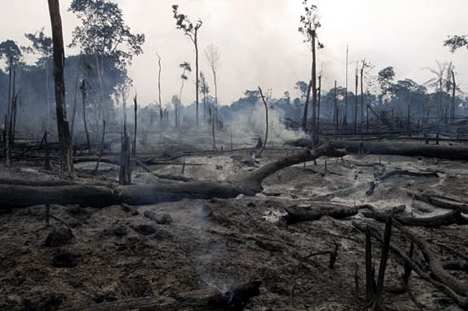
If you think about it for more than a minute or two, there is something rather mad about this methodology. The cost to the natural environment is immense. Right across the planet fragile ecosystems are under enormous threat.

The human cost is also huge. The value of good is….

CONTINUE HERE              another-green-world.

Brazil: LAST STAND FOR THE XINGU

Amazon Watch has organized a “Cause” at Facebook:

“This has been a time of tragedy in the Amazon. This week the Brazilian government green-lighted construction on the monstrous Belo Monte Dam despite searing local, national and international opposition.

Yet despite the initiation of this criminal operation, I can assure you that the battle to defend the Xingu River and its people is far from over. “I have just returned from the Brazilian Amazon, where Chief Raoni gathered with hundreds of Kayapo warriors, indigenous leaders from 18 ethnicities, and leaders from the Xingu Alive Forever Movement (MXVPS).

“This is the last chance we have to paralyze Belo Monte’s construction,” Renata Pinheiro told the indigenous assembly. “The future of the Xingu is in your hands, indigenous peoples and social movements. You succeeded in stopping Belo Monte for 30 years – now more than ever we need to strengthen our resolve, joining forces to stop the beginning of construction.”

“It’s now more important than ever that we take this campaign to the next level. “Take a stand, stop this monstrous project by joining the Cause on Facebook “Stop the Monster Dam: Protect the Xingu River and its People”.

Your donation today will support the travel of indigenous leaders to Brasilia and Altamira to make their voices heard.” Xingu Alive Forever! Xingu Vivo Para Sempre! Please join the cause. Also, please note that the avaaz.org petition is still active. If you have not signed it you can do it now here. Posted by Lou Gold at 4:22 PM

ALF: Link Between Child Abuse And Animal Abuse

Bill Sees Link Between Child Abuse And Animal Abuse; Reports By DCF Employees Would Not Be Anonymous

The state House of Representatives voted overwhelmingly Wednesday for a bill that links cases of child abuse with cases of animal cruelty.

The bill requires local animal control officers and employees at the state Department of Children and Families to report cases of animal cruelty to the state agriculture department. The agriculture commissioner would then be required to issue a monthly report, starting in November 2011, to the DCF commissioner, who would determine whether anyone suspected of animal cruelty is also simulataneously on the list of families at DCF.


full story:
http://blogs.courant.com/capitol_watch/2011/05/bill-sees-link-between-child-a.html

Africa: GMO seeds introduced despite public rejection

By David Njagi

NAIROBI, May 16, 2011 (IPS) – Farming with genetically modified organisms (GMOs) is becoming more widespread in Kenya due the promotion of biotechnology through clever schemes,  and the lack of a legal framework for these controversial products.

”Because Africans are strongly against GM foods the companies are using their economic muscle and criminal disregard for local opinion to gain  a foothold and get the farmers ‘hooked’.

Africa: policy on genetically modified organisms (GMO) and genetically engineered (GE) foods (map/graphic/illustration)

Click here, or on the graphic, for full resolution.

Africa: policy on genetically modified organisms (GMO) and genetically engineered (GE) foods. The Cartagena protocol on biosafety, a supplement to the convention on biological diversity, has strong support in Africa, with a majority of the countries as signatories. In addition, several countries have, in the past, rejected aid (especially unmilled grains) in food imports with concerns for national biosafety. South Africa is so far the only country that is seeing wide-spread use of genetically modified crops.

In Kenya The Sygenta Foundation has triumphed with a novel scheme to insure farmers crops. The Syngenta Foundation is a not-for-profit organisation attached to the Syngenta Company that researches and produces GM seeds. The foundation is involved in the “Safe Biotechnology Management” (SABIMA) project aimed at promoting GM technology among small-scale farmers in Ghana, Nigeria, Burkina Faso, Kenya, Uganda and Malawi.

The Kenya Biodiversity Coalition (KBioC) regards the scheme as part of seed-manufacturing multinational companies’ renewed appetite to use Kenya as a testing ground for GMOs by offering seeds to farmers.
“We suspected that a lot of GM seed, particularly for maize, was being imported from South Africa either as contaminated maize or plain GMOs,” recalls Kamau of KBioC. “We went to the key maize-growing regions and did random sampling. We bought the seed and found it was laced with GM strains.”Controls on seed imports are often slack or lacking.”So even if Kenya has not commercialised GMOs, it is likely that farmers are planting GM seed without their knowledge,” says Kamau.

Despite rejection everywhere but South Africa, Dr. Margaret Karembu, of a pro GMO company, predicts that 10 African countries will have adopted the technology before 2015

read more…http://ipsnews.net/news.asp?idnews=55648

Amazonía: Adelino Claudio y Maria matado!..amnestía para destructores!

Adelino, Claudio y Maria

”Con la amnestía para crimenes contra la selva los terroristas rancheros y maderistas  ven su oportunidad de hacer dinero con la destrucción de la Amazonia para satisfacer la demanda de los criminales corporaciónes internacionales, como Burger King y MacDonalds.”

  
  Adelino fue asesinado cuando estaba vendiendo verduras de su producción por enfrentar a la mafia maderera en la Amazonia de Brasil. Era dirigente del Movimiento Campesino Corumbiara y se llamaba Adelino Ramos. Un motociclista lo mató a tiros en Rondonia, norte del país.
   Tres días antes fueron ejecutados José Claudio Ribeiro da Silva y su esposa, Maria do Espírito Santo da Silva, en el municipio de Nova Ipixuna. También eran dirigentes comunitarios y peleaban contra la tala ilegal en el estado de Pará. La presidenta Dilma Rousseff mandó a investigar el hecho.

líder campesino superviviente de una masacre es asesinado en el Amazonas

 Adelino Ramos había denunciado recientemente a explotadores ilegales de madera

EFE – Sao Paulo – 28/05/2011 .El líder campesino Adelino Ramos, conocido como Dinho, uno de los supervivientes en 1995 de la masacre de Corumbiará, fue asesinado ayer en el estado de Roraima y se convirtió en la tercera víctima por conflictos de tierras esta semana en la Amazonía brasileña.
Dinho, que sobrevivió a la matanza en la que 12 campesinos, entre ellos varios niños, murieron a manos de presuntos paramilitares, fue asesinado cuando vendía verduras de sus cultivos en el barrio de Vista Alegre do Abuna, en Porto Velho, capital del Estado de Rondonia, según la organización católica Pastoral de la Tierra. La organización detalló en un comunicado que Dinho fue asesinado a balazos por pistoleros que viajaban en una motocicleta.
El líder campesino, presidente del Movimiento Campesino de Corumbiará, había denunciado ecientemente a explotadores ilegales de madera en los estados de Acre, Amazonas y Rondonia y pedía la instalación de un campamento para campesinos desplazados. “Dinho venía siendo amenazado hace años y en julio del año pasado denunció otra vez amenazas contra su vida”, apuntó la Pastoral.

El martes, en el también amazónico estado de Pará, fue asesinado a balazos el matrimonio compuesto por José Claudio Ribeiro da Silva y María do Espírito Santo, reconocidos ambientalistas de la región y exlíderes del Movimiento de los Trabajadores Rurales Sin Tierra.

El debate sobre la explotación del Amazonas ha tomado gran vuelo en Brasil después de que en una semana se siguieran dos noticias contradictorias: la publicación de un alarmante aumento de los niveles de deforestación, y la aprobación en la noche del martes, por aplastante mayoría en el parlamento, de una reforma del Código Forestal brasileño que establece una amnistía general para todos aquellos que incurrieron en delitos contra la vegetación hasta 2008

Peru: Indigenous anti mine protestors hold Puno city

Customs warehouse in Puno on fire after it was attacked overnight

20,000 Aymaras occupy Puno

Thousands of angry indigenous protesters have taken over the city centre of Puno in south-eastern Peru.

Looters have taken advantage of the unrest and ransacked offices and shops as the police retreated.

Cars and buildings were torched on Thursday night when protesters went on the rampage, demanding an end to a Canadian silver mining project.

The indigenous Aymara activists say the mining company will pollute their ancestral lands.

The protesters have blocked the main roads into the city.


Border crossing still closed

A customs office was set ablaze on Friday and several other buildings are still smouldering after being torched in the night.

The demonstrators have threatened to continue the disruption until the government revokes the mining concessions for the Canadian Bear Creek mining company.

The activists say the mining corporation will contaminate nearby Lake Titicaca, decimating the fish stocks.

However, the firm denies it will harm the environment and wants to begin production next year.

The unrest in Puno comes two weeks before the 5 June presidential run-off election.

The indigenous activists say they will try to stop the polls from going ahead in Puno if their demands have not been met.

Bee Gardens: Flowers..Fruits for a Bee-Friendly Habitat

An estimated 70 percent of the food we eat is dependent upon pollination by insects such as bees. You can help support these vital, fascinating creatures by learning how to raise them yourself! Whether you want to keep bees for pleasure or profit, in the city or in a rural area, “Keeping Bees and Making Honey” can guide you every step of the way, from where to place your hive all the way up to how to best savor your first spot of “homegrown” honey.
COKeeping Bees And Making Honey
You may want to give your bees a helping hand when it comes to collecting pollen and nectar by planting bee-friendly flowers and shrubs in your garden or outside space. Even in a larger garden, you’ll unlikely have enough flowers to produce sufficient nectar to sustain a hive, so your bees will probably go farther afield — up to 3 miles — to find richer and denser sources of food. But the right flowers, fruit and vegetables in your garden will attract some of your own bees, as well as welcoming other visitors such as the bumblebee and solitary bee species. Above all, a garden or patch devoted to plants that are attractive to bees can be a source of great pleasure to any beekeeper, as much for the riot of color as for the activity of the bees.