occupy london squat – ‘school of ideas’

Tagged as: free_spaces occupylondon school_of_ideas squatting
Neighbourhoods: city old_street

this week, ‘occupy london’ activists opened up a new community squatted building in the city, near old street. it is a deserted primary school with loads of beautiful airy classrooms, a small gym, and some pleasant outdoor space. it has lain unused for three years and the owners are awaiting planning permission before demolishing. in the meantime, the hope is to put it to good use for the community. see photos and report and watch video of the new ‘school of ideas’.

a Spring diary..agenda de primavera

 
Global mobilization for May 2012
May 1: strike (in Latin America and the U.S.)
May 12: day global rally
May 15: Global Strike / day Transition
  info: Minutes of the meeting of the International via Mumble 28/01/2012
 

Why I’m anarcha-feminist

anarcha feminist

From The F Word– by Natalie DzerinsDisclaimer: This article will discuss my personal feelings about anti-capitalism, anarcho-communism and their relationships with feminism (and other systems of oppression). Because of this, I will not be discussing the histories of the movements. If you wish to learn about these, the origins section on the wiki-page for anarcha-feminism will point you in the right direction.

When I was about seven years old, I asked my mother why everyone couldn’t just do what they were good at and share everything equally. This was my first foray into anti-capitalism, and my opinions haven’t changed much in the past fifteen years.It has always been very important to me to strive for social equality, and capitalism simply does not provide that. I could wax lyrical all day about the oppressive and unjust nature of the capitalist society, in which we are told that the only value of a human being lies in their ability to make profits for a CEO, but this is a feminist website, and I have a 700-word limit. So I will merely outline why I believe that capitalism is inherently anti-feminist and that the solution to smashing patriarchy will necessarily involve smashing capitalism.

It is in capitalism’s best interests to oppress women. The main reason for this is that by devaluing and denigrating 51% of the population as useless and inferior, it seems legitimate to pay them less, or to not pay them at all, for their work – no matter how good it may be for society. Childcare and housework are two prime examples of this. They are services essential to humankind, yet we expect women to a) be the sole or primary providers of these services and b) perform them for free as well as generating capital by holding down other jobs.

This is what is known as the “double burden” on women. In a truly equal society, not only would these roles be seen as suitable for everyone, they would be seen as equally important to other work. As it stands, “Women work two-thirds of the world’s working hours, produce half of the world’s food, but earn only 10% of the world’s income and own less than one percent of the world’s property” (Global Poverty Project).

Another way in which capitalism exploits women is by creating problems for them to worry about, then offering to sell them a solution. This usually takes the form of making women feel disgusted about their own natural bodies, and convincing them they must change – see pantyliners, douches and pretty much the entire make-up industry. If we smashed capitalism, we’d smash the need for people to sell us things by making us ashamed of who we are.

There are many more examples of this, but once again, I am writing a blog post, not a doctorate. So – why do I believe that once we have smashed capitalism, anarchism is the solution?

Honestly, it’s mainly because I don’t believe in anything else. Any hierarchical system of government or community, be it feudalism, the current parliamentary system or party-led communism will necessarily contain inequality. The needs of the few who make the decisions will outweigh the needs of the many who have decisions made for them. We can see this with the current coalition, whose members have both simultaneously claimed £35,000 on a “second home” when their first home is literally down the street and demonised people with severe disabilities wanting to live normal lives as “scroungers”. Four legs good, two legs better indeed.

However, people in the anarchist movement have been brought up in the same prejudiced, patriarchal societies as the most rabid capitalist, and that has to be overcome. Whether it’s women’s needs not being taken care of in an anarchist environment, or silencing women in group discussions, manarchism seems to constantly rear its ugly head, and we need a feminist movement-within-the-movement to counter it, and that movement-within-the-movement is anarcha-feminism.

So, that’s a very short version of why I am an anarcha-feminist. I’m not claiming to be 100% right, or to speak for all anarcha-feminists(!), but this is what I believe we need to do to create a fair, just and equal society for all.

For more on anti-capitalist feminism in the current UK climate, this article is a very worthwhile read.

Comments From You

Saranga // Posted 24 January 2012 at 13:04

hear hear!

k gallagher // Posted 24 January 2012 at 13:43

Brava! It’s so good to see anarcha-feminism getting a voice in the “Big Feminist Blogosphere!”
http://anarcha.org/ is another great resource for information 🙂

tom hulley // Posted 24 January 2012 at 19:22

What a refreshing article, thanks Natalie.

From The F Word– by Natalie Dzerins

Long and shocking history of total repression of women

Caitlin Moran:the planet doesn’t need your babies

Dump Donald Trump.. top sexist hog

Pussy Riot and Madonna, branded sluts and therefore liars!

Why I’m anarcha-feminist

Assemblea per la Comunicació Social /Occupy the TELLY!

http://blip.tv/play/h4ATgujZSAI.html?p=1

LaTele

Assemblea per la Comunicació Social    /Occupy the TELLY!!!!

Benvingut/da a la pàgina web del projecte LaTele.cat. Estem treballant en la construcció d’una nova web que presentarem a partir del febrer. Tindrà espais participatius (la wikitele) i espais de gestió que facilitaran el treball col·lectiu de LaTele i les sinèrgies amb tots aquells col·lectius/entitats/persones que hi esteu participant o que us hi vulgueu afegir. També millorarà la presentació de la informació, amb noves aplicacions i seccions.

Si tens ganes de saber més sobre tot el que estem preparant, no dubtis en contactar-nos a: info(a)latele.cat. També si vols que fem una presentació-taller de gestió de la web i LaTele al teu espai!. Mentrestant, pots seguir veient els nostres vídeos aquí o gaudir de tota la programació al canal 37 de la TDT. * **

* Welcome to the website of LaTele.cat! /Occupy the TELLY

We are working on a new website to be launched in February 2012. The new website will have open participatory spaces (the “WikiTele”) as well as online management tools for collective working and synergies between all those collectives/organisations/people who are already part of, or who want to be part of, LaTele. We are also exploring ways to improve information presentation, using new applications and info-sections. If you want to know more, get in touch at info(a)latele.cat Also get in touch if you’d like us to come to your collective and make a presentation about the new web or a workshop about how to use the participatory tools! Meanwhile, you can carry on watching our videos here and enjoy the full programming on Channel 37 (DDT) in Barcelona.

** Bienvenido/da a la web del proyecto LaTele.catEstamos trabajando en la construcción de una nueva web que presentaremos a partir de febrero. La nueva web tendrá espacios participativos (la wikitele) y espacios de gestión que facilitarán el trabajo colectivo de LaTele y las sinergias con todos los colectivos/entidades/personas que estáis participando en LaTele o que os queráis añadir a este proyecto comunitario. También mejorará la presentación de la información, con nuevas aplicaciones y secciones. Si tienes ganas de saber más sobre todo lo que estamos preparando, no dudes en contactarnos en: info(a)latele.cat. ¡También, si quieres que hagamos una presentación-taller de gestión de la web y de LaTele en tu espacio! Mientrastanto, puedes seguir viendo nuestros vídeos aquí, o acceder a toda nuestra programación en el canal 37 de la TDT.


http://a.blip.tv/api.swf#h4ATgujZSAI

25-G Fora Feixestes..stop the Fascists 25th Jan

25-G Fora Feixestes dels nostres barris

20h. CONCENTRACIÓ (Hospital de Sant Pau cantonada Av. Gaudí)
20.30h. CASSOLADA. Vine a boicotejar la seva marxa

El dia 25 de cada mes, les organitzacions ultracatòliques “Hazte Oir” i “Derecho a la Vida” es concentren davant l’hospital de Sant Pau amb l’objectiu de pressionar als centres mèdics perquè deixin de practicar avortaments, promovent alhora un discurs feixista, lesbo-trans-homòfob, patriarcal, sexista i racista, propi de la dretas més rància. És per això que nosaltres hem decidit fer una contra-concentració per donar suport a la decisió de les dones a interrompre un embaràs no desitjat, i perquè en definitiva nosaLtres ens oposem a tot discurs que posi en perill la nostra llibertat i la nostra capacitat de decidir sobre la nostra vida i el nostre cos.

NOSALTRES DECIDIM SOBRE ELS NOSTRES COSSOS
AVORTAMENT LLIURE I GRATUÏT!25-G Out Feixestes our neighborhoods
Posted by foradelesnostresvides on January 13, 2012 in Announcements

20h. 25th Jan every month DEMO  (Hospital de Sant Pau corner of Av. Gaudí)
20:30. Saucepan Banging Sessions. Come to boycott the march

The 25th of each month, organizations ultracatòliques “Hazte hear” and “Law and Life” are concentrated to the hospital of St. Paul in order to put pressure on medical centers to stop abortion, while promoting a fascist speech , lesbo-trans-homophobic, patriarchal, sexist and racist in itself dretas more stale. That’s why we decided to make a counter-concentration to support the decision of women to interrupt an unwanted pregnancy, and because ultimately we are opposed to any discourse that endanger our freedom and our ability to decisions about our lives and our bodies.

ENGLISH google

Just Do It: A Tale of Modern-day Outlaws

Just Do It: A Tale of Modern-day Outlaws (2011)

INFO:
Emily James, UK, english, 2011, 90 min.
http://www.imdb.com/title/tt1941569/
http://justdoitfilm.com/
http://www.youtube.com/user/JustDoItFilm

(en) The world of environmental direct action has remained a secretive one, until now. Emily James spent over a year embedded in activist groups such as Climate Camp and Plane Stupid to document their clandestine activities. With unprecedented access, Just do It takes you on an astonishing journey behind the scenes of a community of people who refuse to sit back and allow the destruction of their world. Torpedoing the tired clichés of the environmental movement, Just Do It introduces you to a powerful cast of mischievous and inspiring characters who put their bodies in the way; they super-glue themselves to bank trading floors, blockade factories and attack coal power stations en-masse, despite the very real threat of arrest. Their adventures will entertain, illuminate and inspire.

Trailer:
http://youtu.be/zavTd31qxho


Watch online:
http://www.novamov.com/video/baceb9cf89871Download:
http://fileserve.com/file/FkjhTM8/Just.Do.It.2011.XviD.DVD-Screener.avi
—or—
http://www.wupload.com/file/2637694477/Just.Do.It.2011.XviD.DVD-Screener.avi
—or—
http://www.filesonic.com/file/oQPW3Jr/Just.Do.It.2011.XviD.DVD-Screener.avi

Torrent:
http://thepiratebay.org/torrent/6848141/Just_Do_It__A_Tale_of_Modern-day_Outlaws_2011_DVD_SCREENER_XviD-

Subtitles:
Not found. Help transcribe/translate this documentary!

Titulky:
Nenašiel som. Pomôžte preložiť tento film!

You might also like:
If a Tree Falls (2011)
Cultures of Resistance (2010)
Banksy Presents: The Antics Roadshow (2011)
These Streets Are Watching (2005)

http://fuckcopyright.blogspot.com/2012/01/just-do-it-tale-of-modern-day-outlaws.html

feminism: Occupying the Occupy Movement

Occupying the Occupy Movement

Robin Morgan   January 3, 2012   Women’s Media Center

An Occupy movement for 2012 could gain strength and staying-power with strategies suggested by an emerging feminist critique.

As women of the Arab Spring are rediscovering, being participants, even leaders, of the uprisings hasn’t led to women’s equality—a depressingly familiar scenario, notoriously reminiscent of the 1960s aftermath of the Algerian revolution. In fact, the phenomenon is historically omnipresent (including the American revolution).

Here in the Global North, for example, women were active early in the Occupy movement. Yet that movement has presented an optic of being  predominantly male (and in the United States, white and young)—as well as indifferent to the fact that capitalism simply cannot be transformed without confronting its foundation: patriarchy, itself reliant on controlling and exploiting women. And women, by the way, comprise 51 percent of the 99 percent (and virtually zero of the 1 percent).

Who then is the real constituency in need of economic justice?

The United Nations acknowledges that the world’s poor are 70 percent female. Women’s unpaid labor is worth $11 trillion globally, accounting for 41 percent of the GDP in, for instance, North America. It could well be argued that, given women’s massive amount of unpaid labor—and since women are the means of reproduction who produce the labor force itself—most women exist more under feudalism than under capitalism.

Join Us!  Subscribe to WAMMToday from our blog website and “Follow” us.  www.wammtoday.wordpress.com.   
WAMMToday is now on Facebook!   Check the WAMMToday page for posts from this blog and more! “Like” our page today.

Equal pay, reproductive rights, maternity leave, childcare—all are economic as well as human-rights issues. So are sweatshop labor/maquilliadores, sex trafficking/slavery/tourism, and war’s impact on women, who with their children comprise some 80 percent of refugees and displaced peoples. Women are the primary caregivers for the ill, the young, the aged, and the dying—so health costs are “women’s issues.”The pornography and prostitution industries each run into the hundreds of billions of dollars annually; China spends $27 billion just on Internet pornography. We only have statistics for a few “developed” countries on the staggering cost of domestic violence. We do know that domestic violence costs $5.8 billion a year in the United States alone.

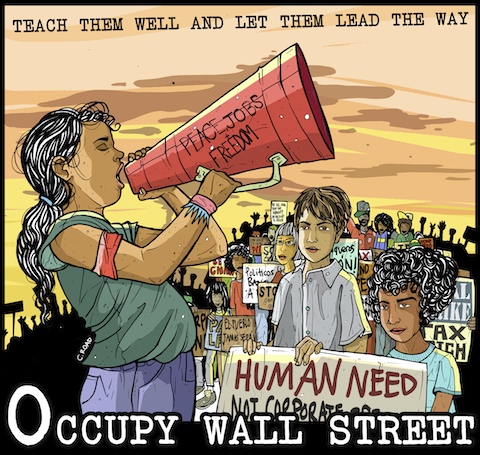
One would think that such “women’s issues” would make unarguable the centrality to economics of female human beings. Wrong. Too often, the Occupy movement has betrayed its own vision by revealing itself as a sexist microcosm of the society it opposes. Harassment and assaults required women to define safe sleeping areas—immediate necessities yet questionable strategically, since these can become “ghettos,” while the problem, a  male sense of entitlement, goes unchallenged.

Nor does this happen only in the United States, although North American sites got more press attention. Incidents of sexual assault and rape have been reported not only in New York, Cleveland, Dallas, and Baltimore, but in Glasgow, Montreal, London, and more. In some locations, male site monitors were reluctant to call police for fear that negative attention would be deleterious

by Christy C. Road

to the Occupy “message.”

Brooklyn, Occupy Imnop, from Occuprint.org

Now, however, women are protesting that kind of protest. In Bristol, England, feminists called for “Carrying Our Safe Space With Us,” aiming to empower women to speak at Occupy general assemblies. On November 25, International Day for the Elimination of Violence Against Women, Feminists Occupy London took to the streets denouncing rape; that same day, Italian women marched in Rome, defining economic austerity measures as a form of violence against women, and citing policies that in effect force women to work multiple jobs, paid and unpaid. In Manila, Occupy was taken over by women, becoming Occupy RH (reproductive health), Filipina-led. Women in Slovenia, New Zealand, and Australia publicly decried the lack of safety for women at Occupy sites.

Such international groups as Code Pink, WomenOccupy, RadFem, the Filipina network Af3IRM/GabNet, and others raised women’s profile, thus challenging men’s hegemony. The Feminist Peace Network established the Occupy Patriarchy website, to  provide a supportive, global space for  feminist analysis, response, organizing, and networking within the global Occupy movement.

Having caught the world’s imagination with an admirable energy, seemingly spontaneous and seemingly grassroots,  the Occupy movement is now poised at a crossroads. It has enormous potential—but lasting change will require consciousness that doesn’t ignore the majority of  humanity. It needs to break free of being “a guy thing” or risk drowning in its own rhetorical generalities.It’s not as if certain models aren’t there. The women of England’s Greenham Common “occupied” turf decades before OWS—they endured, and won. Irish women barred doors to keep men from storming out of Northern Ireland peace talks. Women in Liberia sat singing for months in a soccer field to birth a revolution. Market women in Ghana brought down a government. Gandhi acknowledged copying the concept of  Satyagraha— nonviolent resistance—from India’s 19th century women’s suffrage movement.

These are  different—and long-lasting—techniques of protest, by which at first it seemed the Occupy movement was influenced. (At the risk of offending anarchists, I’ll paraphrase two of the Women’s Media Center slogans: “You have to name it to change it,” and “You have to see it to be it.” As a woman who once agreed “Level everything, then we’ll talk politics,” I recommend examples and clearly articulated demands as pretty good stuff.

It’s not too late. As the Occupy movement in many areas moves away from the tactic of claiming physical space, a change of protest style is in order: more hit-and-run, engage-disengage, morning-long, afternoon-long, or day-long (not open-ended) demonstrations—plus focused, doable demands.

Most women have far too many other responsibilities—including children—to spend months in tents playing drums, even if the tents were safe spaces. The Occupy movement needs women—the numbers, the economic analysis, the different strategic approach—to survive, let alone succeed. Yet women’s engagement with it might well require turning up in numbers massive enough to effect a de facto transformation of leadership and focus;:occupying Occupy in a “women’s style” could make all the difference.At the minimum, it should be possible to demand that men become the change they claim they want to see.  (I mean,really, guys.) If Occupy men can dare be unafraid of that different kind of leadership—can even seek it out and welcome it—everyone wins and the paradigm is transformed.

If not, they will at least have radicalized a whole new generation of feminists.

Women’s Media Center  (reblogged whole article with thanks)