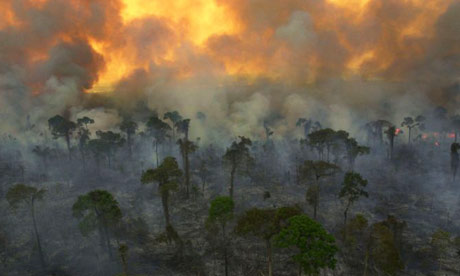
Amazon destruction..6 fold increase..- 593,000,000 m2 in 2 months

BRASILIA (AFP) – A sharp increase in forest destruction in March and April in the Amazon has led Brazil to announce the creation of an emergency task force to fight against deforestation.

The two-month total of 593 square kilometers (368 square miles) deforested represents a six-fold increase compared to the same period last year, according to official statistics. The office will be comprised of government experts and representatives of states badly impacted by recent deforestation, according to Environment Minister Izabella Teixeira, who announced the office at a press conference. “Our goal is to stifle deforestation,” Teixeira said. “And we are going to do it by July.”

In the Amazon state of Mato Grosso alone, 480 square kilometers (298 square miles) of forest were destroyed in two months, according to official statistics based on satellite images.

The land is used for cattle and soybean farming. Teixeira said those responsible for illegal deforesting will have their cattle seized. Officials in Mato Grosso are investigating how so much land was destroyed in their central-western state, Teixeira added. Brazil, the world’s fifth largest country by area, has 5.3 million square kilometers of jungle and
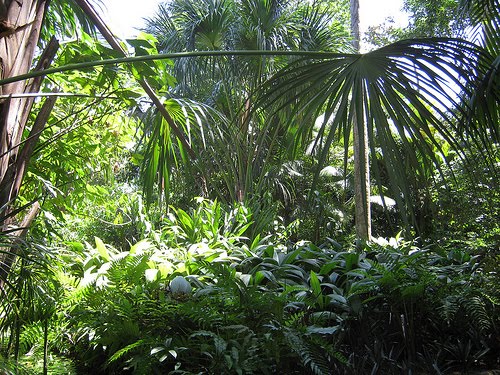
PARÁ, BrazilThe Amazon jungle is metaphorically referred to as the lungs of the world: CO2 in, O2 out, transformed through a dense emerald mass. It’s an irreplaceable treasure, in many spots still unmapped, and a biological preserve filled with species that we likely haven’t even seen.http://theamazonforest.blogspot.com/2009_11_01_archive.html

forests — mostly in the Amazon river basin — of which only 1.7 million are under state protection. The rest is in private hands, or its ownership is undefined.

Massive deforestation has made Brazil one of the world’s top greenhouse gas emitters. But the pace of deforestation peaked in 2004 at 27,000 square kilometers a year, and in 2010 it dropped to 6,500 square kilometers. The announcement comes as Brazil’s Congress debates a bill that has sparked clashes between environmentalists and supporters of farmers and ranchers over how to regulate the country’s vast but vulnerable wilderness. At issue is a reform of the 1965 law regulating forestry.

The current law forces land owners that have forest on their property to keep part of it intact. A reform is being pushed by Brazil’s powerful agribusiness sector, which is chafing under the country’s strict environmental rules.

Brazil is a major world exporter of grains — including wheat, rice and corn — as well as soybeans, coffee and beef, and posted record exports worth $80 billion over the past 12 months, according to recent government figures. The government hopes the proposed reform would force private owners to re-forest land they have already destroyed. Debate has created splits across the political spectrum, and President Dilma Rousseff’s control over her party on the issue appears in question.

Rousseff pledged during her campaign to make no concessions that would result in further deforestation or threaten Brazil’s international environmental commitments.

http://news.yahoo.com/s/afp/20110519/sc_afp/environmentbrazilpolitics_20110519013854
Still NO Roadmap for Sustainable Development

By Portia Crowe

UNITED NATIONS, May 18, 2011 (IPS) – The road to the crucial Rio+20 conference on greening the world economy next year has hit a setback with the breakdown of the 19th session of the U.N. Commission on Sustainable Development after 10 days of intense negotiations.

No decisions were adopted at the session, also known as CSD-19, which ran from May 2-13 in New York and examined consumption and production, transport, chemicals, waste management and mining.

BRAZIL ..New Forest Code sellout.

By Clarinha Glock*

PORTO ALEGRE, Brazil, May 16, 2011 (Tierramérica) – The adoption of a new Forest Code in Brazil could threaten efforts to curb Amazon deforestation, which was reduced 70 percent between 2004 and 2010.

The proposal to amend the current Forest Code, presented in the Chamber of Deputies by Communist Party of Brazil representative Aldo Rebelo, was to be put to a vote on May 11. After hours of heated debate, the vote was postponed until Monday May 16. But on Monday the entire process was once again put off.

In addition to reducing the so-called permanent preservation areas that must be reforested if cleared, it establishes an amnesty for landholders who have illegally cleared forests on their properties. Under the current legislation, they are subject to fines. “This makes it seem as if the law wasn’t made to be obeyed,” said Azevedo.

If this part of the proposal is approved, reforestation would no longer be required on up to 15 million hectares of land, according to the Ministry of Environment.

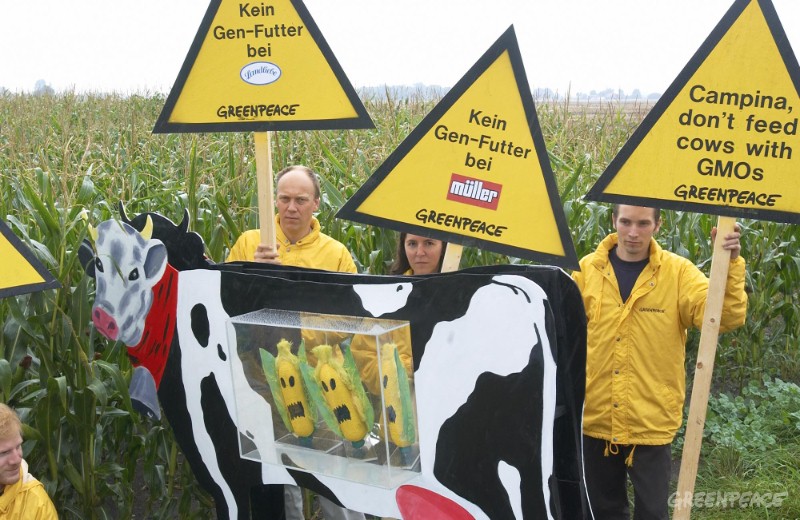
Activists Dump GMO Foods at shops

Activist Dump Genetically-Modified Groceries

If you’re walking past the Lincoln Park Whole Foods this morning and see a huge heap of food sitting on the ground, it’s not a sale. The Organic Consumers Association, as part of their “Millions Against Monsanto” campaign, is dumping genetically modified foods in front of Whole Foods at noon. They’ll also be holding a press conference, in an attempt to convince more of the food-shopping public that GMO foods should be labeled.The “Millions Against Monsanto” campaign is fighting for transparency in labeling, an issue which causes tremors amongst the food industry. While almost all of us have eaten genetically modified food of some sort, a 2006 survey by Pew indicates that less than 30% of consumers think they have – probably because there is no requirement that genetically-modified food be labelled. On the other hand, food producers are worried consumers are much less likely to buy foods if they have scary labels with scientific terms on them, and Monsanto claims that genetically modified foods have no proven health risks. [Full Disclosure – I am a member of the OCA, but do not plan to participate in this protest.]

The problem gets even more complicated. In order to get USDA organic certification, a product cannot contain GMOs. Whole Foods also has started a program, through the Non-GMO project, to make sure that their store-brand products are GMO free. But, Whole Foods (despite its environmental credentials) still carries many conventional products, which may contain GMOs. Should they be forced to label them?

>>> Read the Full Article

Illegal Logging Spreading in Madagascar

Illegal Logging Spreading in Madagascar
By Lovasoa Rabary-Rakotondravony

ANTANANARIVO, May 19, 2011 (IPS) By Lovasoa Rabary-Rakotondravony

– The transitional authorities in Madagascar are struggling to overcome the problem of illegal logging of precious wood. In spite of an April 2010 decree that prohibits the logging, transporting, trading and export of precious woods, felling in the forests is still continuing.

In mid-April, the heads of the police force of Antalaha, a town on the northeastern coast of Madagascar – the area most affected by the phenomenon – seized 30 tonnes of rosewood being transported in two trucks.

But this is far from the only place where trafficking in illegal timber is taking place on this island, which has the biggest rosewood reserves in the world. A few days earlier, three other trucks transporting 115 rosewood logs, were intercepted in Tolagnaro, in the southeast. Before the raid, more than 1,000 pieces of another kind of precious rosewood found in Malagasy forests, were seized in the same region.

In Mahajanga in the northwest, more than 250 containers full of rosewood destined for export have been held at the port since December 2010. Most of this wood comes from Mampikony, an area situated about 250 kilometres southeast of Mahajanga, Ndranto Razakamanarina, a forestry engineer and president of the Voahary Gasy alliance, an umbrella body of civil society organisations working for the protection of the environment, told IPS.

Destroying the Arctic for a three-year fix

How much oil lies under that Arctic ice? 90 billion barrels, according to the US Geological Survey.

But, how much really is that? If you ask an oil company, that’s a huge amount. With a barrel of oil over the hundred dollar mark, that’s nine trillion dollars worth at today’s prices – if you could get at it all.

However, there’s a much more important number than the mind-boggling figures that the oil companies deal in.

That’s the number of years the Arctic oil could keep our addiction going for.

Three years.

It’s astonishing. All the flag planting, dragging of icebergs and gambling with risky drilling, is all to dig up a dead fuel that will only keep us going for three years (global consumption is approx. 80 million barrels / day).

via Destroying the Arctic for a three-year fix | Greenpeace UK.

This blog promotes ‘The Free’, an adventure novel set in the collapse of Capitalism.  free DOWNLOAD page, click HERE 

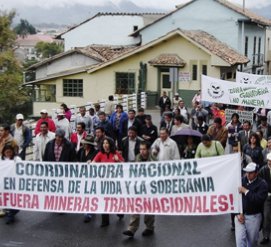
No Justice, No Peace: Mining in Ecuador

No Justice, No Peace: Canadian Mining in Ecuador and Impunity | 

Lawsuits against the blatant atrocities of mining corporations have been thrown out, one in Canada and the other in Ecuador, where projects are pushing ahead despite passionate united local, cultural  and environmental opposition.

‘Water is worth more than Gold!’ is the popular warcry.

No Justice No Peace

”…Therefore, many communities could read into the defeat of the lawsuit that their only practical (and affordable) solution to the threats that mining and other extractive industries pose on their rights, land and cultures lies in physically standing up to these projects – even at the risk of being labeled terrorists or saboteurs….

This, at a time when special laws are being enacted in countries rich in natural resources, such as Ecuador, to judicially categorize acts of civil disobedience as terrorism.

As of today, there are nearly 300 activists in Ecuador facing terrorism and sabotage charges for standing up to mining and other extractive activities that threaten the livelihood, or well-being of communities and the environment….

Over half of these targeted activists are indigenous, including the leaders of the most important indigenous groups in the country…..

Ironically enough, this happens in the context of Ecuador’s progressive Constitution, which recognizes that nature has rights, and that Ecuadorians have the right to a good life (Sumak Kawsay)….

Take away the only effective tool that communities and indigenous people have to protect these rights from transnational corporations and you have the making of a major, and sustained, human rights nightmare supported by the State….”

Continued…

No Justice, No Peace: Canadian Mining in Ecuador and Impunity | 

This blog promotes ‘The Free’, an adventure novel set in the collapse of Capitalism.  free DOWNLOAD page, click HERE