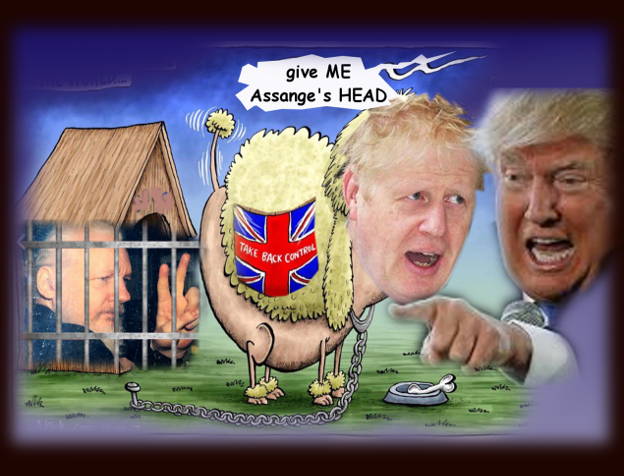
Follow RT on Julian Assange’s extradition to the US would sound the death knell for both investigative journalism and the rule of law, Pink Floyd co-founder Roger Waters told RT ahead of a march organized in support of the WikiLeaks publisher.
Campaigners have projected the footage of an American airstrike on Iraqi civilians, originally exposed by WikiLeaks, onto the parliament building in London, to protest against the proposed extradition to the US of Julian Assange. Clips from the infamous 2007 footage were projected onto Westminster Palace, where both houses of parliament are located.
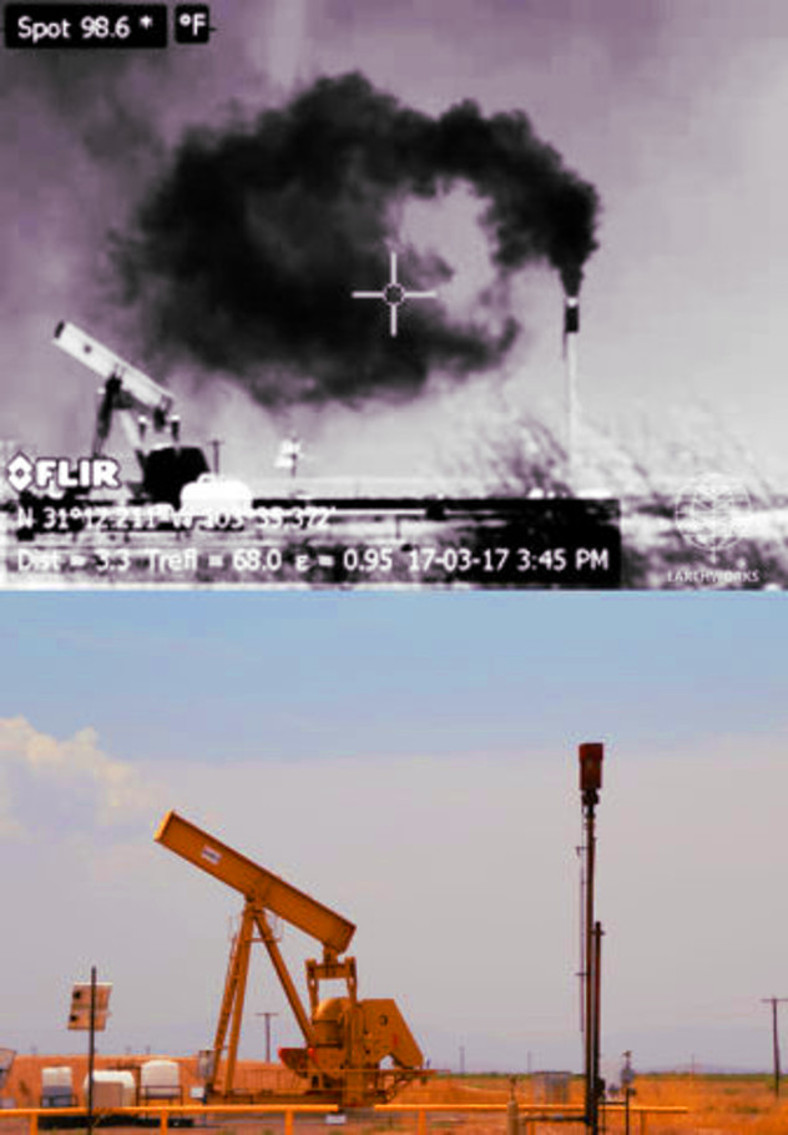
[Top] Optical gas imaging by Earthworks reveals normally invisible air pollution from an unlit flare. [Bottom] A regular still image taken at the same time and place shows what you see with the naked eye
Back in 2007 we already got this news in a Nature published study by Robert Howarth and c . But the US media and corrupt capitalist politicians denied the proof, even when images from space showed huge clouds of methane over the gigantic US fracking fields .(PDF) Methane and the Greenhouse-Gas Footprint 2007
Obama was only able to implement a call for voluntary checks by the gangster style US energy industry on the then already over one million fracking wells, all with zero methane management, excused even from the Clean water legislation, and half of them already abandoned.“Fracking” Shale Gas Emissions Far Worse Than Coal For Climate …A groundbreaking report
With the advent of Trump among hundreds of criminal ecocidal policies even voluntary checks on methane releases were abandoned. Ubiquitous fracking gas and oil wells made the US nearly self sufficient, (though the extraction has always been uneconomic), while covertly flooding the planet with methane up to 85 times as bad as CO2 in the short term.
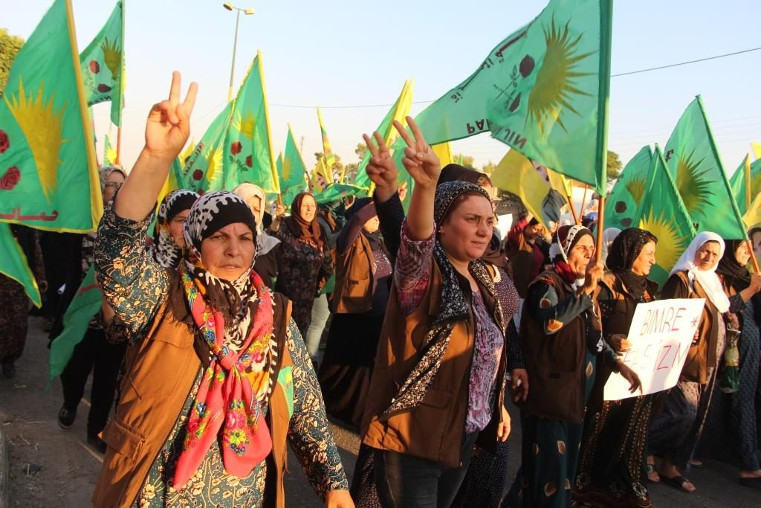
These are the reflections of an internationalist woman from Catalonia who joined the YPJ defence of North and East Syria. Originally published in Spanish here.
I arrived in March, it was very cold and everyone welcomed me warmly. They all crowded together by the stove, brought tea and cigarettes. They looked at me with big eyes, asked me: “Where are you from?” Someone said quietly… “she’s from Europe”. “How did you get here? Do you understand Kurdish?”
I felt an emotion not easy to explain… I had them before my eyes, members of YPJ, from the unit of Serekaniye. Young comrades, some mothers of children being cared for by their own mothers because they joined the People’s Defence Forces, some who had joined by escaping from their families because they did not want to be slaves to unknown husbands and unwanted babies, some from families ravaged by war, some convinced of the defence of Democratic Confederalism and the words of Serokatî, some for avenging fallen relatives and friends; Arabs, Kurds, Muslims… all together under the same promise. And I, who did not yet know all that I would be taught about the meaning of life and of being born a woman in the Middle East.
France. The strangely intermittent general strike in opposition to proposed pension reforms in france is neither “general”, nor truly a “strike”. If the movement is soon to enter its third month, with another day of protest scheduled for today (Yesterday, Paris-luttes.info), the strike has never succeeded in paralysing the country’s economy (indeed, it barely reaches…
PUSL.- Dos años y ocho meses después del último juicio del grupo de presos políticos conocido como el Grupo Gdeim Izik, estos 19 saharauis detenidos en las cárceles marroquíes siguen siendo maltratados. Los presos políticos en Gdeim Izik siguen sin atención médica, la cual es rechazado en repetidas ocasiones por las autoridades marroquíes, aunque la […]
Corporate Watch “The earth is not dying, it is being killed, and those who are killing it have names and addresses.” – Utah Phillips London is one of the main worldwide hubs of ecocidal capitalism. This city is home to oil and gas giants including BP and Shell, as well as many of the world’s […]
Fossil fuel companies hold vast oil, gas and coal riches that they frequently tout to the investing universe to help elevate their market values. However, not a single energy company has ever told investors about the potential effects on the environment if all their hydrocarbon reserves were burned..
And certainly few, if any, have ever told investors that a large chunk of these assets could be doomed to forever remain buried in the ground – and essentially worth nothing – should environmental regulations tighten.
Yet, the specter that these assets might one day end up stranded and theoretically worthless as the clamor for clean energy heats up looms large.
According to estimates in the Financial Times’ Lex column, nearly $900 billion worth of reserves – or about one-third of the value of big oil and gas companies – is at risk of one day becoming worthless as market and policy forces continue to undercut hydrocarbon economics due to the threat of climate change.
In effect, these companies could see a third of their value evaporate if governments aggressively attempt to restrict the rise in temperatures to 1.5C above pre-industrial levels for the rest of this century and avert catastrophic climate change as per Intergovernmental Panel on Climate Change (IPCC) estimates.
Consequently, investors are likely to increasingly price in the risk of asset writedowns by the world’s leading oil and gas companies unless a solution to the ongoing climate change is found within the next decade.
High Risk Investments
The effects of such a huge scale in writing off frozen assets – gradually at first and then at an accelerated rate – is likely to be keenly felt across the business world.
´´Capitalism on edge of Mega Crash> In league with the Fossil Fuel mafia the US has decimated oil production in Venezuela, Iran, Libya, Syria, etc to boost its own frack oil and gas, using every means short of open war… but still oil and gas prices keep falling as world trade spirals down. Distrust in the system spreads like coronavirus. . Ubiquitous US sanctions prove to be a self defeating Protection Racket, as consumption falls and climate change and ecological collapse begin to snowball. Perhaps we will see real cuts in CO2 emissions yet in 2020!”
We could argue that notoriously secretive national oil companies (NOCs) and not independent oil companies (IOCs) are the biggest financial risk since they control ~$3 trillion in oil and gas assets and an estimated 90 percent of all known reserves. Nevertheless, considering that publicly traded energy companies have collectively lost $400 billion in their fundamental value over the past five years, losing anything in that ballpark over the next five could be disastrous for the sector.
A good case in point is Chevron Corp. (NYSE:CVX), which recently reported a large $10.4B shale asset writedown. ExxonMobil (NYSE:XOM) also recently found itself in the hot-seat over its failure to make disclosure about climate risk even as shareholder pressure for risk disclosure mounts. It was later absolved.
Here’s a rundown of the financial risk burden that fossil fuel companies carry:
Stranded Assets – the assets currently contributing to the market value of many fossil fuel companies that cannot actually be developed and sold will lower their overall valuations
Loss of market capitalization – downward pressure on energy stocks from divestiture efforts especially by institutional investors could hurt your mutual funds and stocks
Cost of capital – in December, we reported that Goldman Sachs had ruled out financing drilling in the Arctic as well as new thermal coal mines anywhere in the world and that other large banks were likely to follow suit. Fewer banks willing to finance fossil fuel projects will make it progressively more expensive to bring these buried assets to market
Scarcity of insurance – by the same token, fewer insurance companies will be willing to back such projects, thus increasing both the cost and time to get the necessary insurance to build them
Insufficient renewables investment – faced with this critical disruption in the well-established fossil fuel model, it would be smart to develop substantial lines of business that do not carry these risks. Yet, current investment in low carbon energy sources by fossil fuel companies is less than 1 percent, way too little to move the revenue needle for the vast majority
Market risk – there might be seismic changes in how the market begins to value fossil fuel reserves
The Dirtier, The Riskier
Although the Lex report sounds decidedly bearish, let’s not forget that even a more benign case where governments target a 2C rise in temperature – which is what they targeted at the 2015 Paris Agreement on climate change meeting – energy companies would still have to write off more than 50 percent of their reserves as stranded assets.
Meeting the 1.5C threshold would mean leaving over 80 per cent of hydrocarbon assets worthless.
In a recent piece on climate change, we reported that global energy emissions are showing serious signs of slowing down due to a more aggressive clean energy push.
Global CO2 emissions climbed just 0.6 percent in 2019 compared to 3.4 percent in 2018 thanks to China’s green energy push. Better still, the IEA sees CO2 levels in 2050 clocking in at 4 percent below 2019 levels despite an otherwise healthy economy, thanks in large part due to coal power retirements while natural gas consumption – with a lower carbon footprint – is expected to increase quite dramatically. Related: Peak Shale Will Send Oil Prices Sky High
Ultimately, we could be at the cusp of one of the biggest ever shifts in the allocation of capital in the energy sector. Investors need to be wary of the risks that could come with this shift.
A recent study from Harvard, published in Geophysical Research Letters by Turner et al used satellite data over the US and found a 30% increase in methane releases since 2002.