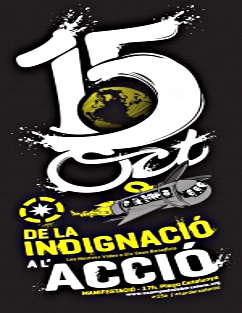
La primera marcha indignada a Bruselas cruza la frontera belga.
La Ruta 1, la marcha procedente de Madrid, cruzará mañana martes 4 de octubre la frontera entre Francia y Bélgica.
Unos setenta caminantes saldrán el martes a primera hora de la mañana de Lille con destino final del dia en Warengem, la primera ciudad belga donde pernoctarán tras más de mil quinientos kilómetros de caminata.
Tras instalar el campamento realizarán la primera Asamblea General en territorio belga.
El recorrido hasta Bruselas dentro del país será el siguiente:
The front of his white and blueT-shirt had the Watershed Management Group (WMG) logo on it and in a font that looked like it had been stamped diagonally across read the words “CO-OP”. When he turned around to grab a pick axe, other wise known as an Arizona Shovel, the back of the shirt said “I Do My Labor with My Neighbor!”.
-This catchy little phrase does more than just rhyme. It tells of an opportunity for community, a way to reach an otherwise high costing goal. A chance to not only change your own personal landscape, but eventually heal a neighborhood and enjoy a little bit more of a responsible feeling as you look out at your land.
-The WMG has created, and successfully run, this CO-OP program down in Tucson and I have been lucky enough to not only participate in some of the workshops, but I have also been able to meet some amazing and interesting people who share like views on how we should be friendly to the desert……….
……….. -While the clock neared the end of the workshop…who am I kidding, it was actually an hour past end time, the clouds could no longer hold back their hydro-soaked insides and it began to RAIN!! Like I said, the workshop was officially over, but there was still almost every single volunteer still there. This was a passion and a need to see this through. A belief that this was important and an opportunity to grow a property AND grow the knowledge inside. So we hit another gear, put the final pieces into place, and actually started catching that SkyGold into one of the pur-tiest metal tanks in the neighborhood.
-My brain, my clothes and my passion left soaked that early evening as I drove off…back to the Valley of the Sun. -Hopefully in the very near future, I too can wear a white shirt with a blue logo that PROUDLY states:
Here’s what I’m excited about these days: we just held a volunteer workshop to totally makeover a Tucson family’s front yard. 15 volunteers transformed it from a sterile, black-plastic and rock-laden heat island into a runoff-capturing garden of native plants, organic mulch, and (soon) living soil. This workshop, which was followed by blessed afternoon monsoon rain showers, was just the second in some 24 public workshops that WMG is co-hosting with six different Tucson neighborhoods over the next year. Through these projects we will de-pave a closed alley to turn it into a pocket park, install rainwater-fed trees along the entrance of a school, and create rain gardens in the middle of a parking lot, among other things. We will do all of this alongside volunteers from each neighborhood. 20 of these volunteers recently completed a 5-month training with WMG to assess, design, build, and advocate for these kinds of green infrastructure in their communities.
WASHINGTON, Oct 1, 2011 (IPS) – Home to a fast-growing network of farmers’ markets, cooperatives and organic farms, but also the breeding ground for mammoth for-profit corporations that now hold patents to over 50 percent of the world’s seeds, the United States is weathering a battle between Big Agro and a ripening movement for food justice and security.
Conflicting ideologies about agriculture have become ground zero for this war over the production, distribution and consumption of the world’s food. One camp – led by agro giants like Monsanto, DuPont and Syngenta – define successful agriculture and hunger alleviation as the use of advanced technologies to stimulate yields of mono-crops.
The other side argues that industrial agriculture pollutes, destroys and disrupts nature by dismissing the importance of relationships necessary for any ecosystem to thrive. At the heart of this struggle is the debate about genetically modified organisms (GMOs), which were given the green light in 1990 when the U.S. Food and Drug Administration (FDA) stated, “(We) are not aware of any information showing that GMO foods differ from other foods in any meaningful or uniform way.”
The Pitfalls of Terminator TechnologyAccording to Frees, one of the worst manifestations of GE/M is the use of Terminator technology, used to cause seed sterility and forcibly eliminate seed saving.
“Terminator is a biological means to enforce intellectual property rights, and its introduction into developing countries that rely on saved seeds for 80 to 90 percent of planting could mean elimination of farmers’ right to save seeds; dramatically higher seed costs; and poor farmers’ inability to survive,” he said.
“Terminator is morally reprehensible and must be banned,” Frees told IPS. Lovera added that between 2001 and 2007, annual U.S. glyphosate use on GE crops doubled to 185 million pounds.
“Ubiquitous Roundup application has spawned glyphosate-resistant weeds, driving farmers to apply even more toxic herbicides, according to a 2010 National Research Council report,” Lovera told IPS.
“Farmers may resort to other herbicides to combat superweeds, including 2,4- D (an Agent Orange component) and atrazine, which have been associated with health risks including endocrine disruption and developmental abnormalities.”
“In the United States, irrigated corn acreage increased 23 percent and irrigated soybean acreage increased 32 percent between 2003 and 2008,” she added. “The rising U.S. cultivation of GE corn and soybeans further threatens the strained High Plains Aquifer, which runs beneath eight western states and provides nearly a third of all groundwater used for U.S. irrigation,” Lovera said.
“Ninety-seven percent of High Plains water withdrawals go to agriculture, and these withdrawals now far exceed the recharge rate across much of the aquifer.”
“The worldwide expansion of industrial-scale cultivation of water- intensive GE commodity crops on marginal land could magnify the pressure on already overstretched water resources,” Lovera warned. “But these are the crops the biotech industry has to offer.”
In addition to wreaking havoc on land, GE/M has also filtered into the oceans, with the attempted introduction by Aqua Bounty of GE salmon engineered with a growth hormone gene to grow faster.
“Studies suggest that the salmon could be more susceptible to disease; and if it’s grown in pens in the ocean and [inevitably] escapes, it could mate with wild salmon and make them less fit, potentially devastating wild salmon populations,” Frees told IPS.
But a report released Wednesday by the Washington- based Food and Water Watch (FWW) on the destructive impacts of GMOs added fuel to a two-decades-long fight by farmers, economists and experts against the FDA’s conclusions.
“Genetically Engineered Food: An Overview” details how the genetic engineering of seeds, crops and animals for human consumption is not the foolproof answer long championed by agribusiness and biotechnology industries to feeding the world.
To the contrary, the study found that genetically engineered/modified (GE/M) organisms do not out-perform their natural counterparts, and their proliferation into vast tracts of cropland have caused a slew of environmental and health crises, and actually increased poverty by forcing millions of farmers to “buy” patented seeds at exorbitant prices.
The report also says that three U.S. federal agencies – the FDA, the Department of Agriculture (USDA) and the Environmental Protection Agency (EPA) – are complicit in these crises due to shoddy oversight, weak enforcement of regulations and a complete absence of coordination.
It found that Big Agro spent half a billion dollars between 1999 and 2009 on lobbying to ease GE regulatory oversight, push GE approvals and prevent GE labeling.
This, after attorney Steven Druker in 1999 obtained 40,000 pages of FDA files containing “memorandum after memorandum warning about the hazards of (GE) food,” including the likelihood that they contained, “toxins, carcinogens or allergens” and testified that GE foods violated “sound science and U.S. law”.
Ceci King, a member of the Black Farmers and Agriculturalists Association, told IPS that in 2011, an estimated “60 to 70 percent of all processed foods in the U.S. contain at least one GE element.”
“Eighty-four percent of GM crops in the world today are herbicide- resistant soybeans, corn, cotton or canola, predominantly Monsanto’s ‘Roundup Ready’ varieties that withstand dousing with herbicide,” Bill Frees, science policy analyst at the Center for Food Safety (CFS) and author of ‘Why GM Crops Will Not Feed the World’, told IPS.
“Pesticide and chemical companies like Monsanto, DuPont, Syngenta, Dow and Bayer have bought up many of the world’s largest seed companies, and now call themselves biotech companies – this represents a historic merger of the pesticide and seed industries, which allows them to profit twice by developing expensive GM seeds that increase use of the company’s herbicide products,” he added.
Seed patents, an off-shoot of the “agro-biotech revolution” that also spawned GE/M, have had two negative consequences since their original issuance by the U.S. Patent Office in the mid-1990s, Frees told IPS: “They enticed pesticide companies to buy up seed firms; and they led to criminalisation of seed-saving.” “Farmers have saved seeds from their harvest to replant the next year for millennia,” he added. “Monsanto is changing that. The company has already sued thousands of farmers in the U.S. for saving and replanting its patented seeds and won an estimated 85 to 160 million dollars from farmers, in lawsuits that have ruined farmers’ lives, and (partially explains) why we have ever fewer farmers in America.”
The fightback
Ray Tricomo, a mentor at the Kalpulli Turtle Island Multiversity in Minnesota, told IPS, “People of colour must re-radicalise themselves and go on the offensive including the return to land bases, from Turtle Island to Africa and Asia.” “Ancient knowledge systems are to be painstakingly recovered, even if it takes centuries,” he added. And this is exactly what is happening.
Despite the deep pockets and aggressive efforts of Big Agro, a major pushback from a broad coalition of forces has limited 80 percent of GE/M planting to just three export-oriented countries: the U.S., Brazil and Argentina. Nearly two dozen other countries, including the European Union and China, have passed mandatory GE/M labeling, and millions around the world are refusing seed patenting and developing seed banks to protect, share and preserve their seeds.
In Florida, the 4,000-strong Coalition of Immokalee Workers (CIW) is organising to resist farm wage-slavery and “seed-servitude”. The Landless Workers Movement (MST) in Brazil has organised 400,000 peasants to join forces with the nearly half-billion farms around the world that are responsible for producing 70 percent of the world’s food. Navdanya, an organisation in the Indian State of Andhra Pradesh, has united 500,000 farmers in their struggle to fight chemical dependency and save indigenous seeds, including preserving over 3,000 varieties of rice. “For five years, the United Nations Conference on Sustainable Development (CSD) had indigenous farmers from all over the globe come to speak against destructive farm practices and GMOs,” King told IPS.
“During the Indigenous People’s Permanent Forum, there were complaints about the harm caused by industrial agriculture and the acts in the name of agribusinesses. Farm workers like the (CIW) are protesting their fate,” she added. “They are picketing companies like Trader Joes and Whole Foods, letting the public know that their tomatoes were picked from workers who are basically slave labour.” “Third World Network is fighting back by exploring the problem of GMOs and publishing findings that scientists working on GMOs are capitalists using humans as guinea pigs in a global lab experiment,” she added.
“[Numerous] deaths and disabilities have been traced back to a GM product emulating tryptophan. It took nearly 20 years to find the source of the problem,” King told IPS. “GM technology i antithetical to an agroecological approach to agriculture, our only hope for truly sustainable food production,” Frees told IPS. “Without radical change we will continue to have famines,” he added. “Haiti is a good example of what happens when a country’s farmers are put out of business by cheap, subsidised imports from a rich producer nation (here the U.S.).”
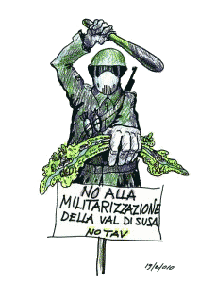
Stop that train!In May,2011 the construction site in Susa was occupied and fortified. On June 26 a massive police army finally evicted the site, after determined resistance by the whole population. The next week 50,000 gathered for another pitched battle and since then it is the police who are under siege. The resistance is stronger than ever, and work had yet to begin.
Latest News is that Italy is totally trapped by Impossible Debts, it’s less and less likely that this TAV line will proceed, indeed the Italians may yet get credit for toppling the teetering capitalist system!
NO TAV (No to the High Speed Train) is a movement based in the Susa Valley in Piedmont that opposes the creation of the new high speed railway line between Turin and Lyon in France.
The simple principle behind the movement is that a new high speed railway line in the Valley is completely useless and not needed, its only purpose being the profit of the many private companies that have shares in it.
The NO TAV think that the current railway line between Piedmont and France is more than sufficient, considering that traffic in the area has never been incredibly high. More importantly, the construction of the line would utterly and irreversibly destroy a huge part of the Susa Valley, causing not only an environmental but also an economic and social disaster, with businesses closing down and villages being completely disfigured or disappearing.
High speed railway lines in Italy are considered to be of “strategic interest”, which translated from political bullshit language means that the law allows this type of works WITHOUT consulting the local population and institutions whatsoever. At a time of economic collapse such as Italy is going through, the works require billions of Italian taxpayers’ money, at the expense of primary services like education and health. It would mainly be construction and other private companies profiting from it, but when finished and in use, the low demand for the line would end up making it a loss-making burden on the taxpayers. Like in Rossport, Ireland, the locals’ concerns and proposals are being completely ignored in the name of the only Modern God: money.
The NO TAV came up with their own plan for the area which would include: – changing the production and distribution processes to decrease transport of people and goods, especially on long distances – supporting local sustainable trades instead of big industries – creating or improving local means of sustainable and green transport for workers and students – supporting and incrementing the use of the already existing local railway line
Myanmar’s president called Friday for work on a controversial Chinese-backed hydroelectic dam to be halted and the concerns of its critics settled, in a startling turnaround welcomed by democracy activists and environmentalists. President Thein Sein said in a statement read out on his behalf at Parliament that the $3.6 billion Myitsone dam project in the northern state of Kachin should be suspended because “it is against the will of the people.” Thein Sein’s statement said Myanmar would discuss pending contracts regarding the dam with China.
Environmental activists have said the dam would displace countless villagers and upset the ecology of one of the country’s most vital national resources, the Irrawaddy River. It also would submerge a culturally important site in the ethnic Kachin heartland where the Malikha and Maykha rivers meet to form the Irrawaddy. The Myitsone dam was supposed to export about 90 percent of electric power it generated to neighboring China, according to the government. The vast majority of Myanmar’s residents, meanwhile, have no electricity.
“This is the first time in 50 years that the government has given in to the wishes of the people,” said Dr. Than Tut Aung, a prominent publisher who is also one of the leading advocates of the“Save the Irrawaddy” campaign. “The decision to suspend the dam project is not just an environmental issue but a national issue. We welcome the good news.”
Thein Sein came to power in March after the nation’s long-standing junta disbanded, promising to bring democratic reforms to one of Asia’s most repressive nations. But skeptics see his government — dominated by retired military officers — as a proxy for continued army rule, and there has been much debate over whether his reform pledges are merely rhetoric.
The new government has boosted hope for change by unblocking the long-censored Internet, calling on exiles to return, and holding talks with prominent opposition leader Aung San Suu Kyi, who was released from seven years of house arrest last year.Yet more than 2,000 political prisoners remain behind bars, while fighting with multiple armed ethnic rebellions has displaced about half a million people within the country and forced at least 200,000 more to flee abroad.
On Friday, Suu Kyi met for a third time with Labor and Social Welfare Minister Aung Kyi, part of an ongoing dialogue between the two sides that some see as proof the that concrete change is imminent.
Afterward, Suu Kyi said she welcomed Thein Sein’s message on suspending the Myitsone dam. “All governments should listen to the voices of the people,” she said.
A judge in Brazil has ordered a halt to construction of a multi-billion-dollar dam project in the Amazon region.
Judge Carlos Castro Martins barred any work that would interfere with the natural flow of the Xingu river.
He ruled in favour of a fisheries group which argued that the Belo Monte dam would affect local fish stocks and could harm indigenous families who make a living from fishing.
The government says the dam is crucial to meeting growing energy needs. Judge Martins barred the Norte Energia company behind the project from “building a port, using explosives, installing dikes, building canals and any other infrastructure work that would interfere with the natural flow of the Xingu river, thereby affecting local fish stocks”.
Legal battle
He said the building of canals and dikes could have negative repercussions for river communities living off small-scale fishing.The judge said building work currently underway on accommodation blocks for the project’s many workers could continue as it would not interfere with the flow of the river.
The consortium behind the project will appeal against the decision.
Now is the moment to escalate the campaign as this will probably be only a temporary victory
More than 700 people from the Occupy Wall Street protest movement have been briefly arrested for marchimng on New York’s City’s Brooklyn Bridge, police say.
They were part of a larger group crossing the bridge from Manhattan, where they have been camped out near Wall Street for two weeks.
“We are unions, students, teachers, veterans, first responders, families, the unemployed and underemployed. We are all races, sexes and creeds. We are the majority. The one thing we all have in common is that We Are The 99% that will no longer tolerate the greed and corruption of the 1%. We are using the revolutionary Arab Spring tactic to achieve our ends and encourage the use of nonviolence to maximize the safety of all participants.” read more at Occupy Wall Street website and occupytogether.org.
UPDATE, 6:07 pm Kristen reports via text: ”Now it’s raining. There are still hundreds of us, people are putting backpacks on their fronts, so cops don’t take them when we’re arrested.”
She says that rumors in the crowd include the suggestion that the Lawyers Guild is working on bail money for the arrested protesters and negotiations with the cops. She says, “a friend told me there’s a rumor this is over. It’s not over.”
As for morale? The remaining protesters are huddled together under umbrellas singing “this little light of mine.”
A Massive Union Just Voted To Side With Protesters
According to Daily Kos, The New York Transit Workers Union (TWU) voted to support the Wall Street Protestors at their meeting last night. A member of TWU Local 100 told a reporter that they would join the protest Friday at 4PM.
Here’s more about them from their website: The TWU has four main divisions: Railroad; Gaming; Airline; Transit; and Utility, University and Service. The Union has 114 autonomous locals representing over 200,000 members and retirees in 22 states around the country.
Occupy Wall Street has been picking up some decent support from unions in the past few days. Yesterday we reported that the Teamsters Union declared their support for protestors, and we also found out that the United Pilots Union had members at the protest demonstrating in uniform.
Today we learned the Industrial Workers of the World put a message of support on their website as well.
UPDATE: Verizon union workers have joined the protestors in NYC.

 La primera marcha indignada a Bruselas cruza la frontera belga.








 The Free