Civil society organizations have called for Saturday, March 15, to be a day of national mourning, with no place for politicians. On March 5, the Warrior Searchers of Jalisco, a collective of family members of the disappeared, found a gruesome scene ..
by It’s Going Down on 15th March 2025 via thefreeonline at https://wp.me/pIJl9-GjH Telegram t.me/thefreeonline/2579

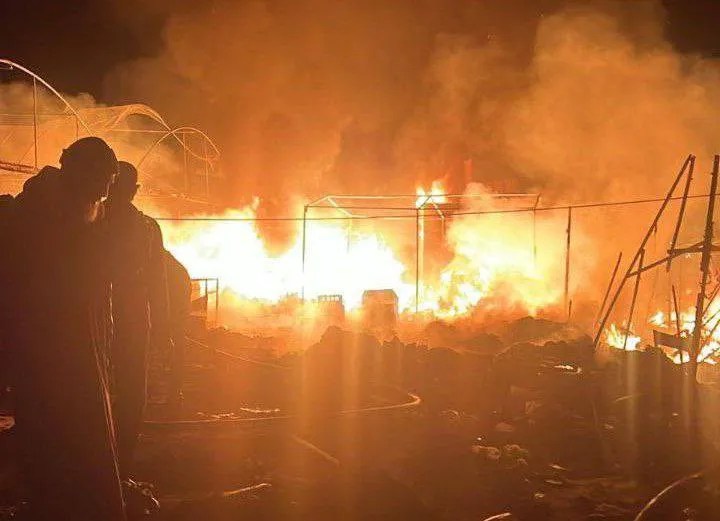
Outrage and grief have shaken Jalisco and the entire country after the discovery of three clandestine crematoriums on a ranch in Teuchitlán, where hundreds of items of clothing and between 200 and 400 pairs of shoes were found, in addition to charred skeletal remains.
There, at a location supposedly searched by the state government in September 2024, they found three cremation ovens, clandestine graves, hundreds of human remains, and countless personal items and clothing, along with lists of names.
The discovery of the forced recruitment and extermination camp run by the Jalisco New Generation Cartel (CJNG) has sent shockwaves throughout Mexico.
It is a moment that makes plain the profound severity of the crisis gripping the country and the collective trauma endured after nearly twenty years of the so-called “drug war.”
Civil society organizations have called for Saturday, March 15, to be a day of national mourning, with no place for politicians. The below text by Silvia L. Gil, published in Revista Común and translated by Scott Campbell, wrestles with the significance of what was found in Teuchitlán and what might be needed to counter the horror.
Several years ago, I heard a colleague say that in order to stop evil from reproducing itself, we had to stop denying it. She argued that our societies had put on a blindfold. Although this may be true in some parts of the world, it seemed to me that in Mexico what we needed was more of a truce, to stop staring horror in the face.

That the problem was not exactly that we should look more or better, but that to survive in the face of what we already saw we should stop looking. At least for a while. This apparent paradox – pain surrounds us, but we cannot become so sensitized as we run the risk of being paralyzed – is very important in this time when violence and extreme precarity have intensified.
There comes a point at which we are unable to assimilate all that we see in a world of injustice. If in other latitudes with this situation – which we can call a global war against life – an answer is sought to the initial question of how to not deny the pain that is spreading throughout the world, in Mexico, the question did a double somersault: once we have seen it all, once we have moved beyond any fictional scenario, what kind of deep transformation of the human do we need so that the horror never repeats itself again?
Meanwhile, in Mexico City, the Regional Network of Migrant Families and the collective Traces of Memory have called for a vigil and an act of national mourning in the Zócalo on March 15th at 5:00 p.m.

In Colima, the Colima Network of the Disappeared has called for a demonstration on March 15th at 4:30 p.m. in the Plaza de Las y Los Desaparecidos, located on Avenida Galván, in the center of the capital.
A few days ago, the group of family members “Guerreros Buscadores de Jalisco [Warrior Searchers of Jalisco]” uncovered remains at a ranch known as La Estanzuela in the locale of Teuchitlán. There, they found crematorium ovens, innumerable graves (it is said that the same graves were used on several occasions), human remains, clothing, shoes of the victims…
For years it was known that young people were captured through offers of employment. In the midst of extreme precarity, many opted to go to the place where the job was supposed to be offered.
They never returned home.
Others were taken by force. The ranch served as a forced recruitment center: only some survived – the strongest – who could ascend the criminal structure. Collectives of the family members of the disappeared affirm that this reality was know about for more than ten years. Authorities were alerted on countless occasions. A survivor has related that in the three years they were there, some 1,500 people were killed.
It is impossible to have exact numbers, to know the scale of the horror. We can probably only know a bit of what happened by weaving the testimonies of the surviving victims. I wonder how long it will be before we can truly hear their words. To understand the objective of an atrocity of this type is very difficult.
The absence of intelligibility is part of the same device of power: the less we understand, the more we are paralyzed in horror, the less sense we can make of what initially seems to respond to the irrational, to the monstrous and unnameable, the more space this kind of power will have to deploy itself.

Mexico currently has 123,808 disappeared and unaccounted-for persons, according to this month’s report from the National Search Commission. It must be kept in mind that these numbers are always provisional. For the first time in the country a greater effort at identification is being made, but there are also innumerable families that make no reports because they are either afraid of the consequences or because they know doing so will yield no result. Jalisco is one of the most violent states in the country.
And it is the state with the highest number of disappearances. The governor of Jalisco, from the Citizen’s Movement party, Enrique Alfaro, ran out of Mexico almost the day after his term ended in October 2024. At the moment, he resides in Madrid, following the footsteps of Felipe Calderón and Enrique Peña Nieto. In recent times, Madrid seems to be a refuge not only for the international right, but also for the suspected collaborators with organized crime.
When we try to understand how a horror of this size is possible, there is a reading that is essential to make, but which, unfortunately, is not enough: we are facing a system of absolutely unbridled and cruel capital accumulation. What this “unbridled” means is that all limits that delimited the framework of this accumulation have been blown apart, so that any means to achieve it becomes possible.

Atrocities are normalized because they are a means to open new market niches, but because above all, just like legal markets, the drive for more – greater extraction, greater yield, greater consumption – is a mandate that permanently mobilizes (Sayak Valencia has worked on this link between subjectivity, violence, and capital).
Continue reading “When the horror comes to light again. March 15 in Mexico: National Mourning”