
Mage ( Mageshima)– Japan’s Island Beyond the Reach of the Law by Gavan McCormack
Mage is one such. Mage (literally: Horsehair) island sits well north of the line that separates Kagoshima from Okinawa prefecture.
It is not Okinawa but is worthy of attention because it shows the same general trends as does Okinawa – of “remote island” blues (especially depopulation), dependence on whims of the central government, and the insidious workings of a military base mentality (even though not one soldier has yet set foot on it).

Flora of Kagoshima islands, as Mage was before speculation.
Recent events in Mage make for a remarkable story, suggestive of bureaucratic irresponsibility, corruption, and environmental abuse on a grand scale.
While a great deal of attention focuses on the chain of islands dividing the East China Sea from the Pacific Ocean between Japan’s Kyushu and Taiwan, it tends to focus heavily on those that are part of Okinawa prefecture and to neglect those in the northern part of he chain that are close to Kyushu and administratively part of Kagoshima rather than Okinawa prefecture.

Furthermore, as in the islands of the Okinawa group, Mage and its adjacent Kagoshima Prefecture islands bear witness now to the gradual awakening of levels of civic responsibility and engagement till recently unimaginable.
Compared to Okinawa’s Henoko and Takae, the Mage struggle is at an early stage and remains little known nationally and scarcely at all internationally, but it shares much of the same character.
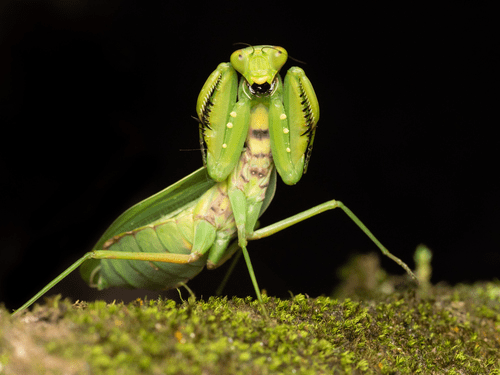
Giant Asian Mantis in Kagoshima Prefecture
Mage Island, now a couple of hours by a fast boat (ca. 115 kms) south of the city of Kagoshima, is located about 12 kilometres west of Tanegashima, the island in the East China Sea where in the 16th century Francis Xavier is said to have first landed in Japan, and about 40 kilometres north of the World Heritage island of Yakushima.
With a circumference of 16 kms and an area of just over 8 square kms, washed by the “warm current” (kuroshio) and enjoying sufficient rainfall to feed no less than 16 rivers, its tiny space is (or perhaps was) home to an astonishing biodiversity on both sea and land, from nesting turtles and giant hermit crabs to several species of killifish (medaka), and over 400 of birds including the ruddy kingfisher and the skylark, and known in particular for its own sub-species of deer, the “Mage deer.”
Mage was only sporadically populated by groups of fishermen till modern times. The researcher who probably knows the island best, having visited it with his students each year between 1987 and 2000, after which access was closed, describes it as a “Treasure island” of life.1
Mage Island (in red), In the Satsunan Islands just south of Kagoshima.
The vicissitudes that the island has undergone in the post-1945 era make it a window into the failures of regional development policies.
From 1951 settlement (or land-clearing, kaitaku) was officially encouraged, both as an outlet for rising population and as a source for food production, and Mage came to support 528 people (113 families), with a primary and junior secondary school, who made a living out of cultivation of rice and sugar cane, fishing, and collecting herbs and sea grasses.
Especially in season, the adjacent seas “boiled” with the eggs of teeming schools of flying fish.
2In the 1960s, however, the state reversed its policy, cutting back especially on rice production and reversing its earlier encouragement to agriculture.
In the 1970s, investors, strictly speaking speculators, gradually bought up the land and the residents abandoned the island, the local school closing in 1980, and successive blueprints for profitable development were imagined, adopted, and in due course abandoned:
as a tourist development site (“Mage Island Marine Leisure Land”), a Self-Defense Force radar base (1983), an oil storage site (1984), a nuclear waste storage site (ca. 1999), or as a landing site for the Japanese “Hope” space shuttle (late 1990s to ca. 2008).
Ownership (over 99 per cent) became concentrated in the Mage Island Development Company and the island was classified as unpopulated, although a small group of company staff continued to be based there.

Gagnep. First confirmed iNat observation on June 09, 2020 in Kagoshima, JP
Since about 2007, however, it has been closed off to researchers, journalists, the public, and even, astonishingly, to officials of Kagoshima prefecture or Nishinoomote City in which it is located who want to investigate apparent infractions of laws and regulations.
The company took the view that prefectural and city authorities were simply being antagonistic to a project designed to benefit the nation and the local region alike.3
For the time being, it remains a law unto itself. Not only is Mage in one sense a “treasure island,” it is also a “mystery island.”
In the early 21st century, it seemed that the speculative investment might be about to pay off. After the scrapping of successive blueprints based on agriculture and fisheries, tourism, heavy industry, and the nuclear and space industries, the military path seemed to offer the best prospect.

Clown triggerfish (Balistoides conspicillum, Kagoshima Prefecture
The Department of Defense was identified as the best potential customer to buy (or lease) the land. With that prospect in mind, Taston Airport (which in 1995 took over from Mage Island Development Company) began clearing the pristine landscape and during the first decade of the 21st century constructed two runways, 4,200 metres south-north and 2,400 metres east-west.
Continue reading “Mage -Japan’s Island destroyed illegally for another US air base – Beyond the Reach of the Law”from thefreeonline , and Sputnik Spanish and Wikipedia

Japan today undertook the construction of a military base on Mage, (Mageshima) an eight-square-kilometre island with population removed, located in the Kagoshima prefecture, south of the Japanese archipelago, the Kyodo agency reported, citing the Defense Ministry.
The works in Mage will last four years and in the first phase tracks and ammunition depots for the Self-Defense Forces will be built, according to an environmental assessment report.
The project will allow American combat aircraft to train in this area. Currently, they are conducting takeoff and landing exercises on the island of Iwoto, some 1,400 kilometers from the Iwakuni base where they are based. Mage is much closer, 400 kilometers south of this airfield.

Ryukyu or Amami rabbit, is a dark-furred rabbit which is only found in Kagoshima Prefecture
Cabinet spokesman Hirokazu Matsuno said the new base will be “indispensable” for US aircraft carriers to consistently operate in the Asia-Pacific region.
“Given the more severe and complicated security environment of the post-war era, the government will build this facility and start operating it soon,” he said.
According to Kyodo, the Ministry of Defense has offered 2.2 billion yen ($17 million) in compensation to local fishermen who will not be able to fish in Mage for four years of works and in the following year, which will be an evaluation.
****************
| Mage – Japan’s Island Beyond the Reach of the Law 馬毛−−法律の及ぶ範囲外の島 Gavan McCormack | February 20, 2012. slightly updated. Volume 10 | Issue 8 | Number 3 Article ID 3694 |
from thefreeonline by Gavan McCormack and Wikipedia
Mage ( Mageshima)– Japan’s Island Beyond the Reach of the Law by Gavan McCormack
Mage is one such. Mage (literally: Horsehair) island sits well north of the line that separates Kagoshima from Okinawa prefecture.
It is not Okinawa but is worthy of attention because it shows the same general trends as does Okinawa – of “remote island” blues (especially depopulation), dependence on whims of the central government, and the insidious workings of a military base mentality (even though not one soldier has yet set foot on it).
Flora of Kagoshima islands, as Mage was before speculation.
Recent events in Mage make for a remarkable story, suggestive of bureaucratic irresponsibility, corruption, and environmental abuse on a grand scale.
While a great deal of attention focuses on the chain of islands dividing the East China Sea from the Pacific Ocean between Japan’s Kyushu and Taiwan, it tends to focus heavily on those that are part of Okinawa prefecture and to neglect those in the northern part of he chain that are close to Kyushu and administratively part of Kagoshima rather than Okinawa prefecture.
Furthermore, as in the islands of the Okinawa group, Mage and its adjacent Kagoshima Prefecture islands bear witness now to the gradual awakening of levels of civic responsibility and engagement till recently unimaginable.
Compared to Okinawa’s Henoko and Takae, the Mage struggle is at an early stage and remains little known nationally and scarcely at all internationally, but it shares much of the same character.
Giant Asian Mantis in Kagoshima Prefecture
Mage Island, now a couple of hours by a fast boat (ca. 115 kms) south of the city of Kagoshima, is located about 12 kilometres west of Tanegashima, the island in the East China Sea where in the 16th century Francis Xavier is said to have first landed in Japan, and about 40 kilometres north of the World Heritage island of Yakushima.
With a circumference of 16 kms and an area of just over 8 square kms, washed by the “warm current” (kuroshio) and enjoying sufficient rainfall to feed no less than 16 rivers, its tiny space is (or perhaps was) home to an astonishing biodiversity on both sea and land, from nesting turtles and giant hermit crabs to several species of killifish (medaka), and over 400 of birds including the ruddy kingfisher and the skylark, and known in particular for its own sub-species of deer, the “Mage deer.”
Mage was only sporadically populated by groups of fishermen till modern times. The researcher who probably knows the island best, having visited it with his students each year between 1987 and 2000, after which access was closed, describes it as a “Treasure island” of life.1
Mage Island (in red), In the Satsunan Islands just south of Kagoshima.
The vicissitudes that the island has undergone in the post-1945 era make it a window into the failures of regional development policies.
From 1951 settlement (or land-clearing, kaitaku) was officially encouraged, both as an outlet for rising population and as a source for food production, and Mage came to support 528 people (113 families), with a primary and junior secondary school, who made a living out of cultivation of rice and sugar cane, fishing, and collecting herbs and sea grasses.
Especially in season, the adjacent seas “boiled” with the eggs of teeming schools of flying fish.
2In the 1960s, however, the state reversed its policy, cutting back especially on rice production and reversing its earlier encouragement to agriculture.
In the 1970s, investors, strictly speaking speculators, gradually bought up the land and the residents abandoned the island, the local school closing in 1980, and successive blueprints for profitable development were imagined, adopted, and in due course abandoned:
as a tourist development site (“Mage Island Marine Leisure Land”), a Self-Defense Force radar base (1983), an oil storage site (1984), a nuclear waste storage site (ca. 1999), or as a landing site for the Japanese “Hope” space shuttle (late 1990s to ca. 2008).
Ownership (over 99 per cent) became concentrated in the Mage Island Development Company and the island was classified as unpopulated, although a small group of company staff continued to be based there.
Gagnep. First confirmed iNat observation on June 09, 2020 in Kagoshima, JP
Since about 2007, however, it has been closed off to researchers, journalists, the public, and even, astonishingly, to officials of Kagoshima prefecture or Nishinoomote City in which it is located who want to investigate apparent infractions of laws and regulations.
The company took the view that prefectural and city authorities were simply being antagonistic to a project designed to benefit the nation and the local region alike.3
For the time being, it remains a law unto itself. Not only is Mage in one sense a “treasure island,” it is also a “mystery island.”
In the early 21st century, it seemed that the speculative investment might be about to pay off. After the scrapping of successive blueprints based on agriculture and fisheries, tourism, heavy industry, and the nuclear and space industries, the military path seemed to offer the best prospect.
Clown triggerfish (Balistoides conspicillum, Kagoshima Prefecture
The Department of Defense was identified as the best potential customer to buy (or lease) the land. With that prospect in mind, Taston Airport (which in 1995 took over from Mage Island Development Company) began clearing the pristine landscape and during the first decade of the 21st century constructed two runways, 4,200 metres south-north and 2,400 metres east-west.
Continue reading “Mage -Japan’s Island destroyed illegally for another US air base – Beyond the Reach of the Law”
























 The Free