Iran football fans raise their voices in support of those protesting in their country.
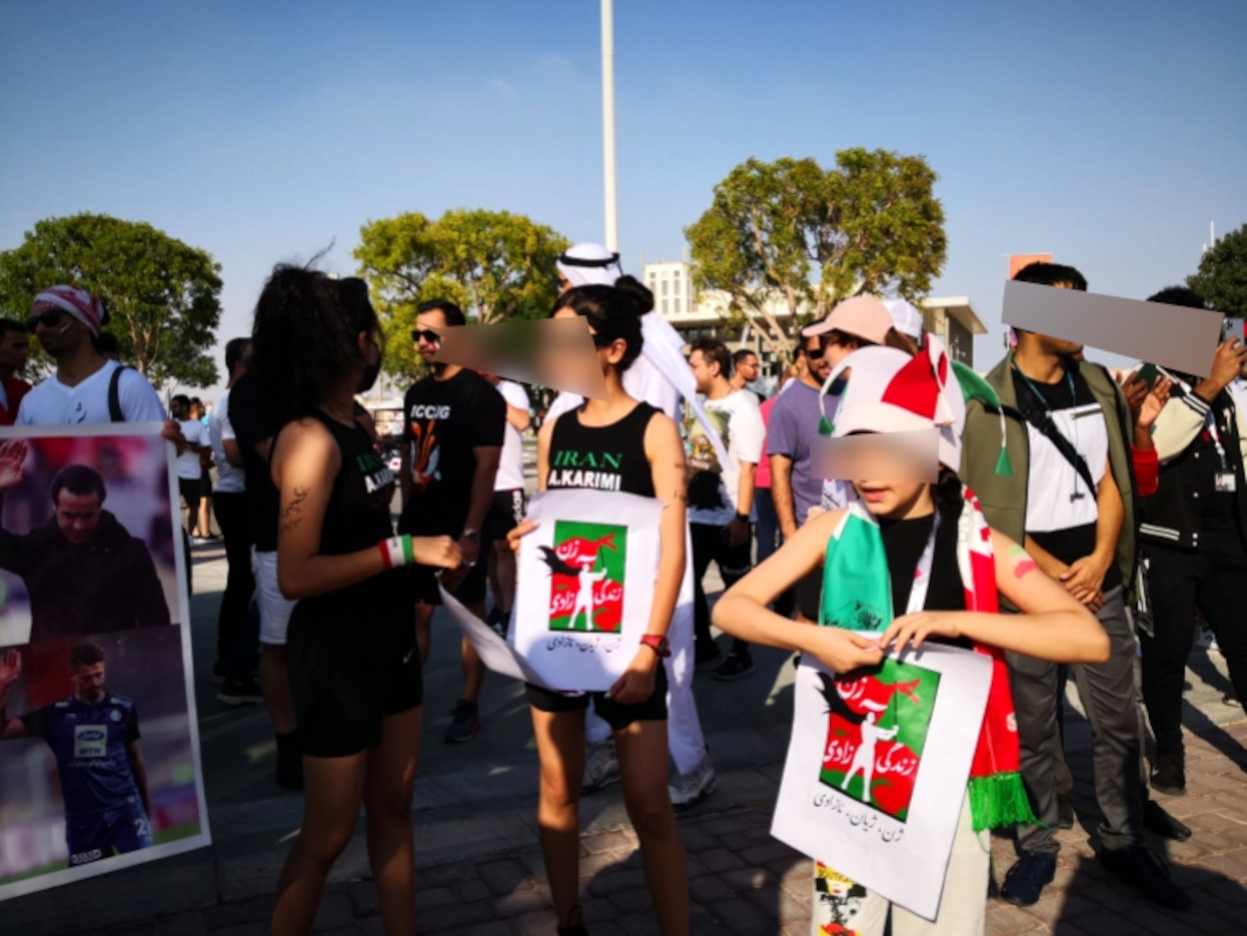
Doha, Qatar – Chants of “Say her name, Mahsa Amini,” reverberated among protesters outside Khalifa International Stadium ahead of Iran’s first match of the World Cup 2022 against England.
A few dozen men, women and children were seen on Monday wearing t-shirts saying “Zan, Zindagi, Azadi” (women, life, freedom), a famous chant from the protests in Iran.
Protests have been taking place across Iran since mid-September after the death in custody of Amini, a 22-year-old woman from Iran’s Kurdistan province. Amini was arrested by the country’s morality police in the capital Tehran for allegedly not adhering to Iran’s dress code for women.
‘Say her name, Mahsa Amini’:
In the past few days, protests have been most intense in northwestern Kurdish-majority provinces, with videos continuing to come out from several cities, including Mahabad, Bukan and Piranshahr in West Azerbaijan and Javanrud in Kermanshah.
“My people in Iran are under a lot of pressure and are being killed by the regime, so we want to use this opportunity to raise a voice for them,” Mahmoud Izadi, one of the protest organisers, told Al Jazeera in Qatar’s capital Doha.
American Liberty Report More than 18 million people were injured so badly by their first COVID shot from Pfizer or Moderna that they had to go to the hospital. That’s according to the CDC’s own internal data, which a court just ordered the federal agency to release to a watchdog group. Instead of alerting the […]
President Recep Tayyip Erdoğan has signaled to proceed with Operation Claw-Sword, which was conducted against the…YPG and PKK groups in northern Iraq and northern Syria with a ground incursion.
“There is no question that this operation be limited to only an aerial operation,” Erdoğan told reporters on board his flight from Qatar to Türkiye on Nov. 20.
“How many troops from the Land Forces should be involved here will be decided together by our relevant units, our Defense Ministry and General Staff. We do our consultation, and then we will take our steps accordingly,” he stated.
***
Türkiye launched Operation Claw-Sword, a cross-border aerial campaign, early on Nov. 20 against the YPG and PKK targets.
Asked if he had consulted with the leaders of the United States and Russia before launching Operation Claw-Sword, Erdoğan said Ankara…
Pretty sure Illia Ponomarenko and the other nazi propagandists aren’t going to put themselves to the slightest discomfort while demanding everyone else fight Russia.
Pretty sure Illia Ponomarenko and the other nazi propagandists aren’t going to put themselves to the slightest discomfort while demanding everyone else fight Russia.
I am totally immersed in departmental bureaucracy (curriculum etc) and a piece on metaverse and journalism. In the meantime, I missed some significant events in Turkey. I am getting lazy for the blog Here is something to be anxious about:
People look at a site damaged by Turkish airstrikes in Hasakah province, Syria. Photograph: Baderkhan Ahmad/AP
Journalists martyred in defence of the truth in Rojava..Our comrades were martyred in attacks of Turkish occupation and its mercenaries. these comrades wanted conveying the truth about the Rojava revolution to the whole world, those left a great legacy on the path of the sacrifice.
After Turkey’s intense air strikes on North and East Syria and Northern Iraq launched in the early hours of Sunday, protests against Turkey’s attacks took place in several different European cities.
10:01 am 21/11/ After Turkey’s intense air strikes on North and East Syria and Northern Iraq launched in the early hours of Sunday 20 November, Kurds living in Europe took to the streets to protest.
On Sunday night and Monday the bombimgs, spread and worsened, and were joined by state massacres of Kurds in Irani Kurdistan and attacks by both Iran and Turkey on Kurds in Iraq in Sulaymaniya… see updating reports..
Upon the call of the European Kurdish Democratic Societies Congress (KCDK-E), demonstrations were held on Sunday in several European cities, and continued throughout the day.
Grîgny Mayor Philippe Rio and Deputy Mayor Evelyne Lebriand attended a march in the Evry district of Paris.
Digital technology is enabling scientists to detect and interpret the sounds of species as diverse as honey bees, peacocks, and elephants. In an e360 interview, geographer Karen Bakker discusses the surprising and complex ways that animals and plants use sound to communicate.
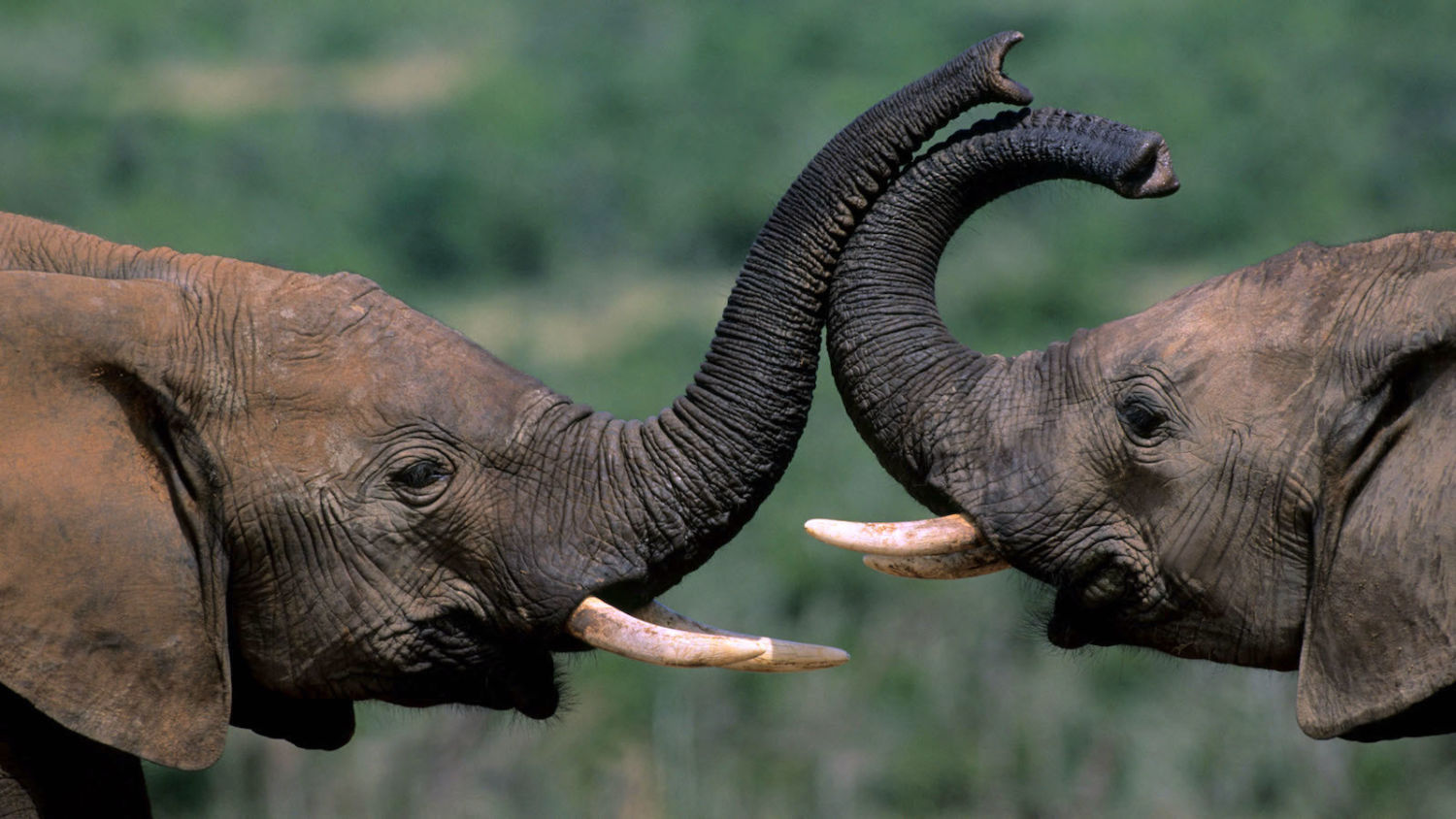
Researchers are decoding the language of elephants.
Karen Bakker is a geographer who studies digital innovation and environmental governance. Her latest book, The Sounds of Life, trawls through more than a thousand scientific papers and Indigenous knowledge to explore our emerging understanding of the planet’s soundscape.
Microphones are now so cheap, tiny, portable, and wirelessly connected that they can be installed on animals as small as bees, and in areas as remote as underneath Arctic ice. Meanwhile, artificial intelligence software can now help decode the patterns and meaning of the recorded sounds. These technologies have opened the door to decoding non-human communication — in both animals and plants — and understanding the damage that humanity’s noise pollution can wreak.
In an interview with Yale Environment 360, Bakker, a professor of geography and environmental studies at the University of British Columbia, describes how researchers are constructing dictionaries of animal communication, focusing on elephants, honey bees, whales, and bats. “I think it’s quite likely,” she says, “that within 10 years, we will have the ability to do interactive conversations with these four species.”
Karen Bakker. University of British Columbia
Yale Environment 360: What inspired you to write this book?
Karen Bakker: I’ve taught a course on environment and sustainability for the past two decades, and every year the picture is grimmer. My students are dealing with a lot of ecological grief and climate anxiety. I wanted to write a book for them. They are digital natives. Digital technology is so often associated with our alienation from nature, but I wanted to explore how digital technology could potentially reconnect us, instead, and offer measured hope in a time of environmental crisis.
The Rabbs’ fringe-limbed treefrog, with its bark-like mating call, went extinct in 2016. Brian Gratwicke via Wikipedia
In part, the idea about sound came from the work that I was doing with Indigenous communities. I was really struck by Indigenous teachings about being in dialogue with the nonhuman world. Such dialogues are not merely allegorical or metaphorical, but real exchanges between beings with different languages. Robin Wall Kimmerer writes in Braiding Sweetgrass that in Potawatomi teachings, at one time all beings spoke the same language, and that has fractured.
As I started to delve into these topics, the world of digital bioacoustics was just opening up — there’s been a literal explosion in research in the last 10 years, and I caught that wave. I was fascinated by scientists rediscovering some things that Indigenous communities have long known, with very interesting digital experimental methods.
e360: You looked at more than 100 species, including some obvious noise makers and sound detectors like whales and bats. Can you give an example that surprised you?
Bakker: Peacocks make infrasound with their tails in the mating dance. We used to think the big tail was a visual display, and it is. But they’re also making infrasound with their tails at a specific frequency that vibrates the comb on top of the peahen’s head. We’ve known about that mating dance for probably thousands of years, but we only just figured out that it’s got a sonic component.
“Octopi hear in their arms with little organelles. There’s a myriad of ways nature has invented to hear that don’t involve ears.”
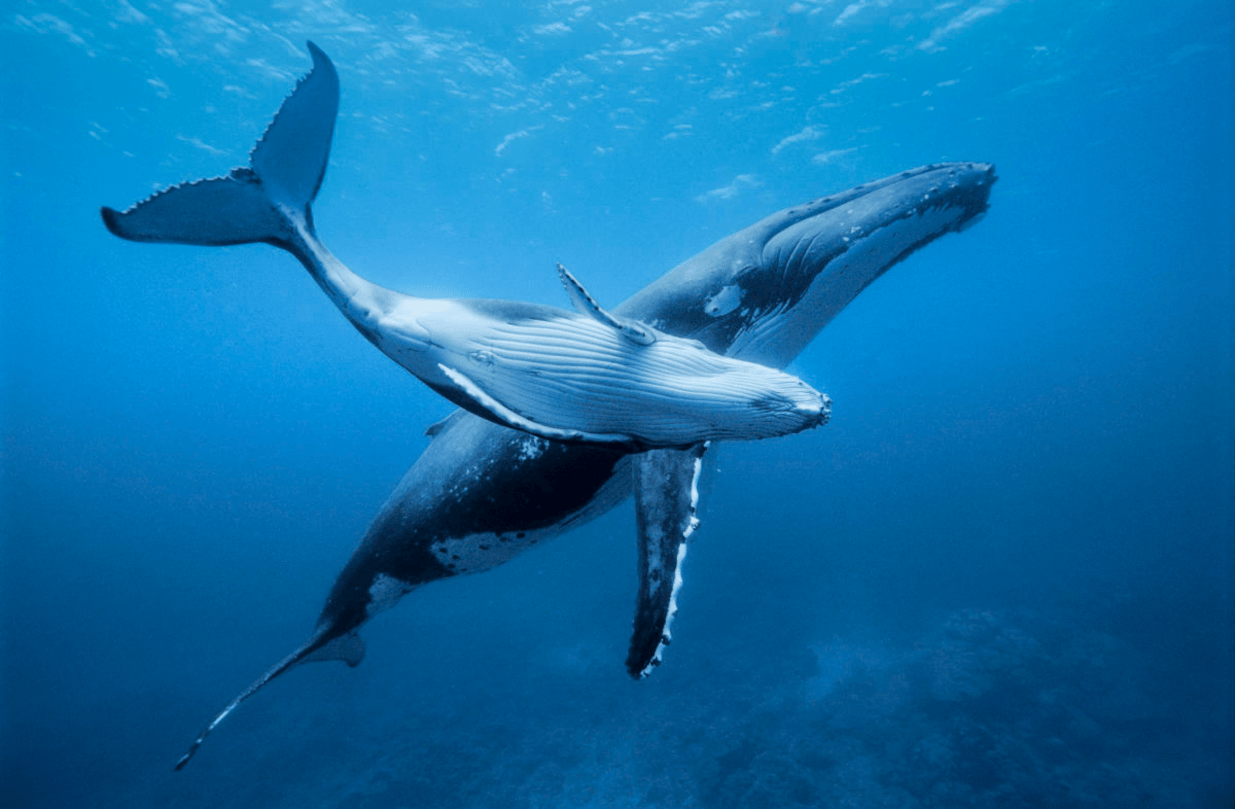
A young humpback whale with its mother near the island of Rurutu in French Polynesia. Alexis Rosenfeld / Getty Images
e360: You also cover species we traditionally think of as silent, such as coral larvae and plants. How do creatures that don’t even have ears hear?
Bakker: They are hearing: they are sensing sound, and they are deriving ecologically meaningful and relevant information from that sound.
Coral larvae, which are microscopic organisms, are able to distinguish not only the sounds of healthy versus unhealthy reefs, but to discern the sound of their own reef and swim towards it, even from miles away across the open ocean. That puts them in the same category as great bird migrations, given their size. We don’t really fully understand how this is happening; we’ve only just learned that they’re capable of doing it.
Heidi Appel at the University of Toledo did this great experiment with plants: plants are played the sound of insects chomping on plant leaves, and they react with the release of defensive chemicals.











 Here is something to be anxious about: