People rally to protest against the Japanese government’s decision to discharge contaminated radioactive wastewater in Fukushima Prefecture into the sea, in Tokyo, Japan, on April 13, 2021.
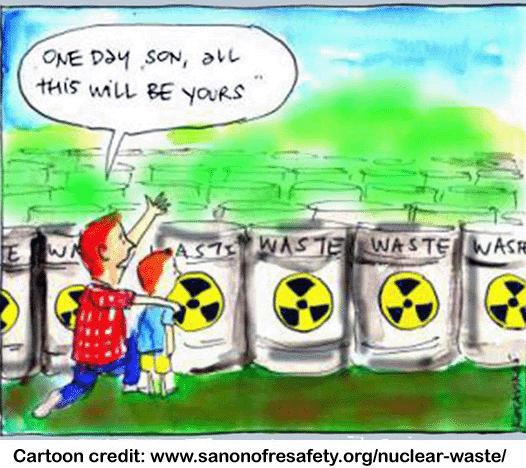
Protests have been held in Japan’s Fukushima Prefecture against the government’s controversial plan to release contaminated water from the wrecked Fukushima Daiichi nuclear power plant into the Pacific Ocean.
Dozens of local residents gatheredin front of the Fukushima prefectural government office building on Tuesday, calling for the cancellation of the move, while also demanding protection for the ocean, as they waved banners with slogans written in several languages in a bid to bring international attention to their concerns.
The Fukushima Daiichi nuclear plant, located on Japan’s northeast coast, was crippled after going into meltdown following an earthquake and tsunami in 2011.
Around 1.25 million tons of water, used to cool the reactors after the meltdown, are currently stored in tanks in and around the plant.
Local polls have shown that more than 70 percent of non-governmental organizations in Fukushima object to the plan of releasing the radioactive water into the ocean. Many people worry the plan will cause great harm to their health.
“If nuclear contaminated water is discharged into the sea, people may be affected by eating fish or other sea food. This may bring sustained harm to people’s health. Since the release plan will take a long time to complete, I am worried the harm will increase day by day,” said a local resident.
“I want to protect the health and future of younger generations, so I oppose dumping the contaminated water into the ocean,” said another local resident.
The protesters also voiced concern that Tokyo Electric Power Company (TEPCO), the operator of the nuclear power plant, had failed to fully disclose information about the Fukushima nuclear disaster or verify the data about the nuclear contaminated water.
“Although the release plan says the radioactive water will be diluted before being discharged into the sea, the total amount of nuclear elements in the water will not change at all. So I think it’s not right to dump the wastewater into the ocean and spread contamination,” said a local resident.
Tuesday’s protest took place as a team from the International Atomic Energy Agency (IAEA) was slated to conduct safety reviews at the plant.
The 15-member team arrived in Japan on Monday to review the government’s plan to release the treated radioactive water into the ocean from the destroyed Fukushima nuclear plant — a review that Tokyo hopes will instill confidence in the plan, which is opposed by neighboring countries.
The task force, headed by Gustavo Caruso, director of the IAEA’s Office of Safety and Security Coordination, is due to stay in Japan through Friday.
Japan and the IAEA have agreed to compile an interim report on the review later this year.
Last April, the then-Japanese Prime Minister Yoshihide Suga said TEPCO would be allowed to release nuclear contaminated water from Fukushima into the Pacific Ocean starting in 2023, leading to a massive outcry from both local residents and the international community.
Local fishing communities expressed opposition as well, saying that the water discharge would undermine years of work to restore confidence in seafood from the region.
The radioactive water, which increases in quantity by about 140 tons a day, is now being stored in more than 1,000 tanks, and space at the site is expected to run out around next autumn.
To meet international standards before disposal, the nuclear wastewater, however, needs to be filtered to remove harmful isotopes. The process, however, cannot remove tritium, an isotope of hydrogen that experts say will be harmful to human health in large doses.
Today I have this piece by war reporter Alexander Kots. He set out to find human interest stories among the over 10,000 refugees who have crossed over from the Donbass region into Russia, just in the past couple of days.
Roughly half of these refugees are technically Russian citizens already, holding Russian passports. The other half being Ukrainian citizens who are resident in the Separatist-controlled Donetsk Peoples Republic (DPR) and Luhansk Peoples Republic (LPR).
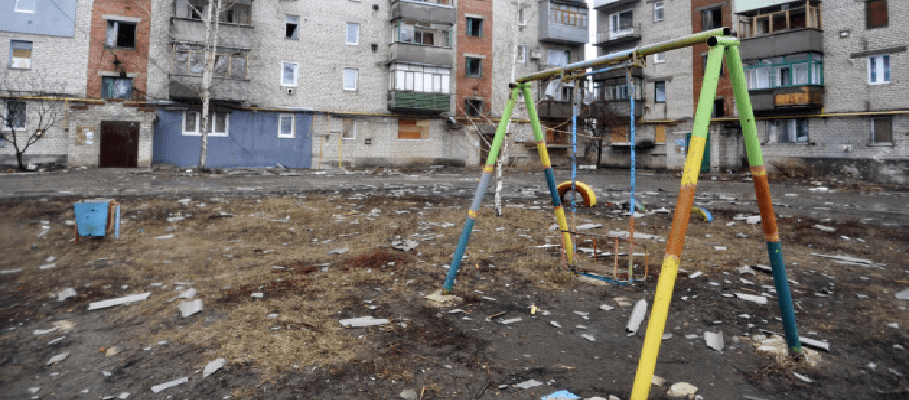
The order (issued by the leaders of those republics) to evacuate women, children, and elderly was given this past Thursday, after the Ukrainian army opened massive artillery barrages on the line of demarcation, threatening massive damage and loss of life to the residential communities.
War correspondent Alexander Kotz
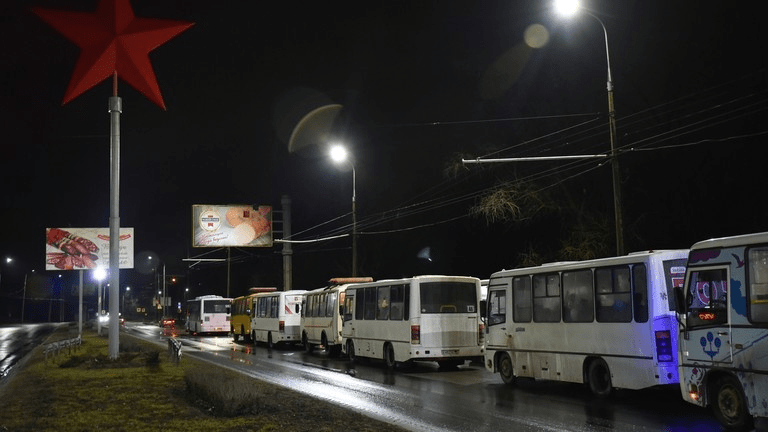
Kots: “How many of you are Russian citizens?” I asked, of the people in one of the 30 buses, parked on the side of the road in the village of Red Landing, near Taganrog.
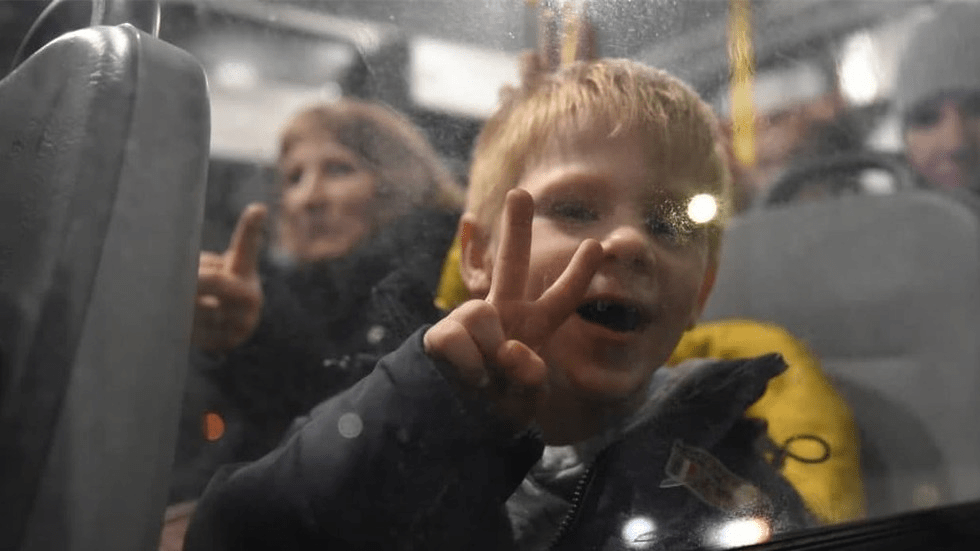
A full half of the people (in the bus) raise their hands. The other half admit that they are in the process of obtaining Russian passports. I see merry toddlers wearing bright outfits, who manage to find ways to have fun even in these circumstances. And here are their mamas, who worry their babies will freeze on the way to Russia.
And they have been waiting here for quite a long time, and nobody knows what is going to happen next, in regard to their resettlement. I see grandmothers who pop into the village store to buy sweets for their grandchildren.
note: while The Guardian here publishes good info (see below) on ‘the Network’, they have also, for example, led the news slanders and smears sabotaging the defence of Julian Assange against the US state and CIA, an issue that prejudices free reporting worldwide. Although this news below appears correct and the comrades need support it also comes just at the height of Anti Russian war hysteria in the UK, openly fannedand financed by the Tory Government and not opposed by The Guardian.
A Russian court has issued harsh sentences to seven antifascist and anarchist activists in a controversial domestic terrorism case marred by claims that investigators tortured the defendants to elicit confessions.
The court in Penza, a city about 390 miles (630km) south-east of Moscow, sentenced the men to terms of six to 18 years in penal colonies for allegedly forming an organisation called Set, which translates as the Network, which prosecutors said planned to carry out future attacks inside Russia to overthrow the government. The men were also charged with an assortment of weapons and drugs charges.
Influential human rights groups have called the case fabricated and said the men may have been targeted for their political activism. Four of the men on trial said they had been tortured with beatings and electrocution during the investigation. In December, Memorial human rights centre, one of Russia’s oldest civil rights organisations, had called for the charges to be dropped.
“It is obvious that the prosecution of the antifascist activists in Penza, part of ongoing repressive measures against anarchists and antifascists that sharply increased in 2017–2018, is politically motivated,” the organisation wrote.
On Monday, supporters of the men shouted “shame” at the Penza courthouse where the verdicts were delivered. The prominent (neo.nazi..ed) opposition figure Alexei Navalny called the sentences “horrific.”
Oleg Orlov of Memorial said: “This is a monstrously harsh verdict, but we didn’t expect anything else.”
The prosecution accused the men of allegedly planning attacks, but gave little concrete detail about when or where they would take place. Investigators originally claimed that the men planned to target the 2018 World Cup or the presidential elections, but those charges were not reflected in the final criminal case.
The men had played airsoft together, an activity which the prosecution said was training for attacks. In 2019, the Network was named an extremist organisation, alongside groups like Islamic State.
John Pilger is an award-winning journalist, filmmaker, and author. Read his full biography on his website here, and follow him on Twitter: @JohnPilger.
Marshall McLuhan’s prophecy that “the successor to politics will be propaganda” has happened. Raw propaganda is now the rule in Western democracies, especially the U.S. and Britain.
On matters of war and peace, ministerial deceit is reported as news. Inconvenient facts are censored, demons are nurtured.
But is this new? It is more than a century since Edward Bernays, the father of spin, invented “public relations” as a cover for war propaganda. What is new is the virtual elimination of dissent in the mainstream.
The great editor David Bowman, author of The Captive Press, called this “a defenestration of all who refuse to follow a line and to swallow the unpalatable and are brave.”
He was referring to independent journalists and whistleblowers, the honest mavericks to whom media organizations once gave space, often with pride. The space has been abolished.
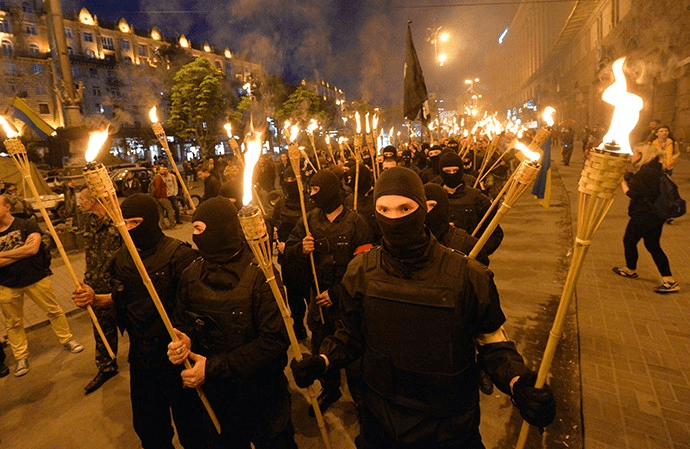
Neo-fascists play an important official or tolerated role in US-backed Ukraine.
The war hysteria that has rolled in like a tidal wave in recent weeks and months is the most striking example. Known by its jargon, “shaping the narrative,” much if not most of it is pure propaganda.
The Russians are coming. Russia is worse than bad. Putin is evil, “a Nazi like Hitler,” salivated the Labour MP Chris Bryant. Ukraine is about to be invaded by Russia—tonight, this week, next week.
The sources include an ex-CIA propagandist who now speaks for the U.S. State Department and offers no evidence of his claims about Russian actions because “it comes from the U.S. Government.”
The no-evidence rule also applies in London. The British Foreign Secretary, Liz Truss, who spent £500,000 of public money flying to Australia in a private plane to warn the Canberra government that both Russia and China were about to pounce, offered no evidence.
Antipodean heads nodded; the “narrative” is unchallenged there. One rare exception, former prime minister Paul Keating, called Truss’s warmongering “demented.”
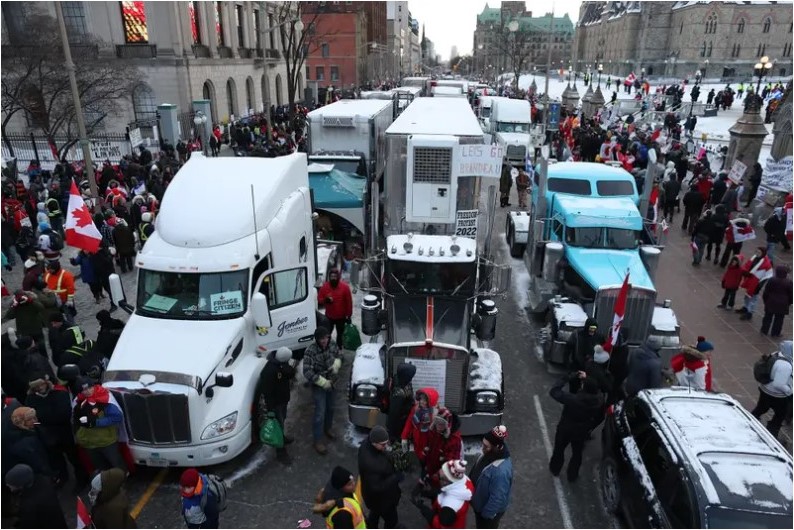
At a press conference earlier today, Interim Chief Bell said, “The secured area includes almost 100 checkpoints that will have police presence to ensure that those seeking entry to that secure area for a unlawful reason, such as joining a protest, cannot enter the downtown core.”
The Charter ensures that Canadians are free to peacefully assemble, to express their ideas, to gather to discuss them and communicate them widely to other people, including vigorous political dissent. These activities are basic forms of individual liberty. They are essential to the basic functioning of a democratic society like Canada. In Canada, people are free to discuss matters of public policy…
Germany and France, countries that together with Russia mediate in the internal Ukrainian conflict, condemned this Friday the attacks on residential areas on the line of separation between the forces of the Government of Ukraine and the militias of Donetsk and Lugansk, in the east of that country.
“We condemn the use of heavy artillery and indiscriminate shooting against residential areas in clear violation of the Minsk Agreements,” German and French Foreign Ministers Annalena Baerbock and Jean-Yves Le Drian said in a joint statement. to which Sputnik had access.
Russia opens criminal case after reporting shelling from Ukraine | February 19, 2022 … a large number of refugees are fleeing from Ukraine’s Donbass to Russia to escape a possible war. http://www.china.org.cn › 19 › content_78059643
The violations of the ceasefire, they added, cause extreme concern.
The representatives of Donetsk and Lugansk denounced that the Ukrainian Army is bombing Donbas with heavy weapons, deliberately violating the 2020 agreements. The use of heavy artillery, they added, points to the preparations for a military solution to the internal conflict that since 2014 has faced the Government of Kiev and Donbas regions.
First refugees from eastern Ukraine arrive in Russia — RT …First refugees from eastern Ukraine arrive in Russia Hundreds of people have arrived in Rostov Region following an evacuation order The first group of refugees from the Donbass region have arrived in Russia following an evacuation order made by the self-proclaimed People’s Republics of Donetsk and Lugansk authorities ahead of an anticipated …
Ukraine’s Defense Minister, Alexei Reznikov, for his part, denied the bombings and stated that President Vladimir Zelenski advocates a political and diplomatic solution to the internal conflict.
This same Friday, the leader of the self-proclaimed Donetsk People’s Republic (DPR), Denis Pushilin, announced the evacuation of women, children and older adults to Russia in the face of the imminent offensive by the Ukrainian Army.
In a video message he warned that Ukraine’s president, Vladimir Zelensky, would soon order his generals to invade Donetsk and Lugansk.
The situation is aggravated in Donbas by the tons of weapons that the United States and other NATO countries sent to the Zelensky government.
Since April 2014, Ukraine has carried out a military operation against the militias in Donbas, where the Donetsk and Lugansk people’s republics were proclaimed, in response to the violent change of government that occurred in February of the same year.
The Minsk Agreements, signed in September 2014 and February 2015, laid the foundations for a political solution to the conflict, but so far have not led to the cessation of hostilities that to date have left more than 14,000 dead, according to UN estimates.
Alemania y Francia, países que junto con Rusia median en el conflicto interno ucraniano, condenaron este viernes los ataques a las zonas residenciales en la línea de separación entre las fuerzas del Gobierno de Ucrania y las milicias de Donetsk y Lugansk, en el este de ese país.
«Condenamos el uso de la artillería pesada y los disparos indiscriminados contras las zonas residenciales en una clara violación de los Acuerdos de Minsk», indicaron los ministros de Exteriores de Alemania y Francia, Annalena Baerbock y Jean-Yves Le Drian, en un comunicado conjunto al que Sputnik tuvo acceso.
Las violaciones del alto el fuego, añadieron, causan una extrema preocupación.
Los representantes de Donetsk y Lugansk denunciaron que el Ejército ucraniano está bombardeando Donbás con armas pesadas, infringiendo deliberadamente los acuerdos de 2020. El uso de la artillería pesada, agregaron, apunta a los preparativos para una solución militar del conflicto interno que desde 2014 enfrenta al Gobierno de Kiev y las regiones del Donbás.
El ministro de Defensa de Ucrania, Alexéi Réznikov, por su parte, negó los bombardeos y afirmó que el presidente Vladímir Zelenski aboga por una solución política y diplomática del conflicto interno.
Este mismo viernes, el líder de la autoproclama República Popular de Donetsk (RPD), Denís Pushilin, anunció la evacuación de mujeres, niños y adultos mayores a Rusia ante la inminente ofensiva del Ejército ucraniano.
En un videomensaje advirtió que el presidente de Ucrania, Vladímir Zelenski, daría próximamente la orden a sus generales para que invadan Donetsk y Lugansk.
La situación se agrava en Donbás por las toneladas de armas que Estados Unidos y otros países de la OTAN enviaron al Gobierno de Zelenski.
Desde abril de 2014 Ucrania lleva a cabo una operación militar contra las milicias en Donbás, donde se proclamaron las repúblicas populares de Donetsk y Lugansk, en respuesta al violento cambio de gobierno ocurrido en febrero del mismo año.
Los Acuerdos de Minsk, suscritos en septiembre de 2014 y en febrero de 2015, sentaron las bases para una solución política al conflicto, pero no han derivado hasta ahora en el cese de las hostilidades que hasta la fecha han dejado más de 14.000 muertos, según las estimaciones de la ONU.