
The race is on to announce the discovery of the first rocky Earth sized planet with water in the habitable zone of a nearby star… NEW EARTH ONE.

13th Sept European Astronomers believe they have found a second planet outside our solar system that seems to be in the right zone for life, just barely., among 50mnew plant discoveries a
nnounced Monday, but it’s about 3.6 times the mass of Earth, temperatures there may range from 85 to 120 degrees with plenty of humidity, 35 light years away an
d may not have water .
We are living through an ast
onishing rush of new discoveries of planets in deep space.
Dozens of teams around the world are competing frantically to find such planets.
On 23rd Sept up to 1000 new planets may be announced by Nasa’s Kepler project which includes the orbiting detector, ground telescopes and supercomputers and focuses just on 1/400th part of the sky
Only in the last year have humans been able to detect Earth size planets, combining supercomputing, the latest techniques and space based observatories.
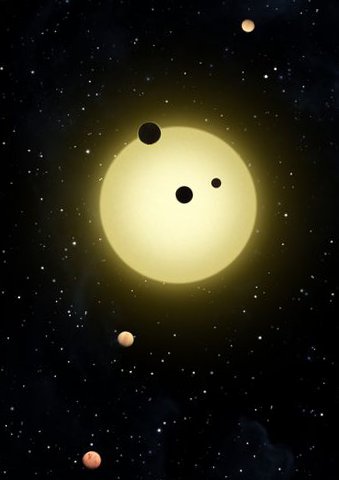
Only in the last months has it been proven that Earth sized planets are relatively common, so statistically there must be MILLIONS of th
em in the Universe
The latest batch of data from Kepler will be publicly released on Sept 23rd. Dozens of scientific teams are working flat out on the mass of new data already out.
Just 3 months ago an amazing new technique called BLENDER has come on line The blend of the foreground target star and the background eclipsing binary using the NASA supercomputer, Pleiades, to make more than 1015 (a 1 followed be 15 zeros or 1,000,000,000,000,000,000) or a quadrillion calculations to test a transiting planet.
Only last February the first roc
ky planet near Earth size was discovered. But it turned out to be an inferno.
Now there are 1000s of new candidates being discovered in just Kepler’s small field of vision, plus new planets being found by dozens of other discovery centers around the world, and huge new precision instruments being built.
Very soon the quest will not be for NEW EARTH ONE, but for which of many such planets really harbours life.
There are various interactive sites where you can follow the story. For the Kepler project Nasa is the best.. see HERE
 The Free