
from Bloomberg News and Earth First
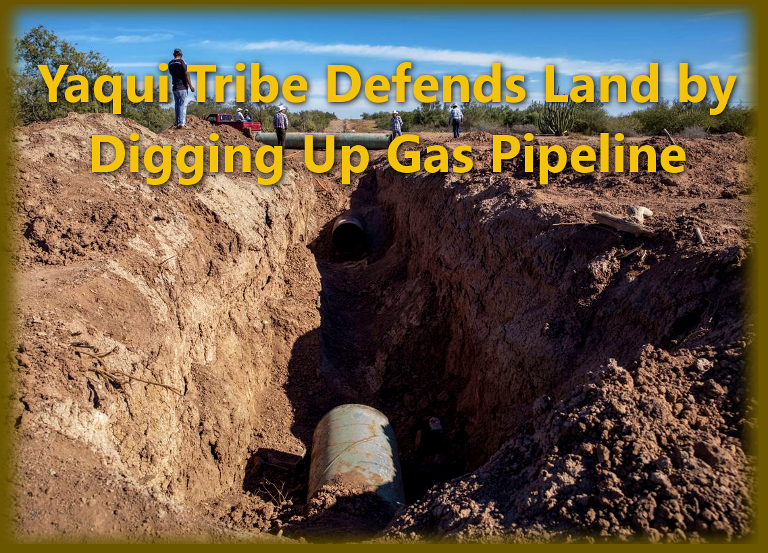
A chunk of Sempra Energy’s natural gas pipeline sits in the dirt behind a community center in the village of Loma de Bacum in northwest Mexico. Guadalupe Flores thinks it would make a great barbecue pit. “Cut it here, lift the top,’’ he says, pointing to the 30-inch diameter steel tube. “Perfect for a cook-out.’’Photo: Yael Martinez/Bloomberg
It would be an expensive meal. The pipeline cost $400 million, part of a network that’s supposed to carry gas from Arizona more than 500 miles to Mexico’s Pacific coast. It hasn’t done that since August, when members of the indigenous Yaqui tribe – enraged by what they viewed as an unauthorized trespass their land – used a backhoe truck to puncture and extract a 25-foot segment. They left the main chunk about a mile from the community center, perpendicular to the rest of the pipeline, like a lower-case t.
It’s not an isolated case. Mexico’s opening of its energy industry has succeeded in attracting capital, but it’s also been beset by territorial or environmental disputes, often involving the country’s myriad indigenous groups. When protest turns into sabotage, there’s a risk that investors will be put off from future phases, like an extensive shale development. It’s also grist to the mill of the leftist frontrunner for next year’s presidential election, who’s vowing to reverse some of the reforms.
‘Refused Consent’
The Yaquis of Loma de Bacum say they were asked by community authorities in 2015 if they wanted a 9-mile tract of the pipeline running through their farmland — and said no. Construction went ahead anyway.
The Energy Ministry acknowledged that account is true, in a statement that highlights the difficulties its officials confront. Consultation of the eight Yaqui communities along the route was carried out, as required by law. Seven of them gave a green light, the ministry said by e-mail, “while the town of Loma de Bacum refused consent.’’ A piece of the gas pipeline extracted by the Yaquis of Loma de Bacum. Photo: Yael Martinez/Bloomberg
The project is now in a legal limbo. Ienova, the Sempra unit that operates the pipeline, is awaiting a judicial ruling that could allow them to go in and repair it — or require a costlier re-route. “If they want to build a pipeline, that’s fine,’’ said Flores, the would-be barbecue designer who’s a local community leader. “But it won’t pass through here.’’
At the Energy Ministry in Mexico City, that’s becoming a familiar refrain. Continue reading “Yaqui Tribe Defends Land by Digging Up Gas Pipeline”



 The Free