Help us protect the Arctic | Greenpeace International

Help us protect the Arctic | Greenpeace International.

Help us protect the Arctic

Stand off between the drill ship Leiv Eiriksson and the Greenpeace ship Esperanza

Drilling in the Arctic is reckless, dangerous – and unnecessary at a time when an energy revolution has been proved possible. The British foreign office believes any oil spill in Arctic waters would be impossible to deal with.

Yet Cairn Energy is going to drill off the coast of Greenland – without making its oil spill response plan public. Experience has shown that we cannot trust oil companies on their word when they say they have it all covered. Cairn is saying that they managed to create a plan that most experts in the world say is impossible to pull off.

Cairn is gambling with the pristine wilderness of the Arctic. We demand that they show their hand.

Write to Cairn Energy’s CEO today to demand to see their Greenland oil spill response plan.

continue here

Help Us ..Press HERE

Peru: Gold rush destroys 6 times more forest.

The greedy capitalists who caused the last economic crash then put their cash in gold. Causing the price to soar to crazy levels and triggering new gold rushes, with tragic consequences for the miners and the environment.

The rising price of gold has multiplied by six the pace of deforestation in the Amazon rainforest in the Peruvian region of Madre de Dios in recent years. Swenson said. “Given the rate of recent increases, we project mercury imports will more than double by the end of 2011, to about 500 tons a year,” she said.

The highly poisonous metal is used by poor gold-diggers to wash gold off rock and sand. It is not only harmful to the health of those who handle it, but it also pollutes the region’s rivers and air. Mercury also gets into the food chain and harms local indigenous communities and even those that live further away.

Once the gold searchers are done, they leave behind a desert landscape that is poisoned by mercury. Peruvian Environment Minister Antonio Brack said gold-diggers have already destroyed 32,000 hectares of rainforest in Madre de Dios. In March, a large joint operation by police and the military targeted tens of thousands of gold searchers, and 32 floating dredges were seized, Brack said. The minister said he was sorry about the death of two prospectors during the raid, although he stressed that the use of force had been justified in the face of an “environmental tragedy.” However, the problem is far from solved. Police assume that at least 250 floating dredges are in use in the region. According to Brack, it will take at least five years to get those searching for gold to leave. And yet poverty in Peru continues to push more and more people into searching for gold, as well as into other equally illegal activities like logging or settling in the rainforest.

There are other factors at work. Climate change in the Andes is already affecting small farming communities, forcing them to adapt or move elsewhere.

The near completion of the Inter-Oceanic Highway, which cuts a swathe straight through this once inaccessible part of the Peruvian Amazon, will lead to migration on an unprecedented scale.

The road, which will link Pacific ports in southern Peru to the Atlantic coast in Brazil, could well become the greatest factor in the environmental degradation of this once pristine pocket of biodiversity.

Final go ahead for Belo Monte. Amazon Tragedy.

Brazil Green Lights Controversial Amazon Dam

June 1, 2011

FOR IMMEDIATE RELEASE

IBAMA authorizes installation of Belo Monte Dam Complex despite escalating local, national and international opposition

Brasília, Brazil – The Brazilian government has issued the full installation license allowing the Belo Monte Dam Complex to break ground on the Amazon’s Xingu River despite egregious disregard for human rights and environmental legislation, the unwavering protests of civil society, condemnations by its Federal Public Prosecutor’s Office (MPF) and the request for precautionary measures by the OAS Inter-American Commission on Human Rights (IACHR). The license was granted by Brazil’s environmental agency IBAMA despite overwhelming evidence that the dam-building consortium Norte Energia (NESA) has failed to comply with dozens of social and environmental conditions required for an installation license.

The risky $17 billion Belo Monte Dam Complex will divert nearly the entire flow of the Xingu River along a 62-mile stretch. Its reservoirs will flood more than 120,000 acres of rainforest and local settlements, displace more than 40,000 people and generate vast quantities of methane – a greenhouse gas at least 25 times more potent than carbon dioxide.

The installation license will allow for NESA to open access roads, initiate forest clearing at dam construction sites encompassing some 2,118 acres, and begin construction on the complex immediately. It also instigates publically subsidized funding from Brazil’s National Development Bank (BNDES) to finance 80 percent of the project’s spiraling costs. The bank has come under increasing scrutiny from the Public Prosecutor’s office and civil society due to alarming evidence that approval is based on political grounds, often downplaying problems of economic viability and compliance with social and environmental safeguards.

“This is a tragic day for the Amazon,” said Atossa Soltani, Executive Director at Amazon Watch. “By turning a blind eye toward the tragic consequences of this dam, President Dilma Rouseff is undermining the positive environmental and social advances Brazil has made in recent years and miring its image on the global stage just as it prepares to host the UN Rio+20 Earth Summit next year.”

Africa: GMO seeds introduced despite public rejection

By David Njagi

NAIROBI, May 16, 2011 (IPS) – Farming with genetically modified organisms (GMOs) is becoming more widespread in Kenya due the promotion of biotechnology through clever schemes,  and the lack of a legal framework for these controversial products.

”Because Africans are strongly against GM foods the companies are using their economic muscle and criminal disregard for local opinion to gain  a foothold and get the farmers ‘hooked’.

Africa: policy on genetically modified organisms (GMO) and genetically engineered (GE) foods (map/graphic/illustration)

Click here, or on the graphic, for full resolution.

Africa: policy on genetically modified organisms (GMO) and genetically engineered (GE) foods. The Cartagena protocol on biosafety, a supplement to the convention on biological diversity, has strong support in Africa, with a majority of the countries as signatories. In addition, several countries have, in the past, rejected aid (especially unmilled grains) in food imports with concerns for national biosafety. South Africa is so far the only country that is seeing wide-spread use of genetically modified crops.

In Kenya The Sygenta Foundation has triumphed with a novel scheme to insure farmers crops. The Syngenta Foundation is a not-for-profit organisation attached to the Syngenta Company that researches and produces GM seeds. The foundation is involved in the “Safe Biotechnology Management” (SABIMA) project aimed at promoting GM technology among small-scale farmers in Ghana, Nigeria, Burkina Faso, Kenya, Uganda and Malawi.

The Kenya Biodiversity Coalition (KBioC) regards the scheme as part of seed-manufacturing multinational companies’ renewed appetite to use Kenya as a testing ground for GMOs by offering seeds to farmers.
“We suspected that a lot of GM seed, particularly for maize, was being imported from South Africa either as contaminated maize or plain GMOs,” recalls Kamau of KBioC. “We went to the key maize-growing regions and did random sampling. We bought the seed and found it was laced with GM strains.”Controls on seed imports are often slack or lacking.”So even if Kenya has not commercialised GMOs, it is likely that farmers are planting GM seed without their knowledge,” says Kamau.

Despite rejection everywhere but South Africa, Dr. Margaret Karembu, of a pro GMO company, predicts that 10 African countries will have adopted the technology before 2015

read more…http://ipsnews.net/news.asp?idnews=55648

Peru: Indigenous anti mine protestors hold Puno city

Customs warehouse in Puno on fire after it was attacked overnight

20,000 Aymaras occupy Puno

Thousands of angry indigenous protesters have taken over the city centre of Puno in south-eastern Peru.

Looters have taken advantage of the unrest and ransacked offices and shops as the police retreated.

Cars and buildings were torched on Thursday night when protesters went on the rampage, demanding an end to a Canadian silver mining project.

The indigenous Aymara activists say the mining company will pollute their ancestral lands.

The protesters have blocked the main roads into the city.


Border crossing still closed

A customs office was set ablaze on Friday and several other buildings are still smouldering after being torched in the night.

The demonstrators have threatened to continue the disruption until the government revokes the mining concessions for the Canadian Bear Creek mining company.

The activists say the mining corporation will contaminate nearby Lake Titicaca, decimating the fish stocks.

However, the firm denies it will harm the environment and wants to begin production next year.

The unrest in Puno comes two weeks before the 5 June presidential run-off election.

The indigenous activists say they will try to stop the polls from going ahead in Puno if their demands have not been met.

A Dark Day for Brazil’s Amazon Jungle

Dark Day for Brazil’s Amazon Jungle
By Fabiana Frayssinet

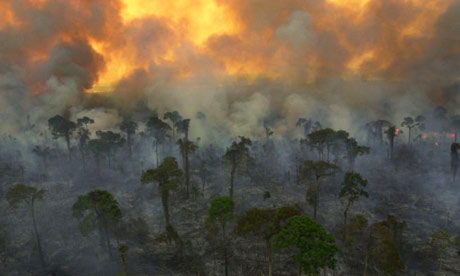
RIO DE JANEIRO, May 25, 2011 (IPS) – The same day that the lower house of the Brazilian Congress approved a reform of the forestry code that would make it easier to clear land in the Amazon jungle for agriculture, a husband and wife team of activists who spent years fighting illegal deforestation in the rainforest were murdered.

After several delays, the revised forest code was approved by the Chamber of Deputies late Tuesday, by a vote of 410 to 63, with one abstention.

Introduced by Communist Party lawmaker Aldo Rebelo, the reform of the 1965 forestry code is, in the view of environmentalists, the first major defeat for President Dilma Rousseff, as the parties allied with her left-wing Workers’ Party did not vote in a bloc with it on this question.

“This vote represents the biggest setback to Brazil’s environmental legislation in decades,” Raul Silva Telles do Valle, assistant coordinator of the Socioenvironmental Institute, told IPS.

“It’s a law that looks to the past, not the future,” WWF-Brazil’s conservation director Carlos Alberto de Mattos Scaramuzza told IPS.

conrtinued

http://ipsnews.net/news.asp?idnews=55788

Brazil: Forest Law passed by fascist landlords..Amazon defenders killed.

Câmara aprova Código Florestal

The Folha de Sao Paolo reports the passing of the forest law, pushed through today by powerful extreme right landlords, headed oddly by  populist communist Aldo.-

No details of final version given .

No mention of the amnesty for previous forest crimes which, imposed by the fascist landlords, now make ALL LAWS in the Amazon a laughing stock, and have caused a 6 fold increase already in the criminal destruction of our world heritage.

The influential Folha da Sao Paolo also fails to mention the murder of  the pro Amazon activist José Claudio Ribeira da Silva and his wife Maria, at least on their front pages of the digital edition , even though the police have attributed it to the loggers mafia, especially as their ears were cut off. Another terrorist murder, but one which will be celebrated by mining, logging and ranching companies.

This goes together with the signing of contracts for BP to extract deep sea oil, and the go ahead for the Belo Monte dam.

aybe the terrorists were celebrating the coming Forest Law.

MÁRCIO FALCÃO
LARISSA GUIMARÃES
DE BRASÍLIA

Após semanas de embate, negociações e troca de acusações, a Câmara dos Deputados aprovou ontem o texto da reforma do Código Florestal com alterações que significaram uma derrota para o governo.

Uma emenda aprovada por 273 votos a 182 rachou a base do governo levando os principais partidos governistas, PT e PMDB, para lados opostos. O texto da emenda consolida a manutenção de atividades agrícolas nas APPs (áreas de preservação permanente), autoriza os Estados a participarem da regularização ambiental e deixa claro a anistia para os desmates ocorridos até junho de 2008.

O líder do governo, Cândido Vaccarezza (PT-SP), chegou a falar, em nome da presidente Dilma Rousseff, que a aprovação da emenda seria “uma vergonha”.

Dilma recebe ex-ministros que são contra texto de lei florestal
Relator do Código Florestal critica ex-ministros de Meio Ambiente
Impasse regimental impede votação do Código Florestal, diz Rebelo
Governo cede para votar nova lei florestal

read more here

http://www1.folha.uol.com.br/ambiente/920514-camara-aprova-texto-do-novo-codigo-florestal.shtml