Occupy Rome: stupid violence or the birth of a new anger?

by italycalling|

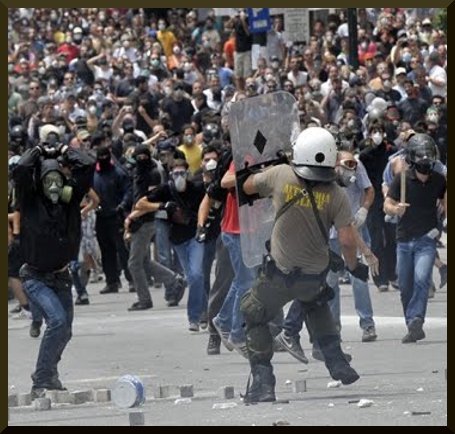
One week after the now (in)famous Roman 15th October that ended up on worldwide headlines as “the only protest of the Occupy movement that ended in violence and riots”, and here we all are reading and writing about it. At the end of the protests 70 people had been injured, and 12 arrested during the riots in Piazza San Giovanni. All of the arrestees are young and have no previous criminal record, like the ones arrested for the events of December 14 last year (all consequently released without charge). The following days several social centres and private houses were raided by the police (in search of black hooded sweaters, no doubt). Some MPs suggested the re-introduction of anti-terrorism laws that haven’t been used in Italy since the 70s. Rome’s Mayor banned any demonstration in central Rome for a whole month, excluding sit-ins (cos they look nice, I suppose, you know, it’s good for the tourists)…………

The media, politicians and pacifists, right and left, started howling merrily together for revenge and prison. In reality the violent resistance was localized , didn’t attack innocents, and was largely provoked by violent police .. (Comment by blogger)

….Some of the more “socially aware” articles were all about how the violent protesters “ruined the day”, stealing it from the peaceful protesters and turning it into their own battle with the police. A lot of the protesters have also been writing on their blogs and networks. Some were very scared and pissed off about getting caught up in a situation they didn’t want to be in; others were disappointed and critical of the behaviour of some of the protesters; some others were happy about the resistance in Piazza San Giovanni, and the birth of a new, angry generation….

….Most of the Italian public seems to think the Black Bloc is either made of a) random vandals, possibly neofascist; b) anarchists; c) police infiltrators (or a mix of the 3, pick your own flavour!). It does seem very plausible indeed, looking at pictures and videos, that a significant number of infiltrators were there. They are very easily recognisable, because even the most expensive intelligence training could never teach them how to dress like “proper” Black Bloc. I don’t find it surprising, and I really don’t understand why people still do…remember the piece I wrote for Cossiga’s death, remember that strategy?

Back to the same devastating debate that split the Genoa Social Forum and the movement after the G8: violence vs non-violence. There would be so much to say about this that I, or nobody else for that matter, couldn’t summarise in a blog’s article. If I may, I’d like to suggest the reading of this little illuminating book: “How non-violence protects the State” by Peter Gelderloos.

Here’s part of a comment from the  Wu Ming blog post

…”I’ve already written it here on other occasions. The catastrophe has already happened. And before being political and economic, it was cultural. Whoever holds things close to their ‘heart’ (ha!) must multiply spaces like this one – precious not just for the content, but especially for their methods, attitude, pedagogy (it sounds like a swear word). Places that invite confrontation, discussion, personal growth and sharing. And conflict, fuck. Even ours, especially ours. And not just on the web. Actually, conflicts are needed especially outside. They are too scarce still.

But things are moving. October 15 is in the past already. We need a new vocabulary – emotional and political. A new generation won’t be enough to take on the task. But we could be proud to be the ones who started it. Occupy everything. Take care.”

READ FULL ARTICLE HERE   (with thanks)  http://italycalling.wordpress.com/2011/10/23/occupy-rome-one-week-after/

Tipnis Saved..’the most beautiful jungle on Earth’

Native Protesters Celebrate Law Cancelling Rainforest Road   By Franz Chávez

LA PAZ, Oct 25, 2011 (IPS) – With victory cheers and predictions of future campaigns in defence of their ancestral territory, indigenous protesters from Bolivia’s Amazon jungle region celebrated the new law that banned the construction of the road through their rainforest reserve.

The 66-day march by the demonstrators to La Paz and the controversy over the road undermined the backing for President Evo Morales among his main support base, the country’s indigenous majority.
Late Monday, Morales signed into law the agreement putting an end to the plan to build the road that was opposed by some 1,000 native protesters from the Amazon, who made the gruelling 600-km march from the rainforest to La Paz.

The demonstrators, who were subjected to a brutal police crackdown in late September near a remote village 330 km north of La Paz, were greeted as heroes by thousands of people who took to the streets on Wednesday Oct. 19 to welcome them when they reached this city in Bolivia’s western highlands…….   …….The indigenous peoples of the Amazon region make up 10 percent of the 10 million inhabitants of Bolivia, where over 60 percent of the population are native people, mainly belonging to the Quechua and Aymara ethnic groups concentrated in the western highlands. Morales, the country’s first-ever indigenous president, is an Aymara Indian.

next…Save the Madidi Campaign

In an interview with IPS, environmentalist Carmen Capriles, one of the leaders of the Save the Madidi Campaign, discussed the concept of the “plurinational state”, as established by the new constitution that went into effect in 2009, in which she said indigenous communities and people of mixed-race or European descent mutually recognise their different identities while declaring their unity in the Bolivian state.

The activist, who is working to defend the 1.9-million-hectare Madidi National Park in northwestern Bolivia, said the plurinational state was achieved by a struggle waged along the country’s roads and in its jungles and mountains, in the face of repression and stiff opposition.

Capriles also said there is a growing sense of unity between indigenous people from poor rural areas and from urban slums, who are forging a natural alliance to defend nature.

Morales’s reputation as one of the world’s foremost champions of the environment was hurt by the plan to build the road across the TIPNIS reserve.

She was referring to areas like the Madidi National Park and the Pilón Lajas Biosphere Reserve and Communal Lands in the north of the province of La Paz – which are close to recently discovered oil reserves.

In addition, the projected El Bala hydroelectric dam would flood some 300,000 hectares of land in the Madidi National Park and the adjacent Pilón Lajas biosphere reserve and indigenous territory, including the TCO owned by the Leco indigenous community.

Read much more here..WITH THANKS!   http://ipsnews.net/news.asp?idnews=105596


Resistance takes root: Preparing for Capitalist Collapse

Resistance takes root in Barcelona

Hilary Wainwright explores the deepening organization of the Indignados movement

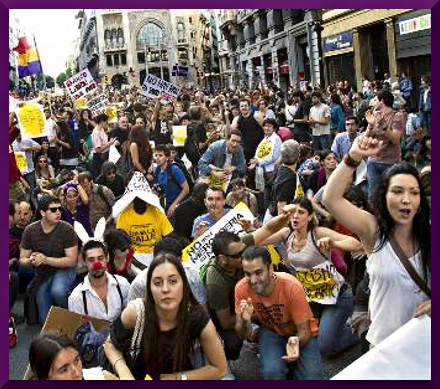
The Catalans have a phrase: ’em planto’. It has a double meaning: ‘I plant’, or ‘I’ve had enough’. At end of the huge 15 October demonstration of Indignados (‘outraged’) in Barcelona – the papers put it at around 250,000 – we were  greeted with an impromptu garden under the Arc de Triomf, the end point of the march. Campaigners for food sovereignty had planted vegetables in well-spaced rows, ready for long term cultivation.

The point was partly an ecological one. But the surrounding placards indicated that the gardeners also intended it to make a symbolic point about the broader significance of the march. ‘Plantemos’ declared a large cardboard placard, meaning: ‘we plant ourselves’ – ‘we stand firm’. Mariel, who was dressed as a bee – essential to flourishing horticulture and now facing pesticidal destruction – explained that the activists who organised the garden were part of the agro-ecology bloc on the march. The march as a whole had several layers of self-organisation that became apparent at certain moments. There were three main focal themes – all issues on which active alliances had come together over recent months: education (yellow flags), health (green flags) and housing (red flags).

As we approached the Arc de Triomf, someone on a loud hailer announced that the different directions in which those following each of the themes should go, guided by an open lorry carrying the appropriate flag. The idea was that the demonstration would end not with speeches to the assembled masses, on the traditional model. Instead, the plan was to hold assemblies to discuss action and alternatives to cuts and privatisation.

News came through later in the evening that two of these assemblies had taken action, leading an occupation of a third hospital – two that were making redundancies had already been occupied the day before the demonstration. They had also squatted a large unoccupied building to turn it into housing for ten families. Evictions have become a focus of intense conflict in Barcelona as the numbers grow every day.

As well as clusters around themes, it was the regular neighbourhood assemblies, feeding into an occasional assembly of assemblies, that were the organism that gave the demonstration its impressive life.

The neighbourhood assemblies emerged in early summer this year, following the birth of the Indignados movement in the occupations of the squares of Spain and Greece. As the occupation of Barcelona’s Plaça de Catalunya reached its peak towards the end of May and the general assembly in the square began to plan its future, the locus of organised indignation spread to the neighbourhoods – sometimes reviving or connecting with pre-existing neighbourhood associations, sometimes building on quite dense social bonds. For example, the assembly from Sant Andreu, a predominantly working-class neighbourhood in the north of the city, marched for over an hour to reach the demonstration, proudly announcing their assembly on their yellow T-shirts.

Like many on the demonstration, they brought handmade placards. Some of their slogans were specific: ‘education is not for sale’, ‘for high quality education; against the cuts’. Others were more general: ‘nothing to lose; all to gain’, ‘the system is dead, the people are alive’. A lot of these homemade banners highlighted the exhaustion and corruption of the political system, one offering a reward: ‘2,000 euro for an honest politician’. Abstentions could be high in November’s elections.

There is disillusionment too with trade unions. In the occupation of the square earlier this year, it was not only parties that were not wanted, but also the unions. They had been part of a social contract with the government that had let workers down, leading to a fall in wages and weak protection. Most significantly, they showed no concern – and often hostility – to the growing numbers of people, especially among the young, who had no chance of a long term job. Yesterday only the CNT (Confederación Nacional del Trabajo), the union founded by the anarchists and still less bureaucratised than other trade unions, dared show its face.

Interestingly, though, there are signs of workers recovering the confidence to organise in their workplaces as a direct result of the collective action taking place on the streets, and waking up the unions in the process.

Bea recently worked in a call centre. She remembers the fear that made her fellow workers timid and passive. She was impressed that after the occupations of the squares, the call centre workers went on strike over injustices they had previously suffered in silence. ‘It was as if the strength of the example of collective action on the square gave them the confidence, broke through the fear,’ she said.

Where this kind of awakening will lead is unclear. General goals are clearly expressed: real democracy based on popular assemblies in the neighbourhoods, reform of the electoral system for different levels of government, the right of referendums including on the European level, an end to cuts and privatisation of public services, banks and finance under public control, economic development based on co-operation, self-management and a social economy – the list is long and elaborate (see here, for example).

The important, distinguishing feature of this vision of change is that it is not centred on what governments should do. Rather it is a guide to action at many levels, starting with what the people can do collaboratively, through spaces they occupy, resources they reclaim, new sources of power they create. There is a self-consciousness that the creation of far-reaching alternatives will take time. In conversation, the slogans are put in context: ‘we’re going slowly, because we are going far’ is a common saying.

One thing is certain: the energy, creativity and will comes from outside the existing institutions. Bargaining, pressure, people and organisations that bridge the outside and the inside will no doubt be part of the process of change, but the established institutions have lost the initiative. There is no bravado about this. Among those I talked to on our way home from the Arc de Triomf and the improvised garden, there was anxiety as well as elation at the size and success of the demonstration. ‘I feel some people are looking for leaders,’ said Nuria, a translator and free culture activist. But in the many levels of organisation producing this impressive show not only of anger but of serious engagement in creating alternatives, it becomes clear that this is not a ‘leaderless’ movement. It is emerging, experimentally perhaps, as movement where leadership is shared and is learnt – a movement that can grow and flourish as well as stand firm.

Oscar Reyes says

Hilary’s really captured the spirit of yesterday’s march well, but I think her post also goes some way to correcting a lot of the US/anglocentric/major financial centres bias written in round-ups of the global protests. Inspiring as the Wall Street protests are, it is not really accurate to claim (as the Guardian, New York Times and even activist sites like ZNet have it) that these were the spur to rallies that swept the globe.

An initial call was made several months ago: http://15o.democraciarealya.es/ and the most successful of these have been based on concerted organising, not simply the fact that (as Jon Stewart of the Daily Show recently put it, the media dial has turned from blackout to circus).

It’s easy to over-state the “new model of protest” line too (eg. http://www.redpepper.org.uk/birth-of-a-new-movement/ ). There are many novel elements in this, enabled by the internet as well as the re-organisation of global labour– as Paul Mason has pointed out a while ago
http://www.bbc.co.uk/blogs/newsnight/paulmason/2011/02/twenty_reasons_why_its_kicking.html
But in other ways it is all decidedly old-school: unemployment, job insecurity and the defence of a welfare state under threat from a massive austerity programme are spurring protests, coupled with a revolt against a banking system that’s totally out of control.

The Barcelona protest was one of the numerous protests in cities across the state of Spain, from 60,000 in Sevilla in the south to over 10,000 reported in Vigo in the north-west, and 500,000 in the capital Madrid. There are reports and videos (in Spanish) at
http://www.kaosenlared.net/noticia/estado-espanol-recopilacion-cronicas-videos-manifestaciones-15-o
and
http://madrid.tomalaplaza.net/2011/10/15/la-indignacion-sale-a-las-calles-de-todo-el-mundo-el-15-de-octubre/

The story of the three strands of the march that Hilary describes is also worth following. In Nou Barris, a working class suburb in the north of Barcelona, the march was followed by the occupation of an empty block of flats, with the aim of housing families that had faced home repossessions:
http://acampada9barris.wordpress.com/2011/10/16/okupat-un-bloc-de-pisos-buits-a-nou-barris/

A 6,000-strong march continued to the Hospital del Mar, in support of a revolt against health cuts that had already seen the occupation of two hospitals on the night before the main demonstration. The symbolic end point saw a huge die-in, with activists playing dead to symbolise “the deaths of many citizens” as a result of savage health sector cuts.
http://www.setmanaridirecta.info/noticia/la-columna-de-sanitat-la-mes-concorreguda-de-totes

Thousands more formed an education block that met up with an occupation at the Geography and History Faculties of the University of Barcelona, located close to the centre of the city. Once there, convened an assembly to discussed the demands of the recently formed Platform for a Public University (Plataforma Unitària per la Universitat Pública), which has called for a strike on 17 November.
http://www.setmanaridirecta.info/noticia/2000-persones-una-assemblea-la-facultat-del-raval-reocupada-la-columna-vermella

Lesley Wood says:

Terrific article! Thanks for filling in the gaps. I was there, but the crowd was way too big to get a sense of what was going on!

Oscar says:

really insightful article….makes great sense to those who weren’t there…this huge demo…and all the rivers of resistances it symbolises…is trully inspiring …it looks like the ‘indignados’ movement is here to stay and hopefully irreversible.

NOTE . This blogger is preparing a series of cool posts,  on Squat Centers,  Free Universities,  Circus Squats, Anarchist roots, Food and consumption  CoOps,  Mutual Aid Networks, Alternative Banking, etc.  in the Catalunya area.. watch this space for updates….

27 Oct.. Dia d’acció..Day of Action vs.Banks

Our Lives or Their Profits.... Day of Action against the Banks

27 Octubre: Dia d’acció contra els bancs i caixes

 Hola companyes i companys indignats, des de el 15M del Vallès occidental proposem que el dia 27 d’octubre sigui un dia ple d’accions a tot el territori català contra bancs i caixes. /

The Sabadell Assembly have cxalled  Day of Action in all Catalunya against the Banks this Thursday 

/ La idea és que cada localitat o cada territori s’organitzi per fer l’acció, aquesta proposta ja va ser aprovada a l’ assemblea general que es va realitzar a Plaça Catalunya.
The idea es that each area organizes to do an action. This proposal was already approved in the General Assembly held in Plaza catalunya.
Salut i revolució

INDIGNADES SABADELL


Stalinists and 15K police defend Greek ‘Parliament’..why bother?

Protecting the parliamentarians from the people they pretend to represent were fifteen thousand riot cops. But remarkably, supporters of the misnamed Communist Party of Greece formed their own battalion, protecting the police and the parliament from those they called “provocateurs” and even, bizarrely, “anarcho-fascists”. They might as well have accused demonstrators of being meat-eating vegetarians!

5000.000 demonstrators. The communist/stalinist union, anxious as ever to control, joined the police to save the Parliament. This allowed sold out politicians to rubber stamp still more cuts to try and save the European Capitalist System. There followed another Battle of Syntagma Square., with one unlucky stalinist dying of a heart attack.

Let Capitalism FALL. Lets make something Better!

This was the biggest general strike and demonstrations yet against the Greek austerity measures, which continue to drive many into desperate poverty, destitution and even death.

An estimated 500,000 took to the streets of Athens  – which is the equivalent of 2.5 million in London. It was the largest show of Greek working class power since the fall of the military junta in 1974.

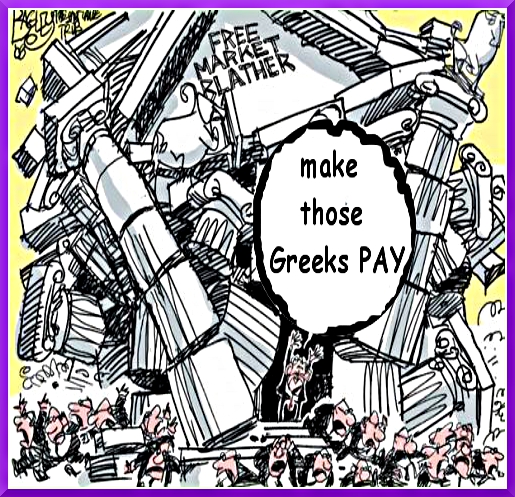
But so long as the profit system remains in place, true power remains in the hands of the ultra-wealthy international financiers. As the debt bubble reaches the point of bursting, there are divisions within this group. Despite the divisions, the combined will of the international financiers in represented by the so-called ‘troika’ – unelected European Commission bureaucrats, the European Central Bank, and the International Monetary Fund. The politicians who meet in the Greek parliament are therefore the puppets of the troika, though they still try to maintain a facade of democracy by arguing a bit before they pass each round of austerity cuts.

Protecting the parliamentarians from the people they pretend to represent were fifteen thousand riot cops. But remarkably, supporters of the misnamed Communist Party of Greece formed their own battalion, protecting the police and the parliament from those they called “provocateurs” and even, bizarrely, “anarcho-fascists”. They might as well have accused

demonstrators of being meat-eating vegetarians!….

”When there’s a Revolution..The PARTY puts it down”
And yet – from the perspective of the trade union bureaucrats who form the base of that party – it makes a lot of sense. Though their website talks of

''if THEY don't pay then WE won't pay at all, then Humpty Dumpty will fall off the Wall!''

the PASOK government enforcing the will of the “plutocracy” by “fire and sword”, their worst fear is a working class movement that they cannot control, which organises on a rank and file basis, and will not accept sell-out after sell-out…..

The whole of Greek society is now in turmoil. Aside from the events of the last two days, almost every day sees fresh strikes and occupations. In response, the PASOK government is mobilising the military to crush resistance by refuse workers. But perhaps in doing so, it is preparing its own demise, one way or another.

Most economists now talk of a Greek default – or at least a huge debt ‘haircut’ – being inevitable. When this happens, the shockwaves will be felt around the world. Sooner or later, the Greek situation is coming to a town near you, and when it does, the international working class will need to organise itself at a grassroots level, and face down the threat of brutal dictatorship….

Read more HERE…(with thanks)

http://infantile-disorder.blogspot.com/2011/10/decoding-battle-of-syntagma-square-as.html

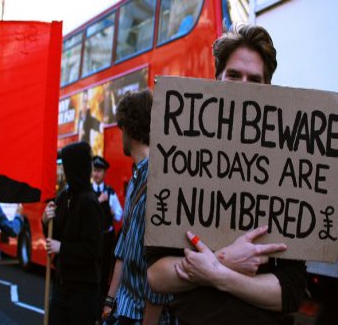
Eat the Rich: One week of Occupy London

On Saturday 22 October at 1pm in London, the general assembly is geared up to receive a swell of visitors, as many who work are inspired by the camp and plan to come and visit and see what it’s all about. It will be an important test for the assembly facilitators, to hold the camp together as more voices enter the equation…Posted by Jamie Kelsey-Fry

Saturday will mark a week since OccupyLondon claimed its space at the feet of St Paul’s Cathedral. It has been a difficult but utterly uplifting experience for all.

IMF predicts collapse of Capitalism!

People are gravitating to the camp constantly, drawn by what is really still an idea taking shape, but an idea that is already inspiring.

The camp is determined and committed to channelling peoples voices through general assembly and consensus. The aims of the London assembly and others around the world are cut from the same cloth.  We all want to challenge the fundamental assumptions that underlie the world’s political and financial systems, which are failing us at all levels.

It’s an easy criticism to make that the assembly ‘offers no solutions’. Of course not, not yet. But the process of building a movement that asks the right questions, and considers that another world is possible, has begun. The systems of general assembly and consensus can be painstaking but they do mean that all those people involved have their voices heard.

The camp came up with their first statement in 48 hours. It’s now only six days in. I would suggest that if this process of forming a concrete vision of a fairer, safer more just world is anything as erudite as the way the London camp has organised itself, then we are in for something of great value. Perhaps an idea whose time has come.

If you plan to visit, I have no doubt that you will find the camp to be, at the very least, a source of hope. At best, you may find yourself deciding that you belong here, and the next thing you know, you’ll be collecting a sleeping bag and joining a working group. See you soon.

Dale Farm being evicted NOW by state gangsters

The Dale Farm Eviction and the Whiff of Fascism

Cops and bailiffs began their invasion at seven this morning.  Despite courageous resistance by families and a group of activists, Basildon Council are continuing their eviction of Dale Farm residents, backed up by the iron fisted brutality of Essex riot cops. Harrowing and devastating though the episode is for the people being oppressed, it also has dark implications for society as a whole, in the UK and globally.

While the corporate media routinely spreads the deception that Dale Farm is an “illegal site”, it is in fact legally owned by the travellers

cops with tasers smashed in at 7 am

themselves. In one part, residents constructed buildings having won planning permission to do so. In the other – where eighty families had been camped before today- no such permission has been won. However, the lack of legal rights for travellers is part of a broader issue, and cannot justifiably be used to excuse one of the largest mass evictions in the country’s recent past. It should be noted that 90% of planning permission applications by travellers are rejected.

The land currently called Dale Farm has been disputed for decades. Though it is often referred to as “green belt”, it was used as a scrapyard by the council as early as the 1960s. English travellers first lived there in the 1970s, but they mostly left around ten years ago, when Irish travellers moved in.

Legal battles have been raging between Basildon Council and the travellers for years, and the latter have exhausted every possible avenue in defending their homes. But when the High Court verdict was handed down last week, it became clear that the council’s eviction would be going ahead.

To READ ON click HERE…(with thanks) http://infantile-disorder.blogspot.com/2011/10/dale-farm-eviction-and-whiff-of-fascism.html

as police in riot gear