
reblogged from Raging Bullshit with thanks
 Attitudes Harden in Spain as Catalonian Referendum Looms (someday,maybe..)
“I hate Catalonia and I can’t stand the Catalans.” These blunt words rolled off the sharp tongue of an habitually sweet-tempered 15-year old Spanish girl called Aina. Aina is from Spain’s north-eastern province of Aragon and she is among a score of Spanish teenagers attending a two-week summer language course I’m helping to organize in the UK.
The first I’ve been involved in for a number of years, the course has been an eye-opener in many ways — especially with regard to the disarmingly frank and often passionate opinions the students express about the political and economic crises currently buffeting Spain, including the sharply polarising issue of Catalonian independence.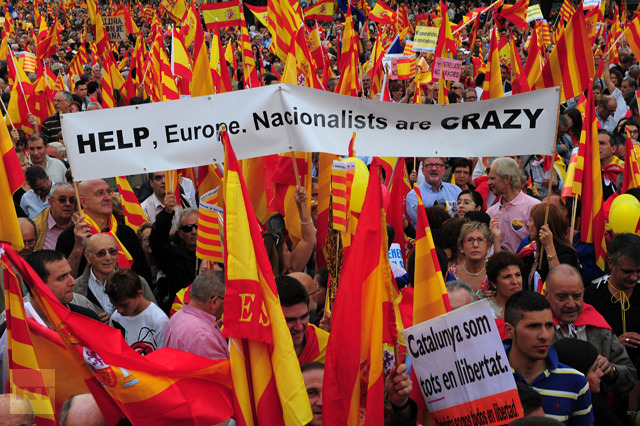
Take Gisela, a 16-year old Catalan girl from Lleida with excellent English and a strong sense of allegiance to her beloved aspiring nation.
“So many things have happened over the last year to make the situation between Spain and Catalonia almost unbearable,” she said. “Worst by far has been the impact of the Wert Law.” [The Wert Law is the Rajoy administration’s latest attempt education reform which seeks, among other things, to restrict — or as some Catalans fear, ultimately abolish altogether — the use of Catalan in the classroom. The legislation also carves out a new role for the Catholic Church in education and further centralises the national curriculum]
As an aside, Gisela is Aina’s best friend on the course — a reminder of the ludicrous contradictions and irrational delusions that proliferate when extreme nationalism takes root. And if my own experience from the last few weeks is anything to go by, nationalist sentiments are hardening on on both sides of the national divide in Spain — and in particular among the youth.
A War of Cultures
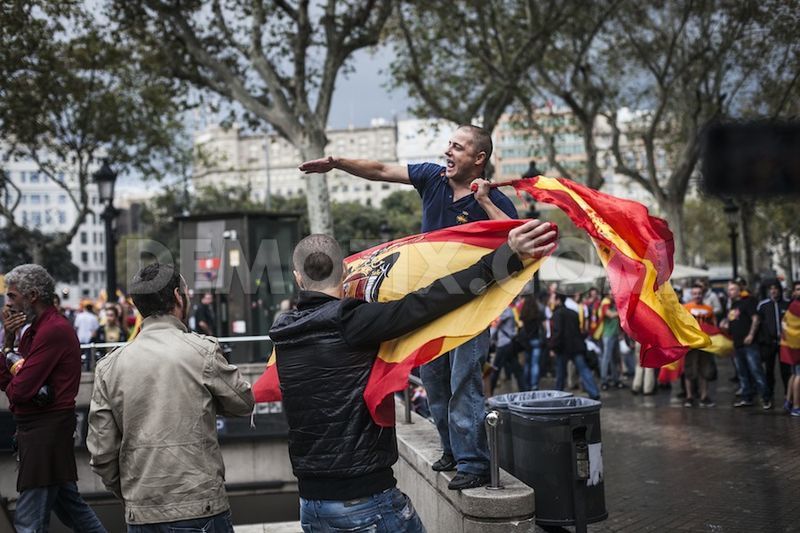
The debate over Catalan independence is not new. Strained tensions between Madrid and Catalonia have been around for centuries. But according to Salvador Giner, a sociologist and president of the Intitut d’Estudis Catalans, the vehemence of the debate fluctuates depending on the political and economic zeitgeist of the times. And right now the zeitgeist could not be more auspicious.
Ever since last year’s unprecedented protests to mark the Diada — Catalonia’s national day of independence, on September 11th – relations between Rajoy’s administration and Catalonia’s coalition government, led by Artur Mas, have soured to the point of curdling. Just a few weeks ago, Mas spoke ominously of a “war of cultures” between the two “countries”. Spain, he said, has traditionally sought to impose its culture on others while Catalonia seeks to reach agreements with others through consensus building.
Mas also announced the busy schedule of events to commemorate the tricentenary, in 2014, of Catalonia’s loss of independence to Spain following its defeat in the Wars of Succession. On the agenda will be congresses, workshops, seminars, symposia, conferences, exhibitions, tributes, inaugurations, shows and diverse publications, all dedicated to the events of 1714 and the evolution of Catalonia over the intervening 300 years.
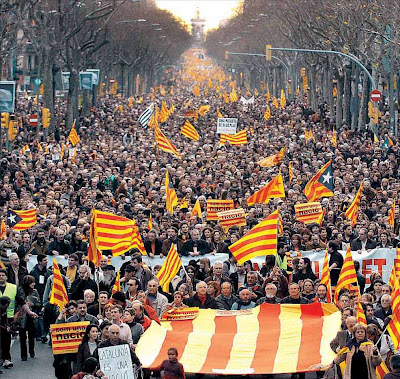
Commemorative acts will also be held far beyond Catalonia’s borders, as the show is taken on the road to “strategic” global cities such as London, New York, Berlin and Brussels.
Unsurprisingly, the news went down like a lead balloon in Madrid, where opposition to Catalan seperatism is already already reaching fever pitch. In late 2012 Esperanza Aguirre, the former hard-line president of the Madrid Community and the person whom many are tipping to replace Rajoy as leader of the Popular Party, warned that “a Spain without a Catalonia or a Catalonia without Spain are inconceivable… Pro-indepenedence demands are like a branch that is breaking off a tree. The tree suffers and the branch dries up.”
Communication Breakdown
But it’s not just in the hallowed halls of government that nationalist feeling and rhetoric are on the rise. In households across both Spain and Catalonia feelings are becoming increasingly polarised.
On social media the tone of the debate grows shriller by the day. For example, in the wake of the recent train accident in Spain’s north-western province of Galicia, some posters lamented the fact that the accident hadn’t happened in Catalonia or the Basque Country. Others complain about the disgust they feel whenever they hear Catalan spoken on TV or the radio.
Granted, social media can be an irresistible magnet for any two-bit nut job with an opinion to share. And sadly, the more extreme and offensive their views, the larger the audience they’re likely to attract.
That said, any country with youth unemployment of over 60 percent that chooses to ignore the threat posed by widespread youth disaffection does so at its own peril. For if history has taught us anything, it is that chronic unemployment, desperation and rising nationalism among the youth are a recipe for disaster. In many ways they set the stage for Hitler’s rise to dominance in the 1930′s and they are currently wreaking havoc in Greece, a country whose 13 million inhabitants the Troika knowingly threw under the bus — all in the name of winning more time for the doomed single currency.
In Spain, meanwhile, the debate on Catalonia descends deeper and deeper into acrimony.
“It seems, at times, that almost everybody hates us,” says Gisela. “Yet they still expect us to stick around and pick up the tab for many of Spain’s poorest regions. They can’t stand us but they need our money.”
Nevertheless, Gisela concedes that it’s both “wrong” and “dangerous” to tar everyone with the same brush, as the media so often does. The reality, she admits, is far more complicated. There are countless Spaniards who are largely unfazed by the prospect of Catalonia’s separation from Spain. Likewise, there are many Catalans who feel a much closer allegiance to Spain than to Catalonia — the inevitable result, no doubt, of the massive waves of immigration to the north-eastern province from other parts of Spain last century.
Imponderables and Unknowns
As for where Catalonia is heading, it’s impossible to say. It is like peering into a pitch-black tunnel and wondering where it might end. There are simply too many imponderables and “known and unknown unknowns,” to borrow a phrase from Donald Rumsfield, the former US Secretary of Defense and one of the world’s “least wanted” war criminals.
One thing that is almost certain is that, barring a miraculous economic recovery in Catalonia or the replacement of the current Spanish government with one that is much more disposed to negotiation with its Catalonian counterpart — neither of which are going to happen any time soon — tensions between the two “countries” are poised to get a whole lot worse.
In my 2012 article “Spain vs Catalonia: A Tale of Two Countries” I wrote that perhaps the most tragic irony of the European project is that it may well end up ushering in a new age of European nationalism, as the European social contract disintegrates, leaving misery and extremism in its stead.
As the British historian Antony Beevor warned, ”The great European dream was to diminish militant nationalism. We would all be happy Europeans together. But we are going to see the old monster of militant nationalism being awoken when people realise how little control their politicians have.”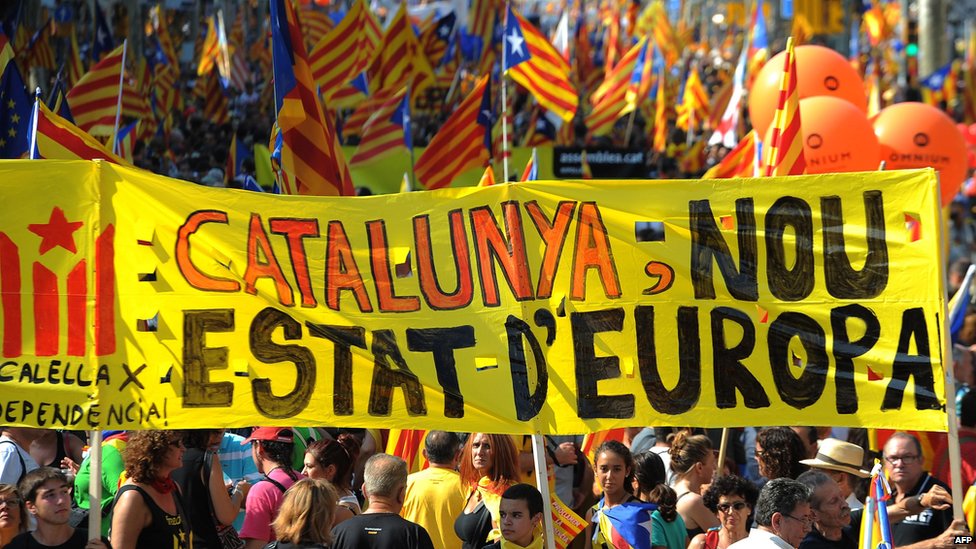
Judging by recent events in Spain and Greece, the monster is already among us. And what’s more, it appears to have its sights set firmly on some of Europe’s youngest and, by extension, most fragile democracies.

 The Free