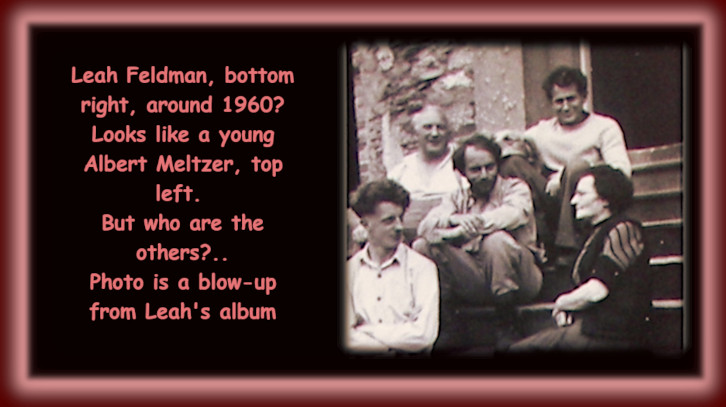
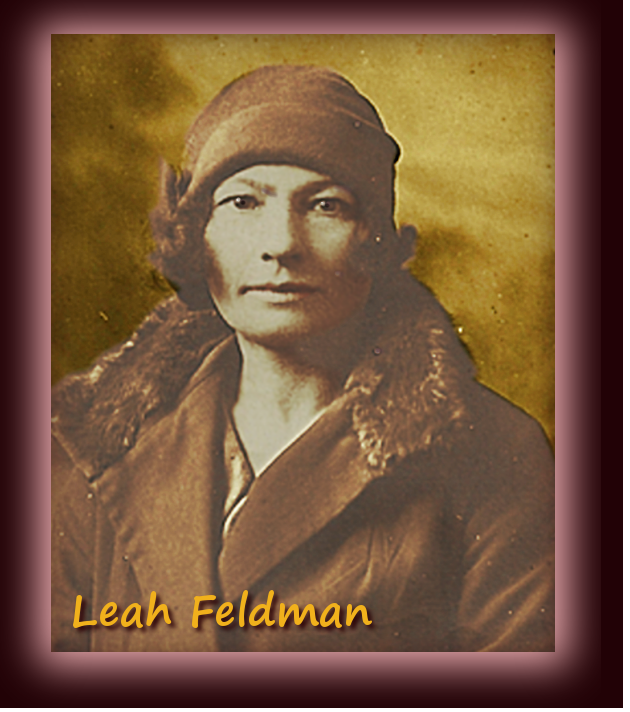
Born in Warsaw in 1899, as a schoolgirl she became interested in anarchism. She said that her mother used to hide her shoes so that she could not attend meetings, which were then illegal in Poland. Finally she ran away to her sister in London where she earned her living at the sewing machine.
Leah’s photo album |
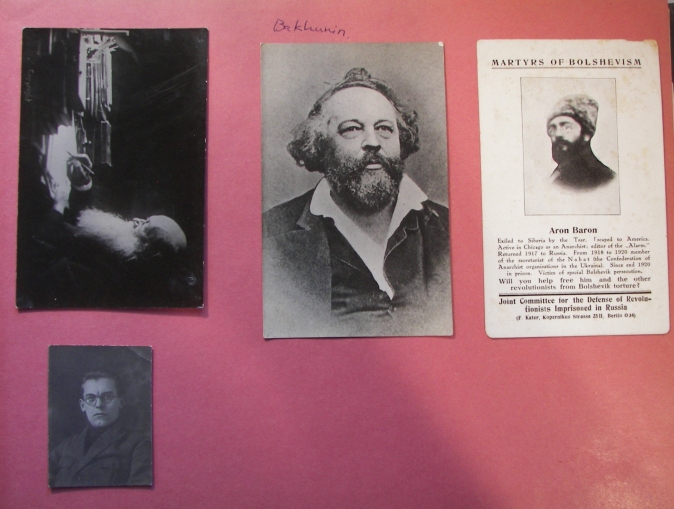
Working in the sweatshops of the East End she became active in the Yiddish-speaking anarchist movement that flourished at that time. When the Russian revolution broke out in 1917 the overwhelming majority of Russian male Jewish anarchists returned home. Many of those women whose husbands and lovers died at the hands of the Tsarists or the Bolsheviks, remained in England.
Leah, however, had made her own way to Russia. Upon arrival she saw the reality of Bolshevik rule and was not impressed. As a working woman she could see the effects of their dictatorship in a way that visiting intellectuals could not.
Before leaving Moscow she attended Kropotkin’s funeral, the last permitted anarchist demonstration until the collapse of Stalinism. (In a great display of self-discipline all of the anarchist political prisoners who were paroled for the funeral returned to jail, in the hope that the Bolsheviks would give parole to others in the future).
Leah travelled south to the Ukraine and joined the anarchist Revolutionary Insurrectionary Army led by Nestor Makhno. The Ukranian anarchists fought Tsarism, foreign intervention and then the Bolshevik dictatorship. Though she did not actually fight (some women who could ride horseback did) she joined the train that followed the army and prepared clothes and food for the orphans and strays they picked up everywhere.
When they were defeated in 1921 she got out of the country by changing her nationality through a marriage of convenience to a German anarchist. They did not meet again. She made her way to Paris and then back to London.
There she acquired British citizenship by another marriage of convenience, this time to a derelict ex-serviceman who was paid £10 for his services. They did not see each other until many years later Leah received an official communication that he was in a geriatric hospital. She used to visit him with presents of tabacco.
Before World War 2 she travelled to Poland and Palestine, working her way to both places. In Palestine she organised a federation of anarchists. One surprise was meeting her old friend Paula Green, who had been pressurised into marriage in Russia, so had chosen an atheist zionist with whom she was in love. Paula knew he was active in Labour politics but thought it impossible that he would ever be in government as he thought her ideas impossible.
Green changed his name to Ben Gurion and became the first prime minister of Israel. His wife did not leave him but she never once took part in any public functions with him. She remained a still believing, if passive, anarchist.
When Leah returned to London at the end of 1935 she helped raise money for the German sailors who organised an anti-nazi resistance group in the 1930s. She also did tremendous work for the Spanish anarchist movement when the civil war broke out.
Leah was a member of a working group of immigrant anarchist women in Holborn ever since 1939. How, with the confusion of tongues – broken English, Yiddish, Polish, French, Catalan, Spanish, Greek Cypriot and Turkish Cypriot – they understood each other was a mystery to many. But they managed.
Leah had to give up work when her eyesight went after an operation. She was completely blind in one eye thereafter and increasingly so in the other. She used her free time to help the movement she had given her life to. In the 1960s she smuggled arms into Spain for the fighters who had continued resisting the Franco regime since 1939. The Catalans, who are prone to giving nicknames, christened her “la yaya Makhnowista” (the Makhnovist granny).
Her last years were sad. Not only were all her family and her early friends dead, there was nobody left with whom she could talk in her own language. But she never gave up. She still supported anarchist meetings and always attended the annual London Anarchist Bookfair when her health permitted.
Our movement has been built by working women and men like Leah. It is right that we do not forget their contribution.
A Rebel Spirit (obituary of Leah Feldman) – by Albert Meltzer at Kate Sharpley Library
http://www.katesharpleylibrary.net/fj6qrv Leah (Leila) Feldman, who was cremated at East London in the presence of some fifty comrades from DAM, ABC, Black Flag and the feminist movement, on January 7th 1993, was a history lesson in herself. She merits more than  an obituary….
She was born (she always said) in Warsaw around 1899. Her British passport says she was born in Odessa, but in view of her problems through life, she must have had many occasions to “change” birthdays, names, birthplaces and nationalities. The problems faced by a woman just in travelling independently in the old days were immense, apart from her anarchist activities. While she was still a schoolgirl she become interested in anarchism (her mother used to hide her shoes so that she could not attend meetings, then illegal). Finally she ran away to her sister in London to earn her own living at the sewing machine.
Working in the sweatshops of the East End, she become active in the Yiddish-speaking anarchist movement that flourished at the time and vanished. She was possibly the last survivor of that Jewish workers’ movement.
When the Russian Revolution was thought to have come about and the army was in rebellion the overwhelming majority of Russian Jewish male anarchists, who had resisted conscription up to then, joined up to return to Russia. The women Anarchists had a more difficult problem – many with husbands or companions who were able to go back, arranged to follow later but that was the last they heard of their menfolk, overtaken by the triumph of Bolshevism.
This Jewish (in the sense they used, neither racial nor religious but language) anarchist movement, gradually dwindled away over the years. A few remaining males survived until the early fifties, and the women, often married into English dockers’ families, ended with Leah so far as this country is concerned.
Leah, however, independently made her own way back, a tremendous task. Viewing Russia from the train, a comrade jestingly remarked she was like Madame Butterfly watching for her lover (we played “One Fine Day” at her funeral, and also Paul Robeson singing the equally appropriate “Joe Hill”). Unfortunately it was no fine day and Leah, as a working woman, was one of the first to see what would be the effects of Bolshevism, something one [none] of the intellectuals who visited could see.
She attended Kropotkin’s funeral, the last permitted anarchist demonstration before the long dark night (they stole the flowers from Lenin’s tribute in the House of the People, but all those paroled from prison for the day returned to jail).
Leah left Moscow to join Makhno’s army in the Ukraine (perhaps that was when she decided she was born in Odessa), which fought into the last against Tsarism, Bolshevism, the Social Democratic oppression and foreign intervention. She was one of a number of Jewish Anarchists who were living testimony to the lie started by the Soviet historian Yaroslavsky and accepted by academics universally (including many encyclopaedists copying each other) about Makhno’s pogroms. Though she did not actually fight, as a few women (who could ride horseback) did, she joined the train that followed the army and prepared clothes and food for the orphans and strays they picked up everywhere. For the rest of her life she was to follow the pattern of behind-the-lines support for revolutionary action.
When the army was defeated, Leah took advantage of one ‘privilege’ offered to women – she changed nationality by a formal marriage to a German anarchist, and left the country. They did not meet again. She made her way to Paris and then back to London. She still wanted to travel and was involved with the Anarchist movement in many countries.
She was however tied by her German “marriage” once she had left Russia, but was later free to contract another formal marriage to a British ex-serviceman, named Downes. In a deprecating obituary in ‘Freedom’, which takes into account only her selling of ‘Freedom’ during and a few years after the war, it is said he was her lover.
This is rubbish. He was a derelict, like many wounded old soldiers after 1918, found for her by Charles Lahr and paid £10 for his services, lent by the Workers’ Friend group and repaid by Leah over a period. (Typically, Charlie joked that to find a real husband would cost a lot more). They never met again until Leah found by official communication her ‘husband” was in a geriatric hospital and she used to visit with presents of tobacco. When she was abroad, Polly Witcop (sister of Milly Rocker and Rose Witcop) undertook the visits for her.
Leah visited both Poland and mandated Palestine once she was a British citizen, working her way to both places. In Palestine she organised a federation of Anarchists, mostly old friends from the old country. One surprise was her old friend Paula Green, who had been pressurised into marriage in Russia, so had decided on an atheistic Socialist-Zionist with whom she was in love. Forced into exile he had obviously chosen (Ottoman) Palestine.
Paula knew he was into active Socialist politics but thought it as impossible he would ever be in government as he thought her ideas impossible. Green changed his name to Ben Gurion, and after 1945 become Prime Minster.
His wife did not leave him but did not take part in any public activities, and the whisper in Socialist-Zionist circles was that she was mad and could not be taken on an official platform. (‘Because he becomes the baker do you have to be the baker’s wife?” Leah asked her back in 1935, ten years before Paula faced the final humiliation as Premier’s wife though a still believing if passive anarchist, getting the reply, with a shrug, “So what do I get but the smell of the bakery?”).
Eventually Leah decided there was nothing she could do in Palestine and returned to London at the end of 1935 when I met her for the first time. She helped raise finance for the German sailors who organised a resistance group in the thirties, and took a tremendous part in activities for the Spanish movement when the civil war broke out.
I used to go to her flat in Lordship Park (Stoke Newington) and hump great parcels of food and clothing which she had collected from her fellow fur machinists. She could never understand why I could “only raise pennies among my friends when she raised pounds” and never appreciated I was still at school, which for some obscure reason I was somewhat abashed at mentioning in then mostly ageing anarchist circles.
She took part in the selling of “Freedom” after the war and still thought of it as Kropotkin’s paper until her death, but a lot of people made that mistake. She could never understand in later years why they persistently ignored her except when she gave them money, and never visited her when she was ill, but the truth was they resented her criticism that Kropotkin intended it for the Anarchist movement not for a few cronies of one man who had seized control.
When “Black Flag” come along she supported it equally always saying to me, “How is it that the people in this group are so different from the Freedom Group?” – I always answered “Because they’re Anarchists” but I fear she didn’t want to hear that.
Leah was associated with Spanish women anarchists in a joint working collective of different Anarchist women in Holborn (London) with Marie Goldberg, Suceso Portales and others, ever since 1939. How, with the confusion of tongues, broken English, Yiddish, Polish, bits of French, Spanish and Catalan, Indian-English of one and broad Scots of another, plus the total lack of verbal communication of two Cypriot women, one Greek and the other Turkish, they could ever have understood each other was a mystery to many, but they made up for it in volume, and maybe that’s how new languages are born.
(The postman once said to me on the stairs, ‘I can never work out what nationality those ladies are – they told me they come from somewhere in Anarchy but Christ knows where that is.”) Leah had to give up work when her eyesight went after an operation (she was blind in one eye thereafter and increasingly so in the other),
She wanted to give aid to the Spanish Resistance in spite of all, and during the turbulent sixties, with the International First of May Movement, helped in taking care of the armoury, even taking it with her luggage into Spain. She was known affectionately by Catalans, always prone to giving nicknames, as “la yaya (granny) Makhnowista”.
In her seventies she revisited Warsaw in a vain attempt to find her relatives. A Polish journalist took her round as she refused to believe everything and everybody in the ghetto had vanished.
“Maybe the neighbours know something,” she said and they had to show her visual proof that the neighbourhood had been flattened, the Polish inhabitants dispersed and scarcely one of the Jewish residents remaining anywhere in Poland other than those who had come in after the war. Presumably this episode appeared on local TV or radio as the journalist took enormous trouble in convincing her of the reality.
Her last years were sad. Not only were all her family and early friends dead, there was nobody left to whom she could even talk in her own language. She still supported anarchist meetings and went on holiday independently but in the last years of her life accompanied by Margaret, Jessica, Peter, Terry from Black Flag.
One of us used to take her to the annual Anarchist Book Fair whenever her health permitted – she always sat at the Freedom Press stall in the hope of meeting some of the people she knew in Freedom who only appeared on the scene that day of the year, if at all, stubbornly refusing to admit it was now quite a different ball game.
As she got increasingly deaf and almost totally blind, she had to surrender some of her cherished independence and allow people to do things for her. She became paranoiac, argumentative and even aggressive in her nineties, after a series of horrendous street accidents, feeling her best friends were trying to kill her by driving cars or motorbikes straight at her.
The fact that these dedicated young people still persevered week after week looking after her, being fond of her, and remembering all she had done in the past, says a lot for them especially, in addition to those already named, the feminists Ann and Cathy, and DAM (Direct Action Movement) people like Ken and Helen.
George Cores said that “most of the work that was done (in building the Anarchist movement) was due to the activities of working men and women, most of whom did not appear as orators or writers in printed papers”, Cathy and Margaret, and our late comrade Leo Rosser, obtained in a series of interviews, and a video, notes of her life which have been transcribed but are voluminous though chronologically jumbled. We hope that these can be edited into a coherent volume, which will be well worth publishing, far more so than the oft-repeated hagiographies of the ‘secular saints’ of the movement in the past.
Feldman, Leah, 1899-1993 – Libcom.org
Feldman, Leah, 1899-1993. – Surrey and Hampshire Anarchist …

Leah Feldman Interview : Kate Sharpley Library : Free …
Spycop’ scandal hits new low with claim that officer …

 The Free
Reblogged this on The Free.
LikeLike
You might be interested to see video of Leah being interviewed by Leo Rosser.
https://archive.org/details/LeahFeldmanInterview
17 minutes. Leah talks briefly about her time in Russia (1917-27), Kropotkin’s funeral, the anarchist movement in London, Emma Goldman and the Spanish Revolution, Rudolf Rocker’s internment during the First World War and her own life. Leah was interviewed in her flat in Stoke Newington, London in 1985 by Leo Rosser.
LikeLike
Thanks a lot for sharing the interview, great to see Leah in such fine form,
and Leo as well, it’s curious how the little mannerisms and way of speaking
come back to you!
Leah is unforgettable! In my veggy garden there’s a battered plastic urn I still
use as a plant pot, and which held Leo’s ashes when they came to Barcelona to
scatter them on Durruti’s grave.
salud and all the best……… mike
LikeLike
Reblogged this on Wessex Solidarity.
LikeLike