
March 10, 2021 by ELCOMUNISTA.NET translated and shared with thanks
Two Greenpeace activists beat security in a a powered paraglider to land and unroll a banner on a roof of the European Central Bank in Frankfurt, Germany, to protest ECB’s loans for carbon-heavy industries
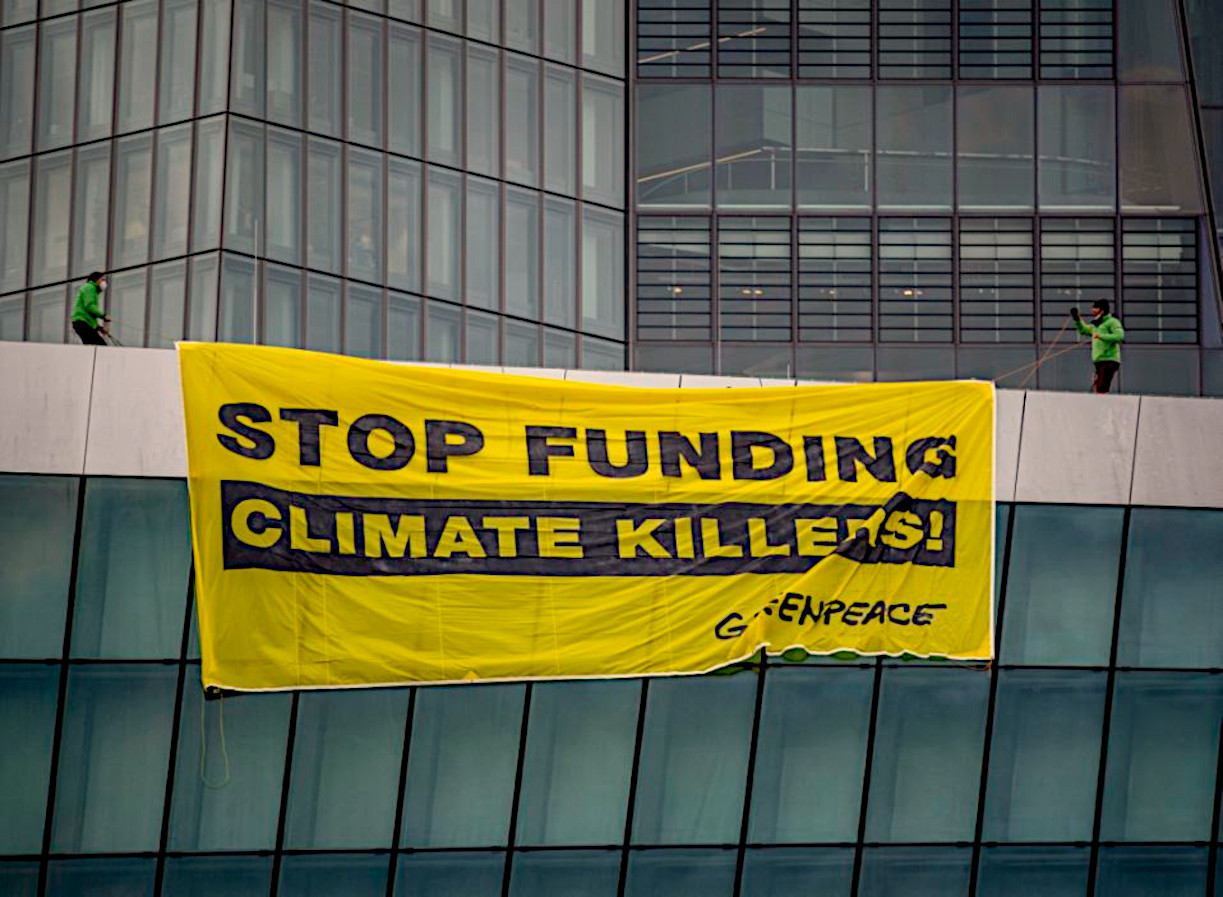
Wednesday, March 10, 2021. Two activists landed on the roof with a paraglider and hung a banner protesting against the ECB’s climate policy.
A spokeswoman for the ECB told EFE that they cannot confirm that the two activists have landed .«The Police have been informed and are here . Our top priority is the safety of the people involved, ‘added the ECB spokeswoman.
“Protecting the climate is one of the greatest challenges facing humanity this century. The ECB contributes to this response within its mandate as a central bank, acting in sync with those responsible for environmental policy ”, according to the European entity.

Greenpeace activists unfurled a 40-foot banner reading “Stop funding Climate Killers” at the entrance to the ECB, according to an image posted on the social network Twitter.
Greenpeace protests in this way against the monetary policy of the ECB, whose Governing Council met to discuss it, because it considers that it is detrimental to the climate to buy debt from companies that pollute a lot and demands a strategy that is oriented to the Paris Agreement.
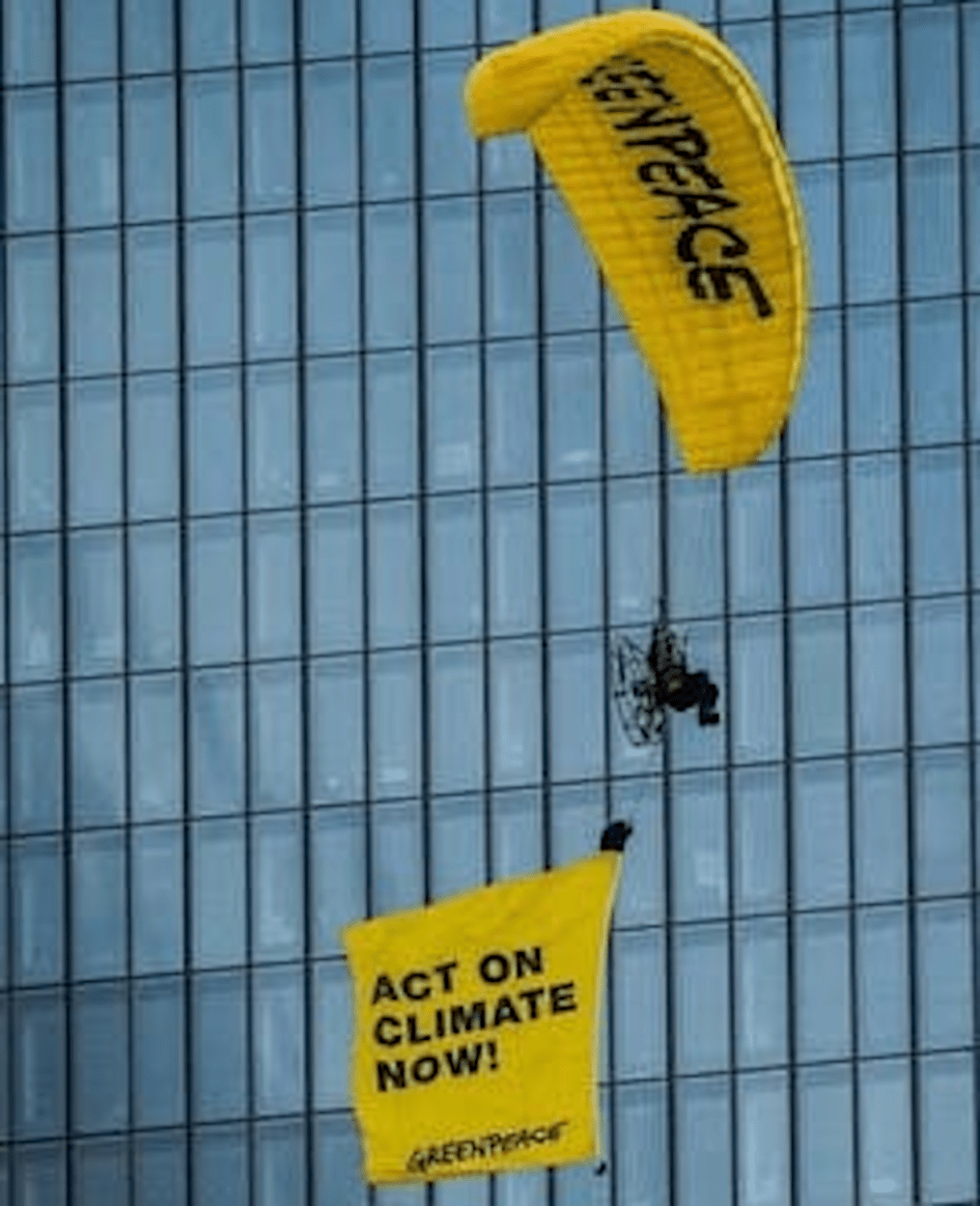
In another image that Greenpeace has posted on Twitter, another activist can be seen paragliding in front of the ECB building with another banner that reads “Act on climate now!”.
A Greenpeace spokeswoman in Germany has told EFE that a third activist paraglided in front of the ECB building with this second banner.
In total, there were ten activists from the environmental organization in the ECB area, as the other seven were in charge of security, the Greenpeace spokeswoman added.
Parallel to this protest action, Greenpeace published a report on Wednesday on the guarantees that the ECB accepts to lend money to banks.
The report is entitled GREENING THE EUROSYSTEM COLLATERAL FRAMEWORK (PDF download here) and has been produced together with the New Economics Foundation (NEF) and several British universities, the SOAS University of London, the University of the West of England and the University of Greenwich.
In this report they conclude that the proportion of high carbon corporate debt that the ECB accepts as collateral is very high and that these collaterals also have a lower value limit when calculating their risk.
It also points out that this ECB guarantee system, as currently designed, runs counter to the democratically defined objectives of the Paris Climate Agreement and the objectives of the European Union (EU).
In a recent analysis, Greenpeace also found that the ECB supports high-carbon companies by purchasing debt from the Lufthansa airline group and thereby breaching European environmental targets.
Lufthansa placed two bonds for a total volume of 1,600 million euros at the beginning of February, with the proceeds of which it has returned a loan of 1,000 million euros from the German State Credit Bank for Reconstruction and Development (KfW), according to information from the own company.

The European monetary entity is currently conducting a review of its strategy, which includes an in-depth analysis on how to respond to the climate crisis through all areas of the ECB’s monetary policy.
The ECB said in late January that it will invest in a euro-denominated green bond fund issued by the Bank for International Settlements (BIS) to finance renewable energy production, energy efficient projects and other environmental projects.
The ECB has purchased green bonds issued by the public since March 2015 and issued by companies since June 2016.
Since March 2016, when the ECB announced that it would also buy corporate bonds, the issuance of corporate bonds has increased rapidly
original en castellano
Dos activistas de Greenpeace aterrizan en parapente en la azotea del BCE
Posted on marzo 10, 2021 by ELCOMUNISTA.NET in INTERNACIONAL, LO MÁS VALORADO // 0 Comments
Dos activistas de la organización ecologista Greenpeace han aterrizado este miércoles en parapente en la azotea de uno de los edificios de la sede central del Banco Central Europeo (BCE) y han colgado una pancarta.
Una portavoz del BCE dijo a EFE que no pueden confirmar que los dos activistas hayan aterrizado en parapente en la azotea de uno de los edificios del BCE y que hayan desplegado una pancarta.
«La Policía está informada y se encuentra en el lugar. Nuestra prioridad principal es la seguridad de las personas involucradas», añadió la portavoz del BCE.
«La protección del clima es uno de los mayores desafíos que afronta la humanidad este siglo. El BCE contribuye a esta respuesta dentro de su mandato como banco central, actuando en sincronización con los responsables de la política medioambiental», según la entidad europea.
Los activistas de Greenpeace desplegaron una pancarta de unos 12 metros en la que se puede leer «Parad la financiación de los asesinos del medioambiente» («Stop funding Climate Killers») en el edificio de entrada al BCE, según una imagen que han colgado en la red social Twitter.
Greenpeace protesta de este modo contra la política monetaria del BCE, cuyo Consejo de Gobierno se reúne mañana para discutirla, porque considera que es perjudicial para el clima al comprar deuda de empresas que contaminan mucho y exige un estrategia que se oriente al Acuerdo de París sobre el clima.
En otra imagen que Greenpeace ha colgado en Twitter se puede ver a otro activista volando en parapente frente al edificio del BCE con otra pancarta en la que se puede leer «¡Actuad sobre el clima ahora!» («Act on climate now»).
Una portavoz de Greenpeace en Alemania ha dicho a EFE que un tercer activista voló delante del edificio del BCE en parapente con esta segunda pancarta.
En total, se encontraban diez activistas de la organización ecologista en la zona del BCE, ya que los otros siete se encargaban de la seguridad, añadió la portavoz de Greenpeace.
Paralelamente a esta acción de protesta, Greenpeace ha publicado este miércoles un informe sobre las garantías que el BCE acepta para prestar dinero a los bancos.
El informe se titula «Greening the Eurosystem Collateral Framework» («Ecologizar el marco de garantías del Eurosistema») y ha sido realizado junto con la organización New Economics Foundation (NEF) y varias universidades británicas, la SOAS University of London, la University of the West of England y la University of Greenwich.
En este informe concluyen que la proporción de deuda de empresas que emiten mucho carbono que el BCE acepta como garantías es muy elevado y que estas garantías también tienen un recorte de valor menor al calcularse su riesgo.
También señala que este sistema de garantías del BCE, tal y como está diseñado actualmente, se contrapone a los objetivos definidos democráticamente en el Acuerdo del Clima de París y a los objetivos de la Unión Europea (UE).
En un análisis reciente Greenpeace también consideró que el BCE apoya a empresas que emiten mucho carbono al comprar deuda del grupo de aerolíneas Lufthansa y de este modo infringen los objetivos medioambientales europeos.

Lufthansa colocó a comienzos de febrero dos bonos por un volumen total de 1.600 millones de euros, con cuyos ingresos ha devuelto un crédito de 1.000 millones de euros del Banco estatal alemán de Crédito para la Reconstrucción y el Desarrollo (KfW), según informaciones de la propia compañía.
La entidad monetaria europea realiza actualmente una revisión de su estrategia, que incluye un análisis profundo sobre cómo responder a la crisis del clima a través de todas las áreas de la política monetaria del BCE.
El BCE dijo a finales de enero que va a invertir en un fondo de bonos verdes denominados en euros emitido por el Banco de Pagos Internacionales (BPI) para financiar la producción de energía renovable, proyectos eficientes con la energía y otros proyectos medioambientales.
El BCE compra bonos verdes de emisión pública desde marzo de 2015 y emitidos por empresas desde junio de 2016.
Desde marzo de 2016, cuando el BCE anunció que también compraría bonos corporativos, la emisión de este tipo de bonos ha aumentado rápidamente.
EFE

 The Free