
from https://kaosenlared.net translation theFreeOnline
Laura Vicente has a doctorate in History from the University of Zaragoza and a professor of history of secondary education. She is a specialist in social history and women’s history, especially in Spain.

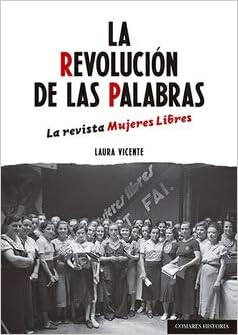
In line with her special interest in social initiatives with anarcho-feminist roots and in social movements, she has published works such as Historia del anarquismo en España (2013), Mujer contra mujer en la Cataluña insurgente: Rafaela Torrents (1838-1909) and Teresa Claramunt (1862-1931) (2018) or The Revolution of Words: The magazine Mujeres Libres (2020).
Currently, she also teaches a course on the Free Women organization in the Crisi space in Barcelona and she is part of the editorial team of the Libre Pensamiento magazine edited by CGT and the XIX y Veinte history magazine.
Interview with Laura Vicente Villanueva
Why were you interested during your career in anarchism and, specifically, in the anarcho-feminism? What came into your life before, anarchism or feminism?
As a historian, anarchism interested me, but what really interested me wasthe issue of conflict and unionism. That was the initial point of interest when I was doing my thesis, I thought of doing a paper on the general strike of 1917. Then, as I passed the ‘opposition exams’, I no longer needed the thesis and, starting from the strike conflict, I
I expanded into unionism and conflict.
The period that I liked was the one before the Second
Republic, because, at the time I was studying, everyone was interested in the stage of the Second Republic and the civil war. It was the great theme and it also generated a lot of controversy and confrontation (the same thing keeps happening but at that time it was much worse)
and I didn’t want to get into that bogged down area.
I went to the 1920s because somehow I had to understand that to understand what happened next. And then, as I say, I was interested in investigating exactly about unionism. The trade unionism that was best known was logically in Barcelona and some other cities, such as Madrid, and it made me very curious to see if really the unionism of not so big cities responded to the same dynamics and characteristics as the unionism of these cities.
I finally saw that it was not so. And the doctoral thesis was developed a little in that area, there was anarchism, obviously, but the trade unionism detached from anarchism was more important.
Feminism interested me from a personal point of view, because I was already involved in it. Since what I was doing was starting from scratch, since there was nothing studied on those years and on that subject, the subject of feminism was vast so I did not treat it.
But there I discovered a woman, suddenly, who was Teresa Claramunt, who arrived in Zaragoza as an expatriate for her participation in Tragic Week, in a rally speaking to male workers who were on strike, and she began to question them, asking where were their wives, their sisters, their companions, etc.
So I imagined that woman in front of a totally masculine audience creating such a scene and it remained with me, to such an extent that when I went back to investigate it had to be about Teresa Claramunt.
Therefore, the journey was this: syndicalism, then anarchism and finally the feminism, which had been growing in me.
Continue reading “Interview with Laura Vicente Villanueva, anarcha-feminist Historian + video”








 The Free