The Health Freedom Defense Fund – a US-based non-profit – has published an open declaration opposing the planned amendments to the International Health Regulations.
Kit broke down the proposed changes in detail in yesterday’s article. Suffice to say, they amount to a massive threat to both individual liberty and national sovereignty.
You can read the full text of the HFDF declaration here, or a (slightly) abridged version below.
To see the full list of signatories, and add your own signature you can click here.
The declaration has already been signed by almost 30,000 people, including Robert Kennedy Jr, Dr Sucharit Bhakdi and Naomi Wolf.
Declaration of Opposition to the Proposed International Health Regulations Amendments
We, the undersigned, oppose the proposed amendments to the World Health Organization’s (WHO) existing 2005 International Health Regulations (IHR) and stand in support of all people’s right to health sovereignty and self-determination.
The United States’ proposed amendments to the IHR are set to be considered at the 75th World Health Assembly, which begins on the 22nd of May, 2022.
The proposed amendments, however, create an ambiguity relating to the date they become effective as the proposed amendments expressly state they will become effective six months after the date of notification by the Director-General, whereas the existing IHR provides that amendments become effective 18 months after notification by the Director-General.
If accepted, these legally binding amendments would come into effect for all member states except those that explicitly reject them. Under Article 59 of the IHR, de facto approval is assumed for any member states that fail to reject or take reservation to the amendments.
The existing IHR, adopted in 2005, respect the sovereignty of all member nations. The proposed amendments, however, would expand and codify the WHO’s authority to implement global health mandates in direct violation of national sovereignty and citizens’ rights.
These proposals attempt to eliminate a nation’s autonomy, during times of real, assumed or anticipated public health emergencies, affording the WHO unilateral power in assessing and determining a health emergency and empowering the WHO to dictate policy and response.
All of this comes on the heels of the COVID-19 crisis during which the WHO grossly mismanaged all facets of the global health response by encouraging economy-destroying lockdowns, suppressing early preventive treatments and recommending interventions that have proven to be neither safe nor effective.
Under the guise of health regulations, these amendments would permit the WHO to seize executive governance powers over member states, granting governing powers to unelected and unaccountable bureaucrats.
In sum, the IHR amendments would, among other changes:
Intensify the surveillance of all countries and their citizens.
Grant the WHO the authority to tell other member states when one member state isn’t reporting and launch punitive actions.
Empower the WHO Director-General to declare when and where a pandemic or “alleged” emergency is occurring using undisclosed sources.
Confer unrestricted powers to the Director-General to define and implement interventions.
Give the WHO the ability to access and mobilize capital in the event of a pandemic.
This power grab by the WHO, its donors, and stakeholders represents a direct attack on the political and economic sovereignty of all nations and their citizens.
By repeatedly promoting policies that caused catastrophic economic, social, physical, emotional and mental damage across the globe, the WHO has failed in its mission as global steward of public health and cannot be entrusted with setting policy for all citizens of the world.
Of note, the WHO enjoys immunity from every form of legal action, arrest, and searches of their papers, documents, and facilities.
The WHO should not be allocated more money, power, or authority nor should it be allowed to further control the world’s health agenda or implement biosecurity measures.
Global agreements brokered by unelected, unaccountable bureaucrats must never be permitted to rule any nation.
It is imperative that each nation and territory retain its sovereignty, especially during times of crisis, so that the entire global community can be protected from globally directed policies that primarily benefit powerful financial and ideological stakeholders.
The undersigned respectfully request that all nations and their representatives repudiate such agreements.
We strongly oppose the proposed IHR amendments which would require nations and their citizens to adhere to the dictates of an unaccountable global body.
We oppose any involvement in a treaty, agreement, or other legally binding global document that would hinder any nation’s sovereignty in the area of public health.
We assert that nations and their citizens are best-positioned and -equipped to make health decisions appropriate to their communities.
We demand that the people of each nation be in charge of determining their response to health crises.
As citizens of the world, we defend the rights, freedoms, and privacy of all members of the global community by calling for the rejection of the IHR amendments and the WHO’s attempt to usurp the power and authority of health policy from its rightful place – at home amongst the people.
On May 18, 2022, this declaration was authored and signed by,
New World Health Organization/Order? | Dissident Voice As you may have heard, members of the World Health [ sic] Organization (WHO) are voting on an international pandemic treaty and amendments to the International Health Regulations between May 22 and 28, 2022. Click here to read those proposed amendment.
The Great Reset Demands Firing All Unvaccinated Employees …Analysis by Dr. Joseph Mercola STORY AT-A-GLANCE The Great Reset has been called a conspiracy theory by many, despite specific plans published on the World Economic Forum (WEF) website and partnerships between the WEF and global organizations like the United Nations and World Health Organization
r/conspiracy – Head of world health organization and Klaus Schaub. WHO is voting May 22 on whether or not to take away a states ability to have a say in declaring a national health emergency. All a part of the Great Reset towards one world government.
The latest story making the rounds is a completely unevidenced claim made by a Ukrainian government official that Russians are going around raping Ukrainian babies to death
The Ukrainian government is quickly learning that it can say anything, literally anything at all, about what’s happening on the ground there and get it uncritically reported as an actual news story by the mainstream western press.
The latest story making the rounds is a completely unevidenced claim made by a Ukrainian government official that Russians are going around raping Ukrainian babies to death.
unconnected photo served up with Daily Beast RAPE FANTASY report
“A one-year-old boy died after being raped by two Russian soldiers, the Ukrainian Parliament’s Commissioner for Human Rights said on Thursday,” reads a report by Business Insider which was subsequently picked up by Yahoo News. “The accusation is one of the most horrific from Russia’s invasion of Ukraine, but is not unique.”
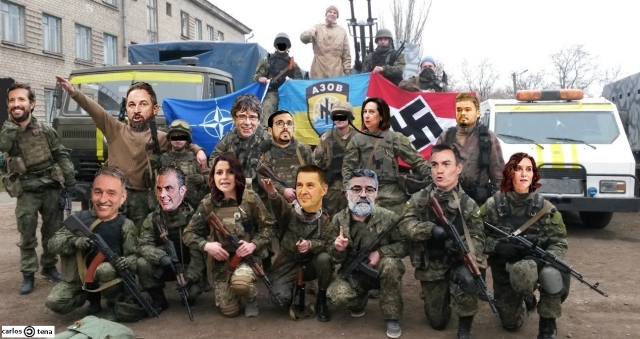
USTEDES DISCULPEN LA REPETICIÓN DE ESTE FOTOMONTAJE DIABÓLICO, PERO A MI ME PARECE MUY REAL
En noviembre de 2021, varios periodistas de izquierda cuyo anonimato era imprescindible para realizar su labor, e incluso llevaban en su ropa algún emblema nazi, llegaron a Ucrania para seguir de cerca lo que ya había sido denunciado en los contados medios independientes europeos, desde 2014, sobre el genocidio en Donbass, que Occidente ha tratado de ocultar en vano, prohibiendo la emisión de documentales veraces, objetivos y contrastados.
Durante este arriesgado viaje, fueron testigos de cómo miembros de los batallones Azov, mostraban a algunos oficiales del ejército de los EEUU los mapas de sus próximas acciones criminales en el Donbass, mientras les obsequiaban con las llamadas “insignias Wolfangel”, inspiradas en los símbolos nazis de la II Guerra Mundial.
El Batallón Azov es un cuerpo miliciano que se incorporó a la Guardia Nacional de Ucrania y…
“Everywhere I go, I see people, often with very little, making huge impacts in their communities and the planet.”
Conservation photographer Ami Vitale is known for her incredible ability to support local communities that are making an impact. This is made clear through her championing of Kenya’s Reteti Elephant Sanctuary.
As the first community-owned and run elephant sanctuary in Africa, Reteti cares for orphaned elephants. The Samburu community opened the sanctuary in 2016 and Vitale has been with them every step of the way.
Through her incredible photographs and a short film, she’s been able to bring their story to a global audience.
The last several years have been trying for the sanctuary as they, like the rest of the world, grappled with the effects of the COVID-19 pandemic.
Supply chain issues greatly affected their ability to care for these young elephants and the sanctuary’s caregivers were left looking for local solutions to their problem.
As Vitale shares below, their ability to think quickly and adapt not only saved these elephants but actually improved their quality of life.
And, at the same time, finding a local source of nutrition has created a new income stream for other members of the community.
We chatted with Vitale about these recent challenges, as well as how she got introduced to the sanctuary and how she kept up with them, even at a distance, when traveling wasn’t possible. We also discuss her short film Shaba, which documents the story of one special orphaned elephant at the sanctuary. Read on for our exclusive interview and if you like what you see, check out our 40-minute chat with Vitale on the Top Artist podcast to learn more about her incredible career.:
What was your first introduction to Reteti?
I had been working with this Samburu community for many years before the sanctuary opened. Back then, having this elephant sanctuary was just a dream and many people thought it would never be possible. When I heard about it and then met all the extraordinary people behind this project, I knew they would do it and I have stayed by them since then, waiting for their beautiful success story to unfold.
As a storyteller, what drew you to their project?
Everywhere I go, I see people, often with very little, making huge impacts in their communities and the planet. I think it’s important to shed some light on those stories of hope, where against all odds, individuals are making a difference. These stories about wildlife and our environment are really about all of us, our home, our future.
I am constantly seeing the wonder and magic of this world. Wonder allows us to get beyond routine ways of thinking. It allows us to believe that we can fundamentally change the course we are currently on. Stories like these have a universal truth and they become a blueprint for so many other places. These are the kinds of stories that really matter to all of us.
Adrien Bocquet, a former French commando, who was in #Ukraine with a humanitarian mission, reports on what he witnessed there: Ukrainian Neonazi fighters’ military crimes, BUCHA, racism, use of civilian infrastructure to store and fire weapons. Azov is everywhere, not just at Azovstal, and he estimates their numbers to be 20,000 when you include all the committed volunteers from all over. Russian soldiers who surrendered were tied up, then shot in the knees with a Kalashnikov and left to bleed to death, while officers were shot in the head. He has video evidence of Ukrainian war crimes. Azov shelled Ukrainian territory causing casualties, through their ineptitude and then blamed it on Russians with the full complicity of the Western media that thought it would make for more sensational reporting. His advice to volunteers who want to go “help” in Ukraine? Don’t go unless your a seasoned military person or war…
The design could someday enable a fully decarbonized power grid, researchers say
“The problem is, you don’t get [renewable] energy when you want it,” Asegun Henry, mechanical engineer at MIT and author of the new Nature study, explained in a video call. “You only get it when the weather is favorable: when the Sun is out or the wind is blowing.”
One answer to this dilemma lies in what Henry calls “thermal batteries,” where power from renewable sources of energy, such as solar, is stored as heat.
Image: Felice Frankel.. A thermophotovoltaic (TPV) cell (size 1 cm x 1 cm) mounted on a heat sink designed to measure the TPV cell efficiency. To measure the efficiency, the cell is exposed to an emitter and simultaneous measurements of electric power and heat flow through the device are taken.
Advantages:
The system would be modular so it can make electricity locally for a village or scaled up for a big city.
Although the TPV cell costs more than photovoltaic ones, the graphite storage is cheap and non polluting. They calculate the process to be 10 times cheaper than lithium batteries.
Engineers at MIT and the National Renewable Energy Laboratory (NREL) have designed a heat engine with no moving parts. Their new demonstrations show that it converts heat to electricity with over 40 percent efficiency — a performance better than that of traditional steam turbines.
The heat engine is a thermophotovoltaic (TPV) cell, similar to a solar panel’s photovoltaic cells, that passively captures high-energy photons from a white-hot heat source and converts them into electricity. The team’s design can generate electricity from a heat source of between 1,900 to 2,400 degrees Celsius, or up to about 4,300 degrees Fahrenheit.
The researchers plan to incorporate the TPV cell into a grid-scale thermal battery. The system would absorb excess energy from renewable sources such as the sun and store that energy in heavily insulated banks of hot graphite. When the energy is needed, such as on overcast days, TPV cells would convert the heat into electricity, and dispatch the energy to a power grid.
With the new TPV cell, the team has now successfully demonstrated the main parts of the system in separate, small-scale experiments. They are working to integrate the parts to demonstrate a fully operational system. From there, they hope to scale up the system to replace fossil-fuel-driven power plants and enable a fully decarbonized power grid, supplied entirely by renewable energy.
“It’s a naturalized, state-sanctioned, normalized and deepening fascism, whose waves of violence seem to measure the strides of a giant… So here this question is key: What do we mean when we speak of feminism? Feminism cannot be defined at the surface level…It’s a struggle that is only renewed by restoring the historical memory of our women fighters, those who have been forgotten in the dustbins of revolutions… We cannot think of a feminism, an anti-patriarchy, without anti-capitalism, without anti-fascism, without anti-racism and without class struggle….”[1]
In the spring of 2017, a video of an anti-fascist being beaten at a counter demonstration in Berkley went viral.
The video depicted counter protestor Louise Rosealma being punched in the face and knocked to the ground by white supremacist and founder of Identity Evropa, Nathan Damigo.
On social media, in major news articles, and within movement circles, the video was the subject of extensive commentary. This incident and the various reactions to it tell us much about our current moment. It reveals that we are living through a time where alt-right, white nationalist, and neo-nazi forces are gaining momentum and becoming emboldened.
As the video circulated, the response of the far-right laid bare the depth of their misogyny and vividly illustrated the extent to which patriarchal ideology is a key component of their politics. Louise was doxed and viciously denigrated online – her personal information including home address and phone number was widely distributed and her career as a sex worker was publicised. She was called disgusting and a whore, and was inundated with both rape and death threats.
Photos of her being punched, as well as photos taken from her work in porn became the backdrop for a plethora of memes appearing on both the internet and the streets. For example on the streets of Berkley, oversized posters appeared showing Louise’s naked body beside Damigo’s smiling face with the text “I’d hit that” written across.[2]
Her attack and violence against women in general, was promoted and celebrated. Others chimed in on the video and their responses were equally revealing.
The reaction of liberal feminists was predictably disappointing and highlighted the many shortcomings of their political project.
Some speculated about whether or not the attack would have happened under Hilary. Others, framed Louise as a victim and in many cases as non-violent. Narratives circulated claiming she was attacked while attempting to deescalate and prevent the violence of others, or was attacked unprovoked while peacefully protesting.
A gendered pacifism was implied, and violence was presented as something done to Louise (as a woman), but not something that Louise (as a woman) could or would do. Hand-in-hand with these claims, were calls for police involvement and the arrest of Damigo.
In the typical style of carceral feminism, increased policing, criminalization, and incarceration were proposed as the appropriate response to the incident. Reactions coming from the left weren’t much better, and exposed the sexism ingrained in anti-fascist politics.
Posts, photos, and memes covering the incident were highly patronizing and critiqued Damigo on the basis that he was a coward for hitting a woman (assumed to weaker and less of a threat). Despite a long history of women putting their bodies on the line to fight fascism, physical confrontation was implicitly presented as the realm of men.
Even in supposedly progressive circles, the popular image of the anti-fascist is a male body; often a white male body that borrows heavily from the aesthetics of antifa movements in Europe. Based in a tacit denial of women’s agency, conversations about Louise became a matter of identity (of her being a woman), rather than a matter of politics or activity.
Last and certainly not least, this incident and the fact that it got so much attention speaks to the deep-seated racism that underlines both the left and the right.
Women get attacked all the time, white supremacists beat women all of the time, and women of colour disproportionately face the brunt of it.
Louise’s experience went viral and garnered such broad interest undoubtedly because she is a white, conventionally attractive cis-woman.
The far-right has been on the rise and over the course of the last several years their ideas have been gaining traction. First at the level of grassroots politics, and now more and more at the level of institutional politics, far-right ideology has a notable foothold. It isn’t only that far- right movements have grown, but further, that far-right ideas from the margins have seeped into the mainstream. The situation is bleak, but not hopeless.
We have to know our enemy and we have a lot of work to do; however, many of the options presented to us can be found lacking. We’re given the choice between a pacifying liberal feminism of “pussy hats” and “protective policing,” or a reductive anti-fascism defined by machismo and sexism.
Against such a backdrop, this article seeks to examine the gendered dimensions of fascist movements and anti-fascist struggle, as well as to consider the possibilities for an anti-fascism rooted in revolutionary feminism. For the purpose of this article, I use the term fascism/fascist broadly to refer to a complicated and diverse phenomenon that includes a plethora of far-right groups, ideologies, and movements, including white nationalists, neo-Nazis, ultra-patriots, the alternative right, identitarians, and traditionalists, amongst others.[3]
The article is divided into three distinct, yet interrelated parts, intended to cover the politics, practices, and histories of fascism, gender, and militant resistance. Part 1 explores the gender politics of fascism today, Part 2 examines the history of women’s participation in anti-fascist resistance, and Part 3 concludes with a consideration of the challenges and prospects for developing an explicitly feminist anti-fascism.
Part 1 – The Gender Politics of Fascism: Across the Spectrum of Fascist Sexisms
“Fascism, then, is an exacerbation, a more militant extension, of the patriarchal relationships between men and women that have persisted for centuries. It is a worsening of the fantasies, the violence, the misshapen desires that the whole system of gender relationships that have long pertained in European societies and those in the new world that are descended from them. Rather than a thing, which is categorically distinct from other social and political systems, fascism is a process, which can easily recur, and wherein we can see men, and groups of men, who have commenced the journey.”[4]
Following the death of Heather Heyer in Charlottesville, an organizer of the Unite the Right event commented that Heather was a “fat, disgusting, communist” and her death was “payback.”
32-year-old paralegal was killed when a car ploughed into protesters (Go Fund Me / Heather Heyer)Mr Kessler, who blamed “anti-white hate” for violent clashes between protesters, tweeted: “Heather Heyer was a fat, disgusting Communist. Communists have killed 94 million. Looks like it was payback time.”
[5] In a similar vein, comments were posted online celebrating her murder and calling her a “useless slut” on the grounds that “a 32-year old woman without children is a burden on society and has no value.”[6]
Beyond being attacked for her anti-fascist politics, Heather was attacked for being a woman. At the 2018 Women’s March in Seattle, posters exclaiming “Make women property again” made an appearance.[7]
During this same time at a similar march in Providence, members of the white nationalist group Vanguard America showed up with a banner reading “Feminists Deserve The Rope.”[8]
On International Women’s Day, an article on a popular neo-nazi website proposed that an “International Burn a Witch Day” and an “International Shame a THOT Day” be celebrated as “it’s only fair that we reward AND punish.”[9] Only a few years earlier at an International Women’s Day celebration in Sweden, neo-Nazis attacked the crowd and seriously injured five women.[10]
More recently, in Santiago this past July a feminist march in support of free and legal abortion in Chile was attacked by the fascist group the Social Patriotic Movement. Several hundred members of the group – infamous for describing feminists as animals and arguing for their sterilization – attempted to block the march and in the process covered the streets in animal blood, physically attacked the demonstrators, and stabbed three women.[11]
Such examples are seemingly endless.
Incidents such as these are taking place with growing frequency, as those on the far- right increasingly decry the role of feminism in propagating “Cultural Marxism” and destroying “Western Civilization.”[12]
Echoing the idea promoted in Nazi Germany that women’s emancipation “would destroy the German race and lead to the introduction of Bolshevism,” feminism (and women) are still the enemy.[13]
Then, as in now, patriarchy is fundamental to fascism. Taking this assertion as a starting point, this section focuses on where and how the question of gender fits into fascism. To do so, I explore the rise of the Alt-Right, examine the differing perspectives on gender and sexuality found on the contemporary far-right and finally, consider the role of the “white women victim” trope in propping up white supremacy.
MRA’s, “the Manosphere,” and the Rise of the Alt-Right
The current resurgence and proliferation of far-right movements in North America has frequently been linked to the rise of the Alt-Right. Short for the alternative right, the Alt-Right can be understood as a loosely organized collection of ideological tendencies, groups, podcasts, websites, think-tanks, and figureheads that have created a new breed of white supremacy. It takes inspiration from the identarian ideas of the European New Right and is tied together by “a contempt for both liberal multiculturalism and mainstream conservatism”[14] and a “trenchant opposition to all socio-economic, cultural, and political propositions based on egalitarianism and collectivity.”[15]
While it is best known for its politics of white nationalism and antisemitism, politics of misogyny are also formative. Patriarchal ideology fundamentally shapes the Alt-Right and misogyny is undoubtedly one of its central pillars.[16] The Alt-Right advocates not only for white supremacy, but more specifically for white male supremacy.[17]
Sexism rather racism, is the gateway drug that has led many to join the Alt-Right.[18]
Romano explains: “The basic idea that ‘women are getting too out of hand’ is the patriarchal common denominator. And it aligns perfectly with male rage against ‘social justice’ activism, which in turn paves the way for white nationalism and white supremacy to gain a foothold.”[19]
To understand this dynamic, it is useful to look at some of the precursors to the Alt-Right movement.
Countless observers have linked the Alt-Right to the so-called “the Manosphere,” arguing that the Alt-Right arose in part from and continues to be closely intertwined.[20]
Emerging in and around the 2010s, the manosphere is most simply defined as “an online antifeminist male subculture that has grown rapidly in recent years, largely outside of traditional right-wing” circles.[21]
It entails a disparate network of websites, internet forums, blogs, and videos that focus on men’s issues, share a chauvinistic orientation, and are united by an emphasis on male victimhood. Those involved speak out against the tyranny of SJWs (social justice warriors) and PC (politically correct) culture, and condemn feminism, along with other equity seeking movements as instigators of societal decline.
The manosphere first entered the public limelight in 2014 with the “Gamergate” controversy, in which a large online campaign was undertaken against a number of women who worked in the video game industry and had spoken out against sexism. Supporters of Gamergate claimed that the campaign was about defending free speech and fighting for journalistic ethics, however, in practice the campaign marked a blatant attack against women in the industry. In the words of one researcher: “This campaign took the diffuse online harassment of women and sharpened it into coordinated attacks against specific women, who faced stream of misogynistic invective, rape, and death threats, and doxing.”[22]
This event was a harbinger of things to come, foreshadowing the rise of the Alt-Right and offering a glimpse into the future.[23] Indeed, the tactics forged by Gamergaters such as online harassment, targeted abuse, and doxing, were picked up by the Alt-Right and have become a common tool of the far- right.[24]
The manosphere universe is comprised of a variety of different and overlapping circles, including MRAs, PUAs, MGTOWs, and INCELs.
The first of which, Men’s Rights Activists (MRAs) assert that the legal system, media, and society at large unfairly discriminate against men. They talk of misandry, argue that men (and not women) are oppressed and otherwise disadvantaged, and advocate on a number of different issues such as suicide, domestic abuse, and child custody. The metaphor of “the red pill” is central; evoked to describe one’s awakening to the dark truths of our world such as “feminism is toxic, sexism is fake, men have it harder than women, and everything the media teaches about relationships is a lie.”[25]
Paul Elam, founder of the influential MRA website A Voice for Men has promoted beating women[26] and infamously commented “there are a lot of women who get pummeled and pumped because they are stupid (and often arrogant) enough to walk through life with the equivalent of a I’M A STUPID, CONNIVING BITCH – PLEASE RAPE ME neon sign glowing above their empty little narcissistic heads.”[27] Their vitriolic hatred of women is undeniable.
















 The Free