The CIA reportedly cautioned US Secretary of State Antony Blinken that Ukraine’s ongoing attempt to counter Russian forces would not be successful. American journalist Seymour Hersh, quoting an anonymous US intelligence official, mentioned that Blinken had come to the realization that Ukraine, as a US ally, was unlikely to emerge victorious in its war against […]
The Pentagon’s interest lies primarily in investigating infections that could potentially serve as weapons, as asserted by Moscow. According to Lieutenant General Igor Kirillov, the commander of Russia’s Nuclear, Biological, and Chemical Defense Forces, the US military is actively examining pathogens that could be employed as biological weapons. This initiative, the US government says, comes as […]
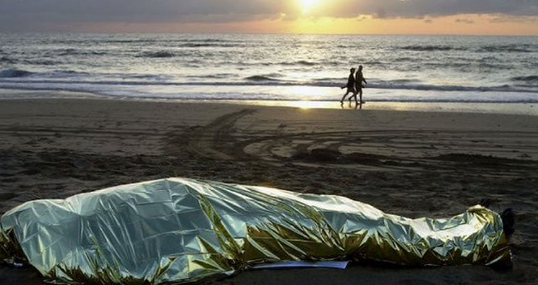
Authorities say a fishing boat that set out a month ago with over 100 passengers has been found
A migrant boat that left Senegal last month was discovered off the coast of Cape Verde earlier this week, with more than 60 of those originally on board presumed dead, the UN’s International Organization of Migration agency (IOM) and local authorities said on Wednesday.
IOM spokesperson Safa Msehli told the media that a Spanish vessel had rescued at least 38 people, including four children, from the fishing boat near the Atlantic island nation on Monday.
The rescuers also found the bodies of seven people on board the vessel, according to Msehli.
Senegal’s foreign ministry said in a statement late on Tuesday that 101 passengers were aboard when it left the West African country’s coastal village of Fass Boye on July 10.
The ministry stated that it was coordinating with Cape Verdean authorities for the repatriation of survivors “as soon as possible,” including a Guinea-Bissau national, who had been transferred to Sal island.
Walking Borders,Caminando Fronteras a Spanish migration advocacy organization, said the vessel was a large pirogue-style fishing boat.
Relatives of the migrants contacted Walking Borders on July 20 after not hearing from the travellers for 10 days, the organization’s founder, Helena Maleno Garzon told the Associated Press.
In a statement on X (formerly Twitter), Garzon called the deaths of those bound for the Canary Islands “terrible.”
“If the searches were efficient, they would be alive; if they were white, they would be alive,” she argued, accusing authorities of turning “immigration control” into a “big business” at the expense of lives.
An estimated 951 migrants died attempting to reach Spain in the first half of 2023, according to a report published by Walking Borders in July.
The victims include nationals from up to 14 countries, including Algeria, Senegal, Cameroon, Ivory Coast, the Democratic Republic of the Congo, Gambia, Ethiopia, Guinea-Conakry, Mali, Morocco, Syria, Sri Lanka, and Sudan.
A total of 19 boats went missing in the first six months of this year with all those on board, including 112 women and 49 boys and girls, dying at sea, the report said.
After months of planning, the Dual Power West Gathering met successfully June 2 to June 4 in the woods outside so-called Portland, Ore.
You find yourself in the middle of the woods, surrounded by the hum of anarchistschatting and the enticing smell of curry and campfire. Without your headlamp, you can’t see anything except the stars through the tree tops. Your cell phone hasn’t gone off in days. You are somewhere special, and everyone here knows it. What’s happening here, what you all are co-creating, it will ripple out from here in many profound ways you have yet to fully realize. But you feel that potential in your bones. You all do.
This article is meant to give people a view of what it took to organize an event like this, actually pull it off, and what the event felt like to those who participated in forming this gathering. We hope this can provide resources and inspiration to those wanting to plan their own such gathering as well as provide those who couldn’t attend a view of what took place this summer in the wild woods of Oregon.
Prepping for the Event
Planning for this, the second event of its time, took about six months. After the first Dual Power Gathering in Indiana on July 29-31, 2022, some participants and organizers felt a need to plan another, more regional event, specifically for the west coast of Turtle Island.
This involved dozens of organizers meeting regularly and chatting freely about a rough schedule, possible campsite locations, resources and equipment that could be gathered, and setting up digital infrastructure to take RVSPs and donations.
After selecting a campground, the focus turned to assembling local resources, facilitating ride shares, planning a menu for the weekend, and thinking heavily about increasing measures of accessibility for everyone in attendance.
For security reasons, the exact location was kept a secret until closer to the event and to only share it with people who had RSVP’d or by word of mouth to known comrades.
Despite this, there was plenty of in-person and online promotion for the event, as organizers traveled extensively up and down the West Coast, visiting radical communities and inviting people to attend.
The result of this incredibly generous time and energy was that the event was so well attended; about 150 people floated in and out throughout the weekend with about 70 people there at the peak on Saturday.
Organizers showed up May 30, a Wednesday afternoon, to get a jump on setting out signage for incoming campers to more easily find the campground as well as to set up a welcome/medic tent to guide participants to the correct sites.
We also selected a central site to become the kitchen area, which would be known as “The Cauldron” during the gathering, and it served an additional function as an activity nexus throughout the weekend.
Organizers designated a nearby campsite for the dining area, and they erected a massive canopy tent along with multiple black and red Industrial Workers of the World (IWW) flags and a projector setup; this became known as the “IWW Movie Haüs.”
By Friday, June 2, the first day proper of the gathering had arrived, and with it, people began to flow into the campground and find one another near the Cauldron.
“Unconference” organizing model
The model used to organize this gathering is referred to as an unconference — an open style of formatting an event which allows for the input of all participants in setting an agenda and facilitating sessions on whatever topics they desire. From unconference.net:
The unconference format creates space for peer-to-peer learning, collaboration and creativity.
At the start, the whole group will gather together and be guided through creating an agenda using open space technology. The exact process is not important to understand in advance – the process will become clear as it happens. The important part is that all those gathered will have the opportunity to put conference sessions on the agenda. No session will be voted off or ‘won’t happen’ for some other reason. All sessions are welcome.
The sessions convened will range from the formal to the informal:
From the well thought out pre-prepared talk reflecting years of research and practice to the spur of the moment ‘new idea’ that would be fun to talk about.
From the demonstration of a working tool to the white boarding of something completely new.
Before the event… There will likely be a wiki that gives you a sense of the range of topics that people are suggesting and to connect with others who you might collaborate with when convening a session.
Although you’ll see suggestions for sessions and talking about ideas ahead of time this is not where the agenda gets created—that happens at the event itself.
Collaboration among participants who convene sessions and even merging of sessions on similar topics are both encouraged. If you convene a session, the decision to merge with another session will always be yours to make.
Convening a session… There are several key points about an unconference:
You do not need to do preparation in order to convene a session. If you get an idea the day of the event, call a session.
There is no ‘right way’ to lead a session. However there is a bias towards interaction and discussion.
Choose a format for your session will help you achieve your vision.
Following are a few ideas about different session types to get you thinking about possibilities.
Types of sessions…
The longer formal presentation
This is tricky, because it’s difficult to make a formal presentation interactive. But if you have a big, well-developed idea you can pull it off.
A short presentation to get things started 5-15 minutes of prepared material/comments by the session leader followed by an interactive discussion
Group discussion Someone identifies a topic they are interested in, others come to join the conversation and an interesting discussion happens
My Big (or Little) Question You have a question you want to know the answer to, and you think others in the group could help you answer it. This format could also just be the seed of a conversation.
Show and tell You have a cool project, a demo, or just something to show and let people play with that is the springboard for all the conversation in the session. Alternatively, you can invite others to bring their own items to show and tell (perhaps with a theme), and everyone takes a turn sharing.
Learn how to do X If you’re inclined to teach, this can be simple and effective. Bring the equipment that you need, and have a plan that will let you teach five, ten, or 15 people how to do something all at the same time.
Do take photos of different elements of your program so you can share them with others either at sessions you lead or in other sessions.
Advice about leading a session…
If you convene a session, it is your responsibility to “hold the space” for your session. You hold the space by leading a discussion, by posting a “first question,” or by sharing information about your program. Be the shepherd – stay visible, be as involved as necessary, be a beacon of sanity that guides the group.
Ask for help holding the space if you need it. You might, for example, put a session on the board and know that you are so passionate about the topic that it would be better if someone else, someone more objective, facilitates the discussion. Choose someone from your team, or another participant who is interested in the topic.
Don’t assume people in the room know more, or less, than you do. You never know who is going to be interested in your session. You might want to start by asking people to hold up their hands if they’ve been involved with the topic for more than five years, for one to five years, or for one year or less.
Don’t be upset if only two people show up to your session. Those two people are the ones who share your interest.
Don’t feel that you have to “fill” up an hour of time. If what you have to say only takes 15 min and the group has finished interacting–then the session can end. At the start of the conference, we will discuss guidelines for how this can happen.
Don’t feel pressure to have everything take “only” an hour. If you start with a short presentation, and then a group conversation gets going, and your discussion needs to continue past an hour – find a way to make this happen. You might be able to keep talking for awhile in the room you are in, or move to another part of the conference area, or post “Part 2” on the agenda At the start of the conference, we will discuss guidelines for how this can happen.
Be Brave! Others are interested in making your session work!
Do think about the ideas that you want to cover in your session, and how you want to cover them. But don’t feel as though you need to prepare a great deal. (If you’re over-prepared, your session might lose energy.)
Experiment with the kind of sessions you lead. There is no such thing as “failure” an an unconference.
Advice for everyone at unconference… Go with the flow – This event is intended to help you and all the other grantees find the time and space to talk with and learn from each other.
Follow your passion – Go to the sessions that interest you.
Take responsibility for your own learning – If there are topics you are really interested in that don’t appear on the agenda at first, you need to put them on there.
Friday night included a facilitator training to help with the work of the next days, and we agreed to meet Saturday morning for a general assembly in order to determine the schedule of sessions for the weekend. We ate dinner together and spent the evening around the campfire in what would be a nightly ritual of decompression and reflections.
The next morning over breakfast, we made introductions to any newly arrived and discussed what sessions we might put on the board for the weekend.
The assembly took place immediately afterwards with us first introducing ourselves, our affiliations, and projects.
Organizers of the Dual Power Gathering acknowledged that we met on the traditional and unceded lands of Multnomah, Wasco, Cowlitz, Kathlamet, and ClackamasBands of Chinookan peoples, the Tualatin Kalapuya, and the Molalla.
One of the goals of the gathering was to discuss the importance of Indigenous leadership of the movements to defend water and life, as well as our collective responsibility to abolish the settler colonial states occupying Turtle Island.
We made time to discuss the needs of elders and those with disabilities, such as speaking up during sessions and making sure that everyone was able to speak, so the event would remain accessible to all. People who needed blankets were connected with those who had extras, those who needed a cot got one, etc, etc.
“From each according to their needs, to each according to their ability” was a principle manifested in the gathering rather than something we’d get to at some unknown point in the future.
We looked over the white board full of offerings people had made to facilitate all sorts of interesting open discussions and more-directed facilitated events, discussing a little bit about what each session would entail. After addressing any last concerns we broke out for the day’s events and everyone went to whichever session drew their passions the most.
First Day sessions (Saturday)
International Solidarity/Nuclear Non-Proliferation [Open Discussion]
Community Defense [Open Discussion]
Regional Breakouts
Rocky Mountain
NorCal
Cascadia
Everywhere else
Indigenous Values vs Capitalist Values [Presentation and Q&A]
Community Based Therapy [Tabling of Ideas]
Radios for Community Defense and Disaster Relief [Tech and Usage]
Cascadia and Bioregionalism [Presentation and Discussion]
Narcan/OD Training and Tranq Discussion [Trainings and Discussion]
Building Bridges into the Politics [Open Discussion]
Rural/Small Town Intentional Residential Communities [Presentation then Open Discussion]
Movement Kitchen and Distro [Skill share and Open Discussion]
Watch this space for a full zine containing summaries of the different sessions that took place over the weekend, but here we want to aim at looking at what the event itself was like in planning and execution.
Meeting basic needs
Most of the food for the three-day event came from gleaning programs nearby or was brought in from various mutual aid depots around the West Coast.
Each day there was a breakfast, lunch, and dinner sign up sheet for prep, cooking, and cleanup, which helped the kitchen bottom-liners plan their meals better and not have to do as much by themselves. Meeting dietary restrictions and allergies was a major concern.
Of note was the “snack stump”, a tree stump centrally located in the cauldron area that was commandeered for snacks and light fare, which was set out throughout the day. This helped provide people with food to eat during daylight hours.
There was far more food than we needed, but this is a key organizing principle we re-affirmed over the weekend: to be over-prepared for everything. When you do it right, being prepared feels like being over-prepared. This involved bringing extra equipment to share with those without their own stuff, being able to coordinate ride shares to and from the campground, and the initial reservation of a large amount of campsites.
Consensus Decision-Making and Limitations
Consensus was centralized, but in some cases was pushed aside due to time constraints and lack of planning. Though it was prioritized where possible during all stages of planning and execution, and while this may have taken a bit longer to accomplish decision making in certain scenarios, it led to a feeling of ownership for all involved. An intention to share a sense of co-creating this event with their fellow organizers was put out to all attending the event.
This was the vibe throughout the weekend with many commenting on how smooth everything had gone and how little conflict there was between participants from a wide variety of backgrounds and experiences.
People made their own sessions as they saw fit, based on what their interests and passions where. People made their way to the river for some swimming if they wanted to do so, or just mingled with others near the Cauldron, openly discussing any number of intriguing and engrossing topics.
We found that the intentionality of the space as a non-hierarchical and co-created space was the largest factor in contributing to well-managed conflict between people attending the event.
Second Day sessions (Sunday)
Sunday saw a bit of a shift change, as some people had to leave early, and others came late. Luckily the new crop of people seemed to fit right in and need little to no reassurance that they could jump right into actively creating the space with us. There were many words of encouragement to those wanting to make offerings on the whiteboard, as it can be intimidating to offer your knowledge up to share with others.
With the new people thoroughly integrated we moved forward into the second day of sessions, the schedule for the day became:
Marx for Anarchists [Open Discussion]
Food Sovereignty and Basic Foraging/ Farming Skills [Discussion and Skill Share]
Conflict in Social Movement Spaces/ White Supremacy Culture in Our Everyday Lives [Open Discussion, Practice, and Sharing]
Squat-Centered Locksmith [Skillshare]
Municipal Eco-Resiliency Project (MERP) [Presentation and Open Discussion]
Answering MLK’s Call for a Radical Revolution in Values [Presentation and Q&A]
Learnings of No Border Struggle in Europa 2005-2022 [45-min Input and Open Discussion]
Mutual Aid Successes [Open Discussion]
LibSoc and Local Politics [Open Discussion]
Anarchist Ecology [Open Discussion, Theory and Practice, Landback]
Atlanta Forest Learnings, Strategy, and Discussion [Land Defense and Alternatives]
Community and Neighborhood Networking [Discussion]
[Radical Media] Reflections and Scheming
5 Veins of Anarchism: Care and Attack [Open Discussion]
De-Escalation and Protest Safety
Transforming Conflict in Movement Spaces [Open Discussion]
Wealth Re-Distro [Open Discussion]
What to do with your 401k/large salary and still have a place to live
Bodywork and Co-Regulation as Mutual Aid [Skill Share]
This day, like all the others, ended around a campfire gleaning what we could from each others’ experiences at sessions we didn’t attend ourselves. Time was spent sharing experiences and projects we were working on in our hometowns. As many people had cleared out in the early evening, the few who dwindled around the campfire as the flames turned to embers took time to reflect on the weekend’s events. Conversation was free flowing and shifted organically between small and intimate conversations with your neighbor, and all encompassing wide ranging group discussions. After one last adventure to collect whatever firewood hadn’t been burnt yet, the group finally dispersed to say goodbye once again in the morning.
Aftermath
Those who stayed for the morning of Monday the 5th where treated to another amazing breakfast, courtesy of the Cauldron. Everyone got some coffee and food and chatted about what lay ahead for them once they returned home; revitalizing old projects, and starting some new ones.
People came together to help break down the remaining campsites and the Cauldron and meeting areas.
A last minute scramble to hand out all the remaining food and to gather all the items left by various campers was successful as a mutual aid crew took the food home to distribute in their work. With everything being packed the last few people headed out promising to remain in contact and to see each other again soon.
In the aftermath of the event, and once we got back to cell phone service, people’s Signal chats swelled with new found friends and comrades. Connections were reaffirmed and plans were hatched for various ways to debrief and report back on what we had all experienced.
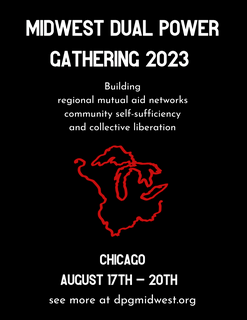
Already, plans are underway for an autonomously organized Dual Power Gathering Midwest, planned for the end of summer, details to come soon. The lessons learned from each event will serve to inform and grow the capacity and accessibility of the next.
The bonds formed will sustain and nourish our communities as we struggle together, building dual power and capacity to act outside the State.
These events and the framing of the event as promoting “Dual Power” are critical to expanding the movement and to retaining and growing the skills and connections of those already involved in organizing. This event wasn’t a retreat, it took a tremendous amount of labor and love to pull off; yet it felt invigorating, not draining. Even the term, “gathering,” served the event well in setting a tone and intention to come together and spend time with one another.
It felt casual and yet a lot was accomplished and many profound conversations were facilitated.
You find yourself on the road home again. One arm is getting sunburned hanging out the window of the van. You choke down another cigarette as you bring up how exactly you and your comrades want to broach all the new ideas and inspirations you’re bringing back home. The van bounces down the freeway. Another earnest conversation about organizing ideas ensues. Headed back home, to a life you can’t wait to revitalize with new connections and a new direction. The world isn’t less horrible than it was the week before, but something has shifted, something in the column of things to fight for has increased. Maybe it’s the new friends, maybe it’s the old friends. Whatever it is you know you want to share it. You want to be the ripple that carries this experience back into your world. You all do.
Does the West’s despairing of Ukrainian military prospects imply a coming draw-down on the war? Or alternatively, a western strategic shift towards a different mode of attritional war against Russia?
“[The Ukrainians are] still going to see, [whether] in the next couple of weeks, there is a chance of making some progress. But for them really to make the progress that would alter the balance to this conflict – I think, it’s extremely, highly unlikely” – an unnamed “senior Western diplomat [told CNN]”.
Yet, as one ‘war front’ bows out, an ‘out-of-view’ war on Black sea shipping has raised its head.
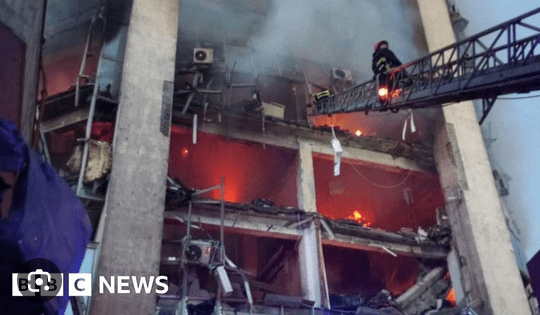
The ‘new war’ might alternatively be called the ‘Grain War’ – as representing the sequent to Moscow’s resiling from the ‘Grain Deal’ last month. To underline Moscow’s serious intent to terminate what, for Russia had proved to be a wholly unsatisfactory affair (amidst a general reneging on its terms), Moscow acted to incapacitate the port facilities of a number of Black Sea ports serving Ukraine, which it said had been used to store weapons (as well as to export grain).
On 19 July, Moscow warned that all vessels approaching Ukraine from the following day would be considered as potential carriers of military cargo, and treated accordingly. Insurance cover costs naturally soared.
A few days later, on 24 July, the grain infrastructure at the Ukrainian port of Reni was destroyed. It was a ‘message’ to the West of Russian resolve to quit the grain deal.
Russia claimed that on 31 July, Ukraine had unsuccessfully attacked a Russian civilian ship and two naval vessels (using three unmanned maritime drones) in the Black Sea. Ukraine denied the attack, and said that it would never attack a civilian vessel. However, a month later, Ukraine admitted attacking a civilian tanker in Novorossiysk port on 4 August.
‘NATO’ then upped the stakes: Three civilian cargo vessels on 1 August entered the Ukrainian port of Izmail. This port – like Reni – lies on the Danube, a near-literal stone’s throw from (NATO) Romania. It was a NATO ‘taunt’ – the Black Sea is no ‘Russian lake’, it implied. And the vessels were docked within 500 metres of NATO ‘territory’. One vessel was owned by an Israeli company; another to a Greek, and the third to a Turkish-Georgian company – but they were all registered to states such as Liberia.
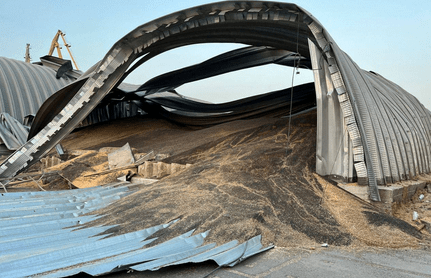
On 2 August, Russia flattened the grain silos of Izmail, using precision drones.
Ukraine is desperate to keep the grain deal alive. It represents ‘big money’ for the Ukrainian agri-business controlling these exports. And it represents ‘big money’ for intermediary Turkey, which processes the grain into flour, before selling it on (mostly to Europe, at a large mark-up).
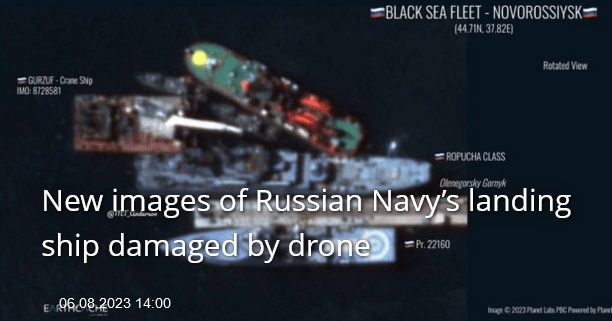
The ‘first round’ in this contest therefore was ‘Moscow’s’. But then NATO ‘upped the ante’ a second time, with two maritime ‘Ukrainian’ drone attacks: One on a small civilian empty crude tanker, and the second on a naval landing ship at anchor in the Novorossiysk port. Neither vessel sank, but both were seriously damaged.
This Novorossiysk attack however, is no ‘small fry’. The seaport, lying beyond the Crimean peninsula, is one of Russia’s largest by volume, and among the biggest in Europe – crucial to the export of Russian grain, oil, and other products to destinations around the world. It has been a hub of international commerce for Russia since the 19th century.
This plainly, therefore, is a serious challenge and a provocation directed at Moscow. Oleg Ostenko from Zelensky’s office followed up by saying that all Russia’s Black Sea ports henceforth were valid military targets for Ukrainian attack.
Several anti-fascist initiatives around the world use their knowledge of the working dynamics of networks and the internet to prevent the far-right from using it to spread their message
On June 21, 2020, Donald Trump had a public event in Tulsa (Oklahoma, USA) on his election campaign calendar, in the midst of the post-pandemic.
Some interesting facts about the choice of place and date: In 1921, Tulsa was the scene of one of the worst episodes of racist violence in the country, when a mob stormed the predominantly black neighborhoods and caused fires and 36 deaths.
Very shortly before Trump’s rally, in May 2020, the US police had choked George Floyd to death on a public street in Minneapolis, in broad daylight. And it also coincided with the annual ephemeris of Juneteenth, Emancipation Day, which commemorates the end of slavery and denounces the systemic oppressions still in force on racial grounds.
At the peak of covid-19, tickets were flying and the same organization boasted on Twitter that they had a million registered attendees. But this million ghosted Trump.
Despite the forecast of a messianic bath of the masses for the standard-bearer of white supremacism, at the hour of truth only 6,200 supporters of the tycoon-aggressor-neocon-tax evader-media personality who then presided over the United States showed up.
Photographs from that day show an empty stadium, with a meager presence of attendees wearing MAGA merchandise (the slogan Make America Great Again, associated with Trump) scattered in isolation among the 19,000 seats.
Where had all the ticket reservations gone? Had covid-19 forced Trumpism to abandon its denialism?
No, the answer lay on the internet, and in particular, in the digital gathering spaces of the transnational K-pop community.
K-poppers are fans of Korean pop music that has become a cult phenomenon since the beginning of the 21st century, spreading to neighboring countries and then gaining ground around the world. Nowadays, there are ‘stans‘ (unconditional followers) of this genre of all ages and backgrounds.
Despite the fact that popular music is often associated with demobilized young people and with political disaffection, the K-pop fan community has made its knowledge in digital environments available to various social movements.
In particular, the savoir faire when it comes to getting tickets to the coveted concerts or events of your favorite bands, and the expertise to turn something into a trend by flooding the networks with linked content to specific hashtags.
K-poppers and anti-fascists signed up in droves to attend the Trump rally. They prevented the provocation of white supremacism from materializing in Tulsa and boycotted its impact on and off the networks.
Trolling the president extended into a strategy of digital anti-fascism.
In fact, it was not the first or the last time that they organized on TikTok, Twitter or Instagram to do actions beyond their common passions.
The 'k-popper' community, fans of Korean pop, massively reserved seats at a Trump rally so that it was empty
In Myanmar, following the coup in 2021, some members of the K-pop community used Telegram and Signal as safer channels to spread information, disprove fake news and organize protests.
They also collected funds to support mobilizations in the streets or to financially support the legal defense of reprisals, just as they had done in Thailand in 2020.
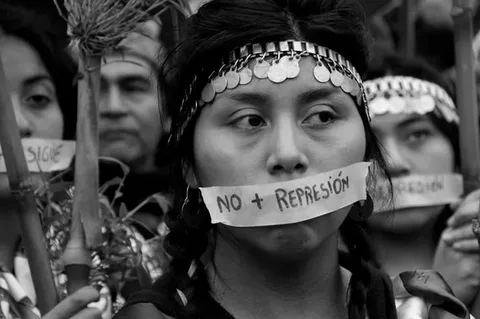
Given the ambiguity of international reactions condemning the violent management of the protests, the government of Dina Boluarte seized power by shedding blood from day one.
A figure of more than 60 dead, hundreds injured with sequelae, and thousands of Peruvians from the provinces terrified (criminalized as terrorists) is an impartial balance of the human rights violations that have occurred in Peru since last December.
On the eve of the national holiday of July 28, the figure of Dina Boluarte was at stake and both the government and the population showed her cards.
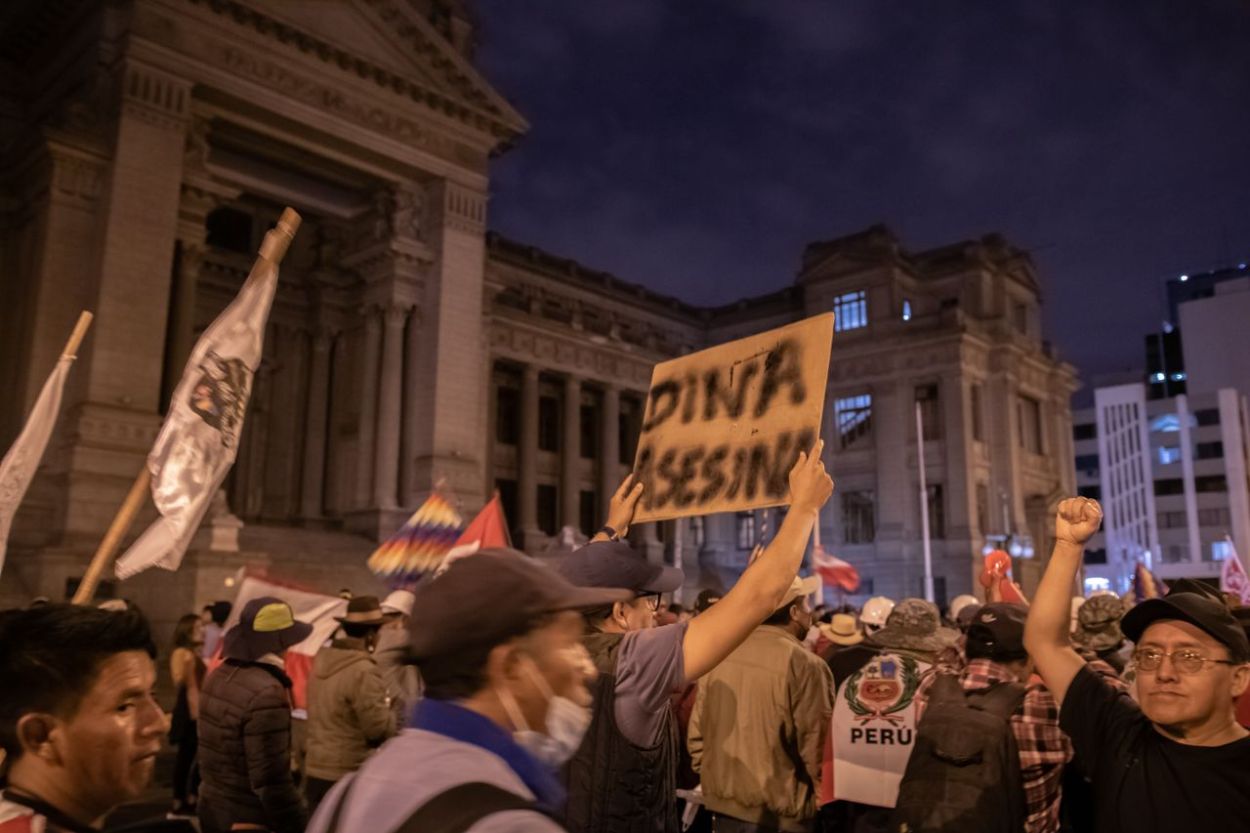
Foto: Manifestante en la Marcha Nacional en Lima, 22 de julio.
Two weeks of marches in Lima
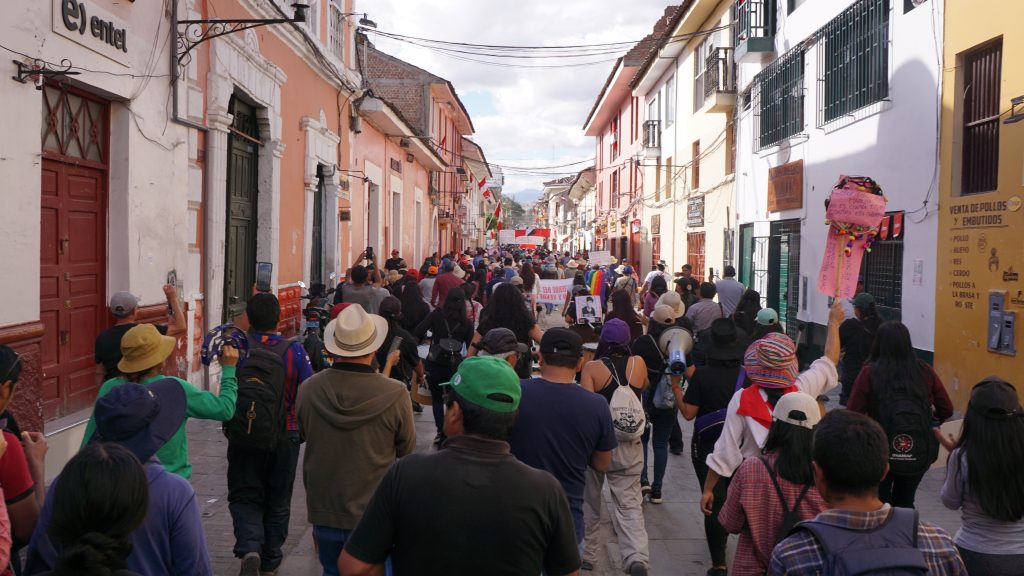
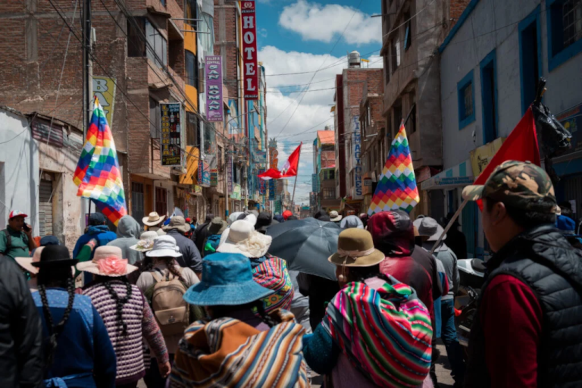
Reinforced by the provincial delegations that arrived in Lima, different marches have toured the capital of Peru to demand the resignation of Dina Boluarte and justice for the fallen.
During the July 19 convocation, known as the Toma de Lima, different demonstrations in which a wide range of popular organizations from all over Peru came together, have once again been repressed with tear gas and pellets.
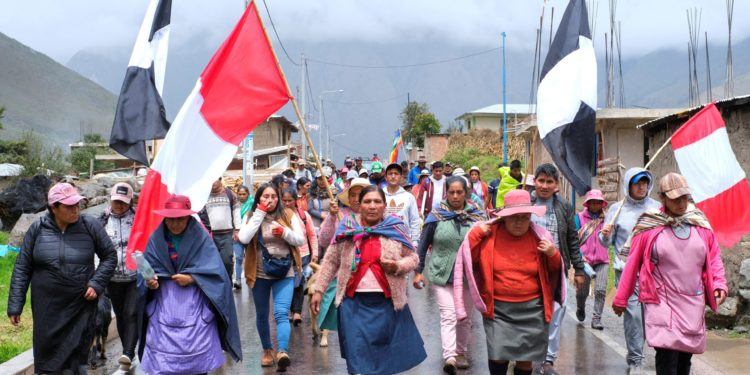
Beyond Lima, this call was actually a national mobilization, since that day there were massive marches in some 20 provincial capitals across the country.
In Ayacucho, we participated in the mobilization day and verified the broad consensus of the organizations in the demands for justice and the demand for Dina’s resignation, for which they have composed several songs that were chanted in the square, at the end of the marches.
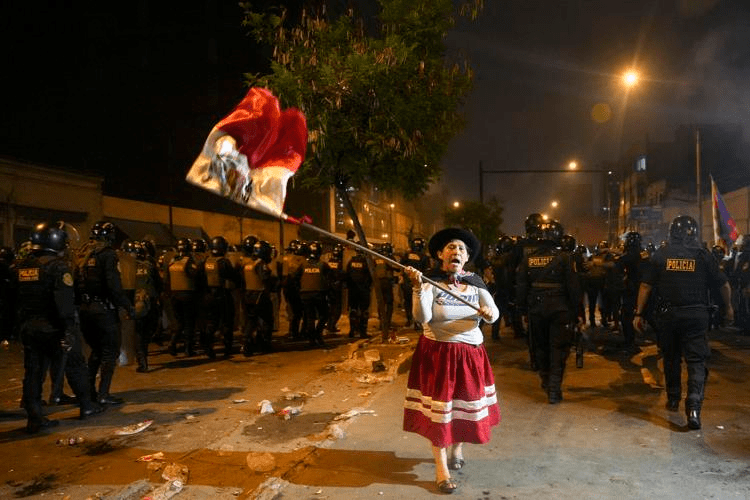
In the National March of Lima, called for July 22, the undersigned was gassed, like the rest of the protesters, when, led by Aymara women with the Andean flag in hand, they managed to reach the feet of the equestrian figure of General San Martin, iconic monument of the liberation of Peru to the Spanish Crown.
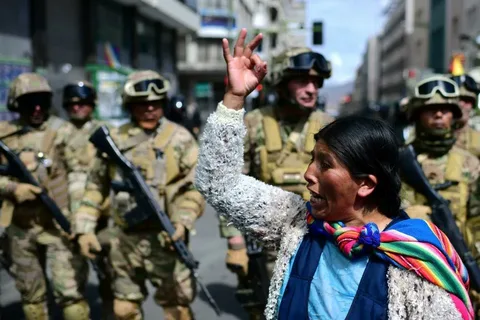
At this moment, under a cloud of corrosive gas, the police evacuated the square, throwing women from Puno to the ground and leaving new images of the treatment that the Peruvian State provides to the indigenous population.
This fact further inflamed social organizations in the southern Andean region of Peru, which announced new blockades and the intensification of the fight.
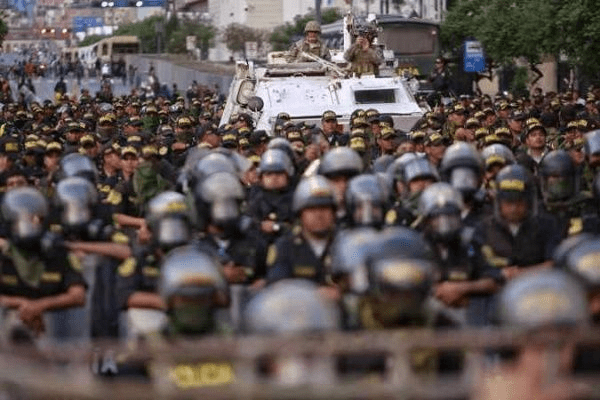
The National Holidays were approaching and the government of Dina Boluarte enlisted police and military forces to parade through the streets and guarantee order. From different parts of the country, social organizations would grease the provincial delegations for new marches in the capital.
On July 28, Dina Boluarte paraded through streets full of soldiers and tried not to listen to the public’s cries of disaffection. That day, scenes of indiscriminate repression were repeated, with the launching of gas bombs and pellets, resulting in dozens of injuries.
Several social leaders were detained, among them the social leader from Puno, Luis Cruz Laime, who was placed in pretrial detention until he was released on August 2 for lack of incriminating evidence. The common cry of Dina Asesina
Foto: Marchas en Ayacucho el día de la convocatoria de movilización del 19 de julio.
The situation in Peru is far from stabilizing. Elevated to power since the failed attempt to dissolve Congress by Pedro Castillo, on December 7, Dina Boluarte seems to have strong support from law enforcement and the army.
The country’s media groups support him in distributing a discourse of criminalization and racial hatred towards rural populations. “Terruqueo” is the strategy nicknamed in Peru to accuse any form of social protest as terrorist and to isolate, imprison or marginalize any social leader who publicly shows his opposition to the new regime.
Entire departments of the country, such as Ayacucho or Puno, are also labeled as terrorists, having suffered precisely in the past from the crossfire between Sendero Luminoso and State terrorism that dedicated itself to killing the population with impunity in the sinister decade of Alberto Fujimori’s dictatorship. .
Despite the factual support of the armed forces for the government of Dina Boluarte, its acceptance among the population is at a low point and the polls move around 90% disapproval. Figures that coincidentally are close to the percentage of votes that Pedro Castillo received in the most mobilized departments such as Puno, Apurímac and Andahuaylas.
These were precisely the regions hardest hit by the repression with lethal weapons in the first weeks of the interim government. Andahuaylas, Ayacucho, Cusco, Arequipa, Junín, La Libertad, Puno and Juliaca are the locations
s where the 60 murdered take place just weeks after the charge was released.
First trial in Andahuaylas
With the presidential band still to be disbanded, Dina Boluarte took the reins of the country on December 9 with a landing of members of the army’s special forces who assassinated five people in Andahuaylas and two more in all of Apurímac.
To prevent helicopters with reinforcements of weapons and troops from landing, the peasant populations neighboring the Huancabamba airport occupied the airstrip, where they were fired upon, leaving two dead and dozens injured.
In the city, police officers climbed onto the roof of a house neighboring the barracks and shot to death two young men who were in a green area far from the mobilization.
The mobilizations lasted several weeks and during them, the imprisonment of a journalist and a teacher falsely accused of having participated in the kidnapping for a few minutes of a policeman who had infiltrated the protests was also revealed.
Shots and deaths in the streets of Ayacucho
On December 15, lethal scenes were repeated in Huamanga, the capital of Ayacucho. According to interviewed testimonies, army troops withdrew from the airport to later round up protesters and the population that was passing by in the vicinity and leave them in the open space to shoot at point-blank range.
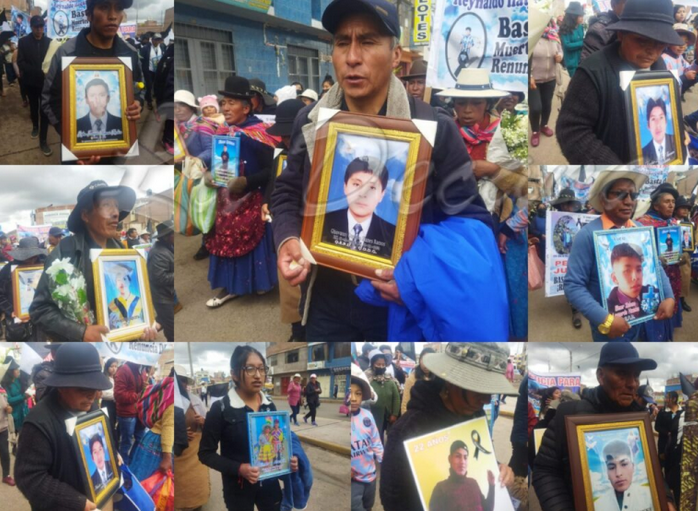
Among them was Edgar Prado, father of Sheila Prado Cisneros, who through rivers of tears told us how his father left the doorway of his house to help an injured person, and there he was hit by a bullet that destroyed his kidney and liver. .
«It hurts me a lot to be told that I am wasting my time and even worse that I am a terrorist. I will not stop until I find justice. I hope to receive international attention for this case, since in Peru there is no justice, seven months after the murder”.
Giovanna Mendoza Huaranca, is president of the Association of Relatives of Victims and Deceased of Ayacucho on December 15. She lost her brother John Henry, who had gone glass-buying for a Christmas charity chocolate party in her neighborhood.
Her mother, sick with cancer, stopped eating and died of sadness after two months. The trace of pain for the deaths has been impregnated in the streets of Huamanga, the capital of Ayacucho.
But the repression does not end with the deaths: the entire leadership of the Ayacucho People’s Defense Front was imprisoned. Five of them remain without freedom, accused of terrorism.
The Juliaca massacre
After the Christmas truce, where the social organizations postponed the mobilizations, on January 9 the military attack was repeated. Juliaca is the commercial capital of southern Peru
With a majority presence of the Quechua and Aymara population, this city was getting ready for mobilization when, once again from the airport, members of the army began shooting with rifles at the population that was mobilized in the street.
There are 16 dead in that massacre, to which must be added a policeman, whose body, burned in strange circumstances involving other police officers, appeared the following day next to a wrecked police car.
During the day and night, outpatient clinics were improvised in several squares and in a fuel pump, because the hospital could not supply. Interviewing relatives and journalists present that day, they describe their corridors full of wounded lying on a blood-soaked floor.
The same impression was collected by the relatives who entered the morgue to recognize the bled bodies. rule over death
It is difficult to understand the reasons for these and many other deaths that occurred in other rural departments such as Trujillo, Arequipa, Cusco, Puno or Junín, but pointing to the punishment and the imposition of fear to protest does not seem unreasonable.
Nor is the lukewarm international reaction to these crimes understood, which have already been verified by different reports from international organizations1. The deep gap between the capital’s white ruling elite and the social reality of the rural periphery is evident.
On the other hand, the complicity and positioning of the country’s large media groups with the “terruqueadora” thesis managed by the government is significant, which judges and condemns based on racist prejudices towards the mobilized rural regions.
Why is Dina still in power? We have an explanation in the unwavering support of the armed forces and the national police of Peru, which are benefiting from budget increases in the current repressive escalation and the cover-up in the judicial cases that have been initiated for the aforementioned deaths.
Yet ruling over the death of the rural population is a giant with feet of clay. And on the soil of the country, in the provinces, there are many families that demand justice and reparation for their political rights.
The mobilization in the capital stops momentarily, but in the peripheries they do not give up. The protest, it is said, will continue.
Marc Gavaldà, Alerta Amazónica Collective (Project Violation of Human Rights in the South Andean region of Peru, Fons Autonòma Solidària – Autonomous University of Barcelona http://alertamazonica.wordpress.com) Note:
1 International Institute of Law and Society (2023), Dossier Peru: Crisis of political representation and indigenous demands for the decolonization of the State. http://www.derechoysociedad.org. International Commission on Human Rights (2023), Situation of Human Rights in Peru in the context of social protests. http://cidh.org. Human Rights Watch (2023), World Report 2023 Human Rights Watch. https://www.hrw.org/es/world-report/2023/country-chapters/peru
The ministry officially “thanked the support of the American government in the subjects of mining and energy and reasserted the determination of the
national government” to expand natural gas production and develop petrochemical production in the south of the country, the epicenter of the protests. Peru’s natural gas exports have almost doubled during the war in Ukraine and have gone primarily to Europe as an alternative to Russian energy.
Ante la ambigüedad de reacciones internacionales de condena frente a una gestión violenta de las protestas, el gobierno de Dina Boluarte agarró el poder derramando sangre desde el primer día.
Una cifra superior a 60 muertos, centenares de heridos con secuelas y miles de peruanos de provincia terruqueados (criminalizados como terroristas) es un imparcial balance de las vulneraciones a derechos humanos acontecidos en Perú desde el pasado mes de diciembre. En vísperas de la fiesta nacional del 28 de julio, la figura de Dina Boluarte estaba en juego y tanto gobierno como población mostró sus cartas.
Dos semanas de marchas en Lima
Reforzadas por las delegaciones provinciales llegadas a Lima, diferentes marchas han recorrido la capital del Perú para exigir la renuncia de Dina Boluarte y justicia para los caídos. Durante la convocatoria del 19 de julio, conocida como Toma de Lima, diferentes manifestaciones en las que confluyeron un amplio abanico de organizaciones populares de todo el Perú, han sido nuevamente reprimidas con gases lacrimógenos y perdigones.
Más allá de Lima, esta convocatoria fue en realidad una movilización nacional, ya que ese día, hubo marchas multitudinarias en unas 20 capitales de provincias de todo el país. En Ayacucho, participamos en la jornada de movilización y constatamos el amplio consenso de las organizaciones en las demandas de justicia y la exigencia de renuncia de Dina, a la cual le han compuesto varias canciones que fueron coreadas en la plaza, al terminar las marchas.
En la Marcha Nacional de Lima, convocada para el 22 de julio, quien suscribe fue gasificado, como el resto de manifestantes, cuando, liderados por mujeres aymaras con la bandera andina en mano, consiguieron llegar a los pies de la figura ecuestre del general San Martin, monumento icónico de la liberación del Perú a La Corona Española.
En este momento, bajo una nube de gas corrosivo, la policía desalojó la plaza tirando al suelo a mujeres puneñas y dejó nuevas imágenes del trato que dispensa el Estado peruano a la población indígena. Este hecho enardeció más aún a las organizaciones sociales de la región sur andina del Perú, que anunciaron nuevos bloqueos y la intensificación de la lucha.
Se acercaban las Fiestas Patrias y el gobierno de Dina Boluarte alistaba cuerpos policiales y militares para desfilar por las calles y garantizar el orden. Desde diferentes puntos del país, organizaciones sociales engrasarían las delegaciones provinciales para nuevas marchas en la capital.
El 28 de julio Dina Boluarte desfiló por calles llenas de militares e intentaba no escuchar los gritos de desafecto del público. Esa jornada se repitieron escenas de represión indiscriminada, con lanzamiento de bombas de gas y perdigones, con el resultado de decenas de heridos. Varios dirigentes sociales fueron detenidos, entre ellos el líder social puneño Luis Cruz Laime, al cual se le impuso prisión preventiva, hasta que el día 2 de agosto fue liberado por falta de pruebas incriminatorias.
El grito común de Dina Asesina
La situación en Perú está lejos de estabilizarse. Encumbrada al poder desde el intento fallido de disolución del Congreso por Pedro Castillo, el pasado 7 de diciembre, Dina Boluarte parece tener un férreo apoyo de las fuerzas del orden y el ejército. Los grupos mediáticos del país, le apoyan en distribuir un discurso de criminalización y odio racial hacia las poblaciones rurales. El “terruqueo” es la estrategia apodada en Perú para acusar de terrorista a cualquier forma de protesta social y aislar, encarcelar o marginar a cualquier líder social que muestre públicamente su oposición al nuevo régimen.
También departamentos enteros del país, como Ayacucho o Puno son etiquedados de terroristas habiendo sufrido precisamente en el pasado el fuego cruzado entre Sendero Luminoso y el terrorismo de Estado que se dedicó a matar impunemente a la población en la siniestra década de la dictadura de Alberto Fujimori..
A pesar del apoyo fáctico de las fuerzas armadas al gobierno de Dina Boluarte, su aceptación entre la población está en horas bajas y las encuestas se mueven alrededor de un 90% de desaprobación. Cifras que casualmente se acercan al porcentaje de votación que recibió Pedro Castillo en los departamentos más movilizados como Puno, Apurímac y Andahuaylas. Precisamente éstas fueron las regiones más castigadas por la represión con armas letales en las primeras semanas del gobierno interino. Andahuaylas, Ayacucho, Cusco, Arequipa, Junín, La Libertad, Puno y Juliaca son las localizaciones donde se producen los 60 asesinados apenas a semanas de estrenar el cargo.
Primer ensayo en Andahuaylas
Todavía con la banda presidencial por desplanchar, Dina Boluarte tomó el 9 de diciembre las riendas del país con un desembarco de efectivos de fuerzas especiales del ejército que asesinaron en Andahuaylas a cinco personas y dos más en todo Apurímac. Para evitar que aterrizasen helicópteros con refuerzos de armamento y efectivos, las poblaciones campesinas vecinas al aeropuerto de Huancabamba ocuparon la pista de aterrizaje, donde fueron disparados con balas, dejando dos muertos y decenas de heridos. En la ciudad, efectivos policiales se subieron a la azotea de una casa vecina al cuartel y dispararon hasta matar a dos jóvenes que estaban en una área verde alejada de la movilización.
Protesters march through Lima [Photo by Candy Sotomayor / CC BY-SA 4.0]
Las movilizaciones se prolongaron varias semanas y en el transcurso de ellas, trascendió también el encarcelamiento de una periodista y una maestra acusadas falsamente de haber participado en el secuestro durante unos minutos de un policía infiltrado en las protestas.
Disparos y muertes en las calles de Ayacucho
El 15 de diciembre, se repitieron escenas letales en Huamanga, capital de Ayacucho. Según testimonios entrevistados, efectivos del ejército se retiraron del aeropuerto para luego acorralar a manifestantes y población que transitaba por las inmediaciones y dejarlas en espacio abierto para disparar a quemarropa. Entre ellos estaba Edgar Prado, padre de Sheila Prado Cisneros, quien entre ríos de lágrimas nos narró como su papá salió del portal de su casa para socorrer un herido, y allí fue impactado por una bala que le destrozó el riñón y el hígado. «Me duele mucho que me digan que estoy perdiendo el tiempo y peor aún que soy terrorista. Yo no pararé hasta encontrar la justicia. Espero recibir atención internacional por este caso, ya que en Perú no hay justicia, a siete meses del asesinato«.
Giovanna Mendoza Huaranca, es presidenta de la Asociación de Familiares de Víctimas y Fallecidos del 15 Diciembre de Ayacucho. Ella perdió su hermano John Henry, que había ido a comprar vasos para realizar una chocolatada caritativa de navidad en su barrio.
Su madre, enferma de cáncer, dejó de comer y murió de tristeza a los dos meses. El rastro de dolor por las muertes ha quedado impregnado en las calles de Huamanga, capital de Ayacucho. Pero la represión no termina con las muertes: Toda la cúpula dirigencial del Frente de Defensa del Pueblo de Ayacucho fue encarcelada. Cinco de ellos siguen sin libertad, acusados de terrorismo.
La masacre de Juliaca
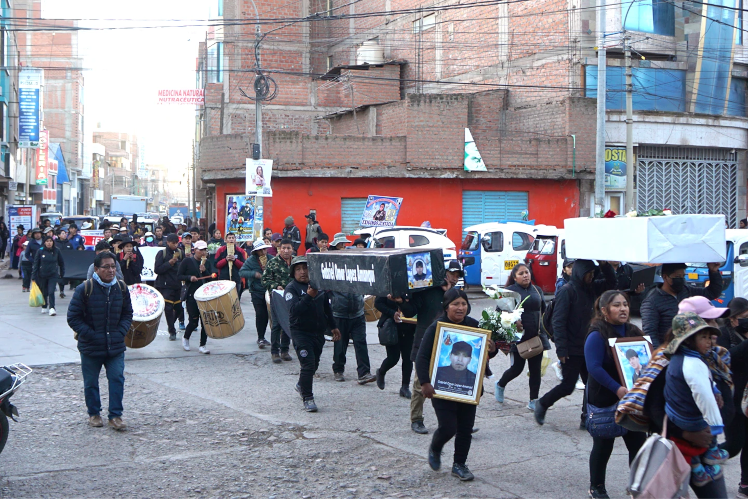
Pasada la tregua navideña, donde las organizaciones sociales aplazaron las movilizaciones, el 9 de enero se repite la embestida militar. Juliaca es capital comercial del sur de Perú. Con mayoritaria presencia de población quechua y aimara, esta ciudad se alistaba para la movilización cuando, de nuevo desde el aeropuerto, efectivos del ejército empezaron a disparar con fusiles a la población que se encontraba mobilizada en la calle. 16 son los muertos de aquella masacre, a la que hay que añadir un policía, cuyo cuerpo quemado en extrañas circunstancias que implican a otros efectivos policiales, apareció el día siguiente al lado de un coche policial siniestrado. Durante el día y la noche, se improvisaron ambulatorios en varias plazas y en un surtidor de combustible, porque el hospital no daba al abasto.
Entrevistando a familiares y periodistas presentes aquel día, nos describen sus pasillos llenos de heridos tirados por un piso encharcado de sangre. La misma impresión fue recogida por los familiares que entraron a la morgue a reconocer los cuerpos desangrados.
Gobernar sobre la muerte
Es difícil comprender las razones de estas y muchas otras muertes ocurridas en otros departamentos rurales como Trujillo, Arequipa, Cusco, Puno o Junín, pero apuntar al escarmiento y la imposición del miedo a protestar no parece descabellado. Tampoco se comprende la tibia reacción internacional ante estos crímenes, los cuales ya han sido verificados por diferentes informes de organismos internacionales1. Queda patente la profunda brecha entre la élite blanca gobernante capitalina y la realidad social de las periferia rural. Por otro lado, es significativa la complicidad y posicionamiento de los grandes grupos mediáticos del país con la tesis «terruqueadora» que maneja el gobierno, la cual juzga y condena en base a prejuicios racistas hacia las regiones rurales movilizadas.
¿Por qué Dina sigue en el poder? Una explicación la tenemos en el inquebrantable apoyo de las fuerzas armadas y la policía nacional del Perú, los cuales se están beneficiando en aumentos presupuestarios en la presente escalada represiva y el encubrimiento en los casos judiciales que se han iniciado por las citadas muertes.
Sin embargo gobernar sobre la muerte de la población rural es un gigante con pies de barro. Y en el suelo del país, en las provincias, son muchas las familias que reclaman justicia y reparación de sus derechos políticos usurpados. La movilización en la capital se detiene momentáneamente, pero en las periferias no se dan por vencidos. La protesta, queda dicho, continuará.
Marc Gavaldà, Colectivo Alerta Amazónica (Proyecto Vulneración de Derechos Humanos en la región Sur Andina de Perú, Fons Autonòma Solidària -Universitat Autònoma de Barcelona http://alertamazonica.wordpress.com)
Nota:
1 Instituto Internacional de Derecho y Sociedad (2023), Dosier Perú: Crisis de representación políticas y demandas indígenas para la descolonización del Estado. http://www.derechoysociedad.org . Comisión Internacional Derechos Humanos (2023), Situación de Derechos Humanos en Perú en contexto de protestas sociales. http://cidh.org. Human Rights Watch (2023), Informe Mundial 2023 Human Rights Watch. https://www.hrw.org/es/world-report/2023/country-chapters/peru
Rebelión ha publicado este artículo con el permiso del autor mediante una licencia de Creative Commons, respetando su libertad para publicarlo en otras fuentes.









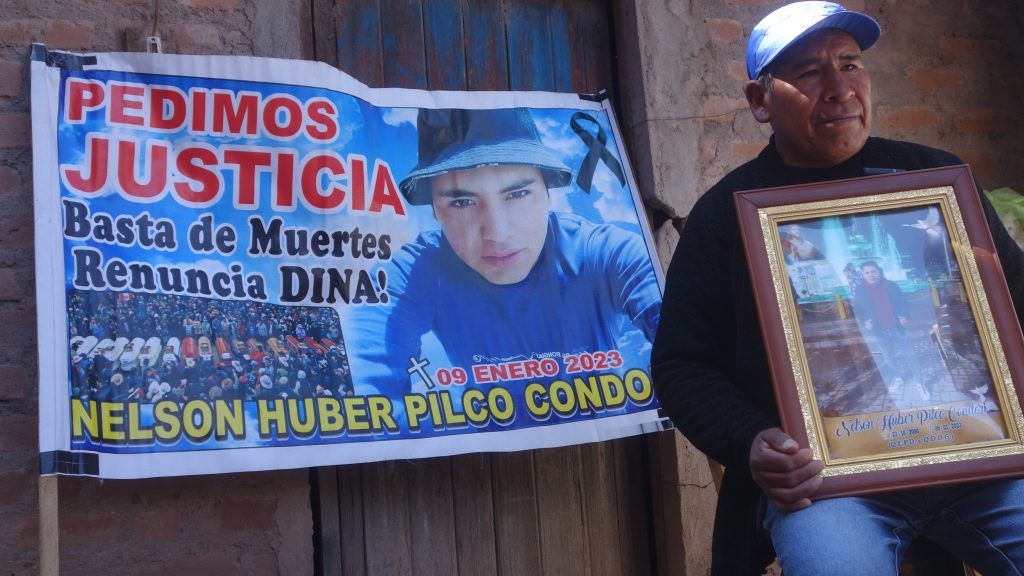 [Photo: Father of one of the victims killed by police bullets in Juliaca, on January 9]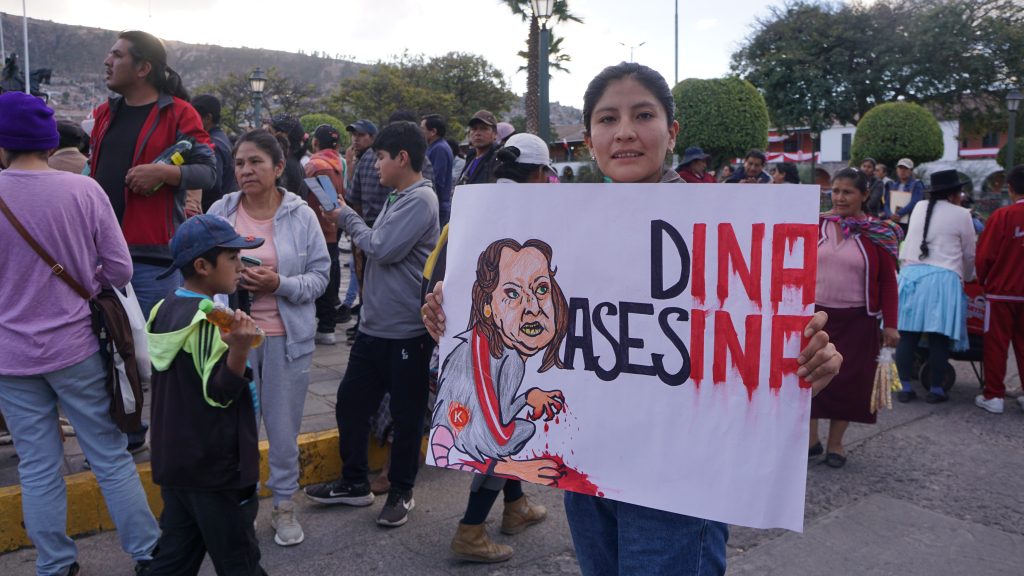


 The Free