
from https://wp.me/pIJl9-E38 https://wp.me/pIJl9-E38 on 17/09/2024 by MedyaNews ( on Telegram: t.me/thefreeonline )
Pakhshan Azizi’s second prison letter frames Jin Jiyan Azadî as revolutionary discourse
In her second letter from Evin Prison, the Kurdish female socio-political prisoner, Pakhshan Azizi, examines the philosophical underpinnings of the slogan “Jin Jiyan Azadî”, arguing that true women’s emancipation can only be achieved through the foundational values and principles of democratic modernity.

In her second letter from Evin Prison, Kurdish political prisoner Pakhshan Azizi delves into the philosophical foundations of the slogan “Jin Jiyan Azadî”, contending that genuine women’s liberation is attainable only through the core values and principles of democratic modernity
Pakhshan Azizi, a Kurdish socio-political activist, was arrested in Tehran in 2023 by the security forces of the Islamic Republic of Iran, and in July 2024 she was sentenced to death by Branch 26 of the Tehran Revolutionary Court. On the eve of the second anniversary of the Jin Jiyan Azadî uprising, and in tandem with the nationwide strike in Iranian Kurdistan (Rojhilat), Pakhshan released her second letter from Evin Prison.

General strike: Jin Jiyan Azadî, struggle for freedom in northwest Iran.. MedyaNews.net
7:02 pm 15/09/2024 Reports confirm that, despite intense intimidation and violence from the Iranian regime, every city in Iranian Kurdistan (Rojhilat) — from Kermanshah (Kermashan) to Oshnaviyeh (Shino) — is observing a full general strike…….. . CONTINUES HERE
Despite the harsh conditions of her imprisonment, Pakhshan’s second letter made its way beyond the prison walls, divided into several sections, and was published in Persian language outlets. In her letter, she reflects on the multiple dimensions of the Jin Jiyan Azadî philosophy, emphasising that the philosophy underlying the slogan represents a philosophy of life, not death. She describes the motto as a scientific revolution, one that can be realised through the academic discourse of jineology.
Pakhshan begins her letter with a quote from Abdullah Öcalan, leader of the Kurdistan Workers’ Party (PKK): “The greatest betrayal to life is removing the meaning of ‘life and freedom’.”

International women’s voices on second anniversary of Jina Amini’s death.. September 16, 2024
She then shifts her focus to the role of women in social relations, describing the 21st century as the century of the women’s revolution. Pakhshan elaborates that if the relationship between men and women is a subject addressed by philosophy, religion and mythology, then it is essential to approach it from a scientific perspective. This is because overcoming the sexism embedded in social relations requires moral and political efforts to address the manner in which genders have been exploited for power and domination.
Pakhshan, in her letter, argues that the 21st century is, indeed, the century of the women’s revolution, and achieving such a transformation requires the development of “women’s science” (jineology) to chart a course for women’s movements in relation to history, revolution and politics. She emphasises that this revolution, founded on democratic and ecological values and promoting equality and freedom for both men and women, demands a sustained, long-term process to bring about genuine social change.
In her letter, Pakhshan stresses that revolution is a prolonged journey, one that cannot succeed without the persistence of a new and scientific paradigm, as well as the hope of realising it. She highlights the deep-rooted gender contradictions that have shaped women’s struggles and stresses the importance of understanding this history accurately. She writes:
“Women, as half of society, are a driving force in democratic civilisation. While there have been achievements in the fight for women’s rights and the recognition of some social rights, these gains have not been sufficient to achieve true freedom. The patriarchal state system, with its reliance on the subordination of women, cannot bring about women’s liberation. Within the authoritarian system, which is inseparably tied to dictatorship and fascism, women’s emancipation is nothing more than an illusion. A woman who perpetuates the cycle of power, believing that freedom lies within it, ultimately reinforces the same patriarchal mindset, which is in direct contradiction to the principles of Woman, Life, Freedom.”
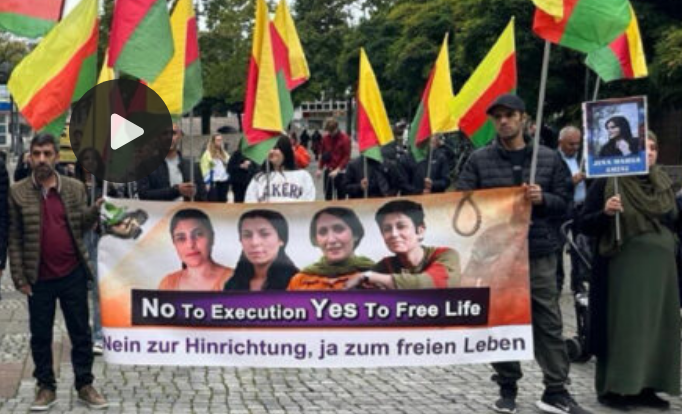
Protests erupt in Europe on second anniversary of Jina Mahsa Amini’s death
In another part of her letter, Pakhshan presents the women’s revolution as radical, theoretical and scientific in nature.
She asserts that, through this revolution — which fosters solidarity and freedom within society — women must challenge patriarchal mentalities, state authority, centralisation and the suppression of the will to resist. It is through these efforts that deep-rooted and widespread changes can be brought about at the societal level.
In this context, the discourse of Jin Jiyan Azadî offers the framework to advance such a revolution. She identifies the organisation of women and the creation of a self-defence force composed of women as the first and most crucial elements of this movement.
Elsewhere in her writing, Pakhshan raises the question, “Who is Woman?” She argues that the essence of womanhood in society is shaped by the historical and analytical processes of socialisation and contends that, in contrast to the capitalist modernity of the West and the dogmatism of Middle Eastern regimes, democratic modernity offers an alternative path forward. This approach, she believes, provides a solution to the challenges posed by the positivist view of society. She writes:
“The aim of knowledge in democratic modernity is to provide meaning to life, enhance self-awareness, and offer a more accurate political understanding of social existence. Democracy presents a radical critique of the authoritarian, state-centric mentality, which standardises race, language, sound, feelings, choices and alternative voices.
This mentality creates a false sense of freedom — an engineered reality, a diminished history and a confined notion of liberty, all presented as the ultimate truth. Women’s emancipation, in its deep roots, is a form of freedom that must be achieved through women’s knowledge (jineology).
In the Kurdish language, the concepts of ‘being’ and ‘self’ are rooted in terms like ‘Xwebûn’ and ‘Serxwebûn’ respectively, representing not the defence of an essentialist view of women, but a quest for their existential truth. Therefore, an ideological struggle is essential to fully understand this truth.”
Regarding women’s position within the Middle East’s political geography, Pakhshan defines this militant ideology as “jineology,” which she argues arises from the culture, history and resistance of women in the region.
Pakhshan says, “Women have been systematically excluded from philosophy, science and knowledge, and in certain societies, they have been deliberately distanced from the education process. Enlightenment philosophy in the Middle East is the product of women’s awareness, creativity, thoughts, feelings and meaningful ways of life.
In capitalist modernity, which leads to ecological crises, human disasters and a rupture from truth and the destruction of society, jineology seeks to prevent these tragedies by restoring the social essence of science. The women’s revolution takes place through the paradigm of democratic modernity. In essence, it can also be understood as the relationship between truth, power and knowledge.”
Womens Uprising in 3rd week. Jineolojî Movement leader Nagihan gunned down near Irani border.-thefreeonline/2022/10/06/
One of the principal aims of jineology is to revive the ‘wisdom industry’ in the Middle East, to transcend the constraints of religious dogmatism. Consequently, Pakhshan maintains that the democratisation of religion is a fundamental aspect of jineology.
Thus, jineology seeks to identify social values, employ women’s resources in analysing society, and remove populism and authoritarianism from social sciences and their inherent genderisation. This is crucial, as the mental structures of women have long been occupied by the dogmas and codes of slavery and femininity imposed by the patriarchal mentality — so much so that these structures have alienated women from each other, from life and from freedom.

In her final part of reflections from the notorious Evin prison, aware of the second anniversary of the Jin Jiyan Azadî uprising, the women’s hunger strike in Evin Prison, and the general strike in Iranian Kurdistan, Pakhshan writes:
“The philosophy of Jin Jiyan Azadî represents the philosophy of life, not death, and it is through jineology — a scientific revolution — that this vision can be fully realised.
To honour the sacrifice of the martyrs of the Jin Jiyan Azadî uprising, the development of a scientific discourse in the form of ‘jineology’ can lay the groundwork for a profound cultural revolution.
This human, moral and political endeavour demands a people with both scientific and revolutionary consciousness to advance the democratisation of family, religion and nationalism, towards socialism and to steer positivist science towards jineology and the sociology of freedom.”
Share post
Tags ( on Medya news):Activism democratic modernity Iranian Kurdistan Jin Jiyan Azadî jineology Kurdish women Pakhshan Rojhilat Woman Life Freedom

Related Posts

The Revolutionary Youth Initiative is born in Rojhilat (Eastern Kurdistan of Iran)

Daily News : 16 SEPTEMBER 2024


Iran: Female political prisoners join hunger strike for ‘Woman, Life, Freedom’ anniversary

Jina Amini family placed under house arrest ahead of protest anniversary

General strike: Jin Jiyan Azadî, struggle for freedom in northwest Iran

 The Free