blog of the post capitalist transition.. Read or download the novel here + latest relevant posts
Author: thefreeonline
The Free is a book and a blog. Download free E/book ...”the most detailed fictional treatment of the movement from a world recognizably like our own to an anarchist society that I have read...
by Pablo Heraklio, PHkl/tctca. Contact at Tarcoteca@riseup.netFuente – Noticias Amor y Rabia
Declaración conjunta de Anarquistas y Antiautoritarios Suecos y Finlandeses contra la entrada en la OTAN
El anuncio de la solicitud de adhesión de Suecia y Finlandia a la OTAN ha provocado el descontento de grupos y colectivos anarquistas, anarcosindicalistas y antiautoritarios de estos dos países que critican la creciente militarización de Europa.
La SAC, la Central Anarcosindicalista Sueca fundada en 1910, que agrupa a unos pocos miles de miembros, condena “la vil guerra de Rusia contra Ucrania y expresa su solidaridad con el pueblo de Ucrania y con todos los que en Rusia luchan por la paz”, pero “al mismo tiempo miramos con horror que Suecia se está armando cada vez más y la retórica militarista de Suecia sobre cuestiones de seguridad, centrándose únicamente en la defensa militar y la pertenencia a la OTAN”, en lugar de “promover la paz y los esfuerzos para mantenerla”.
La SAC también considera que “la OTAN no es una organización de paz, al contrario”.
En Finlandia, el colectivo A-ryhma (Grupo A), que agrupa a anarquistas y otros antiautoritarios, considera, en un comunicado difundido recientemente, que “la mayor parte de la élite finlandesa ha apoyado durante mucho tiempo la pertenencia a la OTAN” y que han aprovechado el ataque de Rusia a Ucrania para llevar a cabo la entrada en la organización.
Los antiautoritarios finlandeses consideran que Putin está debilitado y que no representa un peligro para Finlandia, pero que unirse a la OTAN puede tener consecuencias, sobre todo porque esta alianza tiene armas nucleares y está dirigida por Estados Unidos, un país para el que “atacar y ocupar otros países ha sido parte inherente de su política exterior” en las últimas décadas.
Afirmando defender la “resistencia anarquista ucraniana contra la invasión rusa y las acciones no violentas y violentas de los anarquistas rusos contra la guerra”, los libertarios finlandeses apoyan el “desarme nuclear multilateral” y recuerdan que entrar en la OTAN, de la que Turquía forma parte, podría volverse contra el pueblo kurdo, que Finlandia ha apoyado.
“Erdogan ha ocupado militarmente el norte de Siria, destruyendo la sociedad kurda y continúa atacando el norte de Irak en un intento de aplastar los intentos kurdos de democracia.
Este comportamiento no difiere significativamente del de la Rusia de Putin”.
Individuals in rich countries face huge financial losses if climate action slashes the value of fossil fuel assets, a study shows, despite many oil and gas fields being in other countries.
The researchers estimated that existing oil and gas projects worth $1.4tn (£1.1tn) would lose their value if the world moved decisively to cut carbon emissions and limit global heating to 2C. By tracking many thousands of projects through 1.8m companies to their ultimate owners, the team found most of the losses would be borne by individual people through their pensions, investment funds and share holdings.
The analysis also found that financial institutions have $681bn of these potentially worthless assets on their balance sheets, more than the estimated $250-500bn of mispriced sub-prime housing assets that triggered the 2007-08 financial crisis.
The researchers did not predict if or when these fossil fuel “stranded assets” would cause a financial crash, but said the size of the number was worrying. The US and UK are by far the countries with the biggest potential stranded assets in their financial sectors.
Overall, the study calculated that individuals own 54% of the $1.4tn oil and gas assets at risk – $756bn. Three-quarters of these people are in the 38 developed countries in the Organisation for Economic Co-operation and Development (OECD) group. Governments and corporate creditors carry the balance.
“It is pretty obvious now that the fossil fuel companies are doing things that are not compatible with mitigating climate change,” said Dr Gregor Semieniuk, at the University of Massachusetts Amherst, US, who led the research. The Guardian recently revealed that oil and gas companies are planning scores of vast “carbon bomb” projects that would shatter internationally agreed climate targets.
“I did not imagine that individual people would ultimately end up with so much of the risk,” said Semieniuk. “This is particularly relevant for countries like the US and UK, which show up as very major losers. That is where I think the losses really get spread around society.”
The study, published in the journal Nature Climate Change, said the rate of change needed to tackle the climate crisis was “so large that the rapid collapse of fossil fuel industries presents major transition risks”. The researchers compared a scenario in which little was done to limit global heating and temperatures rise by 3.5C with a scenario in which substantial action was taken and the global temperature rise was limited to 2C.
In the second scenario, oil and gas projects valued today at $1.4tn cannot continue production and lose their value. The team traced this loss from 43,439 oil and gas production assets through a network of 1.8m companies to their ultimate owners. They concluded: “Most of the market risk falls on private investors, overwhelmingly in OECD countries, including substantial exposure through pension funds and financial markets.”
The countries hit hardest by losses in the financial sector would be the US, with $283bn at risk, and the UK ($98bn), both far above the third-placed nation, the tax haven of the British Virgin Islands ($28bn). Canada and Australia are in the top six. About 90% of the risk in the UK is due to ownership of oil and gas assets in other parts of the world.
Companies in the Middle East do not have such high losses in the 2C scenario because some oil and gas will continue to be used and they are the cheapest suppliers.
Semieniuk said the $681bn of potentially worthless oil and gas assets on the balance sheets of financial institutions was large compared with the sub-prime housing assets that led to the 2007-08 financial crash.
“One can compare these numbers in the sense that there’s a bunch of mispriced assets floating around, if we believe in climate change mitigation,” he said. “This number is quite worrying. If the transition [to a net zero world] isn’t prudently managed, it raises the risk of financial instability.”
Mike Coffin, at the financial thinktank Carbon Tracker Initiative, said the new analysis was complementary to CTI’s own research, which recently found oil companies were at risk of wasting $500bn on future projects.
Coffin said the study focused on future losses from existing assets. “What is critical is that investors recognise the risk of committing huge amounts of capital in new assets that run the risk of becoming stranded as long-term fossil demand weakens.” The Guardian recently worked with CTI to show the 12 biggest oil companies are on track to spend $103m a day to 2030 on projects that would mean attempts to keep global heating well below 2C would fail.
The study also focused on exploration and production. But including other parts of the oil and gas industry, such as refineries and equipment suppliers, would increase potential losses, Coffin said. “The overall magnitude of the stranded asset risk within the oil and gas industry is likely to be significantly larger than that quantified in the study.”
Erdogan has announced a 4th invasion of Syria, specifically to destroy the multi ethnic feminist revolution in Manbij, and the Kurdish enclave at Tal Rifat where tens of thousands of refugees from his invasion and occupation of Afrin are still camped out.
While the world is scandalised that Russia invaded Ukraine to protect ethnic Russians, Erdogan gets a free hand for MORE imperialist genocide, taking advantageb of the US needing him to sign for NATO expansion
The US gave Erdogan free rein to flood Rojava with his fast growing mercenary army of jihadi Syrian militias, including many ISIS and Al Qaeda and militias now holed up in Idlib. Erdogan is paying the terrorists 500 Turkish dollars a month and offering loot, land and power destroying Rojava. Especially evil is the promise to destroy the unique womens’ liberation movement, returning women to semi slavery under medieval jihadi rule and implicitly offering his terrorist mercenaries the right to kidnap, rape and torture the heroic YPJ womens defense militia, part of the SDF multiethnic army, as is already happening in Afrin.
The new REPowerEU Plan presented last week by the European Commission is the latest proposal of measures that would speed up the transformation of Europe’s energy landscape..
The dependence on fossil fuels imported from Russia may be the most pressing issue tackled by the proposal. For the first time, geothermal energy has been included as a mainstream solution to address the challenges associated with both Russian aggression and climate change.
This is good news. only deep geothermal energy can offer not just gigawatts, but terawatts of clean and sustainable baseload energy needed by industry and large-scale district heating and cooling.
Deep geothermal energy can be harvested almost anywhere – at depths of 5 km and more. The problem is that the…
A Ukrainian government official frequently cited as a source by western news media for her allegations of atrocities committed by Russian troops has been fired by the Ukrainian parliament, in part because of the unevidenced nature of those claims.
Horrific allegations from Ukraine’s Human Rights Commissioner include a 9-month-old baby being penetrated with a candlestick and triplets, 9, being raped in front… ALL 100% LIES
AUkrainian official has been relieved of her duties over her handling of reports detailing sexual assault allegations made against Russians in Ukraine.
A Ukrainian government official frequently cited as a source by western news media for her allegations of atrocities committed by Russian troops has been fired by the Ukrainian parliament, in part because of the unevidenced nature of those claims.
Horrific allegations from Ukraine’s Human Rights Commissioner include a 9-month-old baby being penetrated with a candlestick and triplets, 9, being raped in front… ALL 100% LIES
A Ukrainian official has been relieved of her duties over her handling of reports detailing sexual assault allegations made against Russians in Ukraine.
On Tuesday, the Ukrainian parliament, the Verkhovna Rada of Ukraine, removed Lyudmila Denisova, the parliament’s commissioner for human rights, from her post, according to Ukrainska Pravda. No new appointment has been made to fill the role.
The move to dismiss Denisova came after outrage about the wording used in public reports about alleged sexual assaults committed by Russians, as well as the alleged dissemination in those reports of unverified information. Despite accusations from Ukraine, the Kremlin has repeatedly denied that Russian soldiers have committed war crimes or sexual assaults during the invasion.
As it happens, Newsweek is one of the many western outlets who have uncritically cited Denisova’s unevidenced claims in their reporting of events in Ukraine. She was the “Ukraine official” in Newsweek’s incendiary April headline “Russians Raped 11-Year-Old Boy, Forced Mom to Watch: Ukraine Official,” an article whose entire first half featured unevidenced claims by Denisova.
"The racist occupiers must bear the strictest responsibility!" said Ukrainian Parliament Commissioner for Human Rights, Lyudmila Denisova, of Russian soldiers. https://t.co/ObN7cDbEJv
A Ukrainian official has been relieved of her duties over her handling of reports detailing sexual assault allegations made against Russians in Ukraine.
The new REPowerEU Plan presented last week by the European Commission is the latest proposal of measures that would speed up the transformation of Europe’s energy landscape..
The dependence on fossil fuels imported from Russia may be the most pressing issue tackled by the proposal. For the first time, geothermal energy has been included as a mainstream solution to address the challenges associated with both Russian aggression and climate change.
This is good news. only deep geothermal energy can offer not just gigawatts, but terawatts of clean and sustainable baseload energy needed by industry and large-scale district heating and cooling.
Deep geothermal energy can be harvested almost anywhere – at depths of 5 km and more. The problem is that the costs associated with traditional conventional drilling in depths of more than 3 km in the hard rock under increasing pressure and temperature rise exponentially.
GA Drilling, a technology company from Slovakia, is one of the few tech startups developing contactless drilling solutions to enable linear cost increase of drilling to any depth – and it is the only one based in the EU.
GA Drilling has now associated with Narbors to: accelerate field commercialization and eliminate traditional economic barriers of ultra-deep projects to expand global access to geothermal energy.. see report below
Its unique drill bit Plasmabit has already caught the attention of major global players in the drilling and oil industry as the technology to power the deep geothermal revolution, anywhere.
With “Plasmabit inside”, the existing drilling equipment and rigs developed originally for conventional oil and gas exploration in shallow sediments will be able to unlock the vast potential of deep geothermal energy in hot hard rock, guaranteeing the economic viability of geothermal projects.
***********
Nabors invests in ultra-deep geothermal drilling technology company
Apr 1, 2022 shared with thanks
Nabors Industries added to its clean energy portfolio with an $8 million investment in geothermal technology company GA Drilling. GA Drilling’s PLASMABIT drilling tool will be integrated into Nabors’ automated and lower-emission drilling operations.
The collaboration aims to accelerate field commercialization and eliminate traditional economic barriers of ultra-deep projects to expand global access to geothermal energy.
GA Drilling joins Nabors’ geothermal ecosystem, which is comprised of three other prior venture investments in geothermal companies. These technologies were assembled to help make geothermal energy widely accessible across geographies, while reducing cost per unit of energy generated to match the cost of other energy sources.
“Now is the time to invest in innovative and bold geothermal solutions that have the potential to unlock terawatts of clean, renewable and reliable energy on a truly global scale,” said Anthony G. Petrello, Nabors Chairman, CEO and President. ecosystem.”
“The present agreement will allow us to move faster through the final stages of PLASMABIT development, to integrate this revolutionary drilling tool into the systems of the rig. Nabors will introduce European high-technology capacities into the US market. Together, we will work toward meeting imminent demand to rapidly diversify the global energy mix.”
**********
Quaise’s ultra-deep geothermal drilling plans: Your questions answered
Quaise says it has a plan, and the technology, to drill deeper than ever before and unlock the vast geothermal power of the Earth to re-power fossil-fired electricity plants with green energy
Quaise’s ultra-deep geothermal power plan is one of the most exciting and fascinating green energy projects we’ve seen. In a nutshell, this Boston-based MIT spin-off says it has repurposed powerful millimeter-wave beam technology – originally developed to superheat plasma in fusion experiments – to blast through previously undrillable rock far below the Earth’s surface.
The company says this will allow it to drill bore holes far deeper than has ever previously been possible, going down far enough to access rock temperatures around 500 °C (932 °F). That’s well past the point where water becomes heated to a “supercritical” state that radically boosts the efficiency of geothermal power extraction.
More or less any existing power station that uses fossil-fueled heat to create steam and run turbines can be connected to a totally reliable, 24-hour supply of green energy that’ll keep those turbines turning without a single puff of CO2 escaping, and without the worrying intermittency of other renewable sources like wind and solar energy.
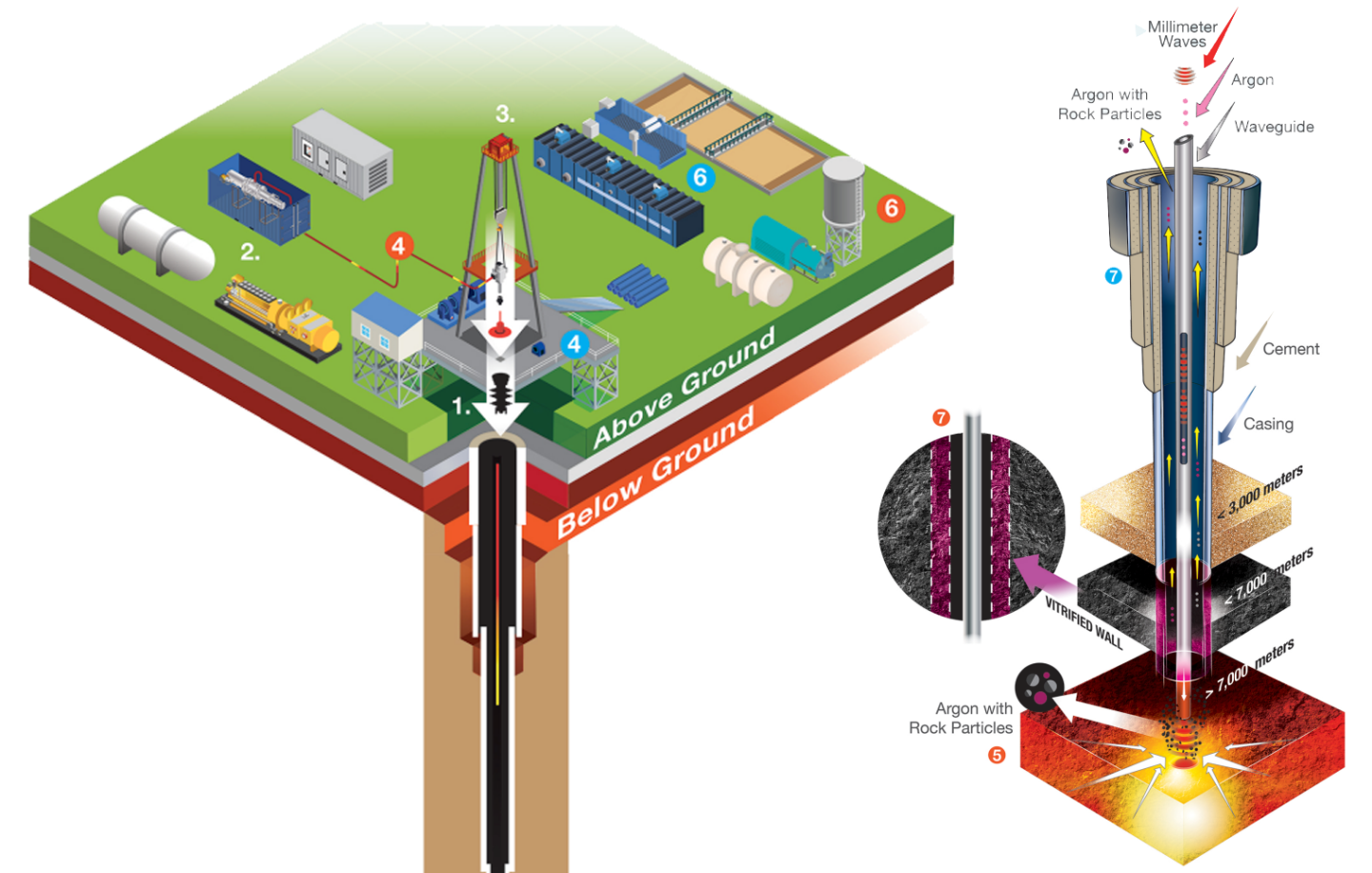
Quaise’s hybrid ultra-deep drilling rig will combine conventional rotary drilling with gyrotron-powered mm-wave directed energy drilling, pressure-purged with electromagnetically-transparent argon gas
It’ll be surprisingly quick, too. The deepest hole humanity has ever drilled to date took nearly 20 years to reach a depth of 12,289 m (40,318 ft), but Quaise says its hybrid drilling rig – using a traditional rotary bit to get through the easy stuff and a gyrotron-powered energy beam to melt, fracture and vaporize the tough stuff – will take just 100 days to deliver you a hole 20 km (12.4 miles) deep.
If all hurdles can be cleared the end result gets you a long-term green energy supply, in a stable bore hole lined with glassy melted rock, wherever you want it.
The details and history are fascinating, and I thoroughly recommend you read our original story to learn a lot more. But as with any radically disruptive idea like this, enquiring minds are going to have questions.
Your questions answered
Here at Atlas we’ve collected the best – and a few of the worst – questions from both these sources, and put them to Quaise CEO and co-founder Carlos Araque, who was kind enough to get back to us. His lightly edited responses are reproduced below.