Publicado por/published by Laura Vicente
read in Spanish- leer original en castellano aquí shared with thanks. http://pensarenelmargen.blogspot.com/ translation theFreeOnline photos added, March 3rd 2022
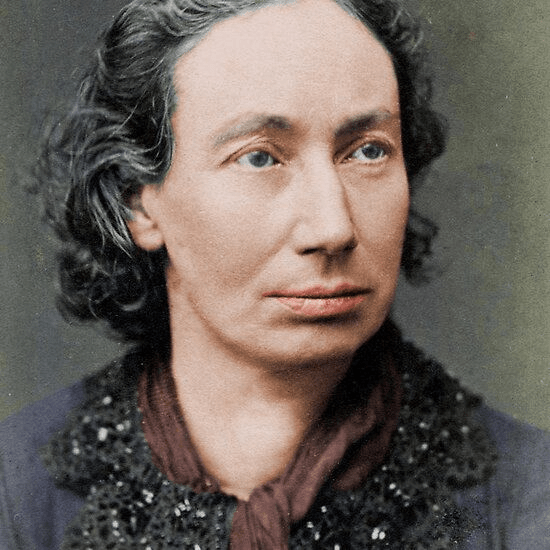
Louise Michel
It is of great importance to resort to female genealogies to find lines of action that allow us to study the processes of change from the perspective of women. These genealogies help to clarify social phenomena that have transformed our lives at the present time and help to reconstruct the milestones and the women who contributed to that change.
It is essential to name women, build the genealogy in ways of doing and being among the founding texts of the feminist movement, to recover the historical voices of women and transmit them in formal and informal education.
The socio-cultural performance of women is not always the product of exceptionality, but rather stems from a trajectory that should be highlighted. We intend to reconstruct a part of the genealogy of anarchist feminism through three women: Louise Michel, Teresa Claramunt and Emma Goldman.
Louise Michel (1830-1905) belonged to a generation older than Teresa Claramunt (1862-1931) and Emma Goldman (1869-1940). The three met, although they never spent long together.
Teresa met Louise in 1897, both had been tried by separate Military Courts and deported. Louise, the ‘Paris Commune’ woman had returned to France after her deportation in 1880 and, finally, she went into exile in England in 1890. Claramunt along with twenty-seven other people, despite being declared innocent in the Montjuïc Trial, were deported to England in 1897.
When they arrived in London, after disembarking in Liverpool, Louise Michel[1], Fernando Tarrida and the Committee for the Protection of Victims of Spanish Atrocities[2] were waiting for them.
Teresa must have known of Louise because her great friend Teresa Mañé (who met with the deportees shortly after) was one of the promoters of Michel’s work in Spain. Perhaps for this reason, her daughter Federica Montseny met and was interested in the Commune and in Louise Michel [3].

Federica Montseny
Both were excellent communicators both at rallies and through articles in the labor press. Both carried out multiple propaganda tours spreading The Idea and were linked to newspapers such as El Productor in the case of Claramunt and Le Libertaire in the case of Michel. Their personal lives were difficult, especially when they stopped being young, due to the little income they had.
The parallelism of the stories of these two women we can assume must have linked them, despite the brevity of their meeting, in a feeling of empathy and solidarity, in addition to explaining why Teresa was called the ‘Spanish Louise Michel’.
Emma and Louise also met in England in 1895. Emma traveled to Europe to study in Vienna and her first stop from the United States was in London where she met various anarchist personalities including Louise (indeed that was her goal in visiting England as she says herself).
It was also a brief meeting since Emma went on to Vienna where she studied a midwifery course and another on childhood illnesses.
Emma’s impressions in her autobiography [4] make clear the great admiration she felt for her and for her intervention in the Paris Commune: «Louise Michel had stood out for her love of humanity, for her great fervor and courage» [ 5].
Her physical description made it clear that Michel was a woman aged by all the hardships she had experienced (she was sixty-five years old and not sixty-two as Goldman wrote): “She was bony, emaciated and looked older than she really was (…) ; but her eyes were full of youth and spirit, and her smile was so tender that she won my heart immediately »[6].

When Emma met Louise she wondered: «how could there be someone who did not see her charm» despite the fact that she did not care about her appearance and showed great disinterest in herself: «her dress was threadbare , the hat was very old. Everything she wore of hers did not fit her »[7].
Let us not forget that Emma was a young woman of twenty-six who looked admiringly at Louise but that she must have seen her as an older woman. It was her admiration for the old ‘Comunera’ (woman Commune member) that transformed the realistic impression of her into a completely different, almost mystical feeling [8]:
«(…) Her whole being was illuminated by an inner light. I was quickly succumbing to the charm of her radiant personality, so irresistible in her force, so touching in her childlike simplicity. The afternoon I spent with Louise was an experience unlike anything that had ever happened to me before in my life. Her hand in mine, the tender touch of her hand on my head, her words of affection from her and intimate camaraderie from her made my soul expand, ascend towards the spheres of beauty where she dwelled » .
Emma and Teresa met in Spain during a brief visit that Emma made between December 1928 and January 1929, to gather information.
It was the Austrian historian Max Nettlau (1865-1944), an anarchist intellectual with an encyclopedic culture, devoted to the study of the history of anarchism and the life of Bakunin, who encouraged his friend Emma, with whom he had been in constant correspondence since they met in London in 1900, to visit a country that had captivated him.
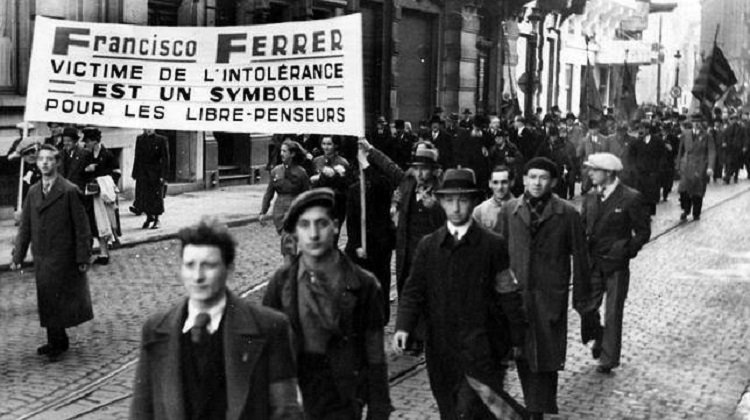
Spain was not an unknown country for her. Her anarchist internationalism had led her from a very young age to want to know the situation of her comrades from the rest of the world.
In the United States he participated in various campaigns against the repressive policy of the governments of the monarchy of Alfonso XIII, specifically as a result of the brutal torture of the prisoners of Montjuic (she probably knew Claramunt as a result of this campaign), and as a result of the execution of the pedagogue Ferrer y Guardia after the Tragic Week in Barcelona in 1909.
Continue reading “Genealogies of Anarchist Feminism: Louise Michel, Teresa Claramunt and Emma Goldman”