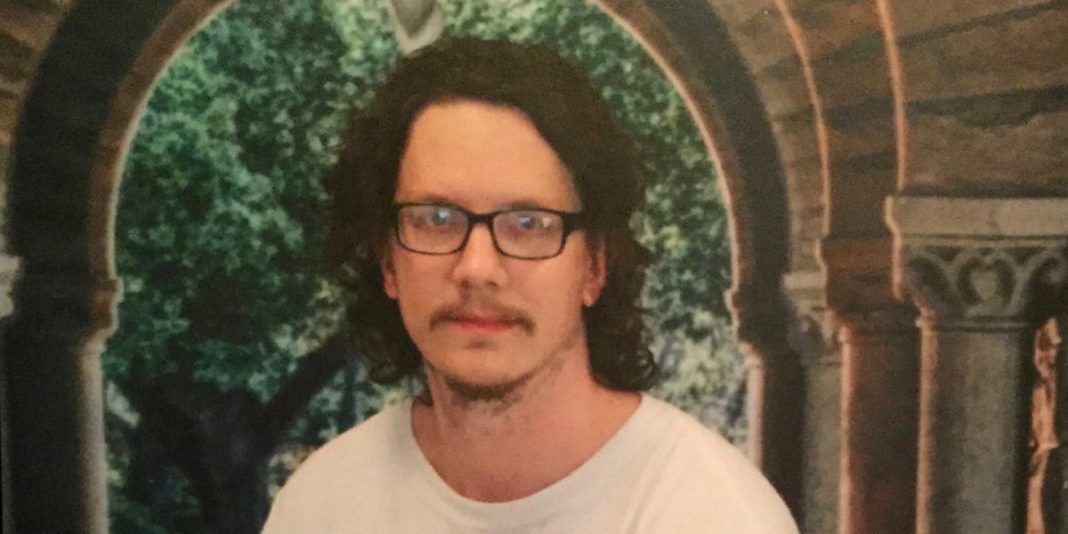
A special message from anarchist prisoner Jeremy Hammond
A raised fist to you all this June 11th! May this letter find you in revolutionary health and spirits. Although I am unable to be with you physically on this occasion due to being held in captivity by the BOP, I still feel connected with you on this day of solidarity. It was nice to run the 5K with you a few days ago for Running Down The Walls. I also sent out a few dozen origami models decorated with June 11th anarchist tattoos; you should be receiving those shortly.
Big ups to the other anarchist comrades behind bars. We have been through a lot of trials and tribulations over the years: harassment from abusive guards, solitary confinement, diesel therapy, the mind-numbing frustrations from battling the brutal bureaucracy for so many years. Never have we been alone, however. Continue reading “Jeremy Hammond: Anarchist Hero sends Message from Prison”
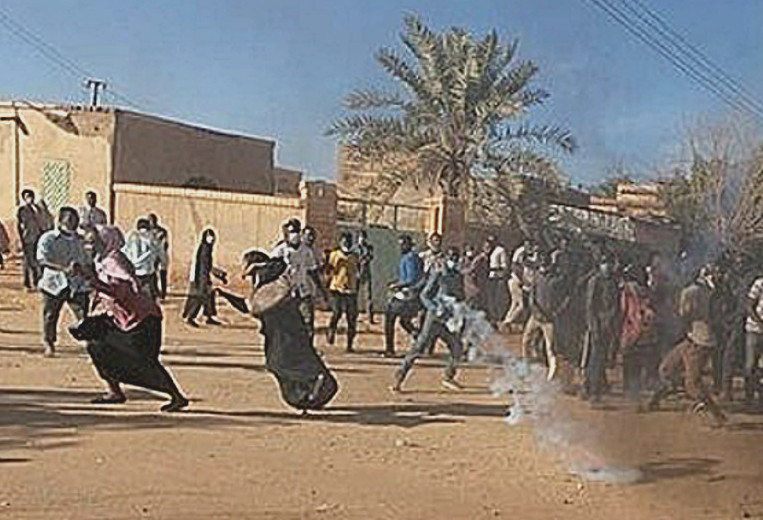
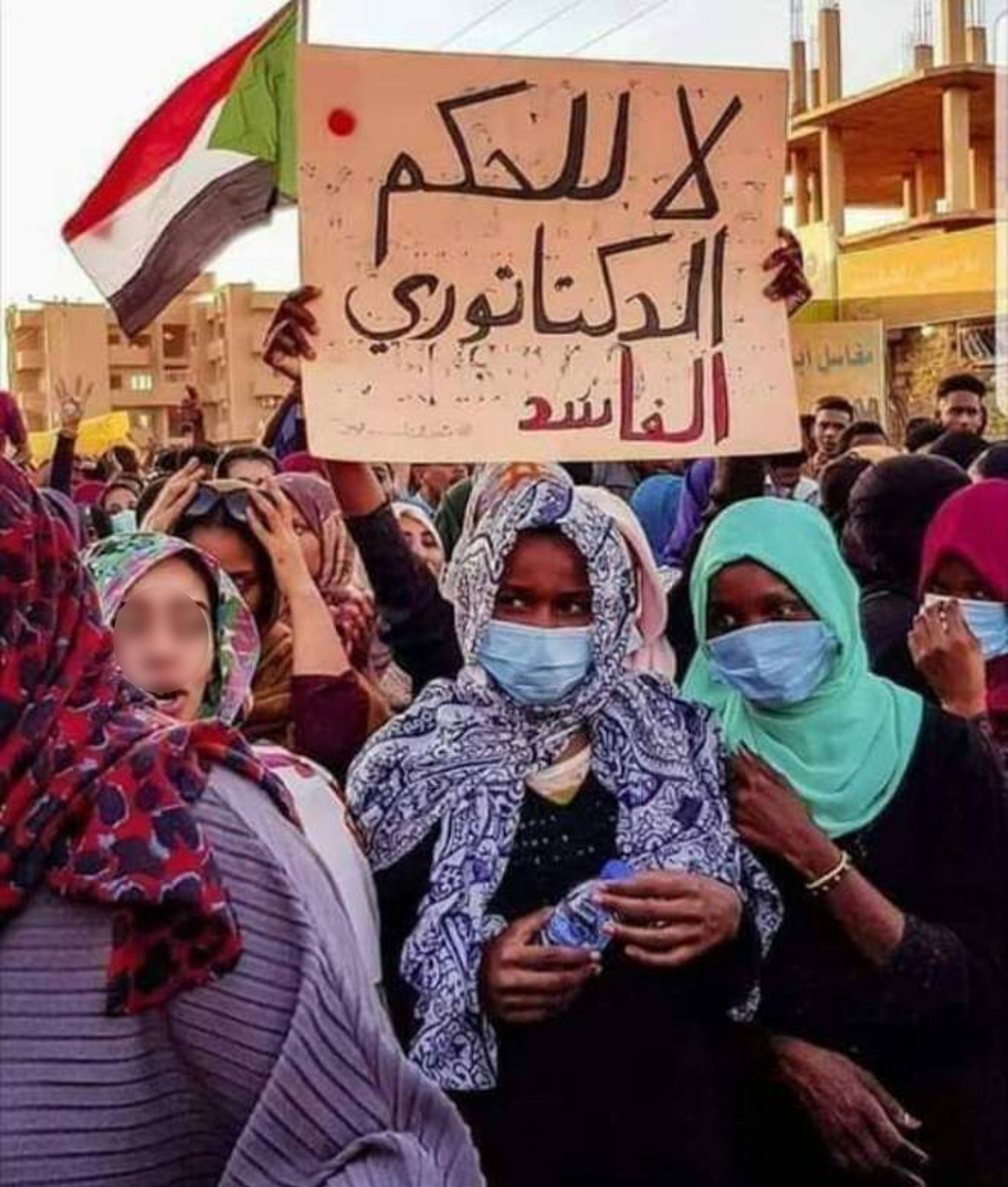
Since the middle of December last year there has been an ongoing revolt in Sudan. This outbreak of rebellion a continuation of earlier struggles against the regime of Omar al-Bashir. In April, escalating protests led to a round the clock sit in occupation of the Military HQ demanding the fall of the regime.
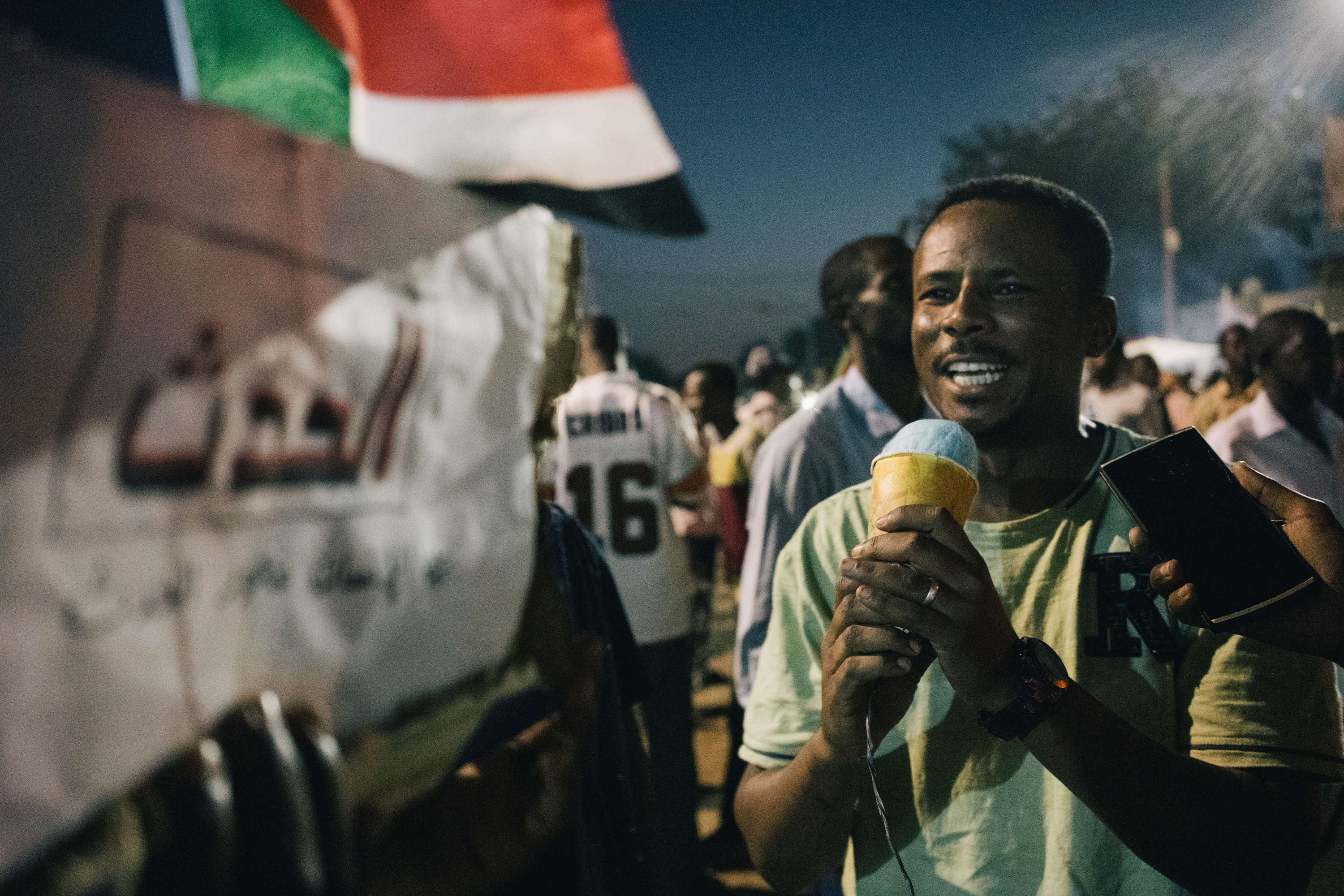
Sudanese protesters mock al-Hadath TV’s coverage with fake cameras and joke interviews (MEE/Kaamil Ahmed)
The military – under the pretext of siding with the revolutionaries – used this unrest to stage a coup and oust al-Bashir and install themselves as the Transitional Military Council(TMC), many of the people on this council had ties to the old regime and to the notorious Janjaweed – an Arab ethno-nationalist militia (re-branded under al-Bashir as the Rapid Support Forces or RSF) involved in war crimes and genocide in Darfur.
Update.. Support General Strike
Many shops and businesses in Khartoum were closed on the second day Monday of the general strike and civil disobedience campaign, aimed at putting pressure on TMC to relinquish power. Opposition and protest groups called for the campaign after security forces stormed the protest camp on June 3, killing scores of people and dealing a blow to hopes of a peaceful transition. The US is supporting the military via its Saudi and UAE proxies. Several protest leaders have been deported and more protestors murdered.Sudan uprising: updates from Al Jazeera English
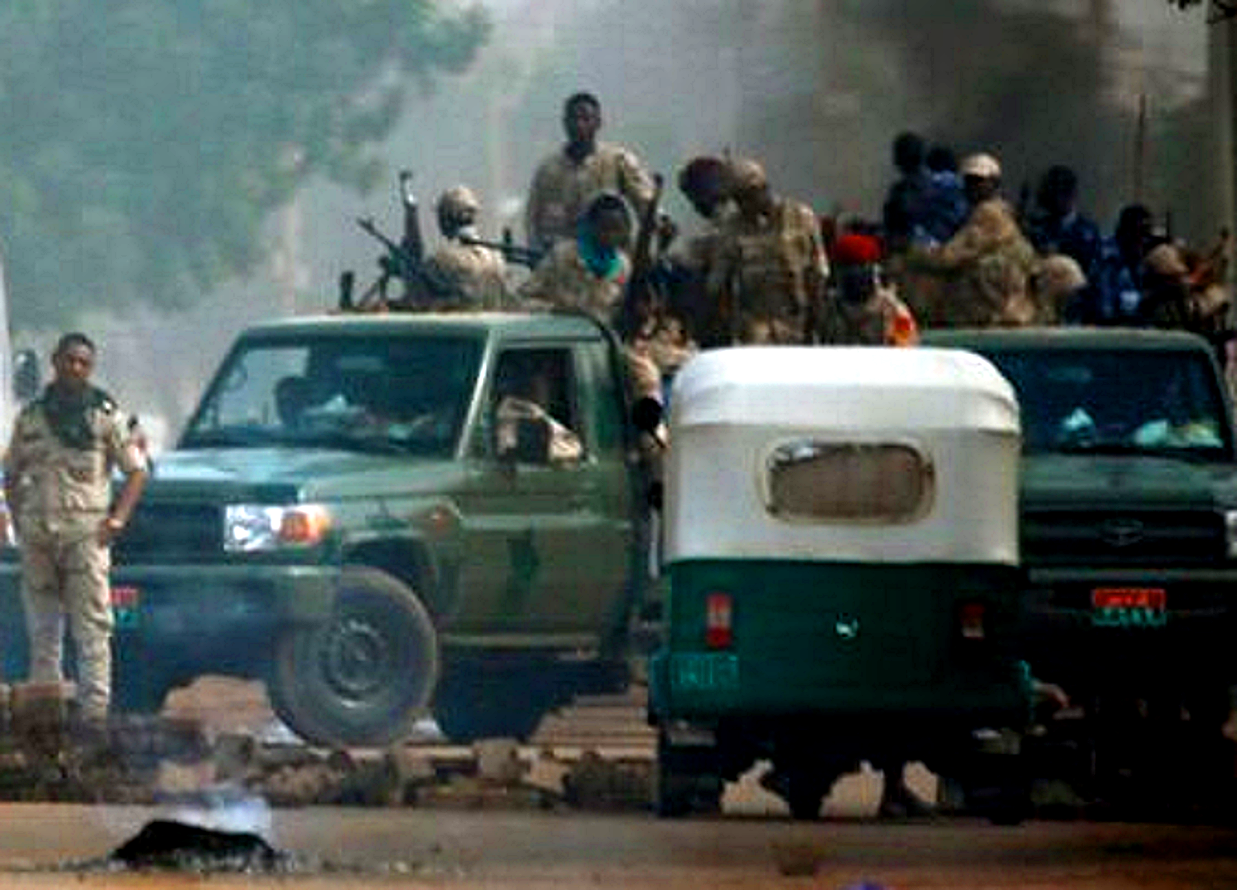
Janjaweed.. the notorious militia were set loose on the protestors
The TMC began to criminalize the protests and declared the sit-in a “security threat”. Only days after the declaration the RSF attacked and cleared out the sit in with live ammo and burned down the tents at the sit in while the army watched. The RSF continued on a rampage all over Khartoum with a confirmed count of over 100 dead and 650 wounded.
The RSF occupation of Khartoum is still ongoing and the TMC has had the internet shut off for over 72 hours making reports of what’s going on hard to come by, but calls have come from the movement for “total civil disobedience” and there is sporadic video and text of people resisting all over Sudan.
“current situation:
– resistance activities at peak, w/ most roads barricaded
– intermittent sound of gunfire heard across neighborhoods
– call to prayer made in most neighborhoods; in some, RSF prevented ppl from attending, in others people insisted on fasting”#SudanUprisinghttps://t.co/Jg7BChIbHw
— Munchkin (@BSonblast) June 4, 2019
Why Does This Matter
Let’s be clear, what’s at stake is the spreading of a rebellious energy across the Middle East and the African Continent that threatens the political order. That’s why regional powers and allies of the US – Saudi Arabia and the UAE – have supported the TMC and their repression of Sudanese rebels.
We find ourselves in a moment of international right wing reaction with fascistic, white supremacist, and other authoritarian movements and states seizing or consolidating power all around the world. Our enemies have spent many years networking and building internationally, capitalizing on both human and environmental crisis, but these crises don’t have a single road out that leads to authoritarian power that we try desperately to react to. These moments also give us opportunity to link and build power with others, who may or may not be or call themselves anarchists but who share the anarchic spirit for total freedom.
We think it is no accident that the height of the anarchist movement – to what ever degree we identify with that history – was precisely when it was an internationalistmovement. Just as capitalism and state power are global – and generate global crisis – so too must the fight against it be.
Call for Anarchist Solidarity
We are calling for immediate acts of solidarity with rebels in Sudan (and against the Sudanese & Saudi state) – whether that’s banner drops, graffiti and wheat-pasting, informational tabling, rowdy marches & demos, fundraisers to help Sudanese doctors get medical supplies, or other creative acts of intervention that make sense in your context.
Sudanese protesters burn tyres as they block Nile Street for the second consecutive day during continuing protests in Sudan’s capital Khartoum on 13 May 2019 (AFP)
Sudanese protesters burn tyres as they block Nile Street for the second consecutive day during continuing protests in Sudan’s capital Khartoum on 13 May 2019 (AFP)
While this call is for immediate reaction we should be taking time to look at our local terrain to find private or state run entities with economic ties to the Sudanese or Saudi state and act against them to move our solidarity from what is most likely symbolic actions to show the people of Sudan they are not alone to a combative solidarity that impedes the smooth functioning of the TMC, the states that support and supply it, and the logistical flows of the supplies used to repress the uprising.
Solidarity is never a one off action, but a constant process of building relationships with other anarchists and movements for liberation, of examining, acting, and learning to build a materially effective practice of attack. International solidarity is key because Capital, it’s defenders, and it’s reaction fights globally and so should we.
For anarcha-feminists, the struggle against patriarchy is an inherent part of the struggle to abolish the state and abolish capitalism, since the state itself is a patriarchal structure.
Although there is a rich, global history of people of color and/or feminist anarchist movements, within the U.S., it’s not uncommon for anarchist spaces to suffer major blind spots when it comes to race and gender.
Given that anarchism, even more than socialism and communism, explicitly denounces any form of hierarchy in political organizing, it is especially ironic when white male anarchists fail to recognize the ways in which they replicate hierarchy by participating in racist and patriarchal forms of domination against their comrades.
So here is a brief introduction to anarcha-feminism—loosely defined as a political philosophy and movement whose goal is not only to abolish the capitalist state, but also all forms of patriarchal domination as well.
Anarcha-feminists do not see the goals of feminism as distinct from anarchism—rather, they see feminism (in its true form) as a kind of anarchism, and vice versa. For anarcha-feminists, the struggle against patriarchy is an inherent part of the struggle to abolish the state and abolish capitalism, since the state itself is a patriarchal structure.
mujeres libres
In a manifesto titled “Anarcho-Feminism: Two Statements,” the authors note: “We believe that a Woman’s Revolutionary Movement must not mimic, but destroy, all vestiges of the male-dominated power structure, the State itself — with its whole ancient and dismal apparatus of jails, armies, and armed robbery (taxation); with all its murder; with all of its grotesque and repressive legislation and military attempts, internal and external, to interfere with people’s private lives and freely-chosen co-operative ventures.”
Below are a list of some anarcha-feminists and anarcha-feminist groups, both historic and present, to get you started:
#Chiapas: The San Cristóbal-Palenque highway is back and so is the resistance
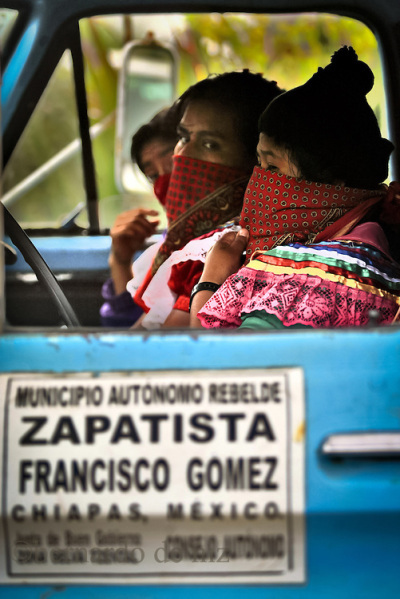
Chiapas, Mexico:The highway is heating up conflicts in the region.Originally published by Chiapas Support.The San Cristobal-Palenque highway is key to an elaborate tourism development plan, the Palenque Integral Center (CIP, its initials in Spanish), which includes a lush green jungle area in the northern zone of Chiapas, the Agua Azul Cascades, the Misol Ha waterfall and the magnificent archaeological site of Palenque.Agua Azul Cascades. [1]The San Cristóbal-Palenque highway and the Palenque Integral Center are part of a regional development plan for Mesoamerica, originally known as the Plan Puebla-Panamá (PPP). [2]The PPP included numerous infrastructure projects that prompted strong opposition from social, environmental and human rights organizations, as well as academics and organized indigenous communities.That led governments and planners to silence the most controversial projects contained in the plan and to re-name it the Mesoamerica Project.In Chiapas, at least up to now, the most controversial projects within the Mesoamerica Project have been the San Cristobal-Palenque highway and the Palenque Integral Center. They go together; the CIP needs the highway to facilitate tourism.
Residents of the areas affected by these projects have had two general concerns: 1) dispossession of the lands of indigenous communities of subsistence farmers through which the highway would pass and the effects on those communities and 2) the massive amount of tourism envisioned in the Palenque Integral Center.
Perhaps the best articulation of why the Zapatista communities and other pro-Zapatista indigenous communities oppose and resist the superhighway and the Palenque Integral Center may be in the words of Miguel Vazquez Moreno, a Zapatista supporter from the San Sebastián Bachajón ejido, who was briefly a political prisoner as a result of resistance to the superhighway and the tourism megaproject.
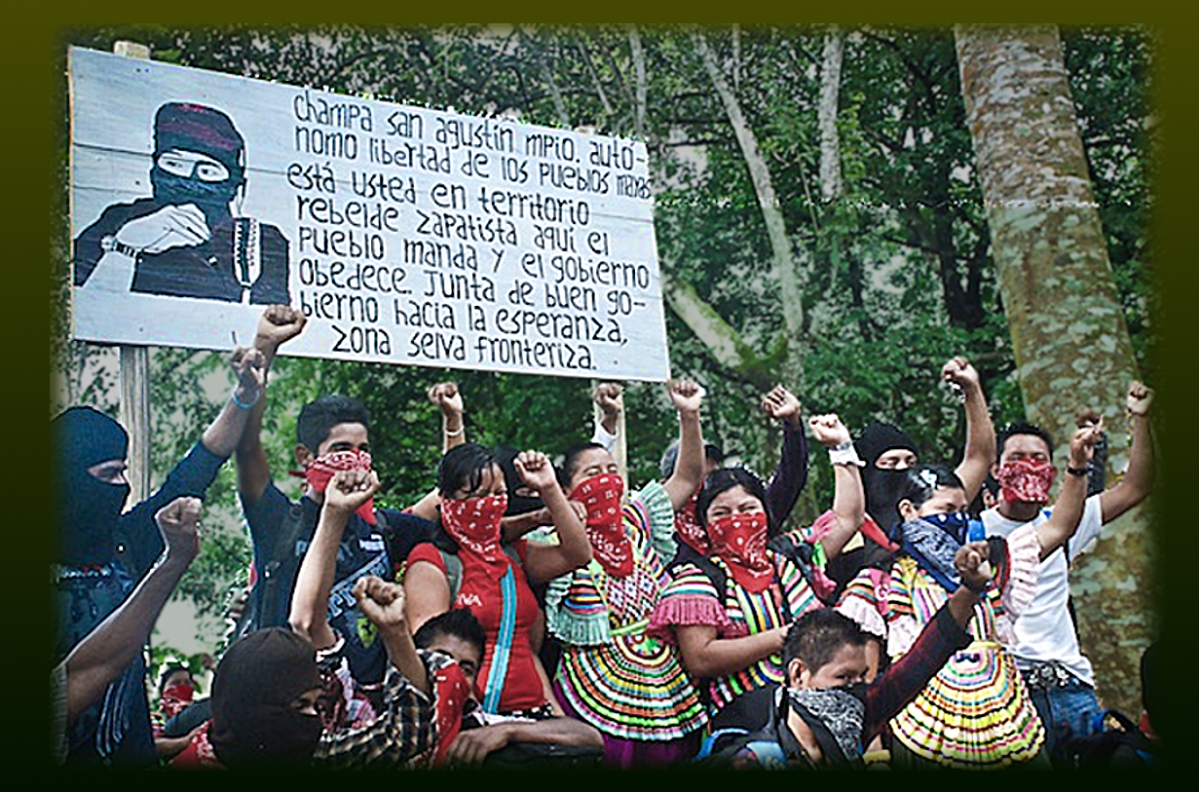
“I am a native of the San Sebastián Bachajón ejido and I am part of the EZLN’s support base, an organization that defends its right to exercise autonomy and self-determination as indigenous peoples, its right to territory and to natural resources.
They [the federal and state governments] want to impose neoliberal economic projects on our autonomous territory. As indigenous people, the land is our life, we eat from it, we work, our children grow and it is something sacred, therefore we consider that the land is not for sale but to work and care for. Our territory is rich in water, animals and natural resources.
They want to make it into a ‘Chiapas Cancun’ by plundering the indigenous of our life, that is, the land, just so that foreign and national companies can become richer, as well as the government officials that benefit from these projects. They want to cross through our autonomous territory without respecting our rights.
They want to impose these projects on indigenous peoples without giving importance to our word, and with discrimination they want to remove us from our lands for tourist purposes and only to benefit rich developers and the federal and state government, putting us aside because to them we give a bad appearance to those eco-tourist centers, being that we are original peoples, descendants of the peoples that have lived on these lands since before anything like an official government existed.” [3]
The San Cristóbal-Palenque highway would pass through small rural indigenous communities, both Zapatista and non-Zapatista, thus dispossessing each community of some of its land and, possibly, dividing those lands in two.
It would also alter animal habitats, endanger animal species and cause air pollution from the giant tourist buses. This is not a highway to facilitate local traffic between one town and the next. It’s a superhighway (toll road) to facilitate international mega-tourism arriving by both airplane and cruise ship.
Cruise ships dock at Puerto Chiapas and from there passengers can then board giant tourist buses to visit the world-famous Palenque archaeological site and other sites, such as the Agua Azul Cascades, within the mega tourism project that the CIP envisions. Imagine the volume of tourism a completed San Cristóbal-Palenque superhighway and CIP would bring when combined with a completed Maya Train station in Palenque bringing tourists to Palenque from Cancun!
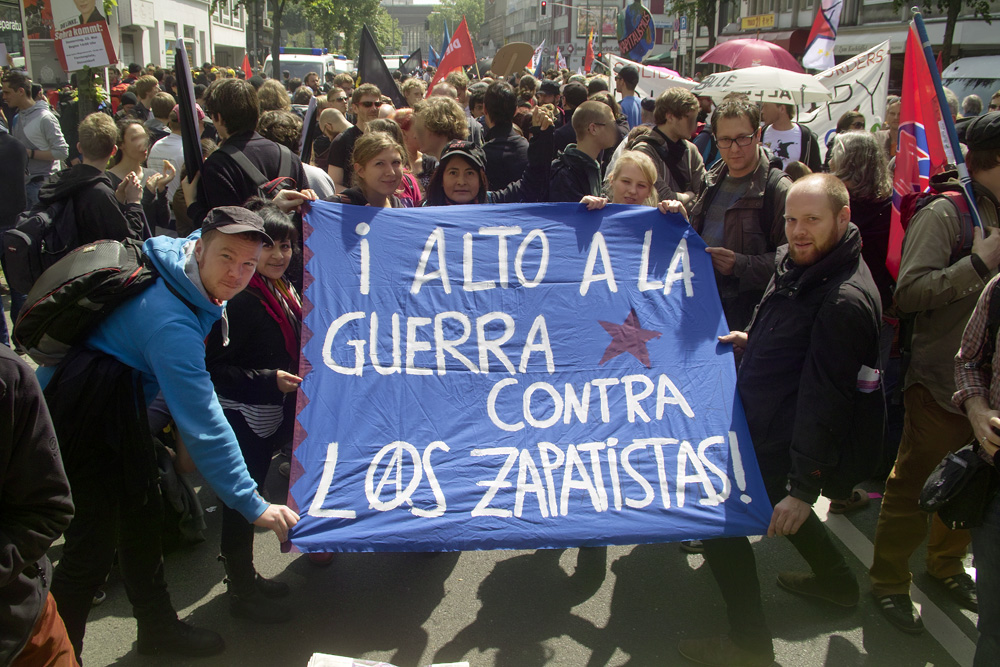
Stop the war against the Zapatistas
It would transform life and culture, as we now know it in that area of Chiapas. Like Miguel Vazquez Moreno above, some have dubbed the CIP “the new Cancun.” [4]
The CIP contains an elaborate plan to convert the area surrounding the Agua Azul Cascades into a “world-class resort destination.” The government plan includes a Boutique Hotel, a European 5-
Star Hotel, a Conference Center with golf course, and a Lodge overlooking the waterfall at Bolom Ajaw, a Zapatista community on land reclaimed in the 1994 uprising.
Luxury tourists would have to helicopter into the Lodge at Bolom Ajaw due to its remoteness, so plans for the lodge include a helipad!
The Agua Azul area has been a flashpoint of conflict between pro-government communities (in favor of luxury tourist development because the government has promised them a cut of the income) and pro-Zapatista communities (opposed to development based on luxury tourism).
The controversial project pAgua Azul, of roposed for which a superhighway is key to attracting large numbers of tourists, has already generated three pro-Zapatista deaths (one in Mitzitón and 2 in San Sebastián Bachajón), numerous violent conflicts, serious bodily injuries, political prisoners, death threats, torture and the death of at least one government supporter in Bolom Ajaw. The San Sebastián Bachajón ejido includes the entryway to the Agua Azul Cascades.
The government argues that these tourist projects will bring jobs and income into a very poor state, while Zapatista supporters, their sympathizers and allies argue that the volume of tourism envisioned will damage the environment, their food security, their autonomy and their way of life; that is, their culture.
Government planners envision converting autonomous subsistence farmers, who believe that the land is sacred, into busboys, maids and bellhops.
The Los Llanos court decision
The Los Llanos ejido is located on the current highway to Palenque, close to where the new highway was originally supposed to start. It is across the highway from the Mitzitón ejido, near the intersection where the current highway to Palenque forks off from the Pan American Highway.
In January 2014, the Los Llanos ejido filed for an injunction against the new superhighway crossing through their lands, based on their right to a prior, free and informed consultation (consulta) about the project. [5]
The government had not followed the United Nations protocol for consulting with Los Llanos before starting construction. A temporary injunction against highway construction was in place while the case was pending. Two years later, in January 2016, the court granted an amparo (permanent injunction) to Los Llanos, ruling that the government failed to conduct the required consultation with the affected communities. [6]
The court decision prevented construction of the superhighway, but only in the municipalities of San Cristóbal de las Casas and Huixtán, where Mitzitón and Los Llanos are located, leaving open the possibility of either re-routing the controversial superhighway or improving the existing highway.
Approximately 9 months after Los Llanos filed its court case, opposition to the San Cristóbal-Palenque superhighway emerged again and it was from La Candelaria ejido in the Chiapas municipality of San Juan Chamula. More than 2,000 representatives, including people of faith belonging to Pueblo Creyente, attended this meeting at La Candelaria’s sacred site of Laguna Suyul and vowed to resist the highway. [7]
The clear implication of this important meeting was that government planners intended to re-route the superhighway to begin in San Juan Chamula, a municipality bordering on San Cristóbal de las Casas, and pass close to the sacred Laguna Suyul site.
A map of the route is shown in the article. The recent news article about resistance in San Juan Cancuc means that the new route remains pretty much the same as that shown at the time of the La Candelaria meeting and would pass through San Juan Cancuc over the mountains in the direction of the Agua Azul Cascades.
Many of the municipalities and organizations represented in La Candelaria have joined San Juan Cancuc in resisting the new route for the superhighway. They issued a statement as members of the Movement in Defense of Life and Territory (Modevite). [8]
The list of municipalities signing the statement is a good indicator of the superhighway’s new route and the municipalities that would be affected.
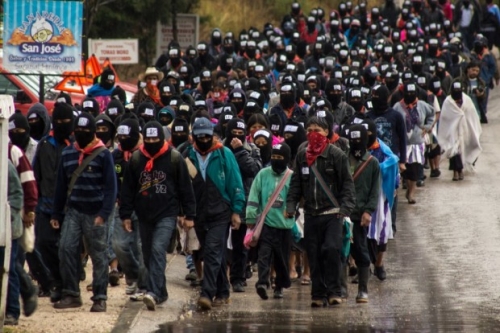
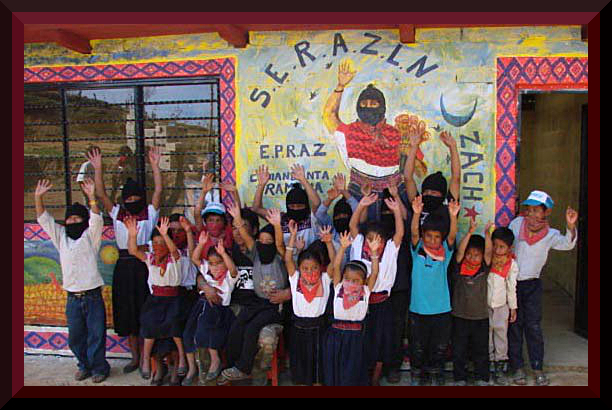
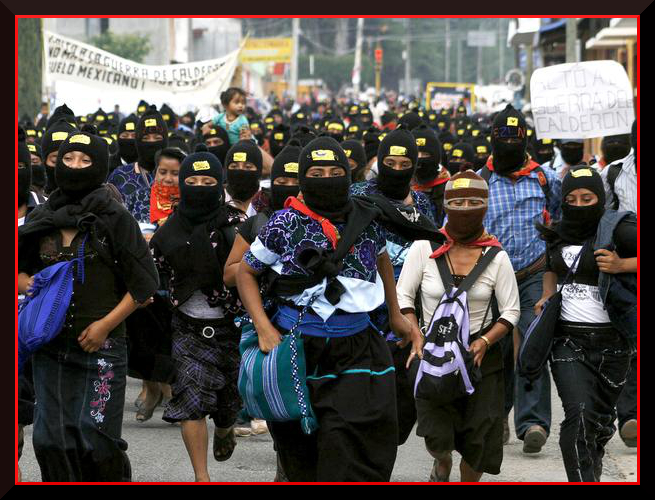
Members of the Mexican Zapatista Army of National Liberation (EZLN) during the celebration act of the New Year in the community of La Garrucha,PHOTO /BERNARDO DE NIZ
Chiapas: Frayba Denounces Intensification of Attacks against Indigenous Peoples since December 2018
On May 27th, the Fray Bartolome de Las Casas Center for Human Rights published a bulletin warning that, “aggressions against peoples, communities and organizations have intensified as part of a strategy to contain civil and peaceful resistance in defense of territory.” Two years after the Constituent Assembly of the Indigenous Council of Government (CIG in its Spanish acronym), of the National Indigenous Congress (CNI in its Spanish acronym).
It illustrated the statement by referring to the six indigenous defenders who have been murdered so far in 2019, as well as mentioning the CNI’s own denunciations since December 2018 with situations of “dispossession, forced displacement, arbitrary detention, forced disappearances, threats, harassment, criminalization and attempts of executions.”
Frayba denounced that “this logic of war against the peoples that build autonomy, is reproduced in the increase of militarization of Zapatista territories, especially the incursions, flights and espionage of the Mexican Army to the headquarters of the Junta de Buen Government Toward Hope, in La Realidad Caracol (Official Municipality of Las Margaritas). This containment is deepened by the presence of the National Guard in the region, which increases risks to the integrity and security of the population.”
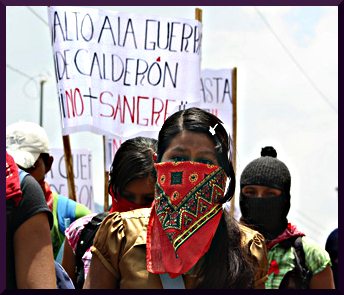
In this context, Frayba demanded that the Mexican State: “Cease the attacks against peoples, communities and organizations that make up the National Indigenous Congress; justice for the defenders and communicators murdered in the country; and high militarization in Chiapas and Mexico.”
Politics as we Know it should Die and loving Anarchy should Prosper
via metro.co.uk one of 7.600 sharesThe present manner of doing politics on this Earth is coming to an finish. Carne Ross explores the possibilities in the UK. The climate emergency will require dramatic changes to the wasteful way we consume resources. The grotesque of the 0.1% cruising in private jets while the rest struggle with rent and debt cannot last.A peaceful, harmonious society requires that people are fairly treated.For now, there is no justice, no peace. The breakdown of consensus is painfully visible in the poisonous cloud of abuse and polarization on mis-named ‘social’ media.This is not working. So what comes next?The Far Right, because it trades in bogus certainties and machismo, has the clearest plan.It is rising in America, Europe and in the UK with its takeover of the Tory party.It appeals because it pretends to return control to those who feel shut out of the existing political system, though in fact its only strategy is more authoritarianism, justified by whipped-up racism and fear of The Other.The Left and Greens offer a more sympathetic proposition but no political party can honestly claim to represent ‘the people’ or even ‘the many’.No single party can claim support from more than about a third of the adult population. One-party government is therefore a recipe for endless political confrontation, with its own polarizing dialectic.
#Switzerland: Night of rage in the streets of #Bern in response to repression and eviciton of #Fabrikool squat
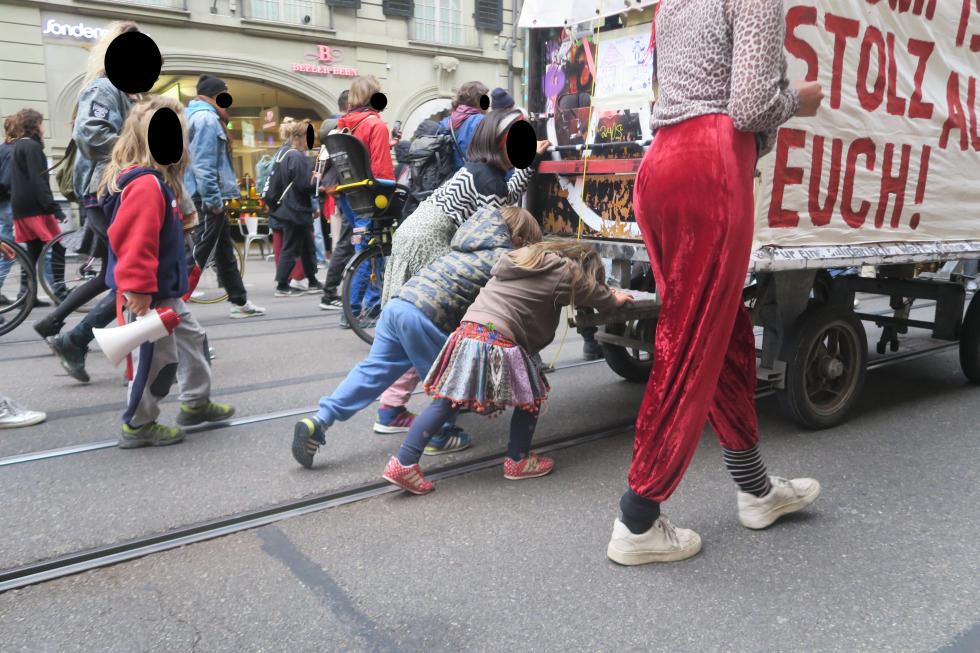
Bern, Switerland: On Friday May 17 there was a demo against the eviction. On May 18 there was a night of rage and resistance against the eviction and the recent wave of repression started in the Swiss capital.
Originally published by Barrikade Info: Here and here. Translated by Enough 14.
Fabrikool Demo on May 17
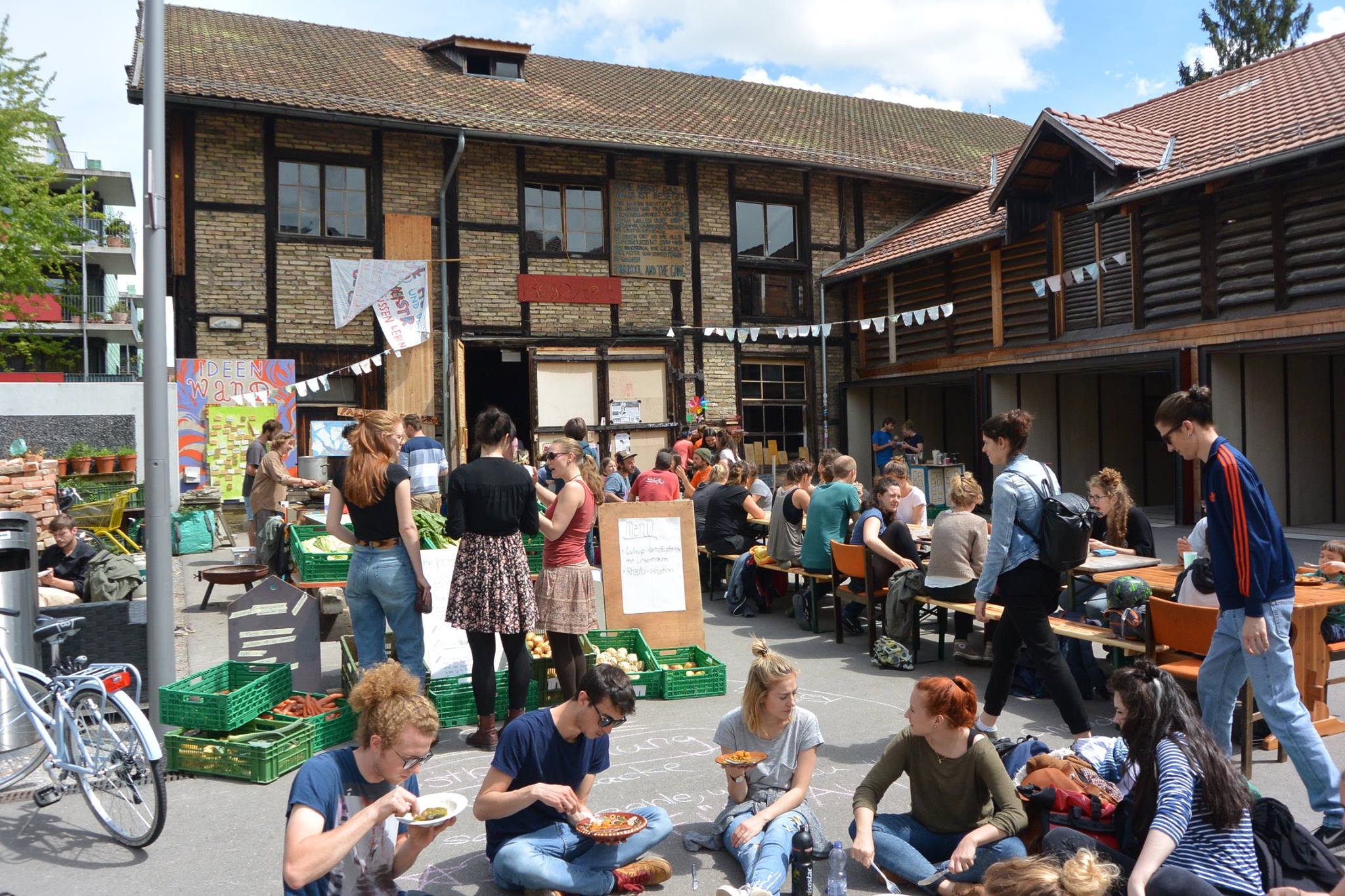
On May 17 about 400 people marched through the streets of Bern loud and self-determined. It was a strong and clear sign to oppose the decision of the canton and shows that free spaces like the Fabrikool are necessary and must be fought for. During the whole demonstration we were fed with the finest food.
AGG, f*ck you!
Hebeisen und Vatter: You really f*ck up!
In the night from Saturday to Sunday we participated in the offensive actions against the police in the area around the Reitschule (riding school). We see today’s move as a necessary response to the recent repression in the Bern area. Today our anger was so big that the police had to withdraw several times. We see this as a sign of success and as an emerging motivation to continue to stand in the way of the state and the police.
We are people who show solidarity with the evicted Fabrikool. We would like to point out that the Fabrikool was fought for within the militant actions around the Effy29 eviction. The state’s fear of a new conflict ultimately led to the Fabrikool not being evicted. Today’s actions should recall the time around the Effy29 eviction. Every eviction has its price!
We place the Fabrikool eviction in the context of a repressive armament that has taken place in recent months. Thus, raids were repeatedly carried out around the riding school, people were threatened and harassed by the police, and almost political sprayers and guests of the riding school were run over by a plain police patrol. The state is also trying to strike with legal means. Thus, dozens of people are currently receiving orders of punishment for the Afrin demo that was surrounded last year. With the new police law, more repressive arrows are waiting in the quiver of the judiciary and police.
As desperate as the state tries to oppress and smash us, resistance to the recent repression manifests itself in various ways. Today it was with stones and burning barricades, for months it has been flowers on the orphanage square for the murdered K. and soon it could be new occupations.
The power and energy we have experienced today will be carried into our future struggles. At the same time such attacks need a phase of reflection and criticism. So we cannot fight for a world free of domination if on such evenings sexist expressions and actions of some are displayed and self-staging is seen as the central reason for such actions.
We greet the arrested in Indonesia.
We greet all who are currently affected by the repression of the Afrin demo.
We greet all people with whom we show solidarity far too rarely.
“Rhubarb affinity group”, May 19, 2019
Support Enough 14!
Donation for our work in the Enough 14 info-café and our independent reporting on our blog and social media channels. Even 1€ can make a difference.
Understand Marxism vs Anarchism in just 20 minutes!
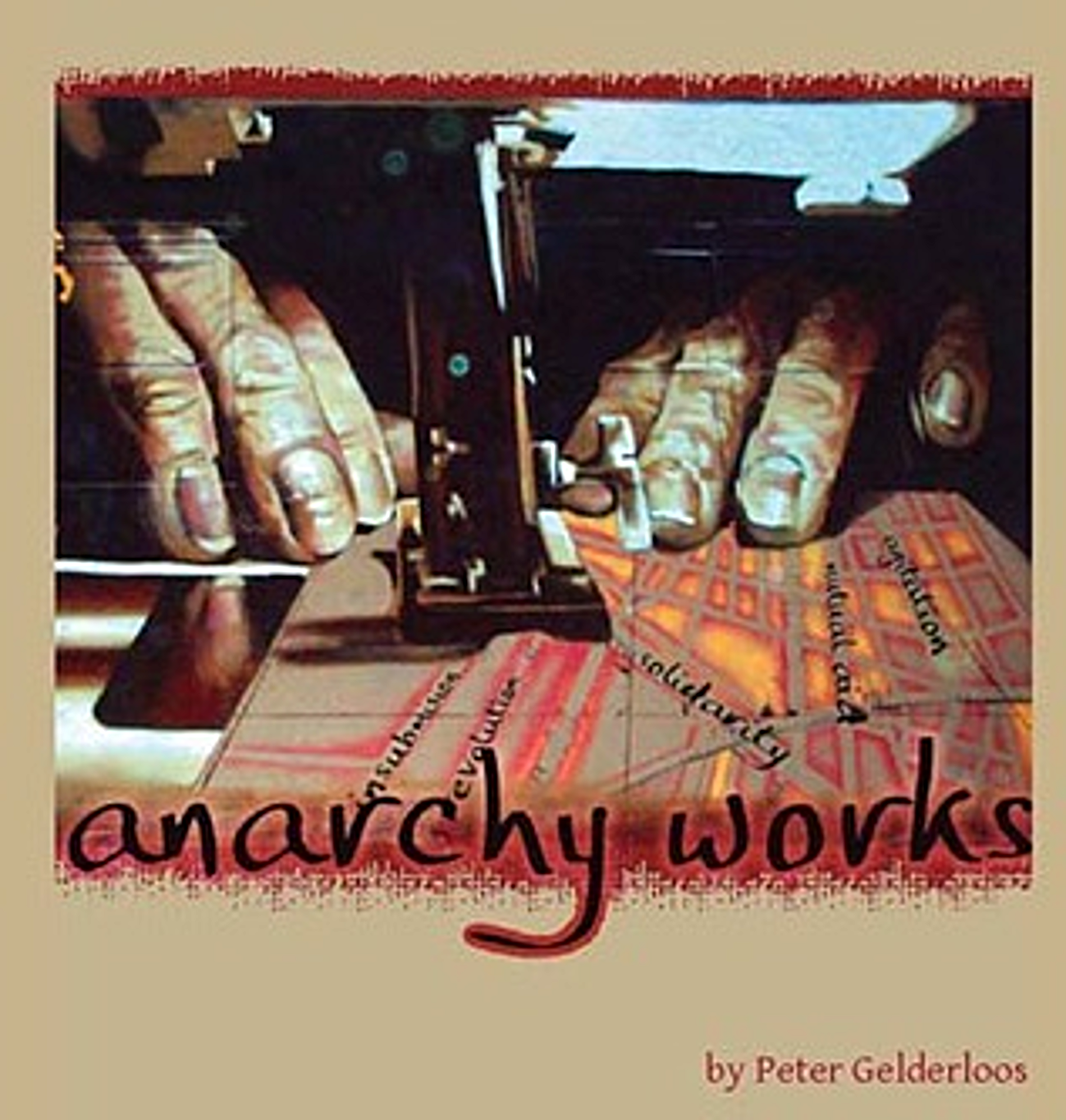
A Case for Anarchist Class Analysis: Why it Works Better than the Marxist Approach and What it Means for Struggles
The purpose of this pamphlet is giving a coherent, comparative analysis on how anarchists and Marxists view the concept of “class,” and the political implications of each approach.
Class is the nucleus of both Marxism and anarchism; however the conceptualisation of class is different for both. In pointing out these differences, it is my hope that I will convincingly show how and why the anarchist conceptualisation of class is more comprehensive and more useful, providing a more holistic analysis of many related aspects of class, and a more practical political guide..
by Leroy Maisiri (ZACF) shared fromZABALAZA, with thanks .. by Leroy Maisir
First published April 2019 as a Zabalaza Books (South Africa) pamphlet, here
The purpose of this pamphlet is giving a coherent, comparative analysis on how anarchists and Marxists view the concept of “class,” and the political implications of each approach. Class is the nucleus of both Marxism and anarchism; however the conceptualisation of class is different for both.
In pointing out these differences, it is my hope that I will convincingly show how and why the anarchist conceptualisation of class is more comprehensive and more useful, providing a more holistic analysis of many related aspects of class, and a more practical political guide. In particular, the anarchist approach – which stresses ownership and control of administration and coercion, not only means of production, as with Marxism – allows us to develop an effective analysis of why the state simply cannot be used to emancipate the popular classes i.e. the working class, the poor and the peasantry.
Theory Matters
The use of theory within the Left has serious implications in our lived experiences and political praxis. Theory has been deployed for, and many times profoundly shaped, political action. Simply put, how we analyse the problem shapes what we see as the solution.
It is therefore essential that activists and the Left, in general, not only know and understand the differences between anarchists and Marxists, but remain cognisant of the implications these differing views have for day-to-day struggle.
Like the Marxists, our theory as anarchists is, from the outset, not developed by arm-chair reasoning, or by intellectual work for the simple pleasure it brings, but as a means of change. Anarchism was designed by and by, the working class in its struggles, and so, it must be tested and regulated by everyday struggles.
If we have bad theory, we have bad practice; we need theory to understand what we are fighting and to understand how it can change.

 Continue reading “Jeremy Hammond: Anarchist Hero sends Message from Prison”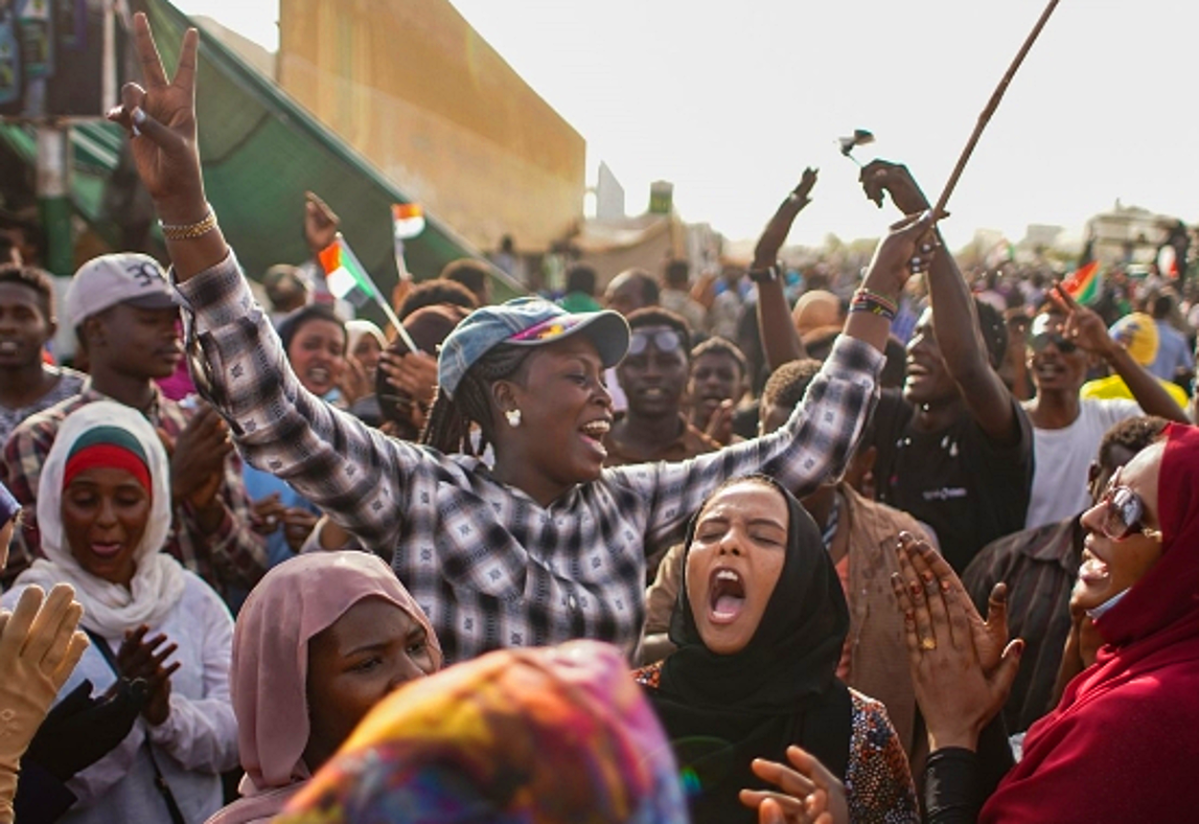






 Agua Azul Cascades. [1]The San Cristóbal-Palenque highway and the Palenque Integral Center are part of a regional development plan for Mesoamerica, originally known as the Plan Puebla-Panamá (PPP). [2]The PPP included numerous infrastructure projects that prompted strong opposition from social, environmental and human rights organizations, as well as academics and organized indigenous communities.

 Bern, Switerland: On Friday May 17 there was a demo against the eviction. On May 18 there was a night of rage and resistance against the eviction and the recent wave of repression started in the Swiss capital.


 The Free