
Mulheres marcham por direitos e contra o Novo Código Florestal

março 8, 2012

por Rachel Duarte,  Sob sol intenso, mais de mil mulheres do campo e da cidade marcharam por mais amor à vida e à terra, nesta terça-feira (6), em Porto Alegre. O grupo ocupou a frente da sede do Incra (Instituto Nacional de Colonização e Reforma Agrária) para sensibilizar as autoridades locais sobre os danos da estiagem aos pequenos produtores e a falta de políticas públicas preventivas à seca.

Mulheres marcham por direitos e contra o Novo Código Florestal

O CEA esteve presente com a militante Cintia Barenho que contribuiu com a formação das mulheres discutindo o que está em jogo no Código Florestal  agora que tramita novamente no Congresso Nacional.

Após uma hora e meia de caminhada – em meio a alguns gritos masculinos pedindo para que elas “fossem para casa trabalhar” -, as mulheres se dividiram em grupos temáticos na Praça da Matriz e organizaram a pauta reivindicatória da Jornada Nacional de Lutas das Mulheres do Campo e da Cidade, organizada pela Via Campesina por ocasião do Dia Internacional da Mulher, 8 de março. Este ano, as mulheres cobram fundamentalmente o veto da presidenta Dilma Rousseff ao Novo Código Florestal.

Mais de mil mulheres camponesas marcharam contra o Novo Código Florestal e outras lutas./Foto: Leandro Silva.

“Começamos e não vamos parar mais. Este papel de luta e esforço está na história das mulheres”, disse a representante do Movimento dos Trabalhadores Rurais Sem Terra (MST), Silvia Marques. Ela explica que tradicionalmente as mulheres dos principais movimentos sociais de trabalhadores aproveitam a proximidade com o Dia Internacional da Mulher para sensibilizar a sociedade e autoridades sobre as políticas de gênero necessárias nas intervenções do estado. “Somos nós que cuidamos do alimento e nos preocupamos com aquilo que está indo para a mesa. Temos pesquisas que apontam que são utilizados 5,2 litros de veneno por ser humano nos alimentos. Nós estamos querendo produzir alimentos saudáveis, mas, precisamos de condições para isso”, cobra Silvia.

Além do uso de agrotóxicos, as trabalhadoras cobram ações preventivas para evitar os danos aos pequenos produtores que sofrem há oito anos com a estiagem no RS. “Se tivéssemos um plano de irrigação não teríamos este problema. Mas, só tem nas grandes lavouras. Nestas não falta água. Nós já perdemos a segunda safra. Perdemos tudo”, lamenta a trabalhadora Adriana Pereira, do MST. Ela afirma que uma pauta específica do MST, referente ao assentamento de mil famílias prometido pelo governo gaúcho seria entregue nesta terça.

“Esperamos que a Dilma se sensibilize”

Via Campesina ocupa por uma hora e meia a Praça de Pedágios da empresa Univias, na BR 290…

PODE LEER MAIS…http://centrodeestudosambientais.wordpress.com/category/codigo-florestal/


Welcome to Green Warrior Permaculture

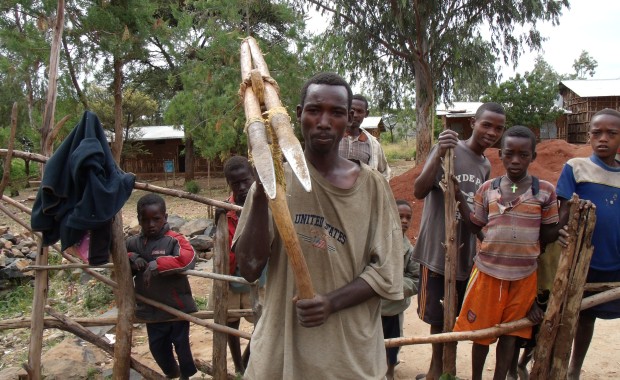
primitive hand made tools rule!
  • Green Warrior Permaculture is a collective of sustainability specialists dedicated to solving the problems of our world through action.

    We have developed effective strategies for sustainability in aid work, community development, disaster mitigation and permanent food security. We train trainers for field work, design projects for NGOs as well as monitor and assess current programs. Green Warrior permaculture can implement projects in disaster zones, conflict zones, remote communities and poverty prone areas as well as urban and high end developments.We are sustainability specialists with the skills to impliment real solutions for the current challenges facing humanity and the planet earth at present. We are kick-ass green warriors!

wordpress_featured_logo_beige_noline

Our Field Courses

Field Trainer Internship The Field trainer Internship prepares students to be permaculture trainers for sustainability aid work in impoverished communities and disaster zones. Their aim will be to provide food security and sustainable development assistance in the field. Field trainers learn all aspects of project design and implementation in difficult situations. Students develop the skills … Read more

So you want to be an aid worker, huh?

Frontline aid work is hard work and takes a special type of person to deliver effective aid, let alone survive in the field. After a disaster, a war, a famine or drought, villages and communities are harsh places to live. Food and clean water are scarce as well as sometimes there are serious security issues.

Filed under What is a Green Warrior? · Tagged with

wordpress_featured_logo_beige_noline

Cool Stuff That Happened

THK field School, Bali Super-Farmer project, Bali Super-Tools, Bali Super-Seeds, Bali Uganda Field Blogs Stuff people wrote

Filed under Cool Stuff That Happened · Tagged with ,

wordpress_featured_logo_beige_noline

What is a Green Warrior?

A Permaculture Green Warrior’s role includes the following activities To consult, design and construct ecologically and economically sustainable systems in all areas of human activity. To assist individuals, farms, communities, companies, organizations and nations to modify their activities to be constructive rather than destructive to the environment. To design and implement food production systems maximizing … Read more

Cleaning your ASS with the last Rainforest ??

American consumers are unwittingly contributing to the destruction of endangered rainforests in Sumatra by purchasing certain brands of toilet paper, asserts a new report published by the environmental group WWF.

Wiping your ASS with the Rainforest ??The report, Don't Flush Tiger Forests: Toilet Paper, U.S. Supermarkets, and the Destruction of Indonesia's Last Tiger Habitats, takes aim at two tissue brands that source fiber from Asia Pulp & Paper (APP), a paper products giant long criticized by environmentalists and scientists for its forestry practices on the Indonesian island of Sumatra.

The brands — Paseo and Livi — are among the fastest growing, in terms of sales, in the United States. Both brands are commonly marketed for hotels, restaurants, and public restrooms, according to the report.

APP has converted large tracts of Sumatran rainforest for wood-pulp plantations used to produce fiber for paper products. The forests serve as critical habitat for a range of endangered species and generate livelihood for rural communities.

“APP is rapidly expanding into the U.S. market with paper products linked to rain forest destruction, originating from areas that are the last home for critically endangered Sumatran tigers, elephants, and orangutans,” states the WWF report.

Wood is stacked up outside APP’s mill in Riau Province, Sumatra, one of the world’s largest pulp mills. Photo by Daniel Beltra / Greenpeace “The mill is in development by a plantation forest concession holder who currently supplies pulpwood to APP,” an APP representative told mongabay.com, refuting the RISI story.

WWF estimates that APP has destroyed nearly 5 million hectares of forest in Sumatra since it began operations in 1984. APP is still heavily dependent on sourcing fiber from natural forests, a consequence of “historically low investment in plantation development and a strong reliance on plantations located on peat soils and in areas with community conflict,” according to the report. ……

Mavis’s miracle Maringa farm


CAPE TOWN, Jan 25, 2012 (IPS) – When a food crisis hits the continent, African countries tend to look to the international donor community to mobilise aid. But a fast-growing, drought- resistant tree with extremely nutritious leaves could help poor, arid nations to fight food insecurity and malnutrition on their own.

A 15-hectare plantation of the “miracle tree” with the botanical name Moringa oleifera has already started to make a positive change in the rural village of Tooseng, which is located in one of South Africa’s poorest provinces, Limpopo.

Moringa leaves are dubbed a “super food” because scientists found that they contain the calcium equivalent of four glasses of milk, the vitamin C content of seven oranges, the potassium of three bananas, three times the amount of iron found in spinach, four times the amount of vitamin A found in a carrot and twice the amount of protein in milk. It is like a supermarket on a tree……

Mavis Mathabatha, a former school teacher from Tooseng, has been working hard to set up a Moringa farm over the past three years that will produce enough leaves to make a positive difference in her community and further afield. “I want to make an impact in my area, province and across the country through this project,” she explains….

Today, Mathabatha’s farm produces and packages up to 10,000 tonnes a year of Moringa leaf powder, which is distributed not only within South Africa, but also exported to Botswana, Swaziland and Lesotho. “I am hoping to further extend my market in the next few years. There is a lot of interest in my product,” Mathabatha says….

Read full story HERE… with thanks!  http://ipsnews.net/news.asp?idnews=106539


Occupy free space, starting Jan 28th– COPY SPAIN

”Occupy Everything! Call-Out to Occupy Buildings on January 28th, 2012 January 12, 2012 at 9:53 pm

We call on people to reclaim space in their areas on January 28th in the spirit of the occupy movement, but first and foremost to move past the idea of private property and build communities of resistance.

Groups in multiple cities have already announced plans for building takeovers on this date. We urge people to partake in actions that match their capacity. Momentum is on our side; resistance is building.

The natural next step of the occupy movement is to create a political squatting movement that will be a base of power for the continued struggle against the state and capitalism.”

https://incorporealcommittee.wordpress.com/

Comment and 10 Tips.. COPY Spain!!

In Spain also squatting is a criminal offence. Yet in Catalunya alone there are dozens of thriving ‘ Occupied Self managed Social Centers of every description.’ How is this possible? any movement to grab a bit of free space in the US could learnlots from our ideas and tactics.

Occupied self managed social center.. barcelona 2012

Here ae some tips from an ancient squatter.

1. Pick a building that’s long disused or forgotten or that it’s a disgrace to be abandoned.

2.Invite the neighbours to open house type participation from the start.

3. Immediately start all kinds of daily activities, from yoga to dance to ‘freegan’ cafes etc

4. Decide things by assembly, seeking consensus, this short circuits the ‘politicos’ and power obsessed men

5. People living there have first choice, maybe we can ‘adopt’ one person with problems, but we

can’t invite in all the drug and mental casualties of the brutal capitalism-

6.Good Squat Centers are often begun by an already strong group of friends.

7. The local economy is often based on recycling and benefit parties.

8. A great tactic is to have a backup place in case you don’t survive the first crucial days

9. A theme is a good idea, from Circus Squats, Womens centers, Prisoners Aid, rural permaculture, etc.

10. Above all look out for each other, beyond personal irritations, and enjoy the adventure!

   THEY’LL NEVETR EVICT OUR DREAMS”

California: ALF’ers burn 14 cattle trucks

Animal Liberators Burn 14 Cattle Trucks in California

12 Jan   by Michelle Macaluso

Animal rights activists are taking credit for setting fire to and destroying 14 cattle trucks at California’s largest beef producing, feeding and marketing ranches.

The North American Animal Liberation press office posted an anonymous letter on its website from activists claiming full responsibility for the arson……

“We were extremely pleased to see that all 14 trucks ‘were a total loss,’ with some being ‘completely melted to the ground,’” the statement reads.

“We’re not delusional enough to believe that this action will shut down the [H]arris feeding company, let alone have any effect on factory farming as a whole. [B]ut we maintain that this type of action still has worth,” the statement reads……

While the Animal Liberation Front is not claiming direct responsibility for the fire, the organization provides a platform on their website for animal rights activists…..

read all HERE  http://earthfirstnews.wordpress.com

Monsanto swindle destitutes millions in India….

Using its colossal market power, Monsanto craftily penetrated into the Indian markets.

Monsanto convinced the Indian government that its GM seeds would produce better crops. According to a report by Farm Wars, one former Managing Director of Monsanto claimed that Monsanto manipulated research data “to get commercial approvals for its products in India.”

Indian regulatory agencies, instead of verifying the data, simply remained compliant with the findings of what Monsanto presented. “They did not even have a test tube to validate the data and, at times, the data itself was faked,” the Farm Wars report says.

 Government regulations worked in favor of Monsanto to monopolize the Indian seed market. For example, “Prime Minsiter’s Office” in India pressured various state governments to sign MOUs with Monsanto to privatize the seed market.

Through these “vested interests” with the Indian government, Monsanto eventually has monopolized the GM seed market for more than a decade……….

The failure of Monsanto’s GM seeds was palpable. The farmers held onto their hopes for better crops after they had planted the “magic” seeds. Their crops never came. Throughout the villages in India the harvest from the GM seeds failed. The parasites destroyed the so-called “pest-proof” GM seeds.

Monsanto uses methods of manipulation and misinformation to reap their own benefits and profits at the cost of the farmers who rely on organic methods to grow their crops and animals, a tradition that existed in India for centuries.

By a contractual clause, the farmers could not save Monsanto’s GM seeds for reuse after the first season……….

With no harvest, the farmers could not pay back the lenders. Burdened with debts and humiliation, the farmers simply took their own lives, some by swallowing poisonous pesticides in front of their families. To date, an estimated 200,000 farmers have committed suicide all over India.

To add to the misery, wives inherited the debts along with the fear of losing their homes and lands. With no money coming in, they also had to pull their kids from the schools. The mass suicide among the Indian farmers is known as the “GM genocide.”

In its company website Monsanto declares that its pledge is “our commitment to how we do business.” And then there are the business philosophies with virtuous words like “integrity” and “transparency.”

Read Long full article HERE Globalresearch.caGlobal Research Articles by Iqbal Ahmed


More bio tech type stories I’d like to re blog   (from The Watchers with thanks)

  1. Organic farmers sue Monsanto over GMO seeds A landmark lawsuit filed on March 29 in US federal court seeks to invalidate Monsanto’s patents on genetically modified seeds and to prohibit the company from suing those whose crops become genetically contaminated. The Public Patent Foundation filed suit on behalf of 270,000 people from sixty organic and sustainable businesses and trade associations, including thousands of certified-organic farmers. In Organic Seed Growers and Trade Association, et al. v. Monsanto, et al. (U.S. District Court, Southern……
  2. Secret GM wheat experiments begin in Australia Australia’s first trial of genetically modified wheat and barley is under way near Narrabri, New South Wales in the south-eastern area of the country. The goal of the GM wheat is said to be more nutritious bread (http://www.smh.com.au/nsw/gm-wheat-…). How exactly the genes were altered to create this alleged more nutritious bread remains a secret. All that is known is that 14 different strains of wheat and barley will be grown. Some strains will allow researchers……
  3. Plant disease raises questions on modified crops Sudden death syndrome (SDS) of soybean was first discovered in 1971 in Arkansas and since then has been confirmed throughout most soybean-growing areas of the U.S. SDS is a fungal disease that also occurs in a disease complex with the soybean cyst nematode (SCN, Heterodera glycines). SDS is among the most devastating soil-borne diseases of soybean in the USA. When this disease occurs in the presence of SCN disease symptoms occur earlier and are more……
  4. Nikola Aleksic, Serbian ecology leader arrested for openly defying GMOs and chemtrails In October 2011, Nikola Aleksic, leader of Ecological Movement of Novi Sad in Serbia, was arrested and fined. Earlier on his way to a conference in Belgrade, an attempt was reportedly made on his life. And Monsanto has sued him with the threat of removing him and his family from their rented flat as “collateral.” Why all the fuss? Nikola made a spirited speech, recorded on video, challenging the Serbian president for allowing GMOs to……
  5. Did the USDA deregulate all new genetically modified crops? In press release titled “ USDA Responds to Regulation Requests Regarding Kentucky Bluegrass,” agency officials announced their decision not to regulate a “Roundup Ready” strain of Kentucky bluegrass—that is, a strain genetically engineered to withstand glyphosate, Monsanto’s widely used herbicide, which we know as Roundup. The maker of the novel grass seed, Scotts Miracle Gro, is now free to sell it far and wide. So you’ll no doubt be seeing Roundup Ready bluegrass blanketing lawns……
  6. BASF tries (again) to push ‘Frankenpotatoes’ on Europe Europeans have made it abundantly clear time and time again that they want nothing to do with genetically-modified organisms (GMOs). But chemical giant BASF refuses to take no for an answer, and is once again pushing for EU approval of a “Frankenpotato” known as Fortuna that, if approved, would represent the EU’s second new legalized GMO in more than a decade. Unlike most Americans, Europeans generally take a keen interest in the integrity of their……
  7. Biotech’s dirty tricks exposed in new documentary: ‘Scientists Under Attack’ “One question means one career.” This was the harsh warning of UC Berkeley Professor Ignacio Chapela for those daring to conduct independent research on genetically engineered foods and crops. “You ask one question, you get the answer and you might or might not be able to publish it; but that is the end of your career.” Both he and biologist Arpad Pusztai dared to asked questions and do the research. And then all hell broke……