As Occupy Wall Street protests intensify around America, it’s important to examine possible solutions
Eric Blair Activist Post ( shortened and slightly adapted, with thanks)
Barack Obama and his 2008 presidential challenger John McCain both received more money from Wall Street donors than their combined lifetime government salaries. It was a billion-dollar-plus campaign. In fact, all of Congress makes more from Wall Street and corporate campaign contributions than their public salaries.
So what could be done if a huge movement could really force change??
Complete Debt Forgiveness:
I have been one of the advocates for a complete write-off of all fraudulent debt, essentially hitting the economic reset button. This act would zap all of the power that the banking cartel has over governments and individuals. Although I truly believe this to be the only way out of this mess, it may require an entirely new free and fair financial structure in place when the button is pushed, or the same group of thugs will likely maintain their control over the system. (blogger’s comment: Seems to me impossible, if most US debt is ‘owned’ by the Chinese, they’re hardly likely to forfeit their savings .)
End the Wars:
Yes, yes, and yes. End the foreign wars. End the phony war on “terror”. And end the war on drugs. They only benefit those funding the wars (with interest) and the pirates who the government gives the spoils to. Because no average citizen ever wants war, it leads some to believe that all wars have been baited by these beneficiaries — and they wouldn’t be wrong. Unfortunately, for too long we have taken the bait and they have gotten their spoils. It is time to stop this insanity. Significantly, this is one of the only practical solutions that will have minimal blowback. It will save trillions in public spending and immediately bring more harmony to the planet. However, America will face the very real challenge of creating new employment for returning soldiers, contractors, and laid-off weapons manufacturers, as well as DEA agents, prison guards and others who participate in perpetuating the war on drugs. So, even though ending all wars is the only sane policy, by itself it is not a silver bullet for economic woes………
WASHINGTON, Oct 1, 2011 (IPS) – Home to a fast-growing network of farmers’ markets, cooperatives and organic farms, but also the breeding ground for mammoth for-profit corporations that now hold patents to over 50 percent of the world’s seeds, the United States is weathering a battle between Big Agro and a ripening movement for food justice and security.
Conflicting ideologies about agriculture have become ground zero for this war over the production, distribution and consumption of the world’s food. One camp – led by agro giants like Monsanto, DuPont and Syngenta – define successful agriculture and hunger alleviation as the use of advanced technologies to stimulate yields of mono-crops.
The other side argues that industrial agriculture pollutes, destroys and disrupts nature by dismissing the importance of relationships necessary for any ecosystem to thrive. At the heart of this struggle is the debate about genetically modified organisms (GMOs), which were given the green light in 1990 when the U.S. Food and Drug Administration (FDA) stated, “(We) are not aware of any information showing that GMO foods differ from other foods in any meaningful or uniform way.”
The Pitfalls of Terminator TechnologyAccording to Frees, one of the worst manifestations of GE/M is the use of Terminator technology, used to cause seed sterility and forcibly eliminate seed saving.
“Terminator is a biological means to enforce intellectual property rights, and its introduction into developing countries that rely on saved seeds for 80 to 90 percent of planting could mean elimination of farmers’ right to save seeds; dramatically higher seed costs; and poor farmers’ inability to survive,” he said.
“Terminator is morally reprehensible and must be banned,” Frees told IPS. Lovera added that between 2001 and 2007, annual U.S. glyphosate use on GE crops doubled to 185 million pounds.
“Ubiquitous Roundup application has spawned glyphosate-resistant weeds, driving farmers to apply even more toxic herbicides, according to a 2010 National Research Council report,” Lovera told IPS.
“Farmers may resort to other herbicides to combat superweeds, including 2,4- D (an Agent Orange component) and atrazine, which have been associated with health risks including endocrine disruption and developmental abnormalities.”
“In the United States, irrigated corn acreage increased 23 percent and irrigated soybean acreage increased 32 percent between 2003 and 2008,” she added. “The rising U.S. cultivation of GE corn and soybeans further threatens the strained High Plains Aquifer, which runs beneath eight western states and provides nearly a third of all groundwater used for U.S. irrigation,” Lovera said.
“Ninety-seven percent of High Plains water withdrawals go to agriculture, and these withdrawals now far exceed the recharge rate across much of the aquifer.”
“The worldwide expansion of industrial-scale cultivation of water- intensive GE commodity crops on marginal land could magnify the pressure on already overstretched water resources,” Lovera warned. “But these are the crops the biotech industry has to offer.”
In addition to wreaking havoc on land, GE/M has also filtered into the oceans, with the attempted introduction by Aqua Bounty of GE salmon engineered with a growth hormone gene to grow faster.
“Studies suggest that the salmon could be more susceptible to disease; and if it’s grown in pens in the ocean and [inevitably] escapes, it could mate with wild salmon and make them less fit, potentially devastating wild salmon populations,” Frees told IPS.
But a report released Wednesday by the Washington- based Food and Water Watch (FWW) on the destructive impacts of GMOs added fuel to a two-decades-long fight by farmers, economists and experts against the FDA’s conclusions.
“Genetically Engineered Food: An Overview” details how the genetic engineering of seeds, crops and animals for human consumption is not the foolproof answer long championed by agribusiness and biotechnology industries to feeding the world.
To the contrary, the study found that genetically engineered/modified (GE/M) organisms do not out-perform their natural counterparts, and their proliferation into vast tracts of cropland have caused a slew of environmental and health crises, and actually increased poverty by forcing millions of farmers to “buy” patented seeds at exorbitant prices.
The report also says that three U.S. federal agencies – the FDA, the Department of Agriculture (USDA) and the Environmental Protection Agency (EPA) – are complicit in these crises due to shoddy oversight, weak enforcement of regulations and a complete absence of coordination.
It found that Big Agro spent half a billion dollars between 1999 and 2009 on lobbying to ease GE regulatory oversight, push GE approvals and prevent GE labeling.
This, after attorney Steven Druker in 1999 obtained 40,000 pages of FDA files containing “memorandum after memorandum warning about the hazards of (GE) food,” including the likelihood that they contained, “toxins, carcinogens or allergens” and testified that GE foods violated “sound science and U.S. law”.
Ceci King, a member of the Black Farmers and Agriculturalists Association, told IPS that in 2011, an estimated “60 to 70 percent of all processed foods in the U.S. contain at least one GE element.”
“Eighty-four percent of GM crops in the world today are herbicide- resistant soybeans, corn, cotton or canola, predominantly Monsanto’s ‘Roundup Ready’ varieties that withstand dousing with herbicide,” Bill Frees, science policy analyst at the Center for Food Safety (CFS) and author of ‘Why GM Crops Will Not Feed the World’, told IPS.
“Pesticide and chemical companies like Monsanto, DuPont, Syngenta, Dow and Bayer have bought up many of the world’s largest seed companies, and now call themselves biotech companies – this represents a historic merger of the pesticide and seed industries, which allows them to profit twice by developing expensive GM seeds that increase use of the company’s herbicide products,” he added.
Seed patents, an off-shoot of the “agro-biotech revolution” that also spawned GE/M, have had two negative consequences since their original issuance by the U.S. Patent Office in the mid-1990s, Frees told IPS: “They enticed pesticide companies to buy up seed firms; and they led to criminalisation of seed-saving.” “Farmers have saved seeds from their harvest to replant the next year for millennia,” he added. “Monsanto is changing that. The company has already sued thousands of farmers in the U.S. for saving and replanting its patented seeds and won an estimated 85 to 160 million dollars from farmers, in lawsuits that have ruined farmers’ lives, and (partially explains) why we have ever fewer farmers in America.”
The fightback
Ray Tricomo, a mentor at the Kalpulli Turtle Island Multiversity in Minnesota, told IPS, “People of colour must re-radicalise themselves and go on the offensive including the return to land bases, from Turtle Island to Africa and Asia.” “Ancient knowledge systems are to be painstakingly recovered, even if it takes centuries,” he added. And this is exactly what is happening.
Despite the deep pockets and aggressive efforts of Big Agro, a major pushback from a broad coalition of forces has limited 80 percent of GE/M planting to just three export-oriented countries: the U.S., Brazil and Argentina. Nearly two dozen other countries, including the European Union and China, have passed mandatory GE/M labeling, and millions around the world are refusing seed patenting and developing seed banks to protect, share and preserve their seeds.
In Florida, the 4,000-strong Coalition of Immokalee Workers (CIW) is organising to resist farm wage-slavery and “seed-servitude”. The Landless Workers Movement (MST) in Brazil has organised 400,000 peasants to join forces with the nearly half-billion farms around the world that are responsible for producing 70 percent of the world’s food. Navdanya, an organisation in the Indian State of Andhra Pradesh, has united 500,000 farmers in their struggle to fight chemical dependency and save indigenous seeds, including preserving over 3,000 varieties of rice. “For five years, the United Nations Conference on Sustainable Development (CSD) had indigenous farmers from all over the globe come to speak against destructive farm practices and GMOs,” King told IPS.
“During the Indigenous People’s Permanent Forum, there were complaints about the harm caused by industrial agriculture and the acts in the name of agribusinesses. Farm workers like the (CIW) are protesting their fate,” she added. “They are picketing companies like Trader Joes and Whole Foods, letting the public know that their tomatoes were picked from workers who are basically slave labour.” “Third World Network is fighting back by exploring the problem of GMOs and publishing findings that scientists working on GMOs are capitalists using humans as guinea pigs in a global lab experiment,” she added.
“[Numerous] deaths and disabilities have been traced back to a GM product emulating tryptophan. It took nearly 20 years to find the source of the problem,” King told IPS. “GM technology i antithetical to an agroecological approach to agriculture, our only hope for truly sustainable food production,” Frees told IPS. “Without radical change we will continue to have famines,” he added. “Haiti is a good example of what happens when a country’s farmers are put out of business by cheap, subsidised imports from a rich producer nation (here the U.S.).”
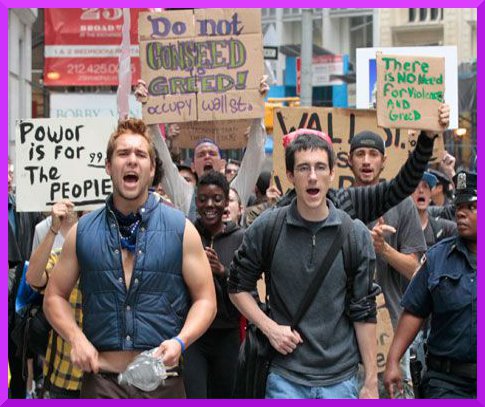
More than 700 people from the Occupy Wall Street protest movement have been briefly arrested for marchimng on New York’s City’s Brooklyn Bridge, police say.
They were part of a larger group crossing the bridge from Manhattan, where they have been camped out near Wall Street for two weeks.
“We are unions, students, teachers, veterans, first responders, families, the unemployed and underemployed. We are all races, sexes and creeds. We are the majority. The one thing we all have in common is that We Are The 99% that will no longer tolerate the greed and corruption of the 1%. We are using the revolutionary Arab Spring tactic to achieve our ends and encourage the use of nonviolence to maximize the safety of all participants.” read more at Occupy Wall Street website and occupytogether.org.
UPDATE, 6:07 pm Kristen reports via text: ”Now it’s raining. There are still hundreds of us, people are putting backpacks on their fronts, so cops don’t take them when we’re arrested.”
She says that rumors in the crowd include the suggestion that the Lawyers Guild is working on bail money for the arrested protesters and negotiations with the cops. She says, “a friend told me there’s a rumor this is over. It’s not over.”
As for morale? The remaining protesters are huddled together under umbrellas singing “this little light of mine.”
A Massive Union Just Voted To Side With Protesters
According to Daily Kos, The New York Transit Workers Union (TWU) voted to support the Wall Street Protestors at their meeting last night. A member of TWU Local 100 told a reporter that they would join the protest Friday at 4PM.
Here’s more about them from their website: The TWU has four main divisions: Railroad; Gaming; Airline; Transit; and Utility, University and Service. The Union has 114 autonomous locals representing over 200,000 members and retirees in 22 states around the country.
Occupy Wall Street has been picking up some decent support from unions in the past few days. Yesterday we reported that the Teamsters Union declared their support for protestors, and we also found out that the United Pilots Union had members at the protest demonstrating in uniform.
Today we learned the Industrial Workers of the World put a message of support on their website as well.
UPDATE: Verizon union workers have joined the protestors in NYC.
Several thousand anti-Wall Street protesters marched through downtown Manhattan on Friday night to protest against incidents of police brutality at a previous demonstration.
The group was part of the Occupy Wall Street movement which has camped for almost two weeks in a New York square to protest against the finance industry, among other grievances.
The group had attempted a march last weekend which ended in scores of arrests. Numerous incidents of police roughing up protesters were caught on film including one senior officer spraying mace at several female demonstrators being kept behind a police barrier.
Video of that attack went viral on the internet prompted mainstream media – which had mostly ignored the protests – to give them sympathetic attention. Computer hackers also released the name and address of the officer caught on film. Since then the occupation has garnered many new supporters and global press attention.
It has attracted celebrity visits from liberal figures such as filmmaker Michael Moore and actor Susan Sarandon. On Friday an apparently false rumour that the band Radiohead were to play an impromptu gig at the square caused a temporary Twitter storm.
But Friday night’s march was aimed at highlighting the police violence at the previous protest. A long line of placard-carrying demonstrators wound the short distance from Zuccotti Park where the protesters are camped near Wall Street to Police Plaza, where the New York Police Department has its headquarters.
The march was led by a group of elderly grandmothers wearing yellows bibs emblazoned with the words: “Grannies for peace”. That seemed to symbolise the protest’s good-natured mood which appeared to be matched by the police’s willingness to give the group the freedom to demonstrate.
Michele Moore, a former bank worker from Georgia, said she had been on the previous week’s march that had ended in violence. “The videos of those events were completely accurate,” she said. But she added that Friday’s protest had felt completely different. “Everything I saw today was peaceful and positive. It was delightful,” Moore said.
The protest was filled with the usual mix of Occupy Wall Street supporters. But there was also a smattering of people wearing T-shirts with trade union logos as well as ordinary working New Yorkers
Despite being in a hierarchical, antigay religions ,the vast majority of U.S. Catholics support gay rights, believe gay identity cannot be altered, favor gays adopting kids, believe in either gay civil unions or marriage and believe that sexual relationships between two people of the same sex is quite alright, according to a study from the Public Religion Research Institute, .
Not only do a vast majority of Catholics in the United States have a gay rights framework, their views are more friendly to our community that the general public, white evangelicals, and white mainline protestants. In other words, we might find more support at the local Catholic Church than the neighborhood hetero bar.
Unfortunately, the leadership of the Catholic Church maintains a hateful attitude towards gay people, which is not surprising since the Pope was a former Nazi. With the hierarchy of the Catholic Church being usurped by the progressive views of its members, perhaps we can look forward to change in the future.
In the meantime, it is up to us to challenge the homophobia and transphobia of dominant religions and fight for the rights of all. It’s hard to imagine living in a world where mainstream religious organizations would not be organizing centers for homophobia and bigotry; however, with the support of many Catholics, a vision of such a world is viable.
In an end of the summer compact EF!AU, find news about kicking shell in the teeth in Rossport again and then some more, solidarity with the community at Dale Farm, and anti-GM resistance – Spuds you Don’t Like demo in England, sabotage in Germany, France and Scotland.
On top of the usual contacts and dates, read about solidarity with jailed Swiss nanotech activists, resistance against steel plants, mobile phone masts, mining and energy projects here & across the world – stay angry and don’t carry on as usual!
6,000 Prisoners Resume Hunger Strike in California
Infoshop News (September 28, 2011) – People being imprisoned in California prisons have resumed a hunger strike which initially happened last July. The expansion of draconian state measures against Californians has led to overcrowding and other terrible conditions in California’s incarceration facilities.
Round 2, Day 3: Strike Spreads Rapidly, At least 6,000 prisoners resume strike
Prisoner Hunger Strike Solidarity – Today (9/28/11) lawyers & mediators of Prisoner Hunger Strike Solidarity’s mediation team confirm that at least 6,000 prisoners throughout CA are resuming the hunger strike that originally began in July. The CDCR refuses to release where prisoners are striking exactly, and how many prisoners are striking at each prison. We know that hundreds of prisoners in the General Population at Calipatria are joining the hunger strike for one week in solidarity with 200 hunger strikers in Calipatria’s two Administrative Segregation Units (Ad-Seg & ASU), bringing Calipatria’s numbers up to 500-1,000 hunger strikers.


 y real challenge of creating new employment for returning soldiers, contractors, and laid-off weapons manufacturers, as well as DEA agents, prison guards and others who participate in perpetuating the war on drugs. So, even though ending all wars is the only sane policy, by itself it is not a silver bullet for economic woes………







 The Free