(en) The world of environmental direct action has remained a secretive one, until now. Emily James spent over a year embedded in activist groups such as Climate Camp and Plane Stupid to document their clandestine activities. With unprecedented access, Just do It takes you on an astonishing journey behind the scenes of a community of people who refuse to sit back and allow the destruction of their world. Torpedoing the tired clichés of the environmental movement, Just Do It introduces you to a powerful cast of mischievous and inspiring characters who put their bodies in the way; they super-glue themselves to bank trading floors, blockade factories and attack coal power stations en-masse, despite the very real threat of arrest. Their adventures will entertain, illuminate and inspire.
Using its colossal market power, Monsanto craftily penetrated into the Indian markets.
Monsanto convinced the Indian government that its GM seeds would produce better crops. According to a report by Farm Wars, one former Managing Director of Monsanto claimed that Monsanto manipulated research data “to get commercial approvals for its products in India.”
Indian regulatory agencies, instead of verifying the data, simply remained compliant with the findings of what Monsanto presented. “They did not even have a test tube to validate the data and, at times, the data itself was faked,” the Farm Wars report says.
Government regulations worked in favor of Monsanto to monopolize the Indian seed market. For example, “Prime Minsiter’s Office” in India pressured various state governments to sign MOUs with Monsanto to privatize the seed market.
Through these “vested interests” with the Indian government, Monsanto eventually has monopolized the GM seed market for more than a decade……….
The failure of Monsanto’s GM seeds was palpable. The farmers held onto their hopes for better crops after they had planted the “magic” seeds. Their crops never came. Throughout the villages in India the harvest from the GM seeds failed. The parasites destroyed the so-called “pest-proof” GM seeds.
Monsanto uses methods of manipulation and misinformation to reap their own benefits and profits at the cost of the farmers who rely on organic methods to grow their crops and animals, a tradition that existed in India for centuries.
By a contractual clause, the farmers could not save Monsanto’s GM seeds for reuse after the first season……….
With no harvest, the farmers could not pay back the lenders. Burdened with debts and humiliation, the farmers simply took their own lives, some by swallowing poisonous pesticides in front of their families. To date, an estimated 200,000 farmers have committed suicide all over India.
To add to the misery, wives inherited the debts along with the fear of losing their homes and lands. With no money coming in, they also had to pull their kids from the schools. The mass suicide among the Indian farmers is known as the “GM genocide.”
In its company website Monsanto declares that its pledge is “our commitment to how we do business.” And then there are the business philosophies with virtuous words like “integrity” and “transparency.”
Read Long full article HERE Globalresearch.caGlobal Research Articles by Iqbal Ahmed
More bio tech type stories I’d like to re blog (from The Watchers with thanks)
Organic farmers sue Monsanto over GMO seeds A landmark lawsuit filed on March 29 in US federal court seeks to invalidate Monsanto’s patents on genetically modified seeds and to prohibit the company from suing those whose crops become genetically contaminated. The Public Patent Foundation filed suit on behalf of 270,000 people from sixty organic and sustainable businesses and trade associations, including thousands of certified-organic farmers. In Organic Seed Growers and Trade Association, et al. v. Monsanto, et al. (U.S. District Court, Southern……
Secret GM wheat experiments begin in Australia Australia’s first trial of genetically modified wheat and barley is under way near Narrabri, New South Wales in the south-eastern area of the country. The goal of the GM wheat is said to be more nutritious bread (http://www.smh.com.au/nsw/gm-wheat-…). How exactly the genes were altered to create this alleged more nutritious bread remains a secret. All that is known is that 14 different strains of wheat and barley will be grown. Some strains will allow researchers……
Plant disease raises questions on modified crops Sudden death syndrome (SDS) of soybean was first discovered in 1971 in Arkansas and since then has been confirmed throughout most soybean-growing areas of the U.S. SDS is a fungal disease that also occurs in a disease complex with the soybean cyst nematode (SCN, Heterodera glycines). SDS is among the most devastating soil-borne diseases of soybean in the USA. When this disease occurs in the presence of SCN disease symptoms occur earlier and are more……
Nikola Aleksic, Serbian ecology leader arrested for openly defying GMOs and chemtrails In October 2011, Nikola Aleksic, leader of Ecological Movement of Novi Sad in Serbia, was arrested and fined. Earlier on his way to a conference in Belgrade, an attempt was reportedly made on his life. And Monsanto has sued him with the threat of removing him and his family from their rented flat as “collateral.” Why all the fuss? Nikola made a spirited speech, recorded on video, challenging the Serbian president for allowing GMOs to……
Did the USDA deregulate all new genetically modified crops? In press release titled “ USDA Responds to Regulation Requests Regarding Kentucky Bluegrass,” agency officials announced their decision not to regulate a “Roundup Ready” strain of Kentucky bluegrass—that is, a strain genetically engineered to withstand glyphosate, Monsanto’s widely used herbicide, which we know as Roundup. The maker of the novel grass seed, Scotts Miracle Gro, is now free to sell it far and wide. So you’ll no doubt be seeing Roundup Ready bluegrass blanketing lawns……
BASF tries (again) to push ‘Frankenpotatoes’ on Europe Europeans have made it abundantly clear time and time again that they want nothing to do with genetically-modified organisms (GMOs). But chemical giant BASF refuses to take no for an answer, and is once again pushing for EU approval of a “Frankenpotato” known as Fortuna that, if approved, would represent the EU’s second new legalized GMO in more than a decade. Unlike most Americans, Europeans generally take a keen interest in the integrity of their……
Biotech’s dirty tricks exposed in new documentary: ‘Scientists Under Attack’ “One question means one career.” This was the harsh warning of UC Berkeley Professor Ignacio Chapela for those daring to conduct independent research on genetically engineered foods and crops. “You ask one question, you get the answer and you might or might not be able to publish it; but that is the end of your career.” Both he and biologist Arpad Pusztai dared to asked questions and do the research. And then all hell broke……
On the morning of January 10, about twenty members of the assembly of solidarity with the case of Revolutionary Struggle (Epanastatikos Agonas, whose trial is currently underway), joined the corporation flash.gr radio station in the Kifisias Avenue and stopped the program from the station to transmit a message of solidarity with the accused.
Although neither the direction of the station or its staff formally requested the intervention of the police, dozens of them (DIAS motorcycle units, such as MAT squads, plainclothes police officers, among others) soon arrived at the scene and surrounded the building. At about 14.00 hours, after hours of being locked in the offices of the radio, the anarchists who participated in the intervention of solidarity were arrested en masse and taken to police headquarters on Alexandras Avenue: two prosecutors , along with squads of police, stormed the radio station, forcing the partners to leave the premises, all were handcuffed and held in police buses, while their mobile phones were confiscated.
As soon as the news spread, anarchists gathered outside the police headquarters (GADA), where a solidarity protest of about 100 people was conducted.
Here is part of a text published by the same 20 detainees’ s:
Today, January 10, 2012, the companions of esapcio anarchist / anti-authoritarian we conducted an intervention in the company’s FM radio station Flash 96 in the context of a series of solidarity actions in the case of Revolutionary Struggle, trial was conducted from October 5, 2011, in the special court Koridallos prison.
We have taken this action in an effort to break the wall of silence and the political order of muzzling the judicial and political discourse of the defendants in the case of Revolutionary Struggle.
It appears that all comrades l @ s @ s s are accused of a misdemeanor of “inciting violence”. ‘S are now threatened to be arrested and should be tomorrow at the hearing, 11 / 1, in the courts Evelpidon in Athens, around the 12:00 BHRS. We call for unconditional absolution!
End the persecution s @ s comrades who participated in Flash 96 FM!
Freedom now to everyone!
Solidarity with the three members of the revolutionary struggle, Nikos Maziotis, Pola roupa, Kostas Gournas, otr l @ s @ s @ s Plead in the same case, Vaggelis Stathopoulos, Nikitopoulos Sarantos, Christoforos Kortesis, Beraha Katsenos Marie and Kostas. We demand the immediate release of K. Katsenos hostage remains in custody.
The struggle began in September, when Wukan residents became suspicious that the local government was in the process of selling common farming land to Country Garden – a company which builds residences for the rich.Protesters began blocking roads and attacking buildings in an industrial park.
Three villagers were arrested at the Communist HQ demonstrations, and the next day hundreds laid siege to the police station, demanding their release. The state responded to this challenge with unrestrained ferocity, with police and mercenaries beating villagers apparently
Wukan VICTORY over State
without discrimination – men and women, children and the elderly.
Chinese police backed down as Wukan uprising got worldwide coverage
Frustrated, the Communist leadership eventually cut a deal. Though details are scarce and unreliable, the provincial government has reportedly agreed to buy back land it had seized, and allow the peasants to collectivise it once more. Detained villagers have been released, and an ‘investigation’ into the death of Xue Jinbao has been announced.
There are growing indications that the national export-led economy is being dragged down by rising recessionary tides in the western world. Factory bosses have already been compelled to attack jobs, wages and conditions across the country, and a strike movement seems to be gathering pace. During the first recession of this global depression, Chinese leaders threw money at the problem, and seemed to have headed off a broad revolt. But that money has now been spent, and indeed led to more problems, as a property bubble seems fit to burst It it now possible to envisage a largescale uprising of the Chinese industrial proletariat, which would no doubt find support in villages like Wukan.
Chevron found guilty in Ecuador… again By Mike G A court of appeals in Ecuador has upheld the ruling of a lower court, confirming what 30,000 Ecuadorians suffering from Chevron’s oil pollution in the Amazon and activists the world over have known for decades: Chevron is guilty. There is no question of Chevron’s responsibility for dumping some 18 billion gallons of toxic oil waste in the Ecuadorian Amazon. The only question, at this point, is: What ludicrous talking point will Chevron roll out this time to explain away its refusal to pay to clean up its mess?
. Evidence recently surfaced of the company’s secret labs used to hide dirty soil samples from Ecuadorian courts. Earlier this year, an appeals court in the US threw out the injunction barring enforcement of the $18 billion judgment against the company. That same week, diplomatic cables released by Wikileaks revealed that Chevron had been lobbying Ecuadorian officials to make the lawsuit go away, and just a couple weeks ago an attempt to buy its way out of liability for its pollution in the Amazon by funding Ecuador’s Yasuni-ITT Initiative blew up in the company’s face.
The real reason Chevron won’t take responsibility for its mess in Ecuador, of course, is unbridled greed and a complete disregard for human life. More than 1,400 Ecuadorians have died from Chevron’s oil pollution in the Amazon, but it’s all about money for the Big Oil behemoth. It’s certainly not that the company can’t afford to pay. Late last year, Chevron announced third quarter profits of $7.8 billion, bringing its haul in just the first three quarters of 2011 to $21.7 billion.-………… Read full article HERE with than http://www.newint.org/blog/2012/01/05/chevron-guilty-
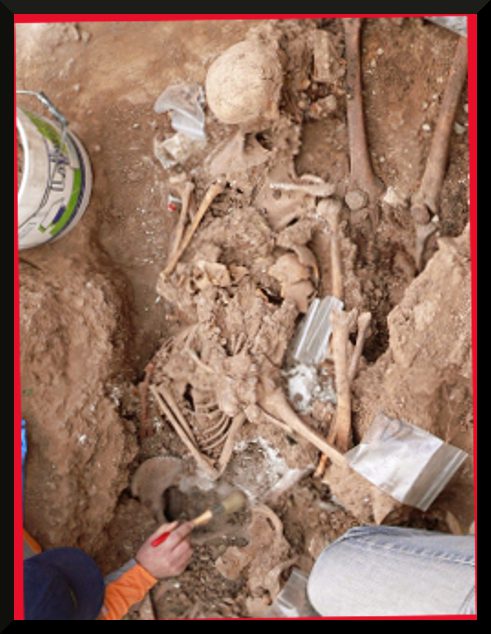
Crédito: Asociación para la Recuperación de la Memoria Histórica
BUENOS AIRES, 27 dic (IPS) – Cobró impulso en Argentina una causa judicial sobre graves delitos cometidos durante la Guerra Civil Española y la posterior dictadura de Francisco Franco (1936-1975).
La jueza federal argentina María Servini de Cubría abrió este mes una investigación a raíz de la querella presentada en abril de 2010 por abogados humanitarios de Argentina en nombre de familiares de víctimas del régimen franquista……….
……..El objetivo no es cuestionar la vigencia de la ley de amnistía española, ratificada recientemente ante un intento de derogarla, sino ejercer la jurisdicción argentina respecto de crímenes “que ofenden y lesionan a la humanidad y que permanecen impunes”, remarcaron los abogados.
Organizaciones de derechos humanos estiman en 113.000 la cantidad de personas desaparecidas en la guerra civil y el régimen de Franco, muchas supuestamente enterradas en unas 2.500 fosas comunes. Pero habría además unos 30.000 casos de menores supuestamente sustraídos de sus familias y apropiados ilegalmente….. “En el caso de España, cuando presentamos la querella había al menos 13 militares vivos, y además están los casos de 30.000 personas que desconocen su verdadera identidad”, dijo el abogado.
“Queremos una investigación a fondo, que se determine la verdad y se establezcan las responsabilidades. Si no lo hace España, lo haremos acá. Ojalá que haya colaboración”, agregó. (FIN/2011)…
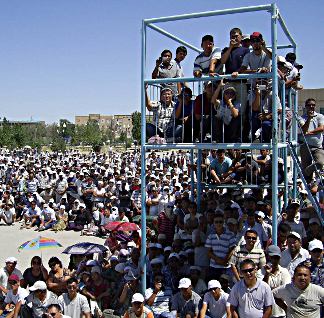
On December 16th (Kazakhstan’s Independence Day) more than 3,000 people met up for a demonstration at the main square of Zhanaozen, a town situated in the oil-rich Mangystau Province in the west of the country.
The people who took part in action were the ex-workers of local oil companies, fired after a bitter seven month strike. Their main demands were the payment of all outstanding salaries and improvement of work conditions.
As expected the oil workers and other town folk announced their intentions to hold a peaceful protest to the authorities of Kazakhstan. However, during the demo, a police Jeep was deliberately driven into the crowd of protesters and ‘peaceful’ went out of fashion from there on in. Angry people turned a police car upside down and set it on fire. A nearby police bus and a yurt (placed on the square “for the celebrations”) were
oil strikers camp Kazakhstan
also torched. Following this, the people, armed with sticks, pipes and molotov cocktails occupied the office of the local gas company and burned rooms on the ground floor of its office building. The local council building and a hotel were also burned. The oil workers surrounded the building and would not let the firemen get to the building. As an encore, they looted the houses of the rich in the exclusive, private area of town.
The state’s answer was to send army divisions, armoured transport and more police. The town’s population defended the strikers and, as a result of the attempt to bring it to ‘order’ more than ninety people (civilians and security) are said to have been killed, with eight hundred injured (these numbers are constantly growing).
Unsurprisingly, official media channels tell of much lower numbers. Many workers across the region have stopped work in support of the demonstrators. First oil workers of Mangystau Province started a sympathy strike, then workers of non-oil industries in the region also stopped their work in solidarity. The protests have become a general strike.
In what will probably become a 21st century standard ‘state-under-threat’ response, mobile phones in affected areas cannot be accessed, landlines do not work, Internet social networks and media are being blocked.
Of course, no mention has been made of punishing any police officers for firing on unarmed and peaceful people.The vast majority of the profits from the sale of the country’s resources are not shared with the nation’s poor, and the Kazakh government has a terrible human rights record. Time and time again members of the security forces, torture, beat, and mistreat detainees. The government continues to use arbitrary arrest and detention, and selectively prosecutes political opponents, often detaining them for long periods.
One might say that the spirit of the Arab spring has been taken up by Central Asians, but with the current low media interest (apart from a few newspapers here and there), there isn’t the same pressure on president Nazarbayev that there has been on Middle-Eastern leaders this past year (and they weren’t exactly exactly keen to fold up that pressure in any event).
However, Kazakhs don’t need to look as far away as the Arab world for inspiration. Another ex-Soviet Central Asian country, Kyrgystan, chucked out their despotic president Bakiyev in April 2010, following riots and demonstrations that led to Bakiyev’s ousting and the formation of a transitional government, headed by former philosophy lecturer Roza Otunbayeva. And what country did Bakiyev flee to? Kazakhstan.
No doubt president Nazarbaev has double checked his private jets are full of fuel and that his Swiss bank cashcard is still valid. Just in case.
Campaign Kazakhstan demonstrates in Berlin and Cologne
Campaign Kazakhstan activists, Germany
Berlin solidarity Kazakh oil strikers
Berlin
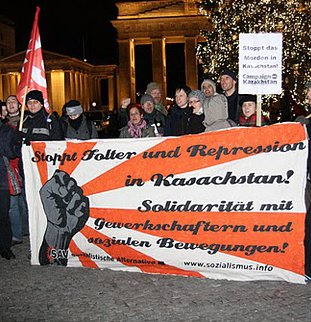
Yesterday, around 50 people protested in the centre of Berlin, criticising torture, repression and murder in Kazakhstan. Trade unionists including, metalworkers, teachers and health workers were joined by activists from the international “CampaignKazakhstan”, as well as members of the German LINKE (LEFT) party, SAV (CWI in Germany) and other left organisations, informing passers-by and tourists at Brandenburg gate of the events since last friday around the oil workers’ strike in western Kazakhstan.
The protesters shouted, “stop the slaughter in Kazakhstan!”





 The Free