In this post Laura Riggi from University of Wageningen (Netherlands) presents her work ‘Strip-cropping legacy enhances potato plant defence responses to aphids via soil-mediated mechanisms’.
She talks about the importance of diversity for agriculture, discusses the connections between above- and belowground organisms, and shares how her love for arthropods guided her to made agriculture more […]
Would you believe it?! Donald told 30,573 false or misleading claims during his first presidency Wikipedia
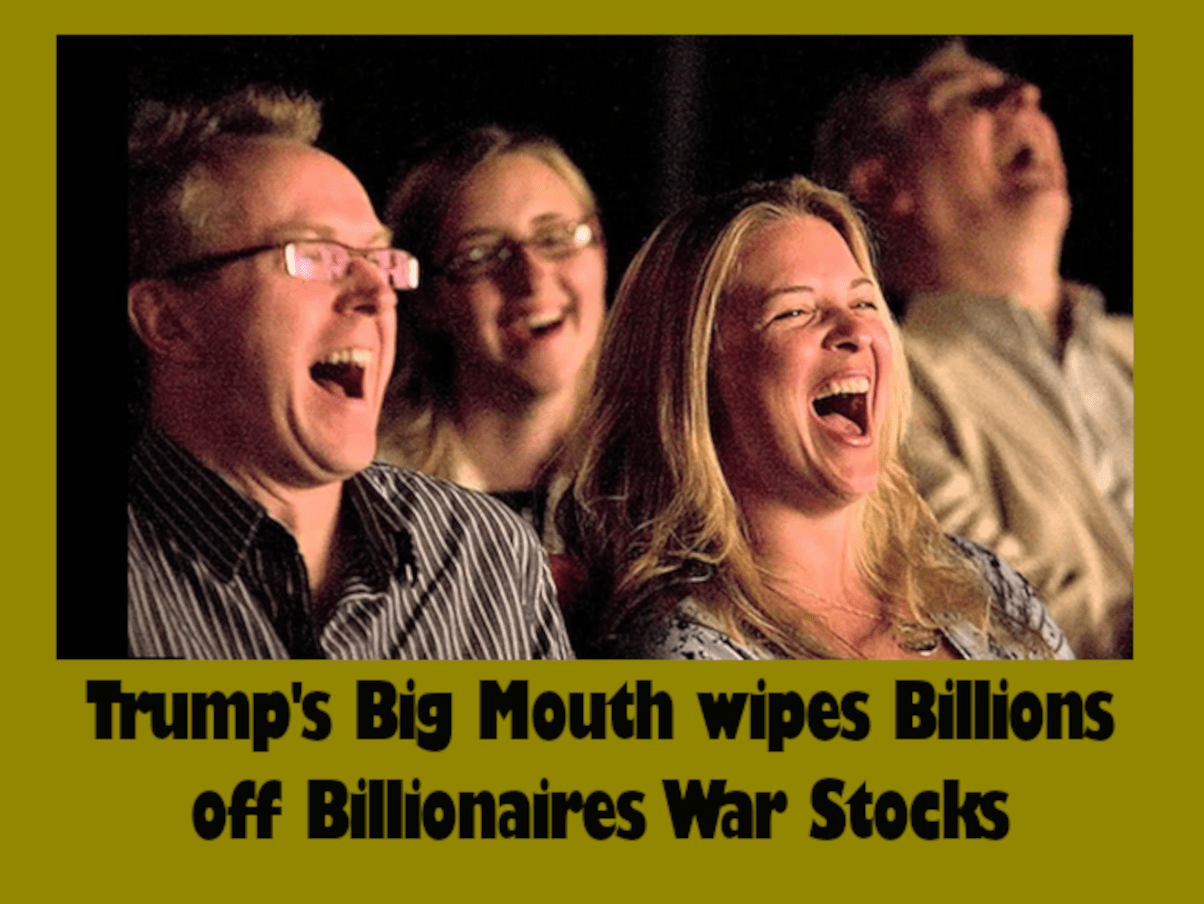
US defense stocks took a sharp dive this week after President Donald Trump announced that he could slash military spending in half. The announcement came amid a wider cost-saving push by his administration.
Lockheed Martin (-4.86%) and Northrop Grumman (-6.58%) as well as General Dynamics (-5.30%),
Days earlier he ordered a US IRON DOME with a 10 TRillion $$ pricetag
Speaking at a White House press conference on Thursday, Trump said he planned to discuss a potential reduction in defense budgets with Russian President Vladimir Putin and Chinese leader Xi Jinping.
“At some point, when things settle down, I’m going to meet with China and I’m going to meet with Russia… and I’m going to say there’s no reason for us to be spending almost $1 trillion on the military… and I want to say let’s cut our military budget in half,” Trump said.
Defense firms have enjoyed increased demand for weapons and military equipment since the escalation of the Ukraine conflict in 2022. Lockheed Martin, the primary producer of the F-16 fighter jets and Patriot missile systems used in Ukraine, posted a 21% year-on-year increase in revenues in 2023.
+++
Welcome to the Truth.free USA
+++
The new US administration has so far sent mixed messages on military spending. Trump has tasked Elon Musk and his Department of Government Efficiency with cutting federal costs, including at the Pentagon. The president has also pushed for a quick resolution of the Ukraine conflict, announcing imminent talks with his Russian counterpart Vladimir Putin.
The current $1 trillion in annual US military spending accounts for about 3.4% of the country’s gross domestic product (GDP). Secretary of Defense Pete Hegseth said during his confirmation hearings at the US Senate in January that he wouldn’t want to spend less than 3% of GDP on defense.
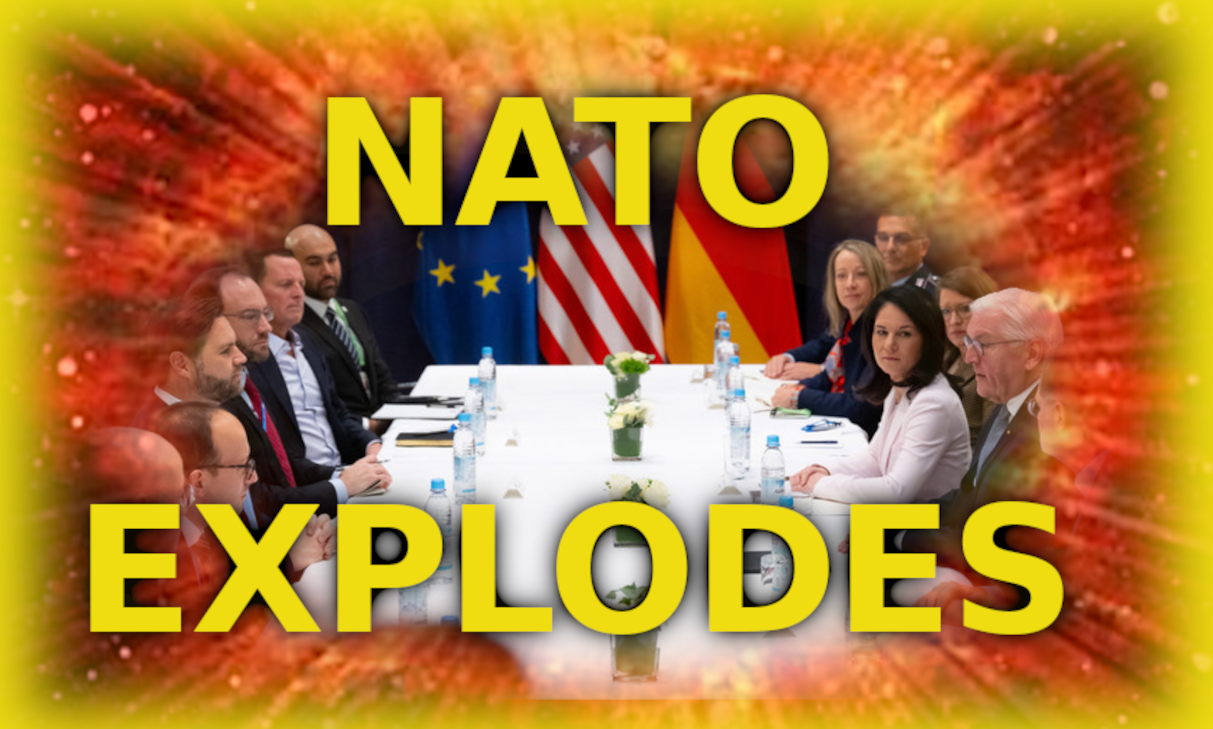
J.D. Vance, Vice President of the United States of America, and Annalena Baerbock , Foreign Minister, BURY Western Alliance at the Munich Security Conference – February 13 2025
The European Union was never in the driver’s seat on the Ukraine conflict. And now that same toddler sitting in the back with the plastic Fisher-Price steering wheel is throwing the kind of full-blown crimson-faced meltdown that makes adults chuckle.
How many times was the EU told, including by its own citizens with sledgehammer subtlety at the ballot box, to stop kissing Uncle Sam’s butt and start covering its own? Instead, its leaders cribbed America’s talking points, completely oblivious as they indulged in economic seppuku.
The EU’s entire economy-wrecking “strategy” over Ukraine was based on the fantasy that they were America’s little bro, not being used as naive pawns in a grand game that would knock them right off the chessboard.
If Washington had picked peace over profit from the start, the closest thing that the Euroclowns would have seen to a military confrontation with Russia in Ukraine would have been playing Sergeant Savoir-Faire back home, armed with a map of the nearest coffee shops and a five-course lunch.
And now the previously unthinkable has happened. The jig is up on Biden’s ridiculous scam of vowing to do “whatever it takes” for Ukraine to beat Russia on the battlefield – mainly by dumping cash into US weapons which miraculously get lost en route to the frontlines after the cheque clears.
Nice racket. Too bad it’s getting people killed – something Trump’s made it clear he’s not exactly a fan of. Looks like he’s finally asked himself if there’s a way for the US to keep feasting on cash without a body count in Ukraine. Spoiler alert: he found a way, apparently. Several, in fact.
Cutting to the chase through all this messy death and destruction stuff, Trump just wants to wrap up the fighting and have Ukraine hand over its resources to cover US spending — most of which has already gone straight into the pockets of American weapons industries.
And can he keep the weapon sales flowing, even without active conflict? Absolutely. Just tell NATO countries to cough up some cash for the sake of “preventive defense,” like he’s been doing relentlessly.
A solid 90% of EU-bought weapons are already American, according to last year’s EU competitiveness report. And that’s not changing anytime soon – unless the EU’s itching for a tariff-spanking.
A group of European foreign ministers have issued a statement insisting that Ukraine and the EU must be at the table for any peace talks. Yeah, they’re at the table alright – the bib-wearing kiddie table, along with Ukraine.
And while they’re busy twisting balloon animals and tossing around buzzwords like ‘enhancing support for Ukraine,’ totally immersed in their ‘choose your own adventure’ game where they’re obviously ‘winning,’ it turns out that Russia and the US – Putin and Trump – did something totally wild.
They picked up a phone. Probably even a landline, like something out of a history book. All while the EU was bravely ‘sticking it to Putin’ by flaming him on social media while wiping croissant crumbs off their keyboard between sips of overpriced lattes.
In the wake of that call, Trump announced the start of immediate negotiations for peace.
And now the EU is acting like it’s just been dumped by Uncle Sam, who’s committing the added insult of hanging around with the guy on whom they’ve been obsessively hating.
“If there is agreement made behind our backs it will simply not work because you need for any kind of deal, any kind of agreement, you need Europeans to implement this deal. You need the Ukrainians to implement this deal,” said the bloc’s chief diplomat, Kaja Kallas.
The agreement is actually being made right in front of your face and ours, for once – unlike the back-room shenanigans between bloc officials and the Biden administration, which ultimately lured the EU economy straight off a cliff with EU “leaders” serving as willing lemmings, sanctioning their own Russian supplies of virtually everything critical to their economy.
Now the German defense minister is yelling from the kiddie table over to the adult table, trying to tell Trump and Putin how they should be conducting their negotiations.
“From my point of view, it would have been better to talk about Ukraine’s possible membership of NATO or the country’s loss of territory only at the negotiating table and not take it off the table beforehand,” said Boris Pistorius.
Everyone’s really keen to hear advice for peace from folks whose strategy so far has resulted in perpetual war.
That’s barely a step above Elon Musk’s toddler, X – the one who was chiseling away at Mount Nostrildamus for the cameras while standing beside his dad and Trump in the Oval Office the other day – offering Trump and Putin his take on negotiated peace in Ukraine.
Sounds like Western European leaders are currently experiencing all five states of grief at once, while frantically refreshing their inboxes to see if either the US or Russia have noticed their total meltdowns and slid into their DMs – and not just taken their freakouts as confirmation that ghosting them entirely was maybe the best way to handle the situation when they’re sounding like they’re on the verge of throwing every dish in the cupboard straight across the room right now.
“All we need is peace. A JUST PEACE. Ukraine, Europe and the United States should work on this together. TOGETHER,”insisted Polish Prime Minister Donald Tusk on social media.
”Russia has to be forced to peace,” said Latvian Foreign Minister Baiba Braze. No, dear, YOU have to be forced to peace. Now, please just go back to the kiddie table and wipe the spaghetti off your face.
European ministers and delegations had been meeting in Paris earlier this week for what they thought was an important strategy session – only to realize that they were basically just holding the equivalent of a corporate teambuilding exercise.
While they were making all kinds of grand public proclamations in their echo chamber, like they were all jockeying for roles they could play in any eventual peace negotiations, it turns out that Trump and Putin were already finalizing the casting, and were even talking about bringing the curtain up.
And they were suggesting that would be a two-man show, not an ensemble slapstick comedy featuring the EU big top circus troupe.
European diplomats are now telling the Financial Times that they figure they’ll be expected to foot the bill for Ukraine’s reconstruction – because Trump will insist on it – and also send troops to enforce a deal they had zero say in while the US refuses military involvement.
Which is like getting handed a massive dinner check for a meal you didn’t even get to touch.
Just picture it: EU soldiers walking around Ukraine at EU taxpayer expense to protect American resource ventures while US troops stay home, as Pentagon chief Pete Hegseth has already stipulated, by adding that the EU needs to honor its commitments.
And Vice President J.D. Vance joined in the Trump administration’s stereoscopic spanking of the EU during their visit to the bloc by telling Europeans repeatedly – both during an artificial intelligence summit in Paris and before the Munich Security Conference – to stop censoring information and views they don’t like under the guise of it somehow being a peril to democracy.
The EU media has already suggested that it looks like the EU’s role is basically to shut up and accept the result of negotiations – like it has been kicked right out of the group chat before it even had a chance to log on, and still has to comply with the outcome of the meeting.
Basically, at this point, Trump sees Europe as an ATM. Putin sees Europe as background noise. And Ukraine’s Vladimir Zelensky probably just sees his gravy train’s looming derailment.
Trump and Putin are already debating between caviar and steak for their peace talks while the EU stands outside like a rejected clubber, begging the bouncer to “check again, bro” – meanwhile, Zelensky is eyeing that tablecloth like a pyromaniac.
Love is a quality of attention, a sensitivity to the world and everything that is possible in it.
When we fight on the basis of what we love, rather than in service of ideology or cowardice, we open ourselves to serve as a channel through which everything beautiful in the world can defend itself.
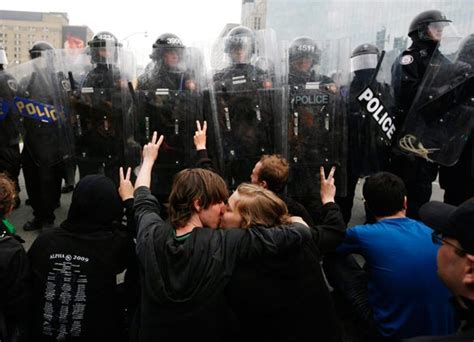
To choose love is to choose to keep feeling the blows when others are under attack—everyone facing felony charges, everyone threatened with deportation, everyone facing water cannons and rubber bullets, all the rivers and animals and plants that sustain us despite all the violence inflicted upon them. Love is not reducible to peace..
Vicuñas enhance nutrient-poor ecosystems in the Andes, aiding plant growth amidst climate change challenges.
These animals have communal toilets!
They survive way above the treeline and place their toilets in the bare space where the glaciers have disappeared due to catastrophic climate change.
Typically it could take generations for vegetation to establish itself.
But, despite thin air and incredibly cold nights, the ‘bathrooms’ of the cute vicuñas quickly become spreading oases of vegetation, insect, bird and animal life.
However the Study concludes that their defecation campaign is not enough to counter Climate Chaos.
El Gobierno de Estados Unidos ha enviado a más de 100 migrantes, todos ellos de nacionalidad venezolana, a la base naval de Guantánamo, en Cuba, según informaron medios estadounidenses.
La Administración de Donald Trump ha subrayado el envío de estos migrantes a la isla -que comenzó el 4 de febrero- como un ejemplo de la […]