from thefreeonline 28th March 2023 by French Revolution
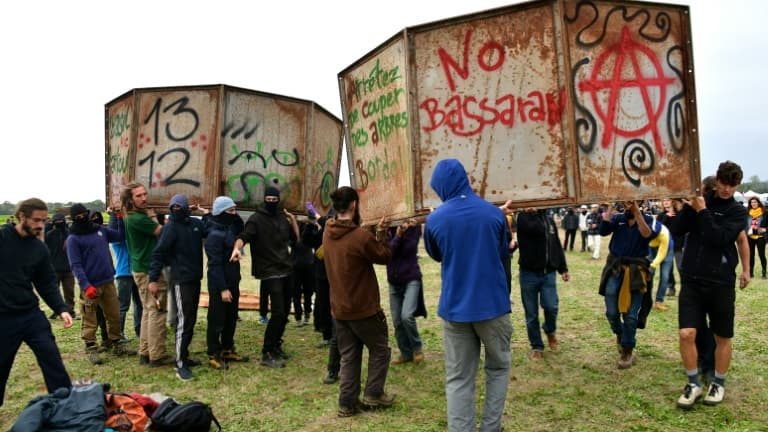
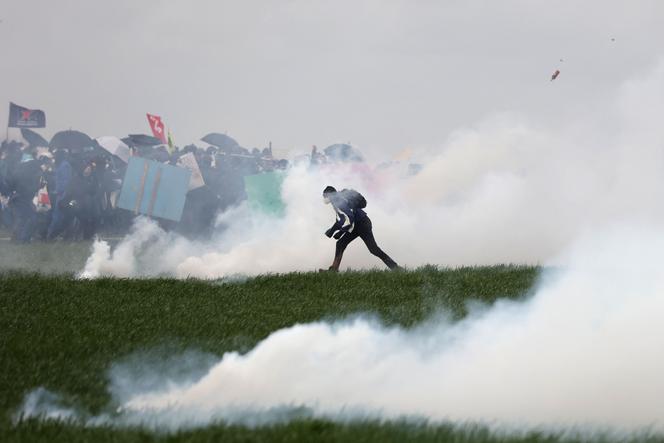
On Saturday March 26, our comrade S. was hit in the head by an explosive grenade during the demonstration against the dams.
Despite his critical condition, the prefecture intentionally prevented emergency services from intervening in the first place and transferring him to a suitable care unit in the second. He is currently in neurosurgical resuscitation. His vital prognosis continues to be compromised.
The outbreak of repressive violence suffered by the protesters resulted in hundreds of injuries, several of them with serious physical injuries, as stated in the various available reports.
‘Police reportedly detonated more than 4,000 non-lethal dispersion grenades to fend off protesters,…the Associated Press reported. Protest organizers said they also counted some 200 injured demonstrators, and that about 40 of them had deep cuts they said were caused by police projectiles’.
The 30,000 protesters had come with the aim of blocking the construction of the Sainte-Soline mega-dam, a project that aims to monopolize water management in the hands of a minority that benefits from a capitalist system that has nothing to defend except death. . The violence of the armed wing of the democratic State is the clearest expression of this.
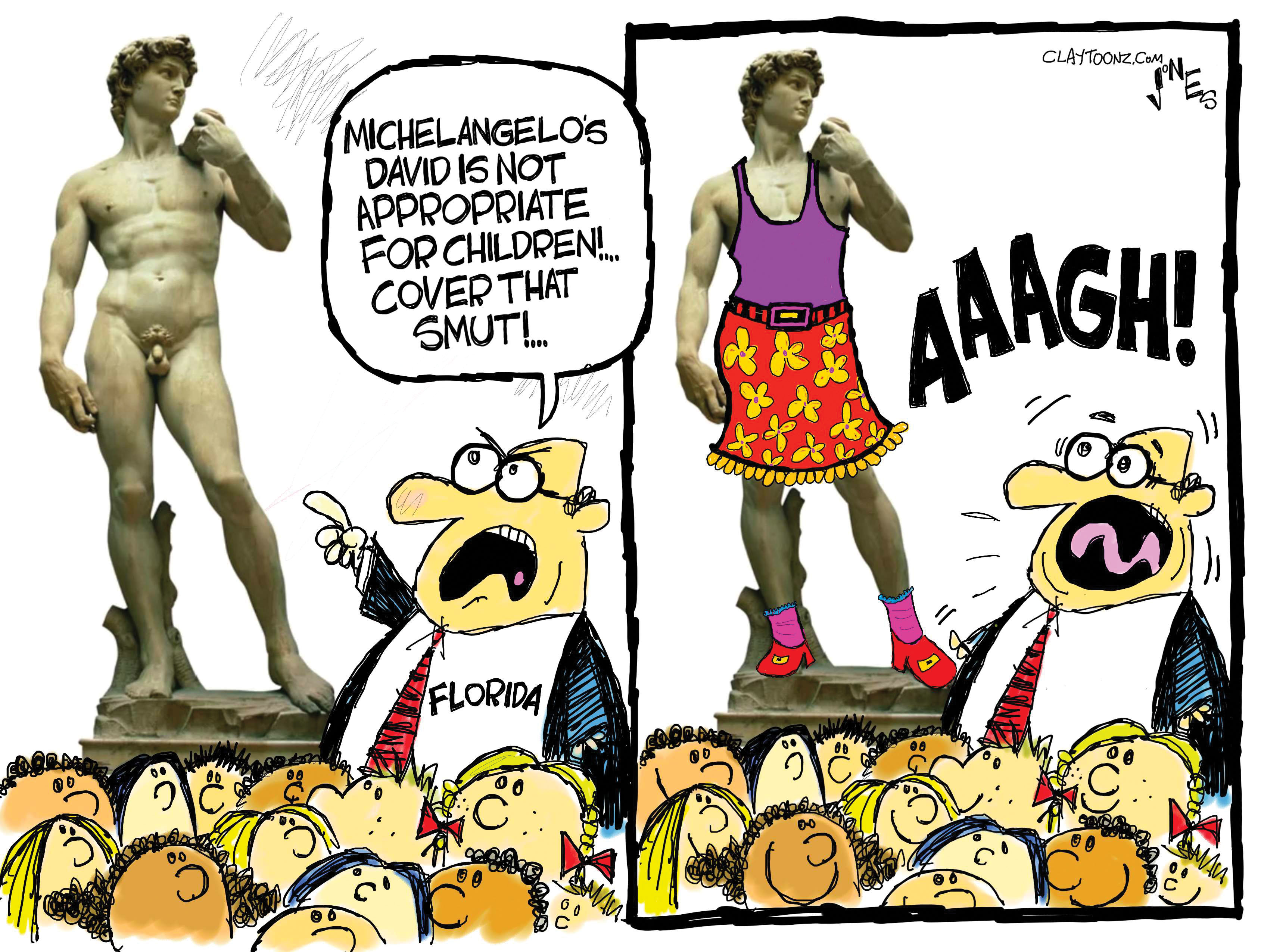
Yesterday, someone commented on my Facebook post about my roughs, telling me to “be careful” because some cartoons could land me in Facebook jail. Seriously? I don’t already know that? I’m the king of being thrown into Facebook and other social media jails. And how am I supposed to be careful with posting my cartoons […]
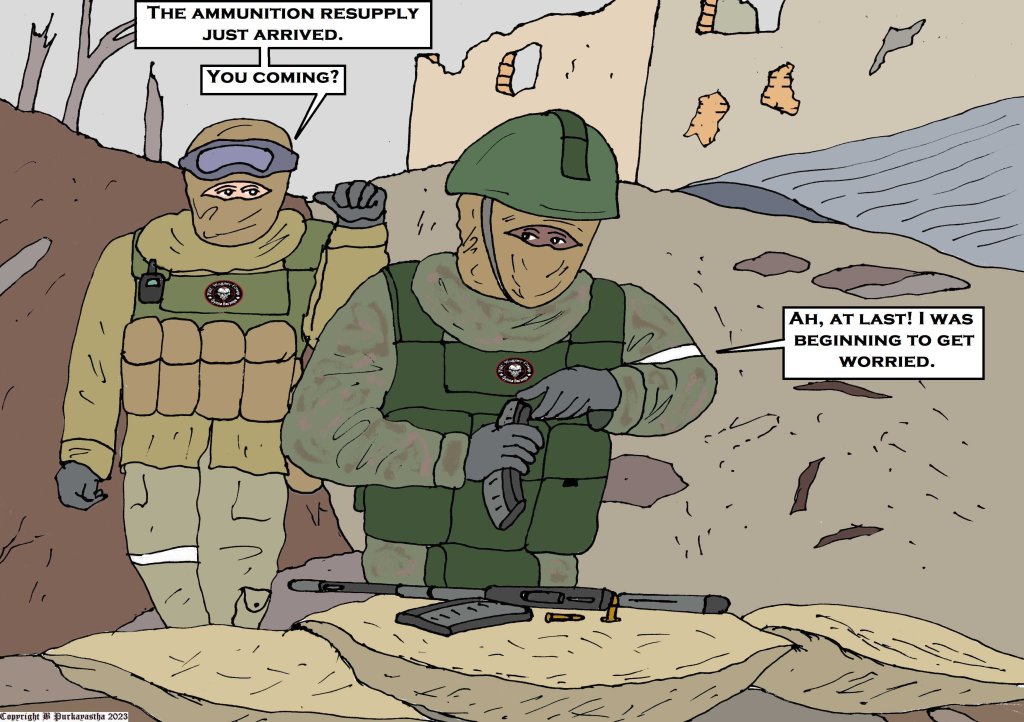
The joke is on Brutish Unintelligence, actually. Those who have read “All Quiet On The Western Front” will remember that Erich Maria Remarque specifically mentions shovels as highly efficient weapons in close quarter trench combat. But who reads these days?
Israelis block streets in anti-government ‘Day of Shutdown’– Protests have escalated since Netanyahu introduced new laws to cripple Courts and block his Corruption Cases
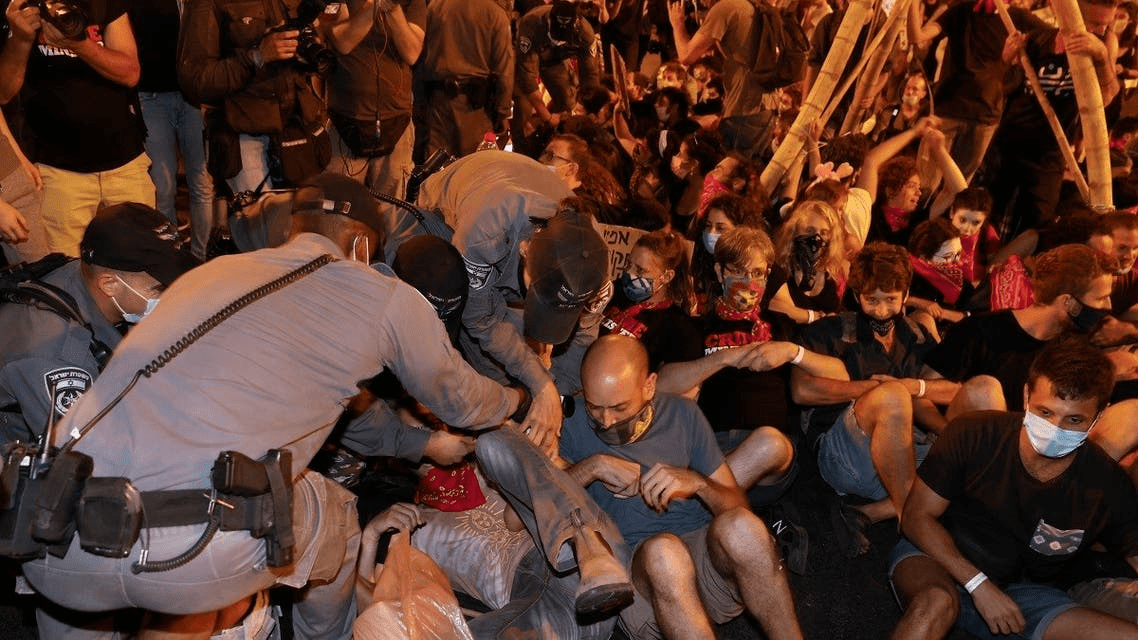
Israelis have taken to the streets en masse in protest against the government’s proposed changes to the judicial system, blocking roadways across the country and intensifying a months-long campaign decrying the move.
Thousands of people carrying flags and signs marched on a Tel Aviv thoroughfare on Thursday, stopping traffic in the middle of the workday. A small group burned tyres on the street outside a seaport, briefly blocking trucks. Police forced demonstrators from the road in front of a conference centre in central Israel.
The protests have escalated since the start of the year when Prime Minister Benjamin Netanyahu‘s hard-right government introduced new legislation that would limit the authority of the Supreme Court.
Military reservists have joined the protests and senior officials in the finance ministry warned this week of an economic backlash.
In Jerusalem, crowds gathered along the walls of the Old City from which they hung a huge replica of the country’s declaration of independence.
“What we are doing here is we are fighting for our lives. We are fighting for our lives as a Jewish people together in the state that we have been building for 75 years,” said Avidan Friedman, who was wearing a prayer shawl over his head.
“We are fighting because we feel like what’s going on now is tearing us apart and we are calling on the government to stop.”
Netanyahu in the meantime pushed ahead with the legislation, which includes bills to give the government decisive sway in electing judges and to limit the court’s power to strike down laws.
Netanyahu – on trial for corruption charges he denies – says the judicial modifications are needed to restore the balance between the branches of government. Critics say it will weaken Israel’s democracy and hand uncontrolled powers to the government of the day.
New law ratified
Earlier on Thursday, a law was ratified by a 61-to-47 final vote limiting the circumstances in which a prime minister can be removed, despite worries that it may be meant to shield the incumbent Netanyahu from any fallout from his corruption trials.
The Knesset approved the bill, under which prime ministers can only be deemed unfit and compelled to step aside if the Knesset or three-quarters of cabinet ministers declare them so on physical or psychological grounds.
The amended definition for the “incapacity” of the prime minister is among a number of legislative measures proposed by the religious-nationalist coalition that have tipped Israel into crisis, with the opposition arguing that judicial independence is in peril and the coalition claiming the proposals aim to push back against Supreme Court overreach and restore balance among branches of government.
Reporting from Jerusalem, Al Jazeera’s Imran Khan said people see the law as one that protects Netanyahu.
“The law stops the attorney general from declaring a serving prime minister as being unfit for office. Netanyahu was very keen on pushing this law through because it allows him,despite the Corruption court cases going through, to remain as prime minister,” said Khan.
“That angered the protesters and pushed them out onto the streets. There are thousands,” he explained.
nomy was doing well in 2006 and 2007, banks earned record profits from their toxic assets. But when economic conditions started to worsen in 2008, those toxic assets plunged in value… and dozens of banks got wiped out. Now here we go again. Fifteen years later… after countless investigations, hearings, […]
“…When the economy was doing well in 2006 and 2007, banks earned record profits from their toxic assets. But when economic conditions started to worsen in 2008, those toxic assets plunged in value… and dozens of banks got wiped out. Now here we go again. Fifteen years later… after countless investigations, hearings, “stress test” rules, and new banking regulations to prevent another financial meltdown, we have just witnessed two large banks collapse in the United States of America– Signature Bank, and Silicon Valley Bank (SVB).“
If Silicon Valley Bank is Insolvent, So is Everyone Else
On Sunday afternoon, September 14, 2008, hundreds of employees of the financial giant Lehman Brothers walked into the bank’s headquarters at 745 Seventh Avenue in New York City to clear out their offices and desks.
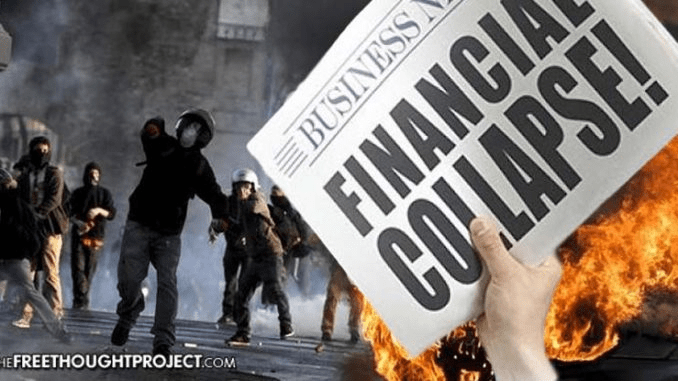
Lehman was hours away from declaring bankruptcy. And its collapse the next day triggered the worst economic and financial devastation since the Great Depression.
The S&P 500 fell by roughly 50%. Unemployment soared. And more than 100 other banks failed over the subsequent 12 months. It was a total disaster.
These bank, it turned out, had been using their depositors’ money to buy up special mortgage bonds. But these bonds were so risky that they eventually became known as “toxic securities” or “toxic assets”.
These toxic assets were bundles of risky, no-money-down mortgages given to sub-prime “NINJAs”, i.e. borrowers with No Income, No Job, no Assets who had a history of NOT paying their bills.
When the economy was doing well in 2006 and 2007, banks earned record profits from their toxic assets.
But when economic conditions started to worsen in 2008, those toxic assets plunged in value… and dozens of banks got wiped out.
Now here we go again.
Fifteen years later… after countless investigations, hearings, “stress test” rules, and new banking regulations to prevent another financial meltdown, we have just witnessed two large banks collapse in the United States of America– Signature Bank, and Silicon Valley Bank (SVB).
Now, banks do fail from time to time. But these circumstances are eerily similar to 2008… though the reality is much worse. I’ll explain:
1) US government bonds are the new “toxic security”
Silicon Valley Bank was no Lehman Brothers. Whereas Lehman bet almost ALL of its balance sheet on those risky mortgage bonds, SVB actually had a surprisingly conservative balance sheet.
According to the bank’s annual financial statements from December 31 of last year, SVB had $173 billion in customer deposits, yet “only” $74 billion in loans.
I know this sounds ridiculous, but banks typically loan out MOST of their depositors’ money. Wells Fargo, for example, recently reported $1.38 trillion in deposits. $955 billion of that is loaned out.
That means Wells Fargo has made loans with nearly 70% of its customer’s money, while SVB had a more conservative “loan-to-deposit ratio” of roughly 42%.
Point is, SVB did not fail because they were making a bunch of high-risk NINJA loans. Far from it.
SVB failed because they parked the majority of their depositors’ money ($119.9 billion) in US GOVERNMENT BONDS.
This is the really extraordinary part of this drama.
Source – internationalman.com “…When a bank fails, the FDIC pays depositors up to $250,000. The FDIC has a reserve of around $126 billion for this purpose. Now, $126 billion is a lot of money. But, considering there are around $9.8 trillion in insured deposits in the US, $126 billion is just a drop in the […]
US government bonds are supposed to be the safest, most ‘risk free’ asset in the world. But that’s totally untrue, because even government bonds can lose value. And that’s exactly what happened.
In principle the US can still ‘Stem the Tsunami’ by just Printing Money.. What’s a few TRILLION more if you Already Owe 20! ..The question is whether the World will continue to ‘Buy the Debt’ from a Terrorist Warmongering Sanctioner – now being EXPOSED as a ‘Paper Tiger’.
Most of SVB’s portfolio was in long-term government bonds, like 10-year Treasury notes. And these have been extremely volatile.
Kropotkin’s Kat...Pension Cuts are the final straw. Revolution is brewing since the YellowVests Rebellion -Against the Great Dictator- For Direct Democracy -Against Politicians sold-out to the 1% Elite- Against NATO Wars, Covid Scams….
GreatResetWatcher…. Hey fake news! The strikes are not just about pension reform they have been going on well before they are basically about France (Like most countries) being wrecked by the globalists. Also about no more elections, just WEF selections.
Police clashed with over a million demonstrators opposed to President Macron’s pension reform. French unions staged more strikes on Thursday to protest against an increase in the retirement age that was pushed through parliament without a vote.
French authorities struggled on Thursday to suppress the protests against President Emmanuel Macron’s pension reform. Over a million demonstrators took to the streets across the country in what some security sources described as an “insurrection” against the government in Paris.
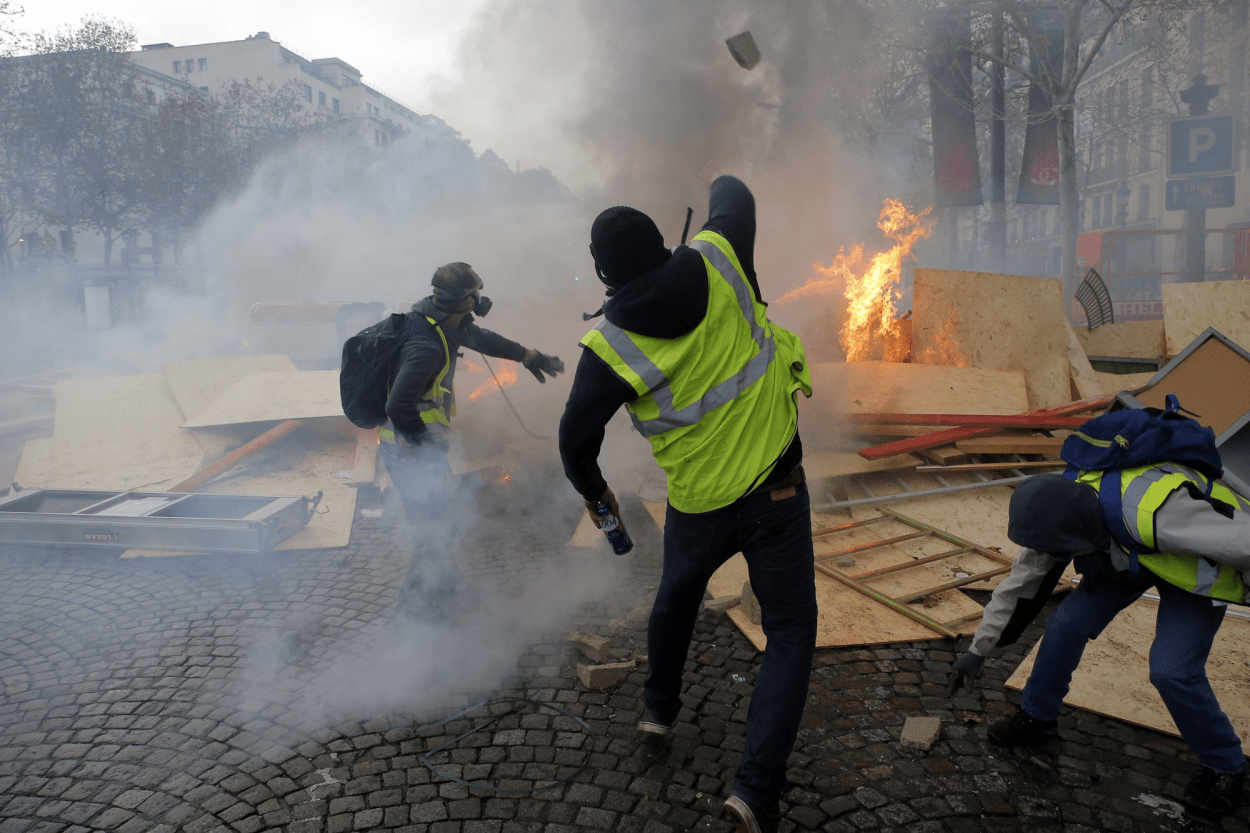
Tens of thousands of workers went on strike and protesters blocked public transportation, schools and oil refineries. Attempting to break up the protests, police used tear gas, water cannons, flash-bangs and batons. Videos making rounds on social media showed heavily armored officers clubbing unarmed demonstrators.
Other videos showed barricades burning in the streets of Paris. The entrance to the city hall in Bordeaux, the regional capital of Nouvelle-Aquitaine, was set ablaze at one point.
At least one unit of firefighters switched sides and joined the protesters. Multiple eyewitnesses described the situation as “out of control.”
JUST IN: Protests in France are NOT LETTING UP, videos from Paris emerge showing what looks like a war zone..
“It’s war in Paris, no time to post, take care of yourself,”tweeted one independent media outlet.
Almost 150 police officers and gendarmes have been injured, Interior Minister Garald Darmanin said on Thursday evening, calling this “absolutely unacceptable” and demanding harsh punishment for the attackers. Darmanin also told reporters that 172 people were detained for questioning about the “looting and arson” in Paris, and that 190 fires had been set in the French capital, 50 of which were still burning as of 10 pm local time.
The interior minister blamed the “extreme left” and “black bloc” anarchists for the worst of the violence.
The police estimated more than a million protesters were in the streets.
The outpouring of popular discontent was triggered by President Macron’s announcement that the retirement age will be raised from 62 to 64, starting next year. Macron insisted that the change was necessary, otherwise the pension system would go bankrupt within the next several years.
The Elysee Palace imposed the change without consulting lawmakers, who have been trying to deal with the controversial proposal since January. Protesters responded by calling on Macron to resign.
Appearing on TV on Wednesday, Macron said his only mistake was “failing to convince people” of the decision’s merits, but insisted he would not back down, even if that meant having to “shoulder unpopularity.”
While there is a constitutionally protected right to protest, Macron said, if the malcontents use violence, “then that is no longer democracy.”
Though heavily criticized due to the harsh coronavirus lockdowns and mandates, Macron easily won re-election in 2022, eventually defeating Marine Le Pen by a 17-point margin. The runoff election saw the lowest turnout since 1969.
Discussion… ‘France protests said to be ‘out of control’
















 The Free