❗️According to information confirmed by several sources, Kyiv intends to carry out a large-scale provocation to accuse the Russian Federation of “war crimes”, the Russian Defense Ministry reports.
Kyiv is planning a controlled bombing of medical buildings in Kramatorsk in order to accuse the Russian Federation of an allegedly deliberate strike on civilian objects. Western media journalists have already arrived in Kramatorsk, accompanied by SBU officers, to cover the planned provocation, the department added.
Where’s the Money, Zelensky? Dutch Party Asks Ukraine’s Prez to Account .“Zelensky has a fortune: various estimates put his wealth at around $850 million. He amassed most of it after taking office as president. Where does the money come from? And more importantly, where is it going?” the Forum for Democracy asked in posts on its Twitter and Telegram accounts on Monday.
18,495 views 1 Feb 2023 Ukrainian officials searched the home of billionaire Ihor Kolomoyskyy on Wednesday, according to multiple outlets, making the one-time backer of President Volodymyr Zelensky the latest target of a weeks-long crackdown on corruption in Ukraine. READ MORE: https://www.forbes.com/sites/tylerrou…
#UkraineWar: Zelensky’s name appeared prominently in both the Panama Papers and the Pandora Papers (as did the name of his key backer, Kolomoisky). His connections to the neo-Nazi Azov battalion are now well-known. pic.twitter.com/G9Pps6VBb5
Ukraine’s ‘Midnight Cowboy’ president exposed for being a billionaire Israeli oligarch… More than a billion dollars are held in Ukrainian President Volodymyr Zelensky’s accounts abroad. This was announced by the deputy of the Verkhovna Rada of the Opposition Platform – Party For Life Ilya Kiva.
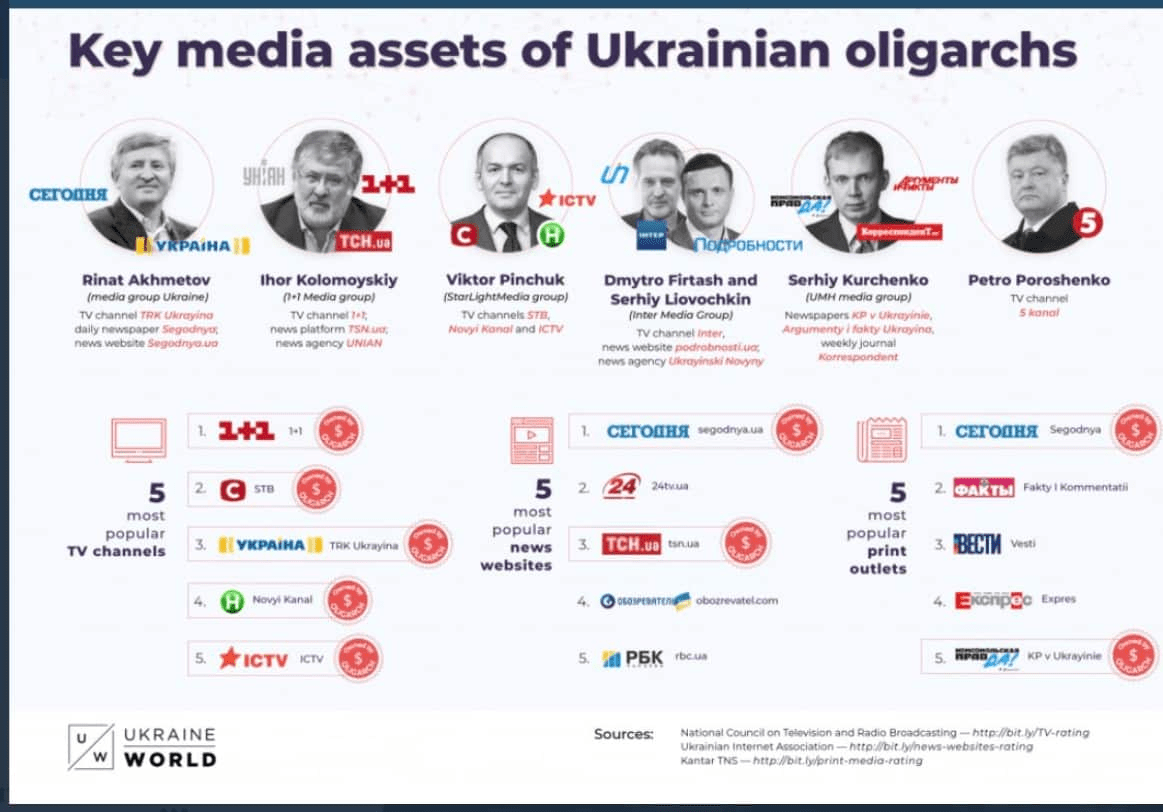
According to him, Zelensky has accumulated $1.2 billion in the Dresdner Bank Lateinamerika in Costa Rica during the two and a half years of his presidency. This money was transferred to the president by Ukrainian oligarchs, such as Rinat Akhmetov, Viktor Pinchuk, Igor Kolomoisky. As Kiva noted, replenishment is done regularly, in tranches of $12 million to $35 million.
And they go through banks like First Union Bank, Deutsche Bank, Banque Nationale de Paris. According to the deputy, the movement of such funds would be impossible without the control of the authorities of Germany and France.
Breaking down Ukraine – let’s start with Zelensky’s $35M mansion in Sunny Isles, FL built by Kolomoisky and Pinchuk. $1.3B in the bank!! pic.twitter.com/wnh7yNg2w8
— George Webb – Investigative Journalist (@RealGeorgeWebb1) March 1, 2022
Is Zelensky corrupt? He amassed an $850 million personal fortune in the … May 2, 2022.. The site also noted that Zelensky and his family have offshore accounts and financial stakes in the Kvartal 95 television entertainment company, which he co-founded in 2003, as well as “a 25 percent stake in the Maltex Multicapital Corp., a tax shelter in the British Virgin Islands, through a separate Belize-registered shell company, Film Heritage, according to the Organized Crime and Corruption Reporting Project.”
..A Pandora Papers leak revealed that Mr Zelensky, who campaigned on promises to “break the system” of oligarchic control and corruption in Ukraine, set up a spider web of offshore companies in 2012. Zelensky’s office justified the move by saying they were a form of “protection” against former President Viktor Yanukovyc
Ukraine – Pandora papers reveal Zelensky’s offshore schemes Oct 5, 2021The Pandora papers reveal that Volodymyr Zelensky and his entourage own offshore companies in the British Virgin Islands, Belize, and Cyprus, three flats in London worth $7.4 million, and that the Ukrainian president potentially received dividends from a company he no longer officially owns…..
But the matter was not limited just to accounts, as Kiva pointed out . Zelensky managed to buy a villa in Miami for $34 million, as well as several sets of jewelry for $5.6 million.
81,785 views 30 Jan 2023 #kyiv#ukraine#russia Ukraine is mired in a corruption scandal. Even as a war is raging with Russia, top ministers from President Volodymyr Zelensky’s cabinet have resigned after allegations of corruption were made. A series of resignations now threaten Zelensky’s personal reputation and his relationship with the West
“In addition to the President of Ukraine at the Dresdner Bank, the head of the office of the President of Ukraine Yermak has accounts for a modest $56 million, Svyatlana Tikhanovskaya for $4.5 million, most of which she transferred in December 2020 to HSBC bank in London office. Also accounts Arseniy Yatsenyuk has one in the Miami branch of the Dresdner bank,” Kiva said in her post on the Telegram channel.
“Every Ukrainian president and his team, after their tenure, walked away as dollar billionaires, and Zelensky, for all his inferiority, was no exception, just in his case, no one will let him just walk away,” Kiva said, and added that the current head of Ukraine is waiting for a prison.
jeradl Facebook is blocking being able to share this story.
Andrew Armavir (Russia) It is true. The position of the President of Ukraine works wonders! Any dollar millionaire president in Ukraine quickly becomes a dollar billionaire. Ask Poroshenko. Everything was exactly the same.
Imre Tihanyi “Money Makes the World Go Around!” WAR is a RACKET! Never TRUER than what is going on today in the Ukraine!
Gordon Duff, Senior Editor It seems to be real. We tracked Zelensky to 13 disappearances last year where we think he and his favorite Oligarch sat in Miami running the war on Donbass
Adrian2MiL18 Also it should be keep an eye over Kolomoisky financial relationship with Don Blinken both them citizens of little shit country and dad of Sec. of State….
Offshore WTF…..????? Where do the revelations go from here… or is this REAL…
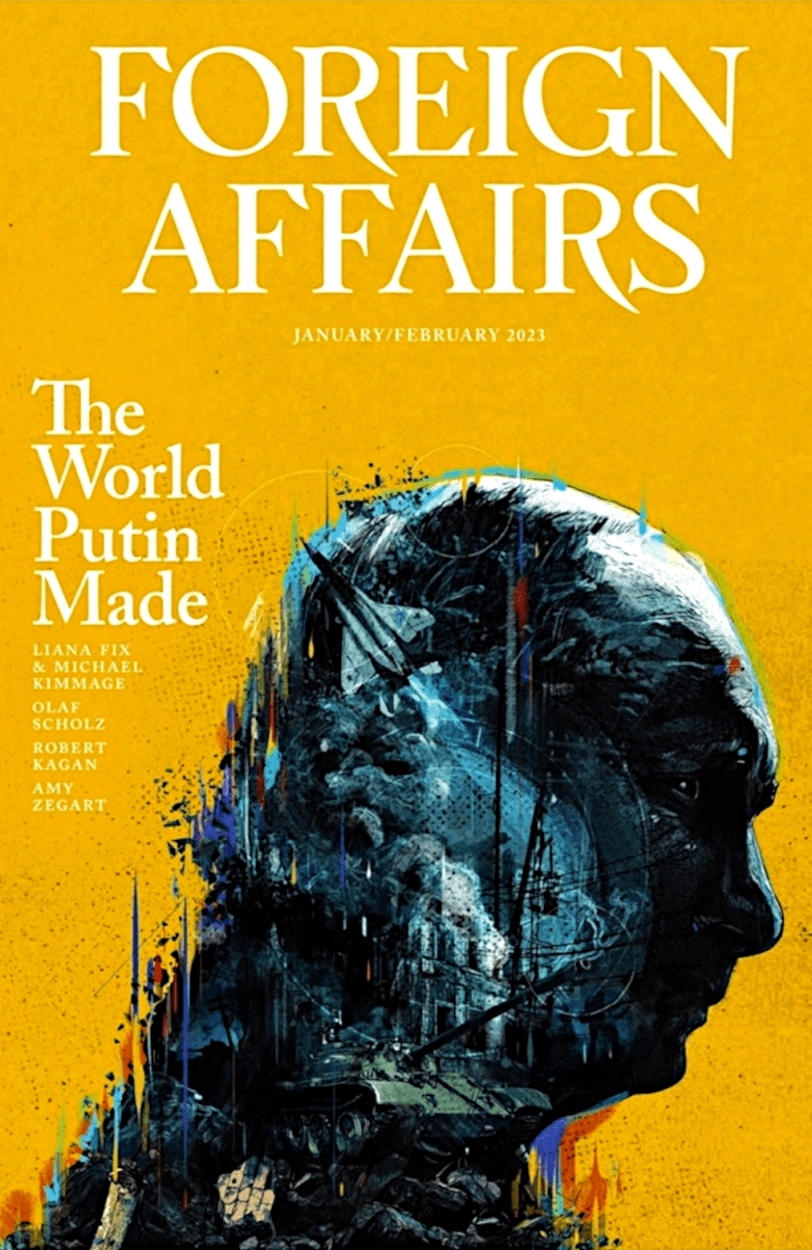
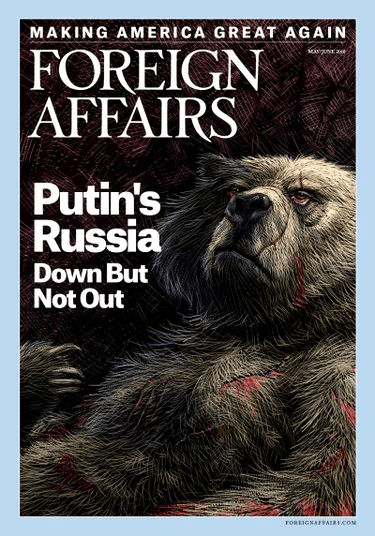
Foreign Affairs, a highly influential US magazine – effectively a US empire house journal – has published an article detailing how sanctions are quickly losing their efficiency as a weapon in Washington’s global arsenal.
Published by the Council on Foreign Relations NGO, Foreign Affairs provides space for officials within the US military industrial complex to communicate with one another on matters they believe to be of the utmost significance.
Therefore, it is important to pay attention when the magazine makes major pronouncements on any issue.
It recently published an appraisal of US sanctions – the conclusion being that they are increasingly ineffective, have prompted Beijing and Moscow to create alternative global financial structures to insulate themselves and others from punitive actions, and that Washington and its acolytes will no longer be able to force countries to do their bidding, let alone destroy dissenting states, through such measures in the very near future.
The article begins by noting that “sanctions have long been the US’ favored diplomatic weapon,” which “fill the void between empty diplomatic declarations and deadly military interventions.” Despite this, it predicts “the golden days of US sanctions may soon be over.”
Merck’s oral antiviral pill for COVID-19, molnupiravir — marketed under the name Lagevrio — is fueling the development of new and potentially deadly variants of COVID-19, according to the authors of a new preprint study.
The study, released Jan. 27 by a team of U.S. and U.K researchers, found, “It is possible that some patients treated with molnupiravir might not fully clear SARS-CoV-2 infections, with the potential for onward transmission of molnupiravir-mutated viruses.”
The study, which is pending peer review, followed the discovery by a middle school science and math teacher in Indiana who found numerous variants of COVID-19 emerged after molnupiravir began to be widely distributed.
“It’s not a surprise that molnupiravir could cause [the] escape of mutant virus strains or substrains into the population,” said Dr. Harvey Risch. “Its main function is to get the virus to mutate faster.”
Risch, professor emeritus and senior research scientist in epidemiology (chronic diseases) at the Yale School of Public Health, told The Defender:
“The idea is that it will mutate itself to death. But some live mutants could get out, and this paper gives evidence that they have.”
Brian Hooker, Ph.D., P.E., chief scientific officer for Children’s Health Defense, said the study’s authors scanned global SARS-CoV-2 sequence databases looking for mutations characteristic of those by molnupiravir (G-to-A and C-to-U) and found an uptick of those mutants starting in 2022 — after molnupiravir was put on the market and specifically in countries where molnupiravir was distributed.
La Directa uncovers a National Police agent who was infiltrated for three years in social movements in Catalonia, and.anarchist spaces in Madrid and the Basque Country.
He has now ‘ disappeared’.
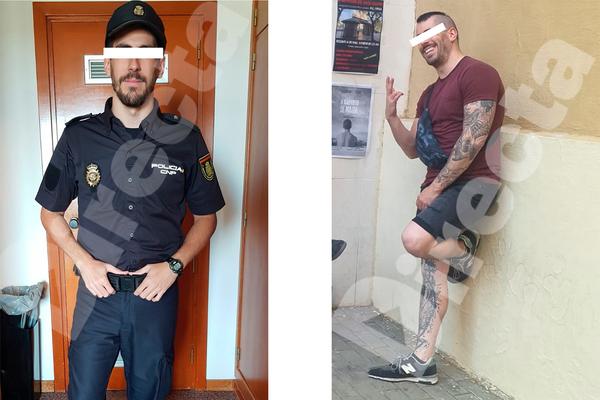
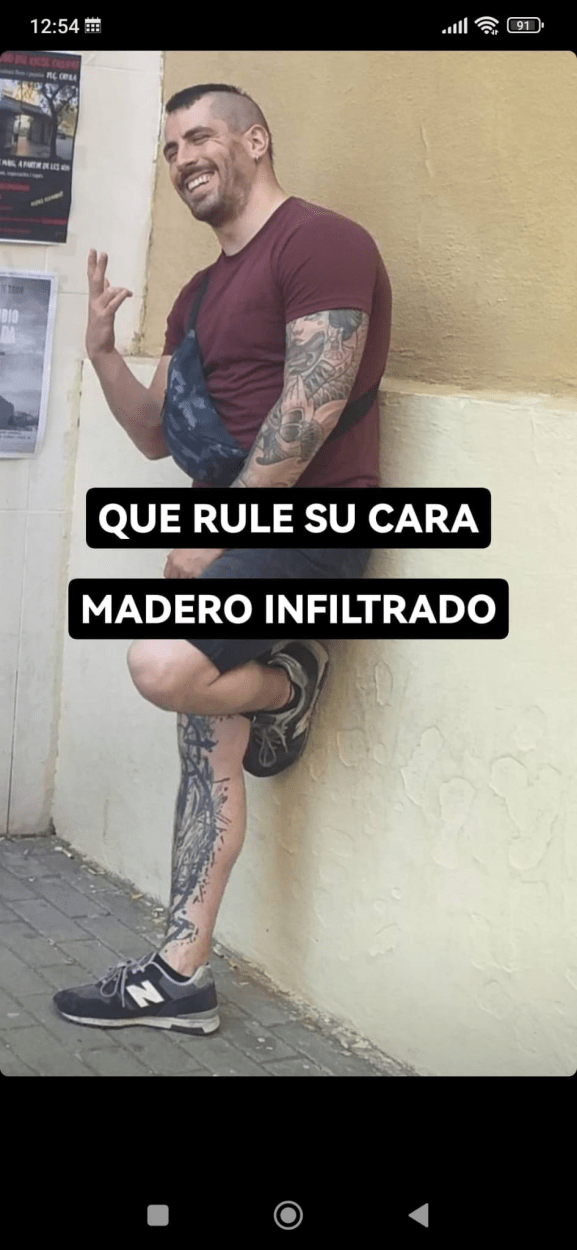
On the left, agent D.H.P. during his time at the Ávila police school. In the image on the right you can see the tattoos he got between 2020 and 2021
“I met Dani one night in June 2020 in the Plaza de las Palmeres in the Sant Andreu neighborhood.
He was a very jokey, smiling and close person, with whom it was easy to connect, and he approached us girls with a funny flirtation.
I slept with him several times and on three occasions we had sexual relations”.
The speaker is Joana, one of the eight women with whom Daniel Hernàndez Pons, a National Police agent, had relations with the aim of infiltrating social movements in Catalonia, according to an extensive report by La Directa.
According to the report, Hernández Pons infiltrated the La Cinètika social center in June 2020.
A la izquierda, el agente D. H. P. durante su paso por la escuela de policia de Ávila. En la imagen de la derecha se pueden apreciar los tatuajes que se hizo entre 2020 y 2021. La Directa
He is not the first National Police agent infiltrated in social movements discovered by La Directa, which seven months ago published how another agent, Marc Hernández Pon, infiltrated in June 2020 the Catalan independence movement.
“After a long and meticulous investigation, La Directa has been able to confirm that we are facing an operation to introduce multiple spies into activism, under the hierarchical leadership of the Spanish Minister of the Interior, Fernando Grande-Marlaska,” La Directa points out in its report. .
Dani appeared for the first time in the gym of the squatted La Cinètika center, on Paseo Fabra i Puig in Barcelona, in June 2020.
ANTI SPYCOP DEMO
He was 31 years old at the time. “He said that he had found the address on the internet while looking for a cheap place to train,” explains one of the space activists.
It was the beginning of a rapid infiltration into the neighborhood’s social movements, facilitated by a mayhem star tattooed on his knee, T-shirts with anti-fascist symbols, earrings, and a mohawk suitable for his new anarchist context.
Even so, from time to time someone mentioned to him that, upon his arrival, someone had distrusted him because nothing was known about his past.
He “answered sportingly, with a smile. Dani has always been a joker”, Jaume explains to La Directa, a pseudonym used for the report by a person who until a week ago considered himself the best friend of the undercover police officer.
As confirmed by La Directa, the real identity of Daniel Hernàndez Pons responds to the same initials: D.H.P.
The newspaper points out that it has verified his real identity thanks to the mistakes made by the infiltrator, through which they have been able to access open data about his past and present, and through a physiognomic expert test that compares the photographs of his passage through the Ávila police school between 2018 and 2019 with images of him as an activist in Barcelona.
During his time as an infiltrator, Daniel participated in the demonstrations against the imprisonment of Pablo Hasél in February 2021, in several rallies to avoid evictions, in one of which he confronted a Desokupa worker, and was fined 600 euros. —which he did not pay— for another mobilization.
He has also visited self-managed spaces in Madrid y País Vasco Madrid and the Basque Country.
Specifically, La Directa details how this infiltrated police officer visited the squatted social center La Casika in Móstoles on several occasions and also attended the first libertarian meeting held in Vitoria in 2021, in Errekaleor.
La Directa explains that, to explain the absences due to his double life, the infiltrator claimed that he worked as an assistant to an air conditioning installer or that he was going away for a few days to visit his family in the Balearic Islands or a friend in Tarragona.
Sexual Relationships as an Infiltration Strategy
According to the La Directa report, the infiltrated policeman had relationships with several women participating in the city’s social movements, one of them for a year, and who served as a bridge to enter the neighborhood collectives.
“Through all of them he set foot in various projects and political spaces,” reads the La Directa report. Among them, he lists the film screenings at La Cinèteka, the work group of the same social center to prepare a guide to prevent and act in the face of patriarchal violence and joining the tour of the Zapatista movement in Catalonia.
He also joined the Antirepressive Coordination group of Sant Andreu. “A good opportunity to see everyone who was active in the neighborhood,” explains Iris, one of the eight women who were related to the infiltrated agent with whom La Directa has spoken.
Another sexual relationship with an activist from Ciutat Vella made it easier for him to enter other spaces, such as the Kasa de la Muntanya. And Rut, with whom he had a six-month relationship, made it easy for him to enter the CGT anarchist trade unión
Filed under: Catalonia ‧ Police ‧ Espionage
Dani, el segundo policía infiltrado en el activismo catalán destapado por La Directa
La Directa destapa a un agente de la Policía Nacional que estuvo infiltrado durante tres años en movimientos sociales de Catalunya, y que pasó por espacios libertarios en Madrid y País Vasco.
“Conocí a Dani una noche de junio de 2020 en la plaza de las Palmeres del barrio de Sant Andreu. Era una persona muy bromista, risueña y cercana, con quien era fácil conectar, y a las chicas se nos acercaba con un flirteo gracioso. Dormí con él varias veces y en tres ocasiones mantuvimos relaciones sexuales”.
Quien habla es Joana, una de las ocho mujeres con las que Daniel Hernàndez Pons, agente de la Policía Nacional, mantuvo relaciones con el objetivo de infiltrarse en los movimientos sociales de Catalunya, según destapa un extenso reportaje realizado por La Directa. Según detalla el reportaje, Hernández Pons se infiltró en el centro social La Cinètika en junio de 2020. No es el primer agente de la Policía Nacional infiltrado en los movimientos sociales descubierto por La Directa, que hace siete meses publicó cómo otro agente, Marc Hernández Pon, llegaba también en junio de 2020 al movimiento independentista catalán. “Después de una larga y minuciosa investigación, la Directa ha podido confirmar que estamos ante una operación de introducción de múltiples espías en el activismo, bajo la batuta jerárquica del ministro de Interior español, Fernando Grande-Marlaska”, señala La Directa en su reportaje.
Dani apareció por primera vez en el gimnasio del centro okupado La Cinètika, en el paseo Fabra i Puig de Barcelona, en junio de 2020. Por entonces tenía 31 años. “Decía que había encontrado la dirección por internet mientras buscaba un sitio económico donde entrenar”, explica una de las activistas del espacio. Fue el inicio de una rápida infiltración en los movimientos sociales del barrio, facilitada por una estrella del caos tatuada en su rodilla, camisetas con simbología antifascista, pendientes y un peinado en cresta adecuado para su nuevo contexto anarquista. Aun así, de vez en cuando alguna persona le mencionaba que, a su llegada, alguien había desconfiado de él porque no se sabía nada de su pasado. “Se lo tomaba deportivamente, con una sonrisa. Dani siempre ha sido muy bromista”, explica a la Directa Jaume, pseudónimo que usa para el reportaje una persona que hasta hace una semana se consideraba el mejor amigo del policía infiltrado.
Según ha confirmado La Directa, la identidad real de Daniel Hernàndez Pons responde a las mismas iniciales: D.H.P. El diario señala que ha comprobado su identidad real gracias a los errores cometidos por el infiltrado, por los que han podido acceder a datos en abierto sobre su pasado y presente, y a través de una prueba pericial fisionómica que compara las fotografías de su paso por la escuela de policía de Ávila entre los años 2018 y 2019 con imágenes suyas como activista en Barcelona.
La Directa detalla cómo este policía infiltrado visitó en varias ocasiones el centro social okupado La Casika de Móstoles y acudió también al primer encuentro libertario celebrado en Vitoria en 2021, en Errekaleor
Durante su tiempo como infiltrado, Daniel participó en las manifestaciones contra la entrada en prisión de Pablo Hasél en febrero de 2021, en varias concentraciones para evitar desahucios, en uno de los cuales se enfrenta a un trabajador de Desokupa, y fue multado por 600 euros —que no pagó— por otra movilización. También ha visitado espacios autogestionados en Madrid y País Vasco. En concreto, La Directa detalla cómo este policía infiltrado visitó en varias ocasiones el centro social okupado La Casika de Móstoles y acudió también al primer encuentro libertario celebrado en Vitoria en 2021, en Errekaleor.
La Directa explica que, para explicar las ausencias que conllevaba la doble vida que llevaba, el infiltrado afirmaba que trabajaba como ayudante de un instalador de aire acondicionado o que se iba por unos días a visitar a su familia en Baleares o a un amigo en Tarragona.
Relaciones sexoafectivas como estrategia de infiltración
“A través de todas ellas puso los pies en diversos proyectos y espacios políticos”, se lee en el reportaje de La Directa. Entre ellos enumera las proyecciones de cine en La Cinèteka, el grupo de trabajo del mismo centro social para elaborar una guía para prevenir y actuar ante violencias patriarcales, se sumó a la gira del movimiento zapatista por Catalunya y se metió en la Coordinadora Antirrepresiva de Sant Andreu.
“Una buena oportunidad para ver a todo el mundo que militaba en el barrio”, explica Iris, una de las ocho mujeres que se relacionaron con el agente infiltrado con las que ha hablado La Directa.
Otra relación sexoafectiva con una activista de Ciutat Vella le facilitó su entrada a otros espacios, como la Kasa de la Muntanya. Y Rut, con quien mantuvo seis meses de relación, le facilitó llegar a CGT.
En El Salto nos tomamos la independencia muy en serio: no aceptamos que nuestros artículos los paguen las grandes multinacionales ni las empresas del Ibex35, no aceptamos publicidad de partidos en campaña electoral y más del 80% del presupuesto viene de las más de 9.000 personas socias del proyecto. Si crees que es necesario consolidar medios que funcionan de forma diferente, te necesitamos. ¡Suscríbete!
RT DE Productions – a German-based company that produces content for the RT DE TV channel and website in Moscow – has announced that it’s halting all its operations in the country. The company cited “the repressive state of media freedoms within the EU.”
The ninth sanctions package introduced in December 2022 amounted to “effectively cutting off oxygen for staff,” the firm said, adding that the EU had “betrayed the reliance on the fundamental rights and freedoms recognized in the Charter of Fundamental Rights” of the bloc itself.
“The EU, in permitting the imposition of sanctions on media freedoms, has shown that the very values claimed to define the core of its existence are without any substance,”
the statement read, adding that the freedom of the press “does not exist in Germany today.”
The latest round of sanctions adopted by Brussels has made any further activities of the company in Germany impossible, RT DE Productions said in a statement on Friday.
The production company also said it was “happy and proud” to be able to provide German-speaking audiences in multiple countries with “essential stories and opinions, often side-lined or overlooked by the mainstream media outlets.”
The sanctions package announced in December blacklisted RT’s parent company, TV-Novosti, as well as revoking the EU broadcasting licenses of Russian media outlets including NTV, NTV Mir, Rossiya 1, REN TV and Perviy Channel.
Following the introduction of these new restrictions, Paris froze the accounts of RT France, citing the need to comply with the new regulations. The move forced RT’s French subsidiary to cease broadcasting.
Even before the conflict in Ukraine, RT had faced multiple obstacles to launching a live TV channel for a German audience back in 2021. German banks abruptly refused to work with the broadcaster, and Luxembourg shot down its licensing bid.
When the channel was eventually launched in December 2021, its YouTube page was immediately banned and European satellite TV operator Eutelsat took it off air shortly after, giving in to pressure from the German media regulator, MAAB.
The regulator then demanded a broadcast ban on the RT DE channel, accusing RT DE Productions of broadcasting without a valid German license.
RT DE Productions is not a broadcaster, but a production company, while the RT DE channel was broadcast from Moscow under a valid EU-wide Serbian license.
However, a German court sided with the media regulator in March 2022.
“It is striking how resonant Le Guin’s work remains even as the future she describes recedes into our past.”
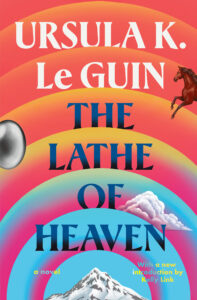
Originally, The Lathe of Heaven appeared in two installments in Amazing Stories, a pulp magazine started in 1926 by Hugo Gernsback. Ursula Le Guin, born in 1929, read Amazing Stories as a child and would go on to outlive almost all the science fiction pulp magazines.
You can read or copy the pdf of The Lathe of Heaven HERE and listen to a reading HERE
While many of the writers Gernsback introduced to the field have fallen out of fashion and been forgotten, Le Guin’s influence has expanded beyond all original bounds of genre, appropriately so, as her writing was profoundly slippery, generous, shape-shifting, and outreaching from the very start.
The Lathe of Heaven has the feel of a fable, part fairy tale, part philosophical and psychological exploration of questions central to much of Le Guin’s work: What are the consequences of working for change, even with the best of intentions? What is the cost of utopia? What is the use and meaning of dreams?
The protagonist, George Orr, changes the world in dreaming. He is frightened by this power, which he does not control consciously, but his therapist, Dr. Haber, seeks to harness his power to make a better world.
It’s a novel with very few characters, the sort of narrative I can’t help but imagine as a kind of black box theater performance, and The Lathe of Heaven was, in fact, twice made into a movie (Le Guin’s contemporary, the artist Ed Emshwiller, served as a visual consultant to the first adaptation, which is perhaps the only faithful adaptation of any of Le Guin’s work).
It is also, notably, Le Guin’s deliberate foray into Philip K. Dick’s territory, with its hallucinatory beginning, its drug-using protagonist, and its surreal, literally world-melting alternate realities. Dick and Le Guin were admirers of each other’s work and occasional correspondents.
They had attended the same high school at the same time, though in a detail once again straight out of a Dick novel, neither Le Guin nor any of her high school class could afterward recall him in any of their classes or circles.
I would argue that The Lathe of Heaven is also in conversation with the work of Theodore Sturgeon. Sturgeon was one of the first writers to introduce psychological realism into science fiction, exploring not only outer space but also the frontiers inside the human mind. Le Guin admired Sturgeon’s writing, and Sturgeon reviewed The Lathe of Heaven for the New York Times.
What are the consequences of working for change, even with the best of intentions? What is the cost of utopia? What is the use and meaning of dreams?
And now I have to digress for a moment, because I have so far only mentioned male writers, to put Le Guin’s work into context, when Le Guin was part of a cadre of women writers who were beginning to publish science fiction.




















 The Free