from thefreeonline at Strategic Culture by Alastair Crooke on 26 Jan 2023
The U.S. government is hostage to its financial hegemony in a way that is rarely fully understood.

It is the miscalculation of this era – one that may begin the collapse of dollar primacy, and therefore, global compliance with U.S. political. But its most grievous content is that it corners the U.S. into promoting dangerous Ukrainian escalation against Russia directly (i.e. Crimea).
Washington dares not – indeed cannot – yield on dollar primacy, the ultimate signifier for ‘American decline’. And so the U.S. government is hostage to its financial hegemony in a way that is rarely fully understood.
The Biden Team cannot withdraw its fantastical narrative of Russia’s imminent humiliation; they have bet the House on it. Yet it has become an existential issue for the U.S. precisely because of this egregious initial miscalculation that has been subsequently levered-up into a preposterous narrative of a floundering, at any moment ‘collapsing’ Russia.
What then is this ‘Great Surprise’ – the almost completely unforeseen event of recent geo-politics that has so shaken U.S. expectations, and which takes the world to the precipice?
It is, in a word, Resilience. The Resilience displayed by the Russian economy after the West had committed the entire weight of its financial resources to crushing Russia. The West bore down on Russia in every conceivable way – via financial, cultural and psychological war – and with real military war as the follow-through.
Yet, Russia has survived, and survived relatively handsomely. It is doing ‘okay’ – maybe better, even, than many Russia insiders were expecting. The ‘Anglo’ Intelligence services however, had assured EU leaders not to worry; it’s ‘slam dunk’; Putin cannot possibly survive. Rapid financial and political collapse, they promised, was certain under the tsunami of western sanctions.
Their analysis represents an Intelligence failure on a par with the non-existent Iraqi weapons of mass destruction. But instead of critical re-examination, as events failed to provide confirmation, they doubled down. But two such failures are just ‘too much’ to bear.
So why does this ‘failed expectation’ constitute such a world-shaking moment for our era? It is because the West fears that its miscalculation might well lead to the collapse of its dollar hegemony. But the fear extends well beyond that too – (bad as ‘that’ would be from the U.S. perspective).
Robert Kagan has outlined how external forward motion and the U.S.’ ‘global mission’ is the lifeblood of American internal polity – more than any equivocating nationalism, Professor Paul suggests. From the founding of the country, the U.S. has been an expansionary republican empire; without this forward motion, civic bonds of domestic unity come into question.
If Americans are not united for expansionary republican greatness, by what purpose Professor Paul asks, are all these fissiparous races, creeds, and cultures in America, bound together? (Woke culture has proved no solution, being divisive rather than any pole around which unity can be built).
The point here is that Russian Resilience, at a single stroke, shattered the plate-glass floor to western convictions about its ability to ‘manage the world’. After the several western debacles centred on regime-change by military shock-and-awe, even hardened neo-cons – by 2006 – had conceded that a weaponised financial system was the only means to ‘secure the Empire’.
But this conviction has now been upended – and states around the world have taken notice.
This shock of miscalculation is all the greater because the West disdainfully had taken Russia to be a backward economy, with a GDP on a par to that of Spain. In an interview with Le Figaro last week, Professor Emmanuel Todd noted that Russia and Belarus, taken together, constitute only 3.3% of global GDP. The French historian questioned therefore, ‘how then is it possible that these states could have shown such resilience – in the face of the full force of the financial onslaught’?
Well, firstly, as Professor Todd underlined, ‘GDP’ as a measure of economic resilience is wholly “fictional”. Contrary to its name, GDP measures only aggregate expenditures.
And that much of what is recorded as ‘production’, such the over-inflated billing for medical treatment in the U.S.’ and (said, tongue in cheek) services such as the hundreds of economists’ and bank analysts’ highly-paid analysis, are not production, per se, but “water vapour”.
Russia’s resilience, Todd attests, is due to the fact that it has a real economy of production. “War is the ultimate test of a political economy”, he notes. “It is the Great Revealer”.
And what is it that has been revealed? It has revealed another quite unexpected and shocking outcome – one that sends western commentators reeling – that Russia has not run out of missiles. ‘An economy the size of Spain, the western media ask, how can such a tiny economy sustain a prolonged war of attrition by NATO without running out of munitions?’.
But, as Todd outlines, Russia has been able to sustain its weapons-supply because it has a real economy of production that has the capacity to maintain a war – and the West no longer does. The West fixated on its misleading metric of GDP – and with its normalcy bias – is shocked that Russia has the capacity to outpace NATO’s arms inventories. Russia was billed by western analysts as a ‘paper tiger’ – a label that now seems more likely to apply to NATO.
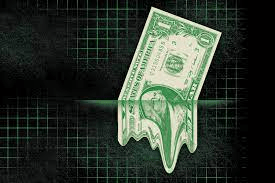
The import of the ‘Great Surprise’ – of Russian Resilience – resulting from its real economy of production vis á vis the evident weakness of the hyper-financialised western model scrabbling for sources of munitions has not been lost on the rest of the world.
There is old history here. In the lead-up to WW1, the British Establishment was concerned that they might lose the coming war with Germany: British banks tended to lend short-term, in a ‘pump and dump’ approach, whereas German banks invested directly in long-term real-economy industrial projects – and therefore were thought to be able to better sustain war materiel supply.
Even then, the Anglo élite had a quiet appreciation of the inherent frailty to a heavily financialised system for which they compensated by simply expropriating the resources of a huge Empire to finance preparation for the coming Great War.
Continue reading “The Most Catastrophic Mistake of the Idiotic US Empire”