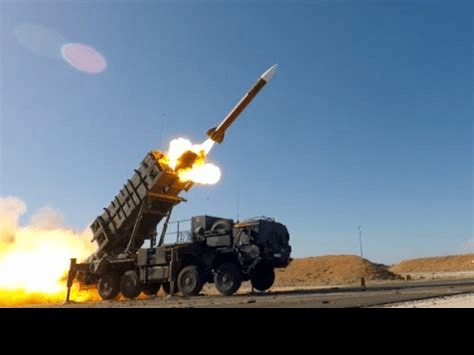
File this under the category, “Still more junk to send into that Junk Yard that is the Ukraine”.
This week we learned that the U.S. most likely will provide Ukraine with Patriot Air-Defense Missile complexes. You can find additional info in this RT story, in English. I also saw this excellent technical analysis by Brian Berletic:
From the Russian mainstream press, I have this piece by reporters Darya Volkova and Evgeny Pozdnyakov.
It could happen as early as next week, according to Westie media such as CNN and the Washington Post. Russian analysts are pretty sure that the final decision has already been made behind the scenes.
A Patriot battery consists of up to 8 launchers, each of which contains 4 rockets ready to launch. Russian media has not yet been able to determine, just how many of these batteries will be shipped to the Ukraine…
SEGUNDA LLAMADA A LA CARAVANA Y ENCUENTRO INTERNACIONAL
¡EL SUR RESISTE! 2023
.
A los pueblos en resistencia y rebeldía del Sur-Sureste de México
A las organizaciones de lucha abajo a la izquierda nacionales e internacionales
A las organizaciones de derechos humanos del mundo
A los medios de comunicación libres, alternativos o como se llamen
Después de reunirnos y conversar sobre los encuentros, actividades y diálogos compartidos durante la «CARAVANA POR EL SUR GLOBAL» realizada del 31 de Agosto al 7 de Octubre a través de diferentes geografías de SLUMIL K´AJXEMK´OP o “Tierra Insumisa” como fue renombrada la Otra Europa, queremos agradecer a las organizaciones, colectiv@s y personas quienes hicieron este recorrido posible y recibieron a quién fue delegado para compartir, escuchar y caminar con ustedes en sus territorios, luchas, resistencias y espacios colectivos, gracias compas. Retomando lo compartido, a manera de reflexión y para continuar construyendo y tejiendo…
“This essay is being written from prison. I am a political prisoner, which has made me strong in my convictions and allowed me to define myself and uproot patriarchal, racist, sexist, hierarchical, specieist and capitalist conditioning. But the programing has done damage deep within my mind, so I must struggle daily to change and grow in a more wholesome direction.“
In a previous essay we explored how to cultivate motivation for direct actions, and to visualize how to make meaningful progress toward the liberation of all beings, in detail. We will now build on that with specific examples and further motivations
Obviously we can be moved by current events, like the Women’s Revolution in Rojava and the more recent uprising of women in Iran, and the global support pouring in for that struggle.
There is also the regressive efforts of sexist religious fanatics in Amerikkka struggling to take away women’s bodily autonomy which need to be opposed. Ignoring these will only allow them to go further and further, slowing breaking down the healthy boundaries of progress that protect women’s rights.
If you still lack motivation to take direct actions then feel free to resort to the media of modern capitalism itself, which can be used against itself. I would like you, the reader, to respond to me directly. Tell me a revolutionary story. Tell me how someone defended the Earth, how someone resisted oppression. We have many examples, and we have many fictional stories too.
The true stories of the American Revolution, the Russian Revolution, the Chinese Revolution, Algeria, Vietnam, Kurdistan, Cuba, Venezuela and so on. A thrilling example is the movie “Beritan” which is available for free on YouTube. This film, produced by actual activists and revolutionaries, some of whom I was honored to meet in person in Rojava, tells the true story of a Kurdish woman named Beritan, who was a revolutionary guerilla fighting against forces of oppression. She and her lover sacrificed their relationship to join the revolution. I met the man who played Beritan’s lover in this movie. He has striking blue eyes. Beritan was betrayed and her team was attacked on a mountain, fighting to the last partisan.
Kurdish women hold a photo of Arin Mirkan, a Rojava defense volunteer (YPJ) killed in the war against ISIS
She refused to surrender, surrounded and outnumbered, and when she ran out of ammunition she smashed her own rifle and threw herself off a cliff rather face the humiliation of capture at the hands of misogynistic men. Her act of defiance moved the enemy deeply and many of them renounced their cause. Please watch this movie, it was filmed with real weapons instead of special effects, and realistically shows what modern combat is like. When I got home from Rojava I received death threats from Turkish soldiers who sent me pictures and videos of themselves killing and abusing Kurdish women. This struggle is still going on.
December 15, 2022The United States will provide combined arms maneuver training to Ukraine geared at enabling the Ukrainian military to better conduct joint operations at the battalion level, the Pentagon announced today.
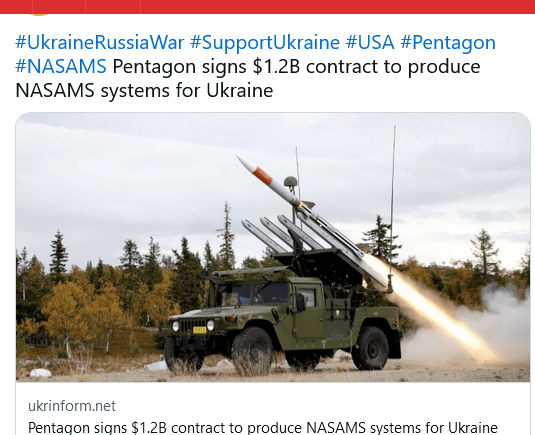
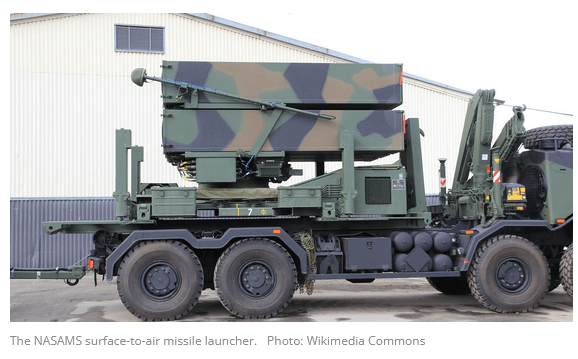
Pentagon to deliver $1.2 billion missile system to Ukraine Raytheon Co., Tewksbury, Massachusetts, was awarded a $1,216,207,829 firm-fixed-price contract for the procurement of National Advanced Surface-to-Air Missile Systems” the Pentagon said a statement.
The new training course, which begins in January, will be led by 7th Army Training Command in Germany and teach about 500 Ukrainian troops per month to give Ukraine training in the High Mobility Artillery Rocket System (HIMARS) and National Advanced Surface-to-Air Missile System (NASAMS) – it has obtained over the course of the war.
The announcement of the new training program comes days after reports that the Biden administration is finalizing plans to give Ukraine the Patriot surface-to-air missile system, with a public announcement that could occur as early as this week….
1 day ago Over the years the Patriotsystem and missiles have been continually modified. The current interceptor missile for thePatriotsystem costs approximately $4 million per round and the launchers cost about $10 million each, CSIS reported in its July missile defense report……
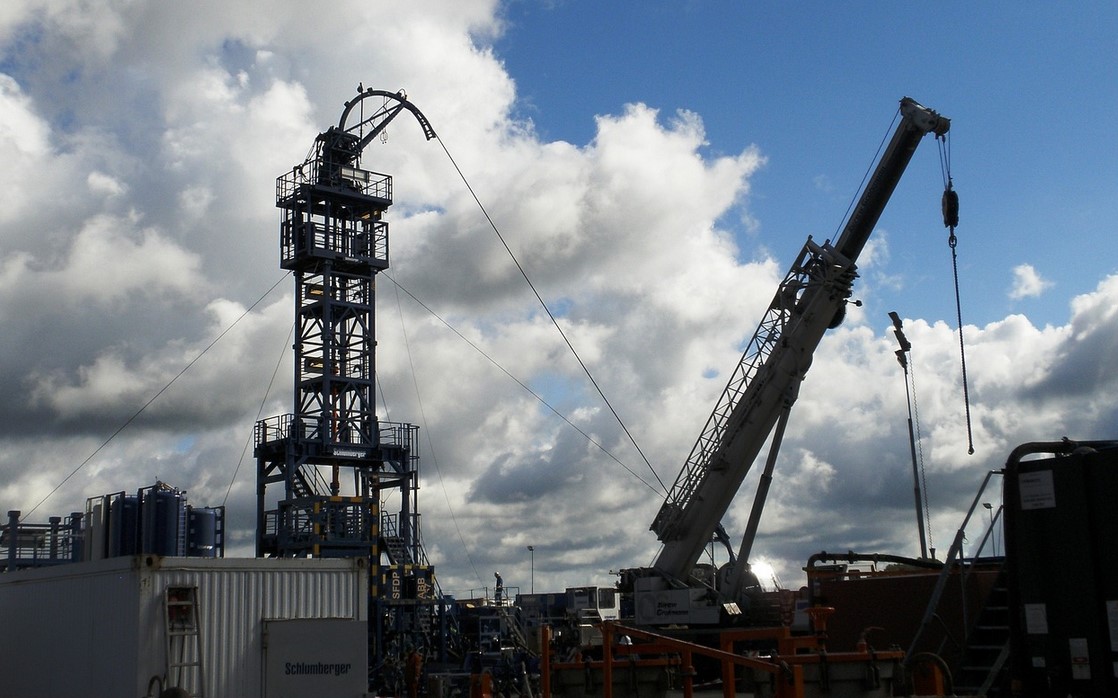
Forever Chemicals (PFAS) are a highly useful water repellant widely included in the secret toxic chemical mixtures added to billions of gallons of water pumped into the fracking wells, with zero oversight and exemption from Clean Water Laws, by the notorious ‘Cowboy Frackers’ who have then abandoned 3.2 million orphaned and abandoned wells (2021) and toxic ponds, often declaring bankruptcy to drill again with a new name, and thus pumping in ever more Forever Chemicals that can be lethal to humans at one part per trillion.
All this beneath US flags and claims to Make America Great Again, selling frack gas as LNG at astronomical prices to desperate nations deprived by the Pentagon’s wars, sanctions, cuts of Russian Gas and sabotage of Nordstream…..
**********
Waste from Fracking contains “Forever Chemicals” (PFAS) found Dumped at 100 U.S. Locations – By B.N. Frank
Earlier this month a fracking company agreed to a plea deal in Pennsylvania after a grand jury investigation revealed that its gas wells were malfunctioning “resulting in flammable methane leaking into aquifers in Dimock and the surrounding area.” Of course, fracking has led to complaints in other U.S. locations as well.
“In the Energy Policy Act of 2005, Congress revised the Safe Drinking Water Act (SDWA) to exclude “the underground injection of fluids or propping agents (other than diesel fuels) pursuant to hydraulic fracturing operations related to oil, gas, or geothermal production activities” from the Safe Drinking Water Act’s requirements for the underground injection control (UIC) program”. ballotpedia.org
Revealed: Nearly 100 potential PFAS-polluted sites in Pennsylvania, Ohio and West Virginia from fracking waste
Kristina Marusic PITTSBURGH — Waste from fracking wells that used PFAS – commonly known as “forever chemicals”– has been dumped at dozens of sites across Pennsylvania, Ohio and West Virginia — all of which could face contamination of soil, groundwater and drinking water as a result.
PFAS (per- and polyfluoroalkyl substances) have been used in hydraulic fracturing and other types of oil and gas wells across the U.S. for at least a decade.
Exposure to the chemicals, which are also used to make various consumer products nonstick and waterproof, is linked to health problems including kidney and testicular cancer, liver and thyroid problems, reproductive problems, lowered vaccine efficacy in children and increased risk of birth defects, among others.
In August, however, Environmental Health News (EHN), documented the first case of private drinking water contaminated with PFAS potentially linked to fracking wells, and in October EHN mapped the eight locations where operators have publicly disclosed the kind of PFAS they used in Pennsylvania fracking wells.
Now, a new map developed for EHN by FracTracker using public data reveals that waste generated at the eight Pennsylvania fracking wells with documented PFAS use has traveled to at least 97 additional sites for reuse and disposal.
Those eight wells generated more than 23 million gallons of liquid waste and 30,390 tons of solid waste between 2012 and 2022 so far.
Anarchism is arguably a useless word. Because it has been so commonly defined as chaos, it’s almost impossible to have a conversation about anarchism without being misunderstood. Scott Branson acknowledges that using the term might be a losing battle, but use it they do, proudly reclaiming and reimagining anarchism as a down to earth way of life.
“Anarchism has to be a continual practice, not a static ideology,” says Branson. It has no end goal. It’s not out to stir up a revolution or deliver a prescribed solution. Instead, the book seeks to “focus on anarchism as a daily practice of care, in relationships with our loved ones, ourselves, our comrades in struggle, our neighbours, strangers, and unpredictable solidarities to come.”
This is a useful idea. At the moment the loudest critiques of state power come from more libertarian voices. They tend to prize individual autonomy and individual rights, and at its more extreme edges this can become deeply anti-social. Anarchism sees freedom within relationships and community, which is more true to how everyday life unfolds.
Most of us are not cabin-dwelling frontiersmen, forging our solitary way against the world. We live embedded in families, communities, societies, networks of relationships that make life possible. “We have our survival bound up with each other,” writes Branson.
Eric Zuesse Currently, the U.S. has exactly 900 military bases in foreign countries, in addition to the 749 bases inside the U.S. itself. The U.S. Government minimizes and tries to hide this reality from the public. Furthermore, although the U.S. is officially estimated to spend around 36% of the entire world’s military expenditures, the actual figure is around […]