
Features, Nov 2022 at FreedomNews by Danny Mitchell and Ross Domoney via thefreeonline.com
In 2019 a crew of experienced documentary makers travelled to the Autonomous Administration of North and East Syria (AANES), commonly known as Rojava. The cameras followed Janet Biehl as she got to grips with the role that her late partner Murray Bookchin’s ideas played in the region’s Kurdish-led revolutionary movement.
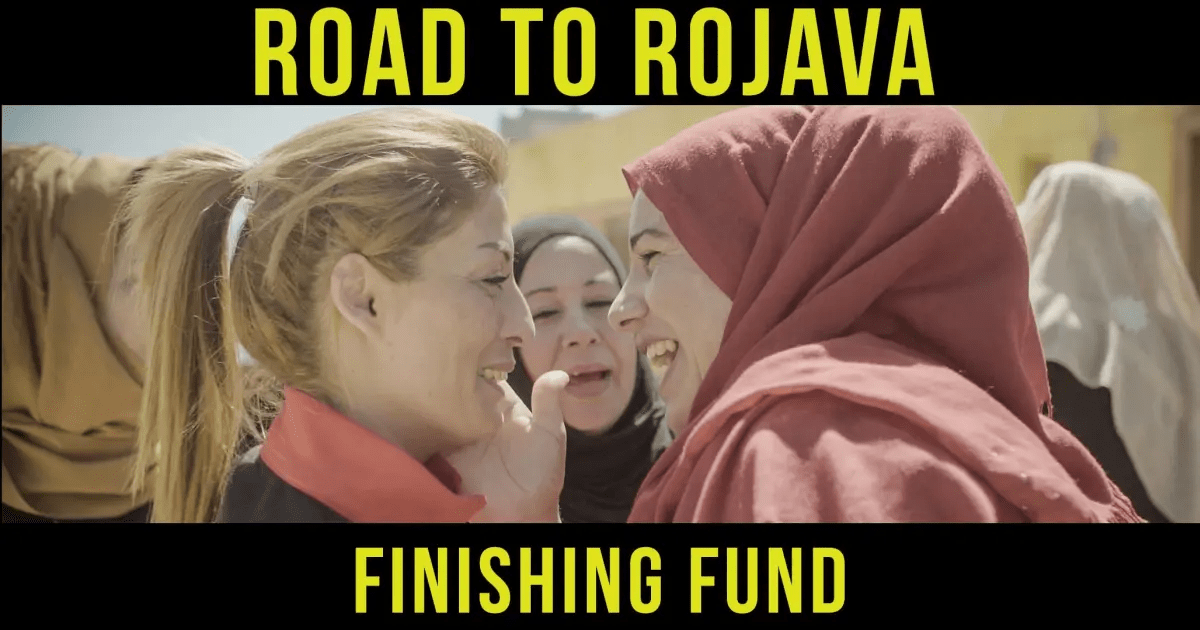
That documentary, called Road to Rojava, is now reaching its final stages of production. The team isasking for help to complete the crowdfunder and finish the film.
This is an interview with directors, Danny Mitchell and Ross Domoney, and looks at the experiences they had making the documentary. The pair met at a screening of The Accidental Anarchist and realised they shared a vision of documenting daily life in Rojava.
What motivated you both to make the documentary?
DM: I have been interested in the revolution in Rojava since I first heard about it around 2014. I wanted to explore what was happening there as a filmmaker and go behind the news headlines because at the time, most of the news was primarily focused on the battles with ISIS and there was hardly anything about the political project being developed in Rojava. I had tried different ways of approaching the story but nothing had materialised but had heard Janet speak at various conferences and was intrigued by her story. I was interested in her connection with Murray Bookchin and how Abdullah Öcalan had used some of Bookchin’s revolutionary ideas as part of the political framework for the revolution in Rojava. I thought this could be a good way to approach the story and may help to bring it to a wider audience.


RD: I had been interested in the politics of Syria since the beginning of the uprising against the authoritarian regime of Bashar Al Assad in 2011. It was not so easy for me to go to other parts of Syria amongst the conflict and I am not a frontline war reporter. The politics of North and East Syria where the Rojava revolution happened, particularly interested me and it was more accessible with the right connections. I had tried to go there twice in the past but the situation was too dangerous so the trips had not gone ahead. I wanted to explore with my camera the radical democratic experiment that was being played out amongst the ashes of war. And where I was interested in the politics of the ecologist Murray Bookchin, I was most interested in learning about life there from the people of North and East Syria. I wanted to spend time with them, and find ways to use the film-making process to put the most value cinematically to their stories. I wanted to go beyond the poster images some western leftists where imagining of the Rojava revolution. We saw a lot of people re-sharing images of women with machine guns taking on ISIS. Of course this is amazing bravery (and we have also captured some of these images in our film). However I wanted to use the film-making process to go further and explore the different layers of the revolutionary society in Rojava.
Continue reading “Road to Rojava”