Retrato del activismo y resistencia de colectivas de jóvenes lesbianas y bisexualas, trans incluyentes en Brasil/Colombia/México, ante un contexto de resurgimiento de la ultra derecha.
Este documental fue grabado durante el estallido en América Latina y realizado por mujeres lesbianas, bisexuales y personas no binaries.
Duración: 41 minutos. Dirección: Al Vallejo Producción: México, Chile, Colombia y Brasil (2021)
*Después de la proyección conversaremos con las realizadoras.
By Ron Paul Source: Ron Paul Institute There is a video clip making the rounds showing President Biden speaking at a recent NATO summit about the seven billion dollars the US government had – at that time – provided to Ukraine. Attached to that is another clip showing the horrific state of several US major […]
PFAS, a group of manufactured chemicals commonly used since the 1940s, are called “forever chemicals” for a reason. Bacteria can’t eat them; fire can’t incinerate them; and water can’t dilute them.
And, if these toxic chemicals are buried, they leach into surrounding soil, becoming a persistent problem for generations to come.
Forever chemicals are everywhere, even in our blood, and are incredibly toxic and almost indestructible.. until now. The new simple way to destroy at least a few of them opens the way for a long control campaign, but can only work if twinned by total and enforced production bans
Now, Northwestern University chemists have done the seemingly impossible. Using low temperatures and inexpensive, common reagents, the research team developed a process that causes two major classes of PFAS compounds to fall apart — leaving behind only benign end products.
The simple technique potentially could be a powerful solution for finally disposing of these harmful chemicals, which are linked to many dangerous health effects in humans, livestock and the environment.
“PFAS has become a major societal problem,” said Northwestern’s William Dichtel, who led the study. “Even just a tiny, tiny amount of PFAS causes negative health effects, and it does not break down.
We can’t just wait out this problem. We wanted to use chemistry to address this problem and create a solution that the world can use. It’s exciting because of how simple — yet unrecognized — our solution is.”
Dichtel is the Robert L. Letsinger Professor of Chemistry in Northwestern’s Weinberg College of Arts and Sciences. Brittany Trang, who conducted the project as a part of her recently completed doctoral thesis in Dichtel’s laboratory, is the paper’s co-first author.
‘The same category as lead’
Short for per- and polyfluoroalkyl substances, PFAS has been in use for 70 years as nonstick and waterproofing agents. They are commonly found in nonstick cookware, waterproof cosmetics, firefighting foams, water-repellent fabrics and products that resist grease and oil.
Over the years, however, PFAS has made its way out of consumer goods and into our drinking water and even into the blood of 97% of the U.S. population.
Although the health effects are not yet fully understood, PFAS exposure is strongly associated with decreased fertility, developmental effects in children, increased risks of various types of cancer, reduced immunity to fight infections and increased cholesterol levels.
With these adverse health effects in mind, the U.S. Environmental Protection Agency (EPA) recently declared several PFAS as unsafe — even at trace levels.
“Recently, the EPA revised its recommendations for PFOA essentially down to zero,” Dichtel said. “That puts several PFAS into the same category as lead.”
Unbreakable bonds
Although community efforts to filter PFAS from water have been successful, there are few solutions for how to dispose of PFAS once it is removed. The few option that are now emerging generally involved PFAS destruction at high temperatures and pressures or other methods that require large energy inputs.
This year, members of the Incarcerated Workers Organising Committee will join with prisoners and their families to call for an end to their incarceration. IWOC will reach out to members incarcerated in Ireland and extend it solidarity with them directly. This year we will draw attention to the case of our member John Paul Wootton […]
“While Beijing has a repeated history of forgiving loans like this, Western governments have made baseless, politically motivated accusations that China uses “debt-trap diplomacy” in the Global South”.
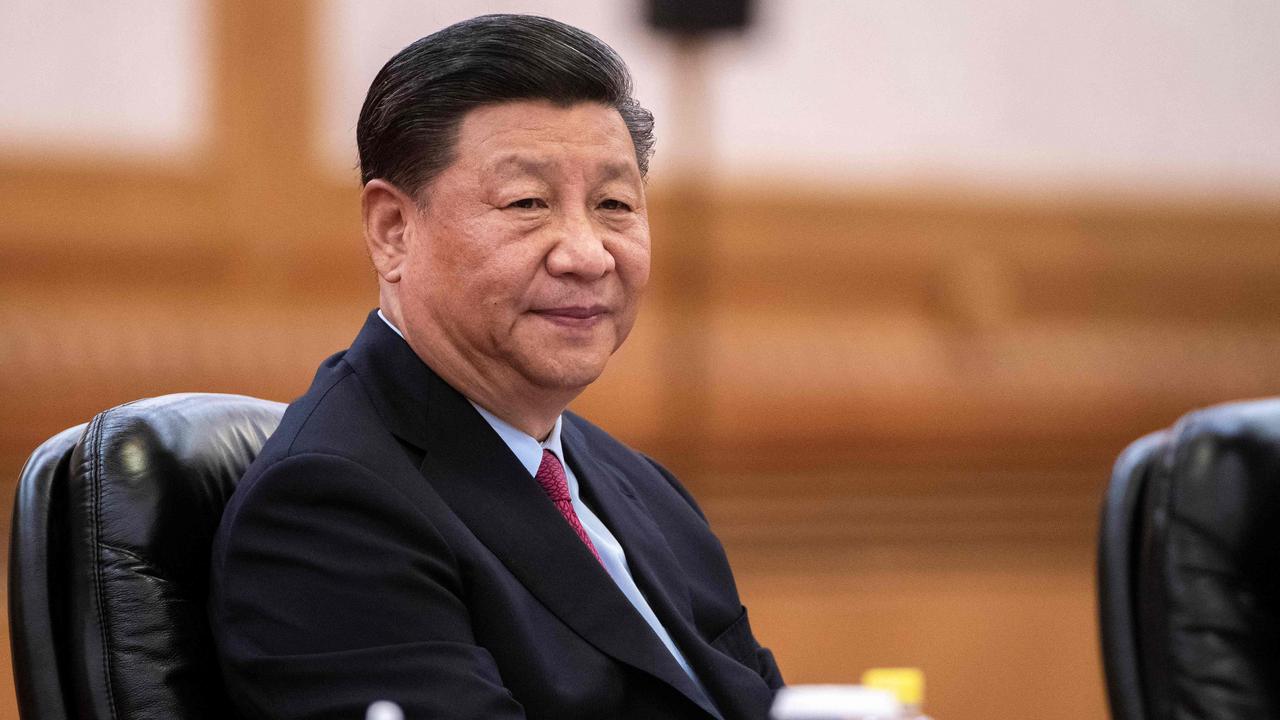
Chinese President Xi Jinping at the Forum on China-Africa Cooperation in 2018
China is forgiving 23 interest-free loans for 17 African countries, after already cancelling $3.4 billion and restructuring $15 billion of debt from 2000-2019. Beijing pledged more infrastructure projects and offered favorable trade deals in a “win-win” model of “mutually beneficial cooperation.”
The Chinese government has announced that it is forgiving 23 interest-free loans for 17 African nations, while pledging to deepen its collaboration with the continent.
This is in addition to China’s cancellation of more than $3.4 billion in debt and restructuring of around $15 billion of debt in Africa between 2000 and 2019.
The United States has turned Africa into a battleground in its new cold war on China and Russia.
And Washington has weaponized dubious claims of Chinese “debt traps” to try to demonize Beijing for its substantial infrastructure projects on the continent.
For its part, China has pushed back against the US new cold war.
Chinese Foreign Minister Wang Yi held a meeting with leaders from various African countries and the African Union on August 18.
In the conference, Wang condemned the West’s “zero-sum Cold War mentality.” He instead proposed a model based on “multi-party cooperation” with Africa that brings “win-win results” for all sides.
Por Semanario Voz Las comunidades campesinas tienen la esperanza en las transformaciones que permitan la superación de la pobreza, el acceso a la tierra y la defensa de la soberanía nacional. VOZ conversó con Nury Martínez, presidenta de la Federación Nacional Sindical Unitaria Agropecuaria, organización que realizará su congreso nacional Claudia Flórez Sepúlveda La Federación […]
“China will waive the 23 interest-free loans for 17 African countries that had matured by the end of 2021,” Mr Wang said at the Forum on China-Africa Cooperation according to a statement.
He pledged that China would continue to actively support and participate in the construction of major infrastructure projects in Africa through financing, investment and assistance.
“We will also continue to increase imports from Africa, support the greater development of Africa’s agricultural and manufacturing sectors, and expand co-operation in emerging industries such as the digital economy, health, green and low-carbon sectors.”
Mr Wang also pledged that China would provide food assistance to the 17 African nations.
Critics argue China is involved “debt trap diplomacy”, alleging the country issues loans in order to eventually secure strategic international assets.
Chinese President Xi Jinping has been criticised of ‘debt trap diplomacy’. Picture: AFP
South Asian country Sri Lanka granted China Merchants Ports Holdings a 99-year lease on the $US1.5 billion ($A2 billion) Chinese-built deepwater Hambantota Port in 2017 after falling deep into debt.
Kenya, South Africa and Uganda are among numerous African states that have borrowed heavily from Chinese lenders.
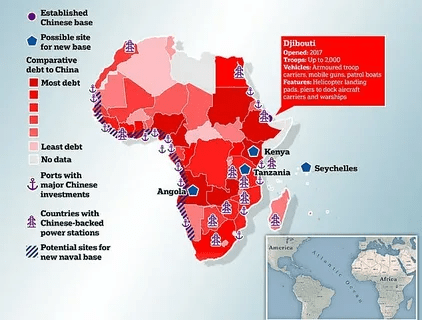
According to World Bank data from 2020 cited by Forbes, the African nations with the highest external debt to China as a percentage of gross national income are Djibouti (43 per cent), Angola (41 per cent) and the Democratic Republic of Congo (29 per cent).
African countries have also enthusiastically joined China’s transcontinental Belt and Road Initiative to build port, rail and land infrastructure, Beijing’s modern-day Silk Road.
But the concept of a Chinese “debt trap” has also been criticised, with a study in 2020 finding China had restructured or refinanced about $21 billion of debt in Africa between 2000 and 2019. The study also noted there was no evidence of “asset seizures”and that Chinese lenders had not used courts to enforce payments, or applied penalty interest rates to distressed borrowers.
Meanwhile, Adalberto Costa Junior, a presidential candidate in Angola, has vowed to examine the county’s debt if he is elected.
Angola owes about $90 billion, which will cost it about $8 billion each year in amortisation, according to Bloomberg.
“The amount of real foreign debt is not known,” Mr Junior said in an interview on the weekend.
Around $27 billion of Angola’s total debt is owed to China, with the funds used to build roads, hospitals and railway links.
Mr Junior warned that any borrowings not linked to infrastructure projects could be renegotiated.