updates.. Slovakia to pay for Russian gas in rubles. Hungary /Austria say it’s ‘Impossible to leave Russian gas. India buys oil….

3 Apr, 2022 13:52 HomeBusiness News
Slovakia cannot afford to lose its major supplier

Slovakia will pay for Russian natural gas in rubles if that’s what it takes to keep the commodity flowing, Slovak Economy Minister Richard Sulik has said on national television.

“If there is a condition to pay in rubles, then we will pay in rubles,” Sulik said. He stressed that Russian imports account for roughly 85% of all Slovakian gas supplies, so the country’s authorities will remain pragmatic on the issue.

“We cannot be cut off from gas,” Sulik emphasized, urging the rest of Europe to jointly seek a solution.

Nearly all of the countries of the European Union, of which Slovakia is a member, slapped Russia with economic sanctions over the past month, jeopardizing Russia’s ability to receive payments from trade partners in the European currency. In response, Russian President Vladimir Putin last week signed a decree introducing a new ruble gas payment mechanism.

READ MORE: Moscow explains switch to ruble for gas payments

Although it is viewed by some as going against existing gas contracts, the mechanism does not imply a change of the currency of payment. It enables buyers to open ruble accounts with Russian Gazprombank to facilitate the transfer of European companies’ payments to Russian suppliers.

According to Putin’s press secretary Dmitry Peskov, “de facto nothing will change for European companies… They will pay, as they used to, in euro, the same currency that is indicated in the contracts,” but the seller, Russia’s major gas exporter Gazprom, will be able to receive the funds in Russia’s national currency. Despite extensive explanations, however, many Russian buyers found themselves puzzled by the change. The initial reaction was mostly one of protest, with countries claiming they would not pay for gas in rubles. However, it appears that this will not be necessary at all.

The Slovakian economy minister, along with a number of other European politicians, said the situation calls for diversification of suppliers. But he said this may take years, while Slovakia has only two months to solve the current problem with fuel purchases.

*************

Germany’s Russian Gas contract was with now Defunct Gasprom subsidiary: The Plot Thickens…/Club Orlov

via.. https://boosty.to/cluborlov/ shared with thanks
by Dmitry Orlov

German-language media has already been going crazy lately about future purchases of oil and natural gas.

Since Germany is included in the list of “unfriendly countries” by Russia, it, like all the EU states, will only be allowed to purchase Russian natural gas for rubles, and not for euros or US dollars.

see also: Slovakia agrees to pay for Russian gas in rubles. Hungary /Austria say it’s ‘Impossible to leave Russian gas..

And now comes this bit of news, which should make the German talking heads go super-double-crazy: Germany will be left without Russian gas because its contract is not with Gazprom but with its subsidiary Gazprom Germany, which Gazprom has abandoned.
Barely a day or two ago, German officials were loudly declaring that their contract with Gazprom provides for payment in euros or dollars, and therefore Germany will not pay for Russian gas in rubles.

That ought to make everything perfectly clear. However, Germany’s gas supply contract is with Gazprom Germania GmbH, located in Berlin, and not with actual Gazprom, headquartered in St. Petersburg!

Do the German authorities even know that these are now two completely different organizations?

continue reading HERE…https://thefreeonline.com/2022/04/04/germanys-russian-gas-contract-was-with-now-defunct-gasprom-subsidiary-the-plot-thickens/

****************

Impossible to replace Russian gas with ‘expensive’ US fuel – Hungary

Viktor Orban says Russian gas is his country’s only option
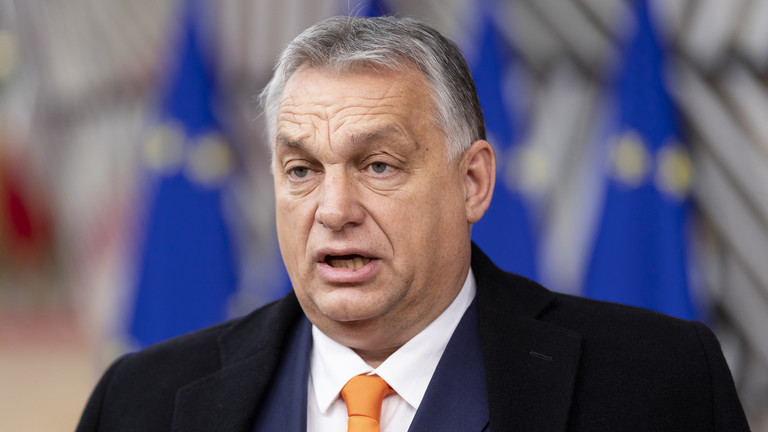
Viktor Orban © Thierry Monasse / Getty Images

Hungarian Prime Minister Viktor Orban said, on Friday, that there are countries which will not be able to substitute Russian gas with the more expensive American alternative.

Speaking to local radio station Kossuth, ahead of this weekend’s parliamentary election, Orban said Russian gas is his country’s only option, as Hungary is landlocked and won’t be able to directly receive liquified gas from the US. 

Orban reiterated that Hungary condemns Russia’s attack against Ukraine, and that he understands the efforts of Ukrainian President Volodymyr Zelensky, as his country is in trouble and he is looking out for Ukrainian interests, but stated that Hungary “can’t help the Ukrainian people by destroying itself.” 

This war is not our war, we can’t win here, but we can lose everything. The question is will we have an economy left by the end of it or not.

‘Impossible’ for Austria to ban Russian gas – energy giant

The repercussions for the economy would be too great
Austria is unable to stop buying Russian natural gas this year, the head of energy giant OMV, Alfred Stern, said in response to calls for European states to place an embargo on Russian supplies.

“Embargo on Russian gas is impossible if we are not ready to accept the dire consequences. Some countries could do it, but for Austria it is not possible this year… The phase-out of Russian gas comes at a price,” he stated in an interview with Die Presse.

Stern explained that unlike some EU countries, Austria “is in a difficult position” when it comes to alternative energy sources, having “no access to the sea, no access to liquefied petroleum gas.”

Stern is not alone in his views regarding Austria’s dependence on Russian energy. Austrian Chancellor Karl Nehammer said earlier this week that he does not support any restrictions on the supply of oil and gas from Russia to Europe.

“From us there should be a clear rejection of any ideas about stopping the import of Russian gas or Russian oil,” Nehammer said in an interview with OE24 TV.

Currently, gas storage facilities in Austria are only 13% full, media reports, citing industry sources.

Moscow’s new gas payment scheme explained

Russia boosts gas flows to Europe through Ukraine

Germany has refused to comply with Russia’s demands

Germany – one of Europe’s industrial powerhouses – is a major importer of Russian natural gas, with 34% of the fuel consumed in the country last year coming from Russia

Germany has refused to comply with Russia’s demands, describing them as “blackmail” which runs counter to the terms of the existing gas contracts. However, refusing to pay for its gas would be financial suicide.

Moscow and the EU are currently at loggerheads regarding payment for future gas deliveries, as Brussels rejected Moscow’s demand of payments in rubles. The Kremlin says currencies like the dollar and the euro have been compromised by the sanctions and Russia will not deliver gas for free.

The Kremlin said on Wednesday that the trans

Russia boosts gas flows to Europe through Ukraine. Pays Transit fees in Hard Cash March 23

****************

A Latvian gas operator says the procedure doesn’t breach Western sanctions

Baltic state may agree to pay for Russian gas in rubles

Latvia’s main gas operator says it won’t rule out paying for Russian natural gas in rubles, revealing that the new settlement method announced by Moscow is being evaluated from a legal and business perspective.

“According to the first impression, the settlement procedure in Russian rubles does not formally violate the sanctions regime and is possible,” Latvijas Gaze said in a statement.

Earlier, Aigars Kalvitis, the board chairman of Latvijas Gaze, which is partially owned by Russia’s Gazprom, said the company couldn’t pay for natural gas supplies from Russia in rubles, since the current contract stipulates that all transactions must be made in euro.

READ MORE: Slovakia agrees to pay for Russian gas in rubles

Last week, Russian President Vladimir Putin ordered the government to take necessary steps to switch all payments for gas sales involving “hostile” countries to Russian currency from April 1. According to the Kremlin, the change concerns nations that imposed sanctions against Russia with the intention of damaging the country’s economy, which includes most EU member states.

Putin warned EU countries that they would need to set up ruble accounts to pay for Russian gas, saying that existing contracts would be halted if the payments were not made.

On Saturday, the head of Latvia’s natural gas storage operator Conexus Baltic Grid said that all the Baltic states – Latvia, Estonia and Lithuania – were no longer importing Russian natural gas.

see also:

Hungary’s Orban criticized for ‘neutrality’ in Ukraine war … https://japantoday.com ‘Blocking Russian energy exports would force Hungarians to “pay the price of the war,” Orban said, noting that 85% of Hungary’s gas and more than 60% of its oil comes from Russia’…./… India, Brazil, UAE, Pakistan, Hungary, Israel and so on all deciding to remain on the fence in what actually is a huge snub to the US. Saudi’s selling oil in Yuan? (bye bye USD) India buying Russian oil in Rubles? (bye bye USD) The EU starting the paperwork to pay for Russian gas in Rubles? (bye bye USD)

Amazon workers form first US union

https://www.rt.com/news/553147-amazon-1 Apr, 2022

Staten Island warehouse employees become first in US to organize in grassroots union

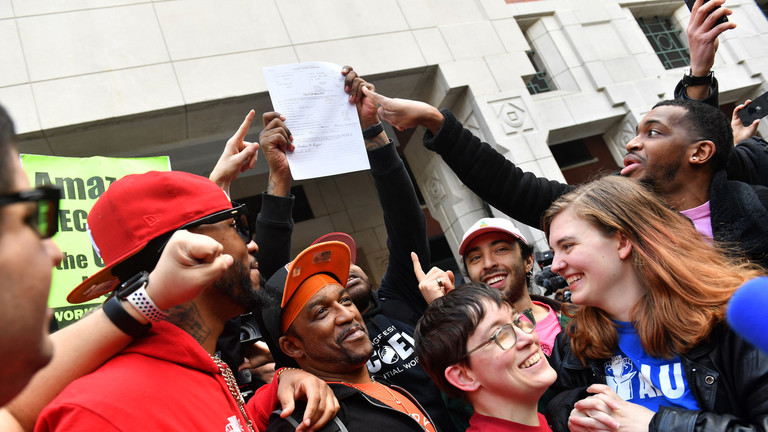
Amazon employees celebrate (with ALU leader Chris Smalls at left) © AFP / Andrea Renault

Employees of Amazon’s largest New York City warehouse have voted to unionize, overcoming the trillion-dollar company’s ferocious opposition, to become its first American workers to successfully organize.

The vote came in on Friday, with 2,654 votes for and 2,131 against union membership, and while it remains to be officially certified by the National Labor Relations Board (NLRB), Amazon has not challenged enough ballots to change the total.

Read more… Black Friday on track to be truly black day for Amazon

Workers at the Staten Island facility known as JFK8 will become part of the Amazon Labor Union, whose demands include “more reasonable” productivity rates in the warehouse, higher wages, more paid breaks and vacations, among other demands.

ALU, which launched last April in an effort to organize JFK8 and the three other Amazon facilities on Staten Island, is a grassroots effort established by a former colleague who got the axe for his own worker organizing efforts in 2020.

Founder Christian Smalls was fired as a warehouse manager a month after the Covid-19 pandemic hit New York, accused by Amazon of violating social distancing rules while he himself claimed the company had retaliated against him for protesting its lackluster Covid-19 safety precautions.

Smalls’ protest attracted the attention of Amazon’s general counsel, who dismissed him in a company memo as “not smart or articulate” and suggested he be used to smear all employee resistance as similarly incompetent.

But the former warehouse worker doubled down on his organizing efforts, denouncing the company’s Dickensian treatment of its workers at rallies and even suing Amazon for alleged racial discrimination, using the executive’s comments as evidence. 

After watching an effort by Amazon workers to unionize in Bessemer, Alabama, fail, Smalls formed ALU, reasoning that a brand-new union made up of solely Amazon employees was the best way to take on the mega-corporation.

The Bessemer warehouse staged a do-over vote after the NLRB ruled Amazon inappropriately interfered in its previous effort to unionize with the Retail, Wholesale, and Department Store Union last year.

While the votes were counted as of Thursday, with pro-union numbers lagging behind, the NLRB and Amazon have both challenged over 100 votes, and it remains to be seen who will be victorious.

READ MORE: Amazon denied sick leave to workers who later died – rights group

Amazon responded with disappointment to the Staten Island election results, revealing in a statement posted to its website that the company is “evaluating our options, including filing objections based on the inappropriate and undue influence by the NLRB that we and others (including the National Retail Federation and US Chamber of Commerce) witnessed in this election.” 

Workers might object to this characterization, however, reportedly laboring in a workplace papered with banners reading “Vote No,” forced to attend mandatory weekly anti-union meetings, and subject to the depredations of Global Strategy Group, a polling firm closely tied to Democratic political groups.

The company launched a spin-heavy website on which it attempted to frame its own benefits as superior to those offered by unions, though it’s not clear whose unions they compared themselves to, given that no American Amazon employees are union members.

New Study finds persistent Heart Abnormalities among Covid-19 Vaccinated Children

ByThe Exposé on •( 10 Comments )

A follow up study conducted at the Seattle Children’s Hospital of children suffering myocarditis following their second dose of the Pfizer mRNA vaccine was published in the Journal of Pediatrics on 25 March 2022.

By Guy Hatchard

The study followed up 16 male children, with an average age of 15 years, 3 to 8 months after their initial diagnosis with myocarditis within a short time frame following mRNA vaccination.

see also More Children Die From the COVID Shot Than From COVID : Malone ++ Sacrificing Children

The authors used Electrocardiograms and Cardiac Magnetic Resonance (CMR) to examine abnormalities in the heart such as myocardial scarring, fibrosis, strain, and reduced ventricular muscle extension which can be associated with reduced capacity to pump blood and increased risk of heart attack.

The authors found that although there was some measure of resolution after 3 – 8 months most subjects still had some persistent abnormalities.

“Although (initial) symptoms (such as chest pain, and exercise intolerance) were transient and most patients appeared to respond to treatment (solely with NSAIDS such as ibuprofen), we demonstrated persistence of abnormal findings on CMR at (3-8 months) follow up in most patients, albeit with improvement in extent of LGE (a measure of the heart’s capacity to pump efficiently).”

A Call to Europe: The Future of Our Children is at Stake – Historical Press Conf. in Brussels Jan 23 [12 Videos with Subtitles]

The authors warned:

“The presence of LGE is an indicator of cardiac injury and fibrosis and has been strongly associated with worse prognosis in patients with classical acute myocarditis. A meta-analysis including 8 studies found that presence of LGE is a predictor of all cause death, cardiovascular death, cardiac transplant, rehospitalization, recurrent acute myocarditis and requirement for mechanical circulatory support.”

Continue reading “New Study finds persistent Heart Abnormalities among Covid-19 Vaccinated Children”

Damning Report Warns We Must Change Food Production to Save Our Planet. Here’s How – ScienceAlert — Barbara Crane Navarro

ScienceAlert — Barbara Crane Navarro shared with thanks

note: we tried to check if Science Alert or the Global Alliance for the Future of Food are connected to the WEF Great Reset conspiracy. Found some good info and a spaghetti of acronyms of similar Western groupings. No analysis here of the Great Agri-business scam, GM foods, etc. . Let’s remember that smallholder farmers produce 70 per cent of the world’s food.!..

Here’s How – ScienceAlert https://ift.tt/kIfwu9P Damning Report Warns We Must Change Food Production to Save Our Planet.

National climate plans often fail to prioritize food systems, and a new report from the Global Alliance for the Future of Food warns that’s a lost opportunity.

see also: Solar Foods – Food out of thin air.

If the world can change the way it produces, distributes, consumes, and disposes of food, estimates show we can reduce greenhouse gas emissions by at least 10.3 billion metric tons a year. That alone would get us 20 percent of the way to the Paris Climate Agreement’s 2050 goals.

Continue reading “Damning Report Warns We Must Change Food Production to Save Our Planet. Here’s How – ScienceAlert — Barbara Crane Navarro”

Callout to prevent a Massacre against the Liberation Process of Mother Earth in Cauca, Colombia

Background article first

Dispossession: origin of the conflict over land in Cauca


Background article intro By: Pedro Augusto García Leal escribano– May 19, 2016

The struggle of the indigenous communities of Cauca for the liberation of the land involves ancestral claims that are part of an authentic culture of resistance, with its own historicity and worldview that cannot be confused with the processes of peasant struggle.

However, given the dynamics of the current conflict over land, the liberation processes can be interpreted as a conflict of ethnic roots that intersects with class conflicts over land.

A story of dispossession

Although the practice of dispossession against indigenous peoples has been constant since colonial times, it is possible to distinguish three central moments.

The first dispossession occurred in the colonial period, during the establishment of haciendas that began in the 16th century and ended in the 17th century, when the great war efforts of the indigenous communities of the department of Cauca and southern Tolima ceased due to expel the Spanish invader, the last of them recorded for 1656, as Víctor Bonilla recalls in his «Political history of the Nasa people».

The second moment occurs during the landed expansion of the late nineteenth century until well into the twentieth century. By then, large landowner families from Cauca, such as the Mosqueras, the Zambranos, the Valencias and the Arboledas, held property titles over the ancestral lands of the indigenous peoples, despite the fact that Law 89 of 1890 guaranteed the non-alienable nature of the lands of the safeguards.

The mechanism for achieving these properties was illegality and violence.

The last moment takes place in the middle of the 20th century, when different factors combined to lead to the usurpation of indigenous lands. On the one hand, the violence of the 1950s allowed the increase of landed property in northern Cauca.

In the 1960s, the agrarian modernization policies and the international increase in the demand for Colombian sugar, generated by the blockade on the commercialization of Cuban production as a result of the 1959 revolution, allowed the increase and consolidation of sugar crops. cane in the North of Cauca, which implied a new cycle of expropriation of indigenous lands.

The history that explains the way in which the lowlands of Cauca are today under property titles of large landowners and mills clearly shows the illegitimacy of the origin of these properties, based on violence as a mechanism that allowed the concentration of land. and the necessary accumulation for the subsequent reproduction of capital.

On the contrary, the struggle of the indigenous communities is not for the private appropriation of these territories, but rather the movement seeks that the lands become part of the collective territories of the reservations.

Collective land, not parceled

The way in which the Nasa indigenous communities assume ownership of the land indicates a historical process of construction of collective identities that distinguishes them from the peasant movement.

Continue reading “Callout to prevent a Massacre against the Liberation Process of Mother Earth in Cauca, Colombia”

Freedom for anarchist Giannis Michailidis – Gathering in Athens [Greece]

Anarchist prisoner Giannis Michailidis has been imprisoned for more than 8 and a half years in the cells of democracy and 3 years in fugitive status in two different periods.

continue reading here…; Freedom to anarchist Giannis Michailidis – Gathering in Athens [Greece]

*************************************

More info…

from Act for Freedom Now

On 30/1/2020, comrades Dimitra Valavani, Konstantina Athanasopoulou and Giannis Michailidis were arrested in a stolen car in Agia Paraskevi following an anti-terrorist operation.
Giannis was originally arrested in 2013 for bank ‘expropriation’ but escaped from the Tyrintha agricultural prison in June 2019. Konstantina was also on the run, she had been sentenced in her absence to 35 years jail..
Dimitra Valavani was not a fugitive although she was awaiting a trial for allegedly resisting the violent taking of her DNA sample by the police see: https://enoughisenough14.org/2021/04/02/dimitra-valavani-trial-..

Weapons were found inside the car, which was driven by Giannis Michailidis. He and Konstantina Athanasopoulou were wanted, the first as fugitive from the rural prisons of Tirintha and for participation in the E.A. , R.O.  REVOLUTIONARY STRUGGLE  the second for bank robbery.

All three comrades were tried on in the courts in Athens , Loukareos Street, room D80ST, 2nd floor.

The robbery of Piraeus Bank in Achaia on 29/8/2019 was added to the case, as well as holding a police officer hostage in Halkidiki on 30/12/2019.

 NO HOSTAGE IN THE HANDS OF THE STATE

HANDS OFF THE FIGHTERS

by Act for freedom now!

************************

Related

continue reading here…; Freedom to anarchist Giannis Michailidis – Gathering in Athens [Greece]

Sentencing of Anarchists Konstantina Athanasopoulou, Giannis Michailidis and Dimitra ValavaniJuly 29, 2021

Anarchist Giannis Michailidis, recaptured fugitive, on the upcoming trial on May 31May 23, 2021

Greek Anarchist Prisoner Escapes .. Giannis is Free!June 13, 2019

SEE ALSO

Free Giannis Michailidis and all the young anarchists imprisoned in the Troika jail!

Greek Anarchist Prisoner Escapes .. Giannis is Free!

Hunger Strike .. Anarchist Comrades Pola and Nikos Forced into Hospital

UN Announces Breakthrough Ceasefire In Yemen That Will See Ports, Airports Reopened

https://t.me/share/embed?Support SouthFront

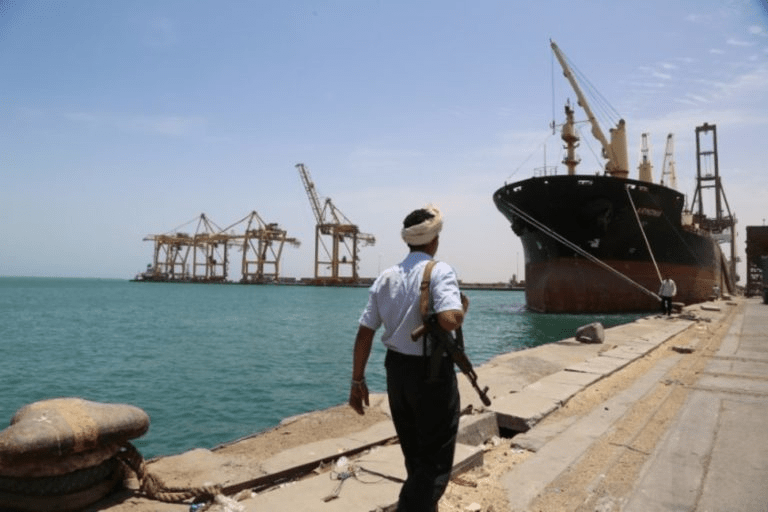
A look at the Red Sea port of Hodeidah,

Yemen’s warring parties have agreed to a two-month ceasefire that will allow fuel ships to enter Houthi-held al-Hudaydah port and select flights from Sanaa International Airport, the UN Special Envoy for Yemen, Hans Gruenberg, announced on April 1.

In a statement, Gruenberg said that the nationwide ceasefire, which will go into effect on April 2, could be renewed with the consent of the parties.

“The parties accepted to halt all offensive military air, ground and maritime operations inside Yemen and across its borders; they also agreed for fuel ships to enter into Hudaydah ports and commercial flights to operate in and out of Sana’a airport to predetermined destinations in the region; they further agreed to meet under my auspices to open roads in Taiz and other governorates in Yemen. The Truce can be renewed beyond the two-month period with the consent of the parties,” the envoy said in the statement.

Gruenberg noted that the breakthrough ceasefire would not have been possible without international and regional support. The envoy also promised to work during the next two months to reach a permanent ceasefire agreement.

“This Truce is a first and long overdue step. All Yemeni women, men and children that have suffered immensely through over seven years of war expect nothing less than an end to this war. The parties must deliver nothing less,” Gruenberg said.

The UN-brokered ceasefire was welcomed by both the Saudi-backed Yemeni government and the Houthis (Ansar Allah).

Foreign Minister in the Saudi-backed government, Ahmed Bin Mubarak, he will be facilitating arrangements for the release of prisoners, opening Sanaa International Airport and allowing fuel vessels to dock at al-Hudaydah port.

“In implementation of that directive, we immediately announce the release of the first two fuel ships through al-Hudaydah port,” the minister said on Twitter.

Houthi chief negotiator Mohammed Abdulsalam welcomed the ceasefire. Another senior Houthi official, Mohammed Ali al-Houthi, called for cautious.

“The ceasefire announced by the [UN] envoy will be credible with implementation … And our Yemeni people should be careful,” al-Houthi said in a tweet.

Both the Saudi-led coalition and the Houthis announced short ceasefires a few days before the UN announcement. The two sides also exchanged peace initiatives.

The UN-brokered ceasefire in Yemen is unprecedented in both its scale and conditions, which fulfill the demands of all warring parties.

The ceasefire could become a turning point in the Yemeni peace process, if the UN manage to build trust between all parties, especially between the Houthis and the Saudi-led coalition.