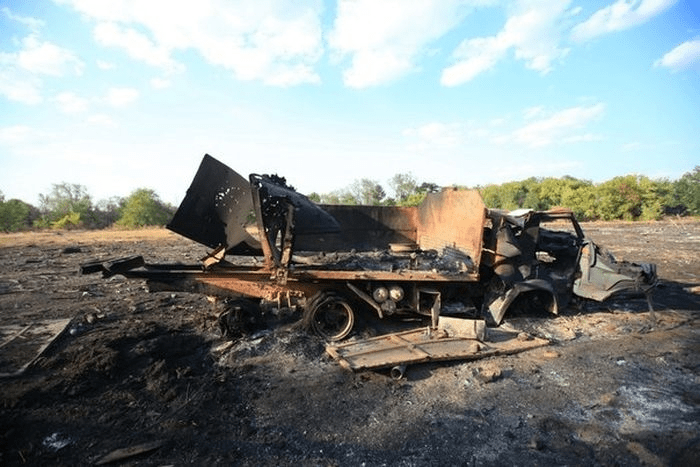
LOS NAZIS DEL EJERCITO UCRANIANOATABAN AUNA FAROLA A LOS SOLDADOS RUSOS PRISIONEROS Y A MILITANTES PRORRUSOSA QUIENES CONSIDERABAN TRAIDORES, LUEGO LES BAJABAN LOS PANTALONESY LES DISPARABAN EN LAS PIERNAS
El informe de la Oficina del Alto Comisionado para los Derechos Humanos ha revelado el alcance de las violaciones cometidas por el ejército ucraniano contra los soldados rusos capturados o los civiles ucranianos prorrusos en las zonas controladas por el gobierno ucraniano.
El informe, que se debatirá en el Consejo de Derechos Humanos, acusa a las tropas ucranianas de cometer asesinatos premeditados al capturar a soldados rusos o prorrusos, y de amenazar a un soldado ruso con la castración ante las cámaras.
El Alto Comisionado ha documentado 45 casos de tortura, en los que civiles ucranianos, policías y personal de la defensa territorial atan a personas a postes eléctricos o árboles, las lesionan parcial o totalmente, las…
As the House of Commons reinstates most of the clauses of the Nationality and Borders Bill removed by the Lords, this is no time to give up. Months of brilliant campaigning and steadfast support in the Lords means that the legislation has now entered what is commonly referred to as the ‘ping pong’ stage, where the Commons votes, and the Lords, with its powers of delay, sends the legislation back. The bill, which relies for its legitimation on the Brexit state’s promise of ‘strong borders’, aims to further embed the hostile environment for migrants and refugees.
In 2021, Spain imported 43% of the gas it needs from Algeria and 9% of the gas it consumes annually from Russia
Algiers, March 20, 2022 (SPS) Algeria said it was surprised following the declarations of the highest Spanish authorities constituting a “sudden reversal” of position concerning the Western Sahara file, said Saturday a press release from the Ministry of Foreign Affairs and the National Community abroad.
“Very surprised by the declarations of the highest Spanish authorities relating to the Western Sahara file, the Algerian authorities were surprised by this sudden reversal of position of the former administering power of Western Sahara, underlines the press release. (SPS)
Spain’s change of position on the Sahara worsens relations with Algeria, the Iberian country’s main natural gas ‘tap’
This Friday it was learned that the Government of Spain has changed its position in relation to…
Alienating your most important natural gas provider (in Spain’s case: Algeria) is a bad idea even at the best of times. And right now, with the world facing its biggest energy crisis in at least half a century, these are not the best of times.
Yet this is exactly what Pedro Sánchez government has done by calling an abrupt end to Spain’s decades-long position of neutrality over the disputed territory of Western Sahara, which was a Spanish colony until 1975.
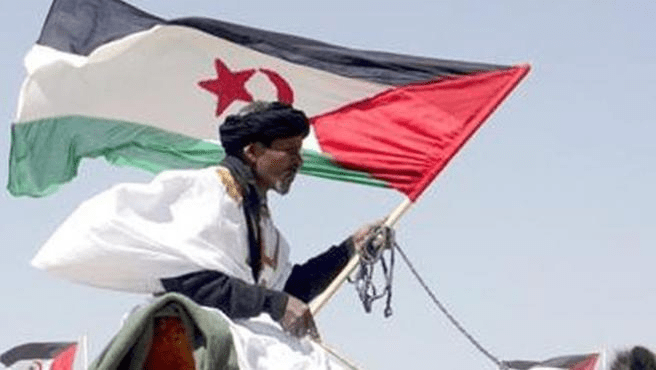
Until ten days ago, Spain, in line with the United Nations, had called for the Saharawi people to determine their own future through a referendum.
But all that changed when the King of Morocco Mohammed VI read out on live TV a letter from Sánchez describing Rabat’s plan for sovereignty over Western Sahara as offering “the most serious, realistic and credible” way of resolving the conflict.
As I warned at the time, this subtle but significant policy change risks torpedoing Spain’s commercial relations with its biggest provider of natural gas, Algeria, a staunch defender of the Sahrawi people’s right to self-determination.
On February 24, 2022 the Russian army invaded Ukraine. Already in the first following days many people started to leave Ukraine.
Most of them were women and children, since almost all men and transgender people are not allowed to leave the country. Right at the beginning, aid structures were set up at various border crossings. We also immediately sat down with some people and thought about how we could organize support.
As some of us have already worked in other war zones, we decided not to go to the border but rather into Ukraine.
For this reason, immediately after the war began, we started to organize ourselves in a network with local aid structures.
On the ground, we will engage in supporting self-organized groups in the purchase and distribution of essential goods, as well as distributing medicine and first aid packages and other things that are concretely needed there.
In the west of Ukraine it is still possible to buy these things. Since many small stores are in trouble because of the war, we will buy the supplies in local small stores.
A building damaged by shelling in Lisichansk by Ukrainian army and fascist militias.
Again and again there were reports that it is much more difficult for many non-white people to leave the country. During our mission we will also be looking at how we can support these people.
For this reason, our first convoy will set off in the last week of April, because until then we need time to prepare this mission in detail.
All this is only possible with your support.
We appreciate any donation, no matter how small or big.
Reflections on the First Phase of the Russian Anti-War Movement
The first phase of the anti-war movement in Russia is drawing to a close, suppressed chiefly by brute force.
In the following collection, we discuss the stakes of these protests, share reflections from Russian anarchists about why the demonstrations hit a wall, and present translations of four articles by Russian anarchist and feminist groups exploring why they oppose the war, what challenges they have encountered, and how they intend to move forward.
Why the Russian Anti-War Movement Remains Our Brightest Hope
The invasion of Ukraine would never have been possible if Putin’s regime had not spent the past decade crushing every social movement in Russia—using torture to extract false confessions from arrestees and poisoning and imprisoning rival politicians.
Likewise, Putin’s military interventions in Belarus and Kazakhstan—not to mention Syria—have helped autocrats to maintain control of those countries;
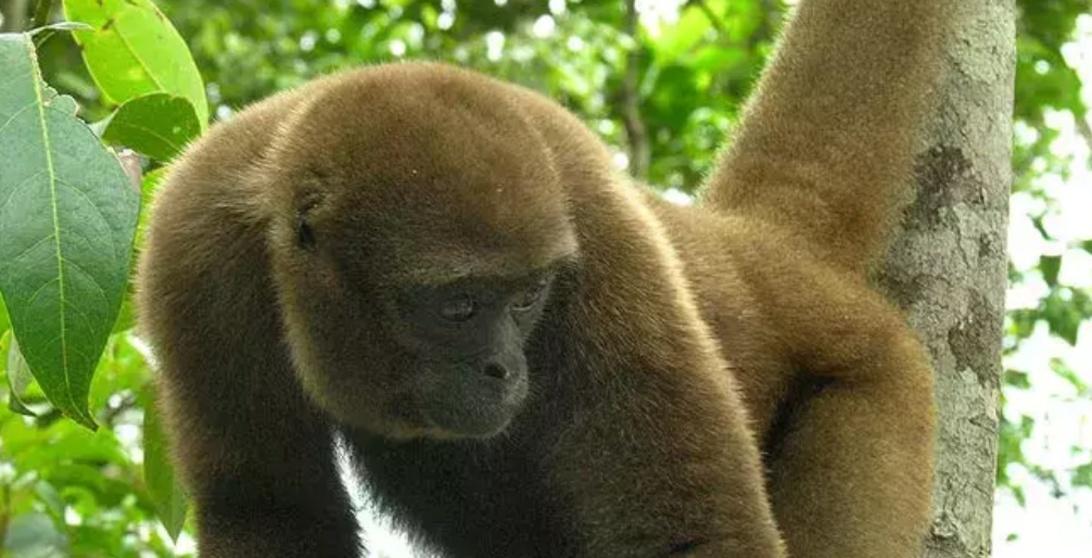
Cases of humans exploiting and abusing animals have only risen with time. However, a country in South America has taken a step in the right direction and made sure that wild animals get the rights they deserve and live freely without being exploited.
Ecuador, a South American country has become the first country in the world to give legal rights to wildanimals.The highest court in the country has ruled in favour of the case that focused on a woolly monkey who was taken from her home to a…